Maritime Tax Relief: When Distance from UK Shores Matters for Your Wallet
Merchant seafarers working aboard vessels calling at British ports face a complex web of UK taxation rules that can significantly impact their take-home pay. While some maritime workers benefit from established reliefs like the Seafarers' Earnings Deduction, non-resident crew members often find themselves caught between conflicting tax obligations—paying UK income tax on earnings whilst maintaining tax residency elsewhere.
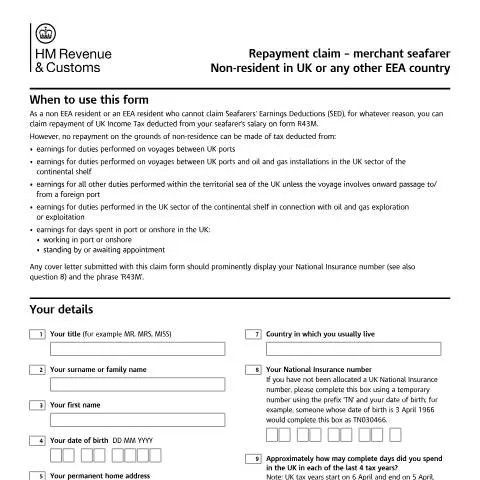
The R43M form addresses this specific predicament, offering a pathway for non-European Economic Area residents and certain EEA nationals to reclaim UK income tax deducted from their seafaring wages. However, the relief operates within strict geographical boundaries that reflect the government's determination to tax earnings generated within British territorial waters whilst acknowledging the international nature of merchant shipping.
This reclaim mechanism becomes particularly relevant given the UK's position as a major shipping hub, where vessels frequently transit between British ports or service North Sea oil installations. Understanding which voyages qualify for tax relief—and which remain firmly within HMRC's taxable scope—can mean the difference between substantial refunds and disappointed expectations.
Territorial Waters and Tax Boundaries: Where Your Voyage Determines Your Liability
The geographical scope of R43M claims reflects the UK's sovereign taxation rights over its territorial waters and continental shelf resources. HMRC maintains four distinct categories of non-refundable earnings that effectively ring-fence British territorial and economic interests from tax relief claims.
Domestic Coastal Trading Routes
Earnings from voyages between UK ports remain fully taxable regardless of the seafarer's residence status. This encompasses traditional coastal shipping routes—from Aberdeen to Portsmouth, Liverpool to Belfast, or any combination of British harbours. The rationale centres on the domestic nature of these services, which HMRC views as equivalent to land-based employment within UK borders.
Ferry services represent a particular complexity within this framework. Seafarers aboard vessels operating regular scheduled services between British ports must provide employer confirmation of continuous service and details of operational routes. Cross-channel ferries operating between, say, Dover and Calais would typically qualify for relief on the international portion of their duties, whilst domestic legs remain taxable.
North Sea Energy Infrastructure
The UK's extensive North Sea oil and gas operations create additional taxable scenarios that reflect the economic importance of these installations. Voyages between UK ports and offshore platforms within the UK continental shelf sector generate non-refundable earnings, as do duties performed directly on these installations for exploration or exploitation purposes.
| Voyage Type | Tax Relief Eligibility | Documentation Required |
|---|---|---|
| UK port to UK port | Not eligible | Discharge book confirmation |
| UK port to UK continental shelf | Not eligible | Voyage reports, day logs |
| UK territorial sea (no foreign port) | Not eligible | Draught water & freeboard pages |
| International voyage via UK | Potentially eligible | Full voyage documentation |
Onshore Time and Port Activities
Perhaps most significantly for practical claims, any days spent in UK ports or onshore locations generate non-refundable tax liability. This includes obvious scenarios like cargo loading operations, vessel maintenance, or crew changes, but extends to less apparent situations such as standby periods awaiting vessel assignment or study leave taken whilst physically present in the UK.
The implications prove substantial for seafarers on regular routes involving extended port stays. A container ship crew member spending three days monthly in Felixstowe for cargo operations would find those periods excluded from any R43M claim, regardless of their non-resident status or the international nature of their broader voyage pattern.
Residency Status and the EEA Exception Framework
The R43M form specifically targets non-EEA residents and a distinct subset of EEA nationals who cannot access standard Seafarers' Earnings Deductions. This dual approach reflects both the UK's post-Brexit relationship with European maritime workers and the complexities of international tax treaty arrangements.
Non-EEA Seafarer Qualification
Seafarers from countries outside the European Economic Area face the most straightforward qualification criteria. Provided they maintain tax residency outside both the UK and EEA territories, they can claim relief on eligible earnings regardless of nationality. The form requires detailed disclosure of UK presence over the preceding four tax years, with HMRC using this information to verify genuine non-residence.
The day-counting requirement serves multiple purposes: establishing patterns of UK connection, identifying potential residence triggers under domestic tax law, and cross-referencing against other HMRC databases. Seafarers must account for complete days spent in the UK, with partial days typically counting as full days for tax residence purposes.
EEA Nationals with SED Restrictions
EEA nationals may find themselves excluded from standard Seafarers' Earnings Deduction schemes for various reasons—perhaps due to specific employment arrangements, vessel registration complications, or timing issues with their UK tax affairs. The R43M provides an alternative route, though these applicants must demonstrate why conventional SED relief remains unavailable.
This distinction becomes particularly relevant for crew members on vessels flagged outside traditional maritime registries or those employed through complex international manning arrangements that complicate standard UK tax relief mechanisms.
Documentation Requirements: Building Your Maritime Evidence Trail
Successful R43M claims depend heavily on comprehensive voyage documentation that proves both the international nature of qualifying duties and the specific exclusion of UK territorial activities. HMRC expects merchant maritime standards of record-keeping, reflecting the professional documentation requirements already familiar to commercial seafarers.
Discharge Book Evidence
The seafarer's Discharge Book forms the primary evidence foundation, providing official confirmation of sea service during claim periods. HMRC requires copies of relevant pages only—typically those covering the specific tax year in question rather than complete career records. Where Discharge Books remain unavailable or incomplete, employer statements confirming sea service become acceptable alternatives, though these require more detailed voyage information.
International seafarers often maintain multiple Discharge Books from different maritime authorities, particularly when working for various flag state operators. In such cases, HMRC accepts documentation from any recognised maritime authority, provided the records clearly demonstrate service periods and vessel details.
Voyage Documentation Hierarchy
Beyond basic service confirmation, claims require detailed voyage evidence through Draught Water and Freeboard pages, day logs, or voyage reports. These documents establish the crucial geographical elements that determine tax relief eligibility—proving whether voyages remained within UK territorial waters or extended to international destinations.
For standby leave periods claimed as exempt, HMRC applies a particularly generous interpretation by accepting documentation from the most beneficial vessel when seafarers transfer between ships during leave. This recognition of maritime employment realities allows for relief claims even during complex crew rotation schedules.
Employment and Earnings Verification
Standard employment documentation includes P60 End of Year Certificates or March payslips, establishing both the earnings subject to UK tax deduction and the amounts available for potential refund. Multiple employers during a single tax year require separate documentation for each, with clear identification of which earnings relate to which voyages or service periods.
- P60 certificates for the specific claim tax year
- Payslip alternatives where P60s remain unavailable
- Employer statements detailing voyage-specific earnings
- Currency conversion records for foreign-paid wages subject to UK tax
Navigating the Claims Process: Timing, Submission, and Administrative Realities
The R43M submission process operates within HMRC's broader non-resident taxation framework, requiring careful attention to both timing considerations and administrative protocols that differ significantly from standard UK tax return procedures.
National Insurance Number Complications
Non-resident seafarers often encounter immediate complications with National Insurance number requirements. The form acknowledges this reality by providing a temporary number system using the prefix 'TN' combined with the applicant's date of birth. For example, a seafarer born on 3 April 1966 would use TN030466 as their temporary identifier throughout the claims process.
This temporary system serves multiple administrative purposes: enabling HMRC to process claims whilst awaiting formal NI number allocation, preventing duplicate applications, and facilitating cross-referencing with other tax databases. However, seafarers should pursue formal NI number allocation simultaneously, as temporary numbers may complicate future UK tax affairs.
Employer Information and Multi-National Complications
The form requires comprehensive employer details for all companies providing taxable services during the claim period. This seemingly straightforward requirement becomes complex in maritime contexts where technical managers, crew managers, and beneficial owners may represent different corporate entities across multiple jurisdictions.
HMRC expects identification of the entity that actually deducted UK tax from wages—often the UK-based crewing agent or ship management company rather than the ultimate vessel owner. Where complex corporate structures obscure this relationship, additional explanatory documentation becomes essential.
Payment Nominee Arrangements
The form provides flexibility for refund delivery through nominee arrangements, recognising that non-resident seafarers may prefer UK-based representatives to handle their tax affairs. Nominee options include UK residents, banks, or building societies, with appropriate authorisation declarations required.
This facility proves particularly valuable for seafarers on extended voyages who cannot reliably receive mail at foreign addresses, or those preferring to maintain UK financial relationships despite non-resident status. However, nominees assume responsibility for refund security and onward transmission to the ultimate beneficiary.
Strategic Considerations: Maximising Relief Within Legal Boundaries
Successful R43M claims require strategic thinking about voyage patterns, employment arrangements, and timing considerations that can significantly impact the available relief amounts. Understanding these nuances enables seafarers to structure their affairs within legal boundaries whilst maximising legitimate tax recovery.
Voyage Pattern Optimisation
Seafarers with flexibility in their employment arrangements can structure voyage patterns to maximise R43M eligibility. International routes with minimal UK port time generate the highest relief potential, whilst domestic coastal trading or North Sea shuttle services offer limited opportunities.
Container shipping routes between major international ports—Hamburg to Singapore via Felixstowe, for example—typically provide substantial relief opportunities on the international portions whilst maintaining taxable liability for UK port activities. Bulk carrier operations between international destinations offer similar advantages, particularly where UK calls represent brief technical stops rather than extended cargo operations.
Leave Period Planning
The treatment of leave periods presents both opportunities and pitfalls for relief maximisation. Standby leave taken aboard vessels in international waters may qualify for relief using the 'most beneficial vessel' principle, whilst similar leave taken in UK ports generates full taxable liability.
Study leave arrangements require particular attention, as courses taken within the UK—even for internationally recognised maritime qualifications—generate taxable presence that eliminates relief eligibility for those periods. Conversely, training undertaken aboard vessels or at international maritime academies may qualify for relief treatment.
Multi-Year Claim Strategies
The form addresses single tax year claims, but seafarers may pursue multiple R43M submissions covering different years where circumstances warrant. This approach requires careful consideration of cumulative UK presence across the four-year disclosure period, as patterns suggesting increasing UK connection could trigger broader residence investigations.
| Tax Year Strategy | Optimal Scenarios | Risk Considerations |
|---|---|---|
| Single year claim | Isolated UK employment period | Minimal administrative complexity |
| Multiple consecutive years | Consistent international voyage patterns | Potential residence pattern scrutiny |
| Selective year targeting | Years with minimal UK territorial work | Requires detailed voyage analysis |
Administrative Processing and Follow-Up Protocols
HMRC's International Specialist Business Centre (ISBC) handles R43M processing through dedicated teams familiar with maritime taxation complexities. Understanding their operational approach and typical processing timelines enables more effective claim management and appropriate follow-up strategies.
Initial Assessment Procedures
Upon receipt, ISBC conducts preliminary verification focusing on documentation completeness, residence status validation, and voyage pattern analysis. Claims with comprehensive supporting evidence typically progress more rapidly than those requiring additional information requests, which can extend processing times significantly.
The assessment process involves cross-referencing submitted voyage documentation against known shipping movements, employer tax records, and other HMRC databases. This verification approach reflects the department's sophisticated understanding of maritime operations and their determination to prevent inappropriate claims.
Additional Evidence Requests
The form explicitly warns that "further evidence may be requested in some cases", reflecting HMRC's flexible approach to complex maritime scenarios. Common additional requests include detailed employer contracts, vessel registration documentation, or clarification of specific voyage routing through UK territorial waters.
Seafarers should anticipate potential requests for currency conversion calculations where wages were paid in foreign currencies but subject to UK tax deduction, or explanatory letters addressing apparent inconsistencies between different documentation sources.
Processing Timelines and Expectations
While HMRC provides no specific processing timeline commitments for R43M claims, maritime tax specialists typically report resolution periods ranging from several months to over a year for complex cases. Factors affecting processing speed include documentation quality, claim complexity, and seasonal workload variations within ISBC operations.
The lack of established processing targets reflects the specialised nature of maritime tax relief and the individual assessment required for each claim's unique circumstances. Seafarers should plan accordingly, particularly where refunds are intended for specific financial commitments or investment opportunities.
Risk Management and Compliance Considerations
R43M claims operate within broader UK tax compliance frameworks that extend beyond simple refund calculations. Understanding potential compliance implications and risk factors enables seafarers to make informed decisions about claim submission and ongoing tax obligations.
Residence Status Implications
Submitting R43M claims creates formal records of UK tax affairs that may influence future residence determinations or other HMRC interactions. Seafarers must ensure consistency between claimed non-residence status and actual living arrangements, as contradictory evidence could trigger broader tax investigations.
The four-year UK presence disclosure requirement serves partly as a residence verification tool, enabling HMRC to identify cases where claimed non-residence may be questionable under statutory residence test provisions. Seafarers approaching residence thresholds should seek professional advice before submission.
Future Employment Considerations
Successful R43M claims establish precedents for future tax treatment that may influence subsequent employment decisions or tax planning strategies. Seafarers transitioning toward UK residence should consider the implications of established non-residence claims on their evolving tax position.
Similarly, those planning extended UK shore-based employment should understand how previous non-residence claims might affect their transition to standard UK tax arrangements, including potential impacts on National Insurance contribution records or pension entitlements.
Record Keeping and Audit Preparedness
HMRC retains extensive investigation powers regarding non-resident tax claims, with potential inquiry periods extending well beyond standard domestic tax return limitations. Maintaining comprehensive voyage records, employment documentation, and residence evidence becomes essential for defending claims against future challenge.
The international nature of maritime employment often complicates record retrieval, making contemporaneous documentation particularly valuable. Seafarers should establish systematic record-keeping practices that anticipate potential HMRC requirements rather than relying on retrospective document gathering.