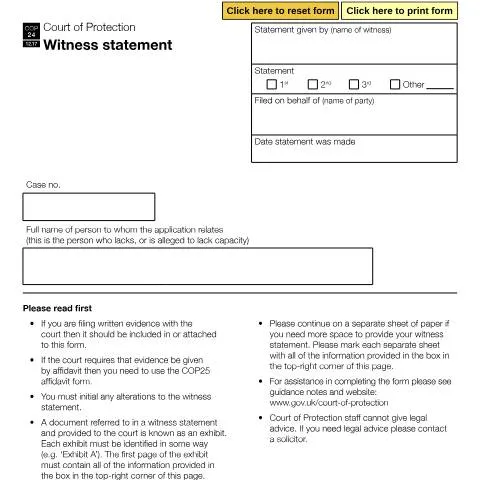
When Mental Capacity Proceedings Require Your Testimony
Mental capacity cases in England and Wales often hinge on witness evidence from those who know the person best. Whether you're a family member, healthcare professional, or close friend, your observations about someone's decision-making abilities could prove crucial in Court of Protection proceedings. Form COP24 serves as the vehicle for submitting this evidence, transforming your personal knowledge into formal testimony that judges can rely upon when making life-changing decisions about vulnerable adults.
The Court of Protection deals with some of the most sensitive decisions imaginable: whether someone can manage their finances, choose where to live, or make their own medical treatment decisions. Your witness statement might be the key piece of evidence that helps the court understand the reality of someone's daily life and cognitive abilities.
Understanding Your Role in Court of Protection Evidence
The COP24 witness statement form operates within a specific legal framework governed by the Mental Capacity Act 2005 and the Court of Protection Rules 2017. Unlike criminal proceedings where witnesses might be called unexpectedly, Court of Protection cases rely heavily on written evidence submitted in advance.
Your statement becomes part of the court bundle - the collection of documents that all parties and the judge will review before any hearing. This means your words carry significant weight, as they may be the primary way the court learns about the person's actual behaviour and capabilities in real-world situations.
Types of Witnesses in Capacity Proceedings
The form accommodates various types of witnesses, each bringing different perspectives:
- Family witnesses typically provide evidence about changes in behaviour, daily living skills, and decision-making patterns they've observed over time
- Professional witnesses such as social workers, care managers, or occupational therapists offer structured assessments and professional observations
- Medical witnesses contribute clinical insights about diagnoses, treatments, and how conditions affect cognitive function
- Independent witnesses like neighbours or long-term friends can provide valuable third-party perspectives free from family dynamics
The court values different types of evidence differently. Personal observations about specific incidents often carry more weight than general impressions, while professional witnesses must clearly distinguish between their clinical expertise and personal observations.
Preparing Your Evidence Before Completing COP24
Effective witness statements require careful preparation. The court needs concrete examples rather than general opinions, so gathering specific incidents and dates strengthens your testimony significantly.
Documenting Observations Systematically
Before drafting your statement, compile a chronological record of relevant incidents. Note specific dates, times, and circumstances where possible. The court particularly values evidence about:
| Evidence Category | What to Document | Examples |
|---|---|---|
| Financial decisions | Unusual spending, confusion about money, inability to understand transactions | Giving away large sums, buying unnecessary items repeatedly, confusion about bank statements |
| Personal care | Changes in hygiene, eating habits, medication management | Forgetting to wash, leaving food to spoil, taking wrong medication doses |
| Social interactions | Communication difficulties, personality changes, relationship problems | Becoming withdrawn, aggressive outbursts, losing ability to follow conversations |
| Safety awareness | Risk recognition, ability to keep self safe | Leaving doors unlocked, getting lost in familiar places, unsafe driving |
Gathering Supporting Documentation
Your witness statement becomes more powerful when supported by relevant documents. These become exhibits - supporting materials that accompany your statement. Common exhibits include:
- Photographs showing home conditions or safety concerns
- Copies of concerning letters or emails the person has written
- Medical appointment letters or reports (with appropriate consent)
- Records of incidents you've documented
- Examples of confused or concerning communications
Each exhibit must be clearly labelled (Exhibit A, Exhibit B, etc.) and referenced specifically in your statement. The court requires the first page of each exhibit to contain the same case information that appears on your COP24 form.
Navigating the COP24 Form Structure
The form follows a standardised structure designed to capture essential information while ensuring legal compliance. Understanding each section's purpose helps you provide more effective evidence.
Header Information and Case Details
The top section establishes the legal context for your statement. You'll need the case number from the Court of Protection, which appears on all court documents related to the proceedings. The "person to whom the application relates" is the individual whose capacity is in question - not necessarily the person who asked you to provide evidence.
The statement numbering system (1st, 2nd, 3rd, Other) tracks multiple statements from the same witness. If you need to provide additional evidence later in the proceedings, subsequent statements would be numbered accordingly.
Personal Details and Professional Context
Section 1 requires your full legal name as it appears on official documents. Section 2 asks for your occupation or description - this helps the court understand your background and potential expertise. Be specific: "retired teacher" provides more context than simply "retired".
Section 3's address requirements vary depending on whether you're providing evidence in a personal or professional capacity. Personal witnesses typically provide their home address, while professionals should include their workplace details and professional position. This distinction affects how the court weighs your evidence and whether you might be considered an expert witness in certain areas.
Crafting Your Main Statement
Section 4 forms the heart of your witness statement. The numbered paragraph format isn't merely administrative - it helps judges locate specific pieces of evidence quickly during hearings and deliberations.
The form explicitly requires you to distinguish between direct knowledge and information from other sources. This distinction proves crucial in court proceedings:
- Direct knowledge covers things you personally witnessed or experienced
- Information or belief includes things others told you or conclusions you've drawn
For information from other sources, you must identify where it came from. Rather than writing "I understand that...", specify "Mrs Smith, the person's neighbour, told me that..." or "According to the GP's letter dated..."
Common Pitfalls in Mental Capacity Evidence
Even well-intentioned witnesses can undermine their credibility through common mistakes. Understanding these pitfalls helps you provide more effective evidence.
Avoiding Opinion Disguised as Fact
Courts distinguish carefully between factual observations and personal opinions. Strong evidence describes specific behaviours rather than drawing conclusions about mental state. Instead of writing "John was confused about his finances", describe the specific incident: "On 15th March 2023, John tried to pay for £20 of groceries with a £5 note and became agitated when the cashier explained this wasn't enough money."
Medical terminology should be used cautiously unless you have professional qualifications. Describing someone as "demented" or "suffering from Alzheimer's" strays into medical diagnosis territory. Focus on observable behaviours and leave diagnostic conclusions to qualified professionals.
Temporal Precision and Context
Vague timeframes weaken evidence significantly. "Recently" or "a few months ago" provides little value to the court. Where possible, provide specific dates or at least narrow timeframes like "between Christmas 2023 and New Year 2024".
Context matters enormously in capacity assessments. A person might struggle with complex financial decisions while retaining capacity for simpler choices. Your evidence should reflect this nuance rather than painting broad-brush pictures of complete incapacity or full capability.
The Statement of Truth and Legal Consequences
The statement of truth at the bottom of COP24 carries serious legal weight. By signing, you confirm that you believe the facts stated are true, making you potentially liable for contempt of court if you knowingly provide false information.
This doesn't mean you must be absolutely certain about every detail. The standard is honest belief based on your recollection and understanding. If you're uncertain about specific details, it's better to express that uncertainty clearly rather than guess or omit important information.
Corrections and Amendments
The form requires you to initial any alterations, reflecting the legal significance of witness statements. If you need to make changes after completing the form, cross out the incorrect information clearly, write the correction above or alongside, and initial the change. Substantial revisions might warrant preparing a fresh statement.
Don't use correction fluid or attempt to erase mistakes, as this could raise questions about the statement's integrity. Transparency in corrections actually enhances credibility rather than undermining it.
Submission Procedures and Court Processing
Once completed, your COP24 statement joins the formal court record. The timing of submission can be crucial, as the Court of Protection operates according to strict procedural deadlines.
Filing Requirements and Deadlines
Witness statements typically must be filed according to directions given by the court, often several weeks before any hearing. Late submission might require permission from the court and could delay proceedings significantly.
The statement should be filed with the Court of Protection office handling the case, with copies served on all other parties to the proceedings. If you're unsure about service requirements, the party who asked you to provide evidence should handle distribution to other parties.
What Happens After Submission
Your statement becomes part of the court bundle reviewed by the judge and all parties before any hearing. Other parties might challenge aspects of your evidence or request clarification through their legal representatives.
In some cases, you might be asked to attend court to give oral evidence or face cross-examination about your statement. However, many Court of Protection cases proceed based entirely on written evidence, particularly when witness statements are comprehensive and clear.
Supporting Vulnerable Adults Through Quality Evidence
Your witness statement contributes to one of the most important decisions the legal system makes - determining whether someone retains the capacity to make their own choices. The quality of your evidence directly affects the court's ability to reach the right decision for a vulnerable person.
Remember that mental capacity isn't binary - people can have capacity for some decisions while lacking it for others. Your evidence helps the court understand these nuances, potentially preserving someone's autonomy in areas where they retain capability while ensuring protection where they need it.
The Court of Protection's ultimate goal is making decisions in the person's best interests while maximising their involvement in choices affecting their lives. Your careful, honest evidence helps achieve this balance, ensuring that legal interventions are both necessary and proportionate to the person's actual needs and abilities.
Preparing Supporting Documentation and Evidence
A robust witness statement requires comprehensive supporting documentation to substantiate your observations and concerns about the person's capacity. The Court of Protection expects witness statements to be backed by tangible evidence rather than relying solely on subjective impressions.
Medical records form the cornerstone of supporting evidence, though you may not have direct access to these as a witness. However, you can reference observable medical appointments, hospital visits, or discussions about diagnoses that you've witnessed. For instance, if you've accompanied the person to GP appointments or noticed prescription medications, these details can corroborate your observations about their cognitive state. When mentioning medical information, be specific about what you directly observed rather than repeating second-hand medical opinions.
Financial documentation becomes particularly relevant if your witness statement relates to concerns about the person's ability to manage their affairs. Bank statements showing unusual spending patterns, unpaid bills despite available funds, or evidence of financial exploitation can support your testimony. However, you should only reference financial documents you've legitimately seen or been shown, clearly stating the circumstances under which you became aware of this information.
Photographic evidence can be powerful, particularly in cases involving self-neglect or living conditions. Images of the person's home environment, personal hygiene, or physical condition can support your written observations. However, you must have obtained such photographs lawfully and with appropriate consideration for the person's dignity and privacy rights under the Data Protection Act 2018.
Written communications from or about the person can provide valuable evidence of cognitive decline or confusion. Text messages showing disorientation, letters demonstrating difficulty with language or logic, or notes you've made contemporaneously about concerning conversations can all strengthen your statement. Ensure any written evidence is authentic and that you have the right to share it in legal proceedings.
Professional correspondence you've witnessed or been copied on can also be relevant. This might include letters from care agencies, social workers, or other professionals expressing concerns about the person's capacity. Again, only reference correspondence you've legitimately received or been made aware of through appropriate channels.
Understanding the Court's Assessment Criteria and Legal Framework
The Court of Protection operates under the Mental Capacity Act 2005, which establishes a specific legal framework for determining capacity. As a witness, understanding this framework helps you structure your statement in a way that addresses the court's key considerations and provides legally relevant information.
The Act establishes that a person lacks capacity if they cannot make a particular decision because of an impairment or disturbance in the functioning of their mind or brain. This creates a two-stage test: first, there must be an impairment or disturbance, and second, this must cause an inability to make the specific decision in question. Your witness statement should address both elements where possible.
The functional test for capacity involves four key abilities: understanding information relevant to the decision, retaining that information long enough to make the decision, using or weighing the information as part of the decision-making process, and communicating the decision. Your observations should relate to these specific cognitive functions rather than general impressions about the person's mental state.
Importantly, capacity is decision-specific and time-specific. The court isn't determining whether someone generally lacks capacity, but whether they lack capacity to make particular decisions at particular times. Your witness statement should reflect this specificity, focusing on the person's ability to make the decisions that are the subject of the court proceedings.
The Act also establishes several key principles that inform the court's approach. These include the presumption of capacity (capacity should be assumed unless proven otherwise), the right to make unwise decisions (a person isn't incapacitated simply because their decisions seem poor), and the requirement for decisions to be made in the person's best interests if they do lack capacity.
Understanding these principles helps you frame your observations appropriately. For example, if the person makes decisions you consider unwise, you should focus on evidence that they don't understand the consequences rather than simply disagreeing with their choices. Similarly, your statement should demonstrate why you believe the person cannot understand, retain, use, or communicate information about specific decisions.
The court will also consider whether capacity might be restored through support or changes in circumstances. Your witness statement might usefully address whether you've observed the person's capacity varying at different times or in different situations, and whether particular support measures have helped or hindered their decision-making abilities.
Post-Submission Process and Ongoing Responsibilities
Once you've submitted your Form COP24 witness statement, several important processes begin that may require your continued involvement and attention. Understanding these can help you prepare for what follows and ensure you remain available to assist the court as needed.
The Court of Protection will first review your statement alongside other evidence to determine whether to accept the application and what directions to give for the case's progression. This initial review can take several weeks, during which the court may request clarification or additional information from you. You should remain contactable and responsive during this period, as delays in responding to court queries can slow the entire process.
Other parties to the proceedings, including the person who lacks capacity, their family members, or appointed representatives, will receive copies of your witness statement. They have the right to challenge your evidence or request that you attend court for cross-examination. This possibility underscores the importance of ensuring your statement is accurate, balanced, and well-supported by evidence.
If your statement raises safeguarding concerns, the court may direct that copies be sent to local authorities or other protective agencies. This could trigger separate safeguarding investigations or procedures, which may require your cooperation and additional witness statements for different purposes.
The court may order a case management hearing to establish directions for the case's progression. While witnesses aren't typically required to attend these hearings, you should be aware that such hearings may result in orders that affect you, such as requirements to provide additional evidence or attend future hearings.
If the case proceeds to a final hearing, you may be called to give oral evidence and face cross-examination about your written statement. This can be a daunting prospect, but preparation helps. Review your statement thoroughly before any hearing, ensuring you can explain and defend your observations. Be prepared to acknowledge the limitations of your knowledge and avoid speculation beyond your direct experience.
During the proceedings, circumstances may change that affect your evidence. The person's condition might deteriorate or improve, new incidents might occur, or you might become aware of additional relevant information. In such cases, you should contact the court or the applicant's solicitor to discuss whether a supplementary statement is needed.
Your responsibilities as a witness extend beyond simply providing your initial statement. You have an ongoing duty to the court to ensure your evidence remains accurate and complete. If you discover that any information in your statement was incorrect, or if significant new developments occur, you must inform the court promptly.
The court's final order may impose ongoing obligations related to your role as a witness. For example, if you're appointed as a deputy or given specific responsibilities for the person's welfare, these will create new legal duties and reporting requirements. Even if you're not given formal roles, the court may expect you to continue monitoring the person's situation and report significant changes.
Throughout this process, maintain detailed records of any ongoing interactions with the person who lacks capacity. These records may prove valuable if circumstances change and further court applications become necessary. They also help demonstrate your continued engagement with the situation and your reliability as a witness source.