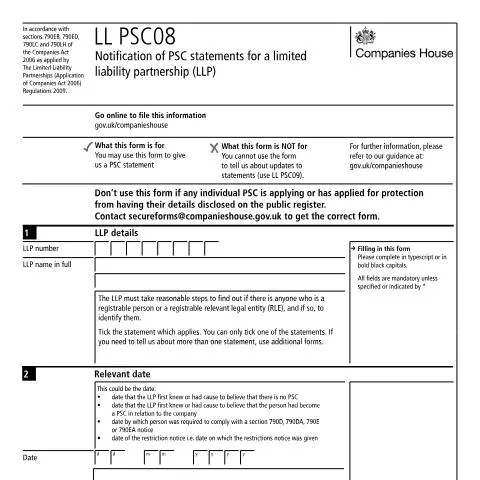
Navigating the PSC Statements: A Guide to the LL PSC08 Document
In the landscape of limited liability partnerships (LLPs) in the UK, understanding the legislative framework surrounding people with significant control (PSC) is crucial. The LL PSC08 document, issued by Companies House, serves as a foundational notification tool for LLPs to declare their PSC statements. This guide delves into the intricacies of the LL PSC08, elucidating its content, application process, and significance within the broader context of LLP regulations.
Understanding the Essence of the PSC Statement
At its core, the LL PSC08 document is designed to communicate a partnership’s knowledge regarding individuals or entities that hold significant control over the LLP. It aligns with sections 790EB, 790ED, 790LC, and 790LH of the Companies Act 2006, and its importance cannot be overstated.
The Legal Framework Behind PSC Statements
The Companies Act 2006 outlines the legal requirements for LLPs concerning PSCs. These regulations enforce transparency and accountability, ensuring that LLPs are diligent in their reporting of individuals or relevant legal entities that qualify as registrable persons. The LL PSC08 form is not merely an administrative tool; it is a reflection of the partnership's commitment to uphold the integrity of public records.
What Constitutes a Registrable Person?
A registrable person may be an individual or an entity that meets certain thresholds of control over the LLP. This may include:
- Holding more than 25% of voting rights
- Holding the right to appoint or remove the majority of the board of directors
- Exercising significant influence or control over the LLP
Recognizing who qualifies as a registrable person is essential for the accurate completion of the LL PSC08 document.
Step-by-Step Guide to Using the LL PSC08 Document
Completing the LL PSC08 requires a systematic approach to ensure all necessary information is captured correctly. Below is a structured methodology to aid in the process.
1. Collecting Relevant Information
Before initiating the PSC statement notification, gather essential information about your LLP and potential registrable persons:
- The full name of the LLP
- The LLP registration number
- Details of any registrable persons or relevant legal entities
It's imperative that the information matches what is on the public register to avoid delays in processing.
2. Assessing the Presence of Registrable Persons
The LLP must take reasonable steps to ascertain whether any registrable persons exist. This not only covers current partners but also includes potential interests in control. If unsure, conducting a review of the partnership structure may be prudent.
3. Completing the Form
The form itself should be completed in typescript or bold black capitals. Each field must be filled out accurately:
- The LLP’s full name and registration number.
- The relevant statement regarding registrable persons—only one statement should be selected.
- Specific dates regarding the identification of registrable persons.
4. Authentication of the Submission
To ensure the validity of the LL PSC08 document, authentication is necessary. This can be done by a designated member or a judicial factor within the LLP. Note that while a signature is not needed, a printed name is required for authentication purposes.
Interconnections with Other PSC Documentation
It's vital to understand how the LL PSC08 interacts with other forms and notices relevant to PSCs. One pertinent document is the LL PSC09. This form is utilized to provide updates regarding PSC statements, highlighting the need for clarity in what each form accomplishes.
The Importance of the LL PSC09
While the LL PSC08 focuses on initial notifications, the LL PSC09 is essential for ongoing compliance. Any changes in control or relevant legal entities must be reported promptly through the LL PSC09 to maintain accurate records at Companies House.
Consequences of Non-Compliance
Failing to follow through with the PSC reporting requirements can lead to significant consequences, including penalties for the LLP and individuals involved. Regular checks and updates are necessary to avoid potential legal pitfalls.
Who Needs to Take Action with the LL PSC08?
Understanding who is impacted by this document is crucial for LLPs. The LL PSC08 is primarily aimed at:
- Designated members of the LLP
- Legal advisors assisting LLPs with compliance
- Stakeholders concerned about regulatory adherence
These parties must ensure that they are well-acquainted with the processes surrounding the LL PSC08 to uphold the integrity of their operations.
Frequently Asked Questions: Clarifications on LL PSC08
While direct FAQs do not exist in this context, several common inquiries arise that elucidate the function and necessity of the LL PSC08.
What happens if a registrable person does not wish to have their details disclosed?
If a registrable individual applies for protection under specific circumstances, they cannot use the LL PSC08. Instead, they must follow a different protocol and notify Companies House via appropriate channels.
How is confidential data managed within the LL PSC08?
Under the Data Protection Act 2018 and UK GDPR, personal data must be handled with care. Information submitted on the LL PSC08 will appear on the public record unless specific protection measures are in place for the registrable person.
Practical Tips for Managing Your PSC Statements
Beyond merely completing the LL PSC08, there are several best practices to consider for ongoing compliance:
- Maintain an up-to-date register of all potential PSCs within the LLP.
- Set reminders to review the partnership's control structure periodically.
- Engage with legal professionals for guidance on complex situations involving PSCs.
These measures will not only safeguard compliance but also enhance the operational transparency of the LLP.
Final Thoughts on the LL PSC08 and Your LLP
The LL PSC08 is more than just a form; it is a critical component of the governance framework for limited liability partnerships in the UK. Understanding its intricacies and adhering to the associated responsibilities ensures that your LLP remains compliant with legal standards and contributes to a transparent business landscape. Properly managing PSC statements not only protects the partnership's interests but also reinforces the trust of stakeholders and the public.
Understanding the Role of Person with Significant Control (PSC)
In the context of UK limited liability partnerships (LLPs), the term 'Person with Significant Control' (PSC) refers to individuals or entities that hold significant influence or control over the partnership. This designation is crucial for maintaining transparency and accountability in business operations. A PSC is defined as someone who meets at least one of the following conditions:
- Holds more than 25% of the shares in the LLP.
- Holds more than 25% of the voting rights within the LLP.
- Has the right to appoint or remove the majority of the board of directors.
- Has significant influence or control over the LLP in another way, such as the ability to exercise rights that enable control of the company.
Recognizing who qualifies as a PSC is vital, not only for compliance with regulations but also for fostering trust among stakeholders, including partners, clients, and regulatory bodies. If a partnership does not adequately identify its PSCs, it may face penalties and legal repercussions, including fines or restrictions on business operations.
Filing the PSC Statement: Key Considerations
When it comes to filing the PSC statement using form PSC08, a few essential elements must be considered to ensure compliance with the regulations set forth by Companies House. One of the first steps is to accurately gather information regarding the PSCs. This involves:
- Identifying all individuals or entities that fit the PSC criteria as outlined above.
- Confirming their respective levels of control or influence over the LLP, as this information must be reported accurately.
- Collecting personal information of the PSCs, which typically includes names, residential addresses (or service addresses, if applicable), and a description of their control over the LLP.
Another critical consideration is the timing of filing the PSC statement. LLPs are required to keep their PSC information up to date, meaning they must file a PSC statement with Companies House within 28 days of any changes, such as a new PSC being appointed or an existing PSC leaving. Failure to meet this deadline can lead to enforcement actions, including fines.
Common Mistakes to Avoid When Filing PSC08
Filing the PSC statement may seem straightforward, but there are several common pitfalls that limited liability partnerships should be aware of. Here are some mistakes to avoid:
- Inaccurate Information: Providing incorrect details about the PSCs can lead to significant issues, including legal penalties. Always double-check the information against reliable sources before submission.
- Failing to Update Records: If there are changes in the PSCs or their control conditions, it is essential to update the PSC statement promptly. Neglecting to do so can result in outdated records, which may attract fines or legal scrutiny.
- Overlooking Privacy Concerns: Under the Data Protection Act 2018 and UK GDPR, sensitive personal information must be handled with care. Ensure that only necessary information is shared and that service addresses are used where applicable to protect the privacy of PSCs.
- Ignoring Deadlines: Remember the 28-day requirement for updating the PSC statement. Setting reminders for key dates can help avoid late filings.
Awareness of these common mistakes, along with diligent record-keeping and regular reviews of your PSC statements, can ensure that your LLP remains compliant and operates smoothly.