When Legal Aid Cases Reach Their End: The Strategic Withdrawal Process
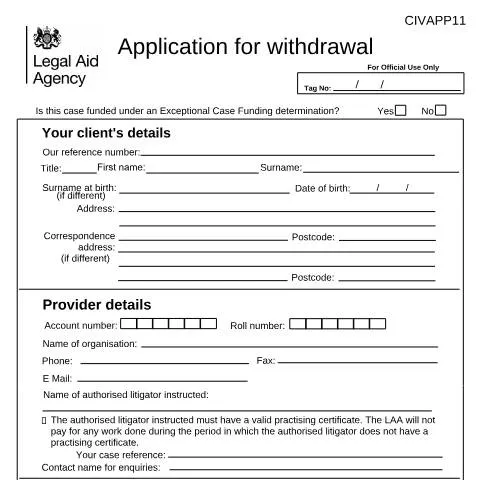
Every legal aid certificate has a lifecycle, and knowing when and how to formally close that chapter can be as crucial as obtaining the funding in the first place. The CIV APP11 application for withdrawal represents the Legal Aid Agency's mechanism for solicitors and barristers to formally terminate civil legal aid certificates, whether due to case completion, changed circumstances, or client decisions. This isn't merely administrative housekeeping—withdrawal carries significant implications for cost recovery, statutory charges, and future funding eligibility.
Unlike criminal legal aid cases, civil certificates operate under strict financial monitoring requirements. The Legal Aid Agency maintains ongoing oversight of each certificate's progress, costs incurred, and any property or money recovered during proceedings. When circumstances change—whether through successful resolution, client death, or fundamental shifts in case viability—the withdrawal process ensures proper accountability and protects both the legal aid fund and client interests.
The Ten Pathways to Certificate Withdrawal
The CIV APP11 framework recognises ten distinct scenarios that justify certificate withdrawal, each carrying different procedural requirements and consequences. Understanding these categories helps practitioners identify the most appropriate withdrawal route and avoid potential complications with cost recovery or statutory charges.
Voluntary Withdrawal Without Cost Claims
The simplest withdrawal scenario occurs when solicitors choose not to pursue payment from either the legal aid fund or their client. This pathway requires confirmation that no other firm acting under the certificate has incurred costs and that no future claims will emerge. Practitioners must acknowledge that any payments on account will be recouped by the Legal Aid Agency. Importantly, this option becomes unavailable once a decision is made to submit a CIVCLAIM 2 final claim form.
This route often applies in early-stage cases where preliminary investigations reveal weak prospects of success or where clients decide against proceeding before significant work is undertaken. The Legal Aid Agency views this favourably as it demonstrates responsible case management and protects fund resources.
Client-Initiated Withdrawal Requests
When clients themselves request certificate withdrawal, practitioners must provide detailed reasons for the client's decision. This might include changed personal circumstances, settlement discussions outside the legal aid framework, or simply a decision not to pursue the matter further. The Legal Aid Agency scrutinises these applications to ensure clients understand the implications, particularly regarding any statutory charges that may apply to recovered property or money.
Client-initiated withdrawals require careful documentation of the decision-making process. Practitioners should maintain file notes demonstrating that clients received proper advice about the consequences of withdrawal, including potential liability for opponent costs if proceedings have already commenced.
Case Completion and Disposal
Perhaps the most straightforward withdrawal category covers cases that reach natural conclusion through court judgment, settlement, or other resolution. The disposal date becomes crucial for calculating final costs and determining statutory charge applications. Practitioners must attach copies of final orders or settlement details, enabling the Legal Aid Agency to assess whether money or property has been recovered that might trigger charge obligations.
The timing of disposal can significantly impact cost entitlements. Work completed after the disposal date typically falls outside certificate coverage unless specifically authorised extensions apply. This makes accurate disposal date identification essential for both cost recovery and compliance purposes.
Financial Triggers and Statutory Obligations
Several withdrawal scenarios directly relate to financial thresholds and statutory charge applications, reflecting the Legal Aid Agency's responsibility to protect public funds while ensuring appropriate client contributions.
| Trigger Event | Threshold/Requirement | Documentation Needed |
|---|---|---|
| Increased disposable capital | Undisputed sum exceeding £3,000 | Financial evidence and calculation details |
| Property/money recovery | Any amount subject to statutory charge | CIVADMIN 1 report and recovery details |
| Financial eligibility loss | No longer meets S.21 LASPO criteria | Updated financial assessment evidence |
The £3,000 disposable capital threshold reflects ongoing financial eligibility monitoring. When clients receive undisputed sums that push their disposable capital above this limit, certificates must be withdrawn regardless of case progress. This protects the legal aid fund from supporting clients whose financial circumstances have improved beyond eligibility criteria.
Statutory charge applications require particular attention when money or property has been recovered or preserved through legal aid funded work. The CIVADMIN 1 report becomes mandatory in these circumstances, detailing the recovery amount, how it was achieved, and the proposed charge calculation. This ensures the Legal Aid Agency can properly assess its charge entitlement against any benefits secured for the client.
Client Circumstances and Procedural Challenges
Withdrawal applications frequently arise from changed client circumstances that affect either their ability to participate in proceedings or their continued eligibility for legal aid support.
Death, Bankruptcy, and Incapacity Issues
Client death triggers automatic certificate review, though withdrawal isn't always immediate. Estates may wish to continue proceedings, requiring careful assessment of whether legal aid can transfer to estate representatives or whether withdrawal becomes necessary. The death date becomes crucial for determining cost entitlements and any statutory charge applications against estate assets.
Bankruptcy orders similarly affect certificate validity, particularly in cases where litigation assets form part of the bankruptcy estate. Practitioners must coordinate with appointed trustees and consider whether proceedings can continue under different funding arrangements or whether withdrawal becomes inevitable.
Failure to Provide Instructions
Client instruction failures present complex withdrawal scenarios requiring careful documentation. The Legal Aid Agency expects practitioners to demonstrate reasonable efforts to obtain instructions before seeking withdrawal on these grounds. This includes evidence of attempted contact through various methods, reasonable timeframes for response, and consideration of any circumstances that might affect the client's ability to respond.
However, practitioners must balance persistent pursuit of instructions against proportionate case management. Excessive attempts to contact unresponsive clients can inflate costs disproportionately, potentially undermining the case for continued legal aid support.
Merits Criteria Failures and Regulatory Compliance
The Civil Legal Aid (Merits Criteria) Regulations 2012 and Civil Legal Aid (Procedure) Regulations 2012 establish ongoing compliance requirements that can trigger withdrawal when no longer satisfied.
Merits criteria failures often emerge through changed case circumstances, adverse expert reports, or unfavourable counsel opinions. When prospects of success deteriorate below required thresholds, or when proportionality assessments no longer support continued funding, withdrawal becomes mandatory rather than discretionary. The Legal Aid Agency requires copies of any unfavourable professional opinions that contributed to the merits assessment change.
Cost-benefit analyses feature prominently in these assessments. Cases where likely damages fall significantly below projected legal costs may fail proportionality tests, particularly in lower-value personal injury or contract disputes. The relationship between anticipated recovery and legal costs must justify continued public funding throughout the certificate's duration.
Vexatious Proceedings Restrictions
Section 42 Senior Courts Act 1981 and Section 33 Employment Tribunals Act 1996 orders restricting vexatious proceedings create automatic withdrawal triggers. When courts identify patterns of unreasonable litigation conduct, legal aid certificates cannot continue supporting such behaviour. These withdrawals require copies of the relevant restriction orders and detailed explanations of how the orders affect the current certificate.
Practitioners facing these situations should distinguish between client-driven unreasonable conduct and legitimate case presentation challenges. The Legal Aid Agency expects clear evidence that withdrawal relates to genuine vexatious behaviour rather than complex case management issues.
Exceptional Case Funding Considerations
Certificates granted under Exceptional Case Funding determinations carry additional withdrawal complexities due to their unique legal basis and enhanced scrutiny requirements.
These certificates typically support cases falling outside standard legal aid scope but where human rights or EU law considerations mandate funding. Withdrawal applications must address whether the exceptional circumstances that justified original funding remain applicable. Changed circumstances might affect not only the specific case merits but also the broader exceptional funding justification.
The Legal Aid Agency applies heightened scrutiny to exceptional case withdrawals, recognising the additional public interest considerations involved. Practitioners should provide comprehensive explanations of how withdrawal grounds relate to the original exceptional funding determination and whether alternative approaches might preserve the certificate while addressing the underlying concerns.
Procedural Requirements and Quality Assurance
The CIV APP11 demands specific information standards and supporting documentation that reflect the Legal Aid Agency's quality assurance framework and audit requirements.
Authorised Litigator Certification
Only authorised litigators holding valid practising certificates can sign withdrawal applications, emphasising professional accountability in legal aid administration. The Legal Aid Agency maintains strict policies regarding work completed during periods when litigators lack valid certification, typically refusing payment for such work regardless of its quality or necessity.
This requirement extends beyond simple form completion to encompass responsibility for all representations made within the application. Authorised litigators certify information accuracy and accept professional liability for any misstatements or omissions that might affect Legal Aid Agency decision-making.
Supporting Documentation Standards
Each withdrawal category demands specific supporting evidence that enables proper Legal Aid Agency assessment. Final orders and settlement details must be provided for completed cases, while financial evidence supports disposable capital or recovery-related withdrawals. The quality and completeness of supporting documentation directly affects processing times and approval likelihood.
Practitioners should anticipate Legal Aid Agency requests for additional information, particularly in complex cases involving multiple withdrawal grounds or significant financial implications. Comprehensive initial submissions reduce delays and demonstrate professional competence in legal aid administration.
Post-Withdrawal Implications and Cost Recovery
Withdrawal approval triggers various administrative processes that affect both immediate cost recovery and longer-term client obligations, making post-withdrawal planning an essential component of effective legal aid practice.
Cost assessment procedures vary significantly depending on withdrawal grounds and case progress at withdrawal. Cases withdrawn before significant work completion may attract minimal assessment activity, while those involving substantial work or property recovery face comprehensive review processes. Understanding these variations helps practitioners set appropriate client expectations and manage cash flow implications.
Statutory charge applications continue post-withdrawal where relevant, with the Legal Aid Agency maintaining ongoing interest in recovered property or money. Clients remain liable for charge obligations regardless of certificate withdrawal, making proper advice about these continuing responsibilities essential for professional compliance and client protection.
The withdrawal process also affects any outstanding opponent cost liabilities, particularly where proceedings have commenced before withdrawal. Practitioners should coordinate withdrawal timing with case management considerations to minimise adverse cost exposure while ensuring compliance with Legal Aid Agency requirements.
Withdrawal Timeline and Court Processing Stages
The CIV APP11 application for withdrawal follows a structured timeline that varies significantly depending on when you submit your request relative to the court's case management schedule. Understanding these processing stages helps applicants set realistic expectations and plan accordingly.
Pre-listing stage withdrawals typically receive the fastest processing times. When your case hasn't yet been allocated a hearing date or assigned to a specific judge, the administrative burden on the court remains minimal. Most applications submitted at this stage receive acknowledgment within 5-7 working days, with formal orders following within 2-3 weeks. The court clerk can often process these applications without requiring judicial input beyond standard authorisation.
However, post-listing withdrawals present considerably more complexity. Once your case appears in the court's diary system, withdrawal affects resource allocation, judicial time management, and potentially other parties' schedules. Applications submitted after listing typically require judicial consideration, extending processing times to 4-6 weeks. The assigned judge must review whether withdrawal serves the interests of justice and consider any implications for case management directions already issued.
Last-minute withdrawal requests—submitted within 14 days of a scheduled hearing—face the highest scrutiny. Courts may require detailed explanations for the timing, particularly if significant court resources have been allocated. Some judges request brief hearings to discuss withdrawal terms, especially in cases involving multiple parties or complex procedural histories. These applications often carry cost implications, as opposing parties may seek wasted costs orders for preparation time rendered redundant.
The case complexity factor substantially influences processing duration. Simple debt recovery cases or straightforward contract disputes may process within standard timeframes. However, cases involving ongoing injunctions, asset freezing orders, or multi-party litigation require careful judicial consideration of the withdrawal's broader implications. The court must ensure withdrawal doesn't prejudice other parties' rights or undermine existing protective orders.
Fill in your form directly online
No printing: type your details into the boxes of the official form, tick, then download the PDF ready to send.
- 1Type into the form boxes
- 2Tick in one click
- 3Save and download the PDF
Electronic filing systems have streamlined certain aspects of withdrawal processing, but don't guarantee faster outcomes. While CE-File users receive instant submission confirmation, the substantive review process remains unchanged. Paper submissions may add 2-3 days to initial processing, but this rarely affects overall timeline significantly given the judicial review requirements.
Financial Implications and Cost Recovery Mechanisms
Withdrawing civil proceedings through CIV APP11 triggers various financial considerations that extend well beyond the basic court fees. Understanding these cost implications proves crucial for making informed decisions about case withdrawal timing and strategy.
Court fees paid to date generally become non-recoverable upon withdrawal. This includes the initial claim fee, allocation fees for track assignment, and any listing fees if your case progressed to hearing preparation stages. Currently, these fees can range from £154 for claims under £1,000 to several thousand pounds for high-value commercial cases that reached multi-track allocation. The court doesn't operate a refund system for withdrawn cases, treating paid fees as compensation for administrative processing completed.
Legal representation costs present more complex recovery scenarios. If you instructed solicitors or barristers, withdrawal doesn't automatically terminate your liability for work completed. However, withdrawal timing significantly affects total costs. Early withdrawal limits exposure to expensive case preparation, witness statement compilation, and expert evidence commissioning. Conversely, last-minute withdrawal after substantial preparation may result in paying for work that provides no benefit.
Opponent cost recovery represents perhaps the most significant financial risk in withdrawal scenarios. Under Civil Procedure Rules Part 44, successful parties can typically recover their reasonable legal costs from unsuccessful opponents. While voluntary withdrawal doesn't automatically constitute 'losing' your case, courts may still award costs against withdrawing parties, particularly if withdrawal appears tactical or wastes the opponent's preparation time.
The indemnity principle governs cost awards, meaning opponents can only recover costs they've actually incurred and paid. However, this still encompasses solicitor fees, barrister fees, expert witness costs, and court fees paid by the responding party. In substantial commercial cases, these costs can reach tens of thousands of pounds, making withdrawal a financially significant decision requiring careful consideration.
Part 36 offers complicate withdrawal cost calculations considerably. If your opponent made a formal settlement offer under Civil Procedure Rules Part 36 before you withdrew, and that offer exceeded any benefits you ultimately received, enhanced cost consequences may apply. These can include indemnity costs (rather than standard basis costs) and additional interest charges, substantially increasing your financial exposure.
Protective costs orders may limit your cost exposure in certain case types, particularly judicial review proceedings or environmental cases covered by the Aarhus Convention. However, these protections don't automatically apply to general civil litigation, and withdrawal may affect their continued applicability. Always verify whether any existing cost protection orders remain effective post-withdrawal.
Insurance considerations add another layer of complexity. After the Event (ATE) insurance policies may not cover costs arising from voluntary withdrawal, particularly if withdrawal occurs without insurer consent. Before the Event (BTE) insurance through household or commercial policies similarly may exclude coverage for costs resulting from case abandonment rather than adverse judgment.
Alternative Resolution Pathways and Strategic Considerations
Before completing CIV APP11 withdrawal applications, exploring alternative resolution mechanisms often proves more advantageous than outright case abandonment. These alternatives can preserve negotiating positions while avoiding the finality and potential cost consequences of formal withdrawal.
Stay applications under Civil Procedure Rules Part 26.4 allow temporary case suspension while parties attempt settlement negotiations. Unlike withdrawal, stays preserve your right to reactivate proceedings if negotiations fail. Courts readily grant stay applications when both parties consent, typically for initial periods of 28 days with possibilities for extension. This approach maintains case momentum while creating space for productive discussions without the pressure of approaching hearing dates.
Tomlin orders provide structured settlement frameworks that satisfy both parties while formally concluding proceedings. These consent orders incorporate agreed settlement terms by reference, avoiding public disclosure of confidential settlement details. When negotiations progress positively, Tomlin orders offer more sophisticated resolution than simple withdrawal, often including staged payment terms, compliance monitoring mechanisms, and agreed enforcement procedures should either party breach settlement terms.
Mediation directions represent increasingly popular alternatives, particularly in commercial disputes or family-related civil matters. Many courts now expect parties to attempt mediation before trial, and voluntary mediation requests often receive favourable judicial consideration. Successful mediation avoids withdrawal altogether while potentially achieving better outcomes than continued litigation. Even unsuccessful mediation demonstrates reasonable settlement attempts, potentially influencing subsequent cost decisions if proceedings continue.
Part 36 settlement offers provide tactical alternatives to immediate withdrawal when your position has weakened but complete abandonment seems premature. Strategic Part 36 offers can shift cost risks to opponents while maintaining case viability. If opponents reject reasonable offers and subsequently achieve worse outcomes at trial, they may face adverse cost consequences despite technically winning their case.
Discontinuance under Part 38 differs from withdrawal applications and may offer more advantageous terms in certain circumstances. Discontinuance allows case termination without court permission in most instances, though it carries automatic cost liability to opponents. However, discontinuance preserves rights to commence fresh proceedings on the same cause of action, subject to limitation period constraints. This flexibility proves valuable when withdrawal results from procedural errors or incomplete case preparation rather than fundamental merit weaknesses.
Conditional withdrawal strategies involve negotiating agreed terms with opponents before submitting formal withdrawal applications. These negotiations might secure cost protection, mutual releases from future claims, or confidentiality agreements. Conditional withdrawals often achieve better outcomes than unilateral withdrawal, as opponents may accept reduced cost recovery in exchange for certainty and avoided trial preparation expenses.
Timing considerations significantly influence alternative strategy effectiveness. Early-stage alternatives typically offer more flexibility and lower cost exposure. However, even late-stage cases may benefit from alternative approaches, particularly when withdrawal would trigger substantial adverse cost orders. The key lies in realistic assessment of your negotiating position and opponent willingness to engage constructively.
Professional advice importance cannot be overstated when evaluating these alternatives. Solicitors experienced in your specific case type can assess whether alternative approaches offer realistic prospects of better outcomes than straightforward withdrawal. This assessment should consider not only immediate cost implications but also longer-term strategic considerations, including preservation of commercial relationships and reputational factors.