Understanding the Application to Restart Form (Form 9B) for Scottish Courts and Tribunals
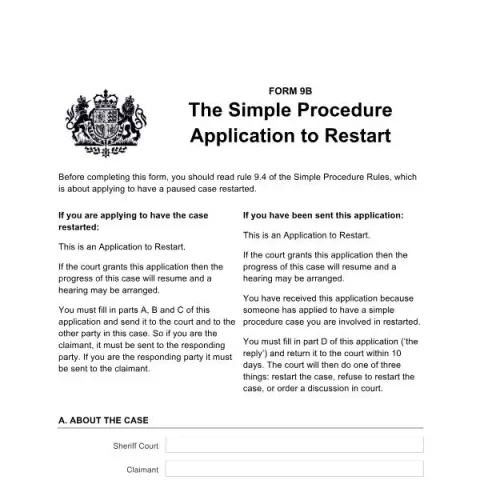
The Application to Restart (Form 9B) is a crucial document used within the Scottish legal system, specifically under the Simple Procedure rules. It allows parties involved in a case to request the court to resume proceedings that have been paused or stayed. This article provides a comprehensive overview of the purpose, process, and key considerations associated with this form, helping claimants and respondents navigate the procedural requirements effectively.
Purpose of the Application to Restart (Form 9B)
The primary objective of the Application to Restart is to seek the court’s approval to proceed with a case that has been temporarily halted. Cases may be paused for various reasons, such as awaiting further information, settlement negotiations, or procedural issues. When circumstances change or new evidence emerges, a party may wish to reactivate the case to move toward resolution or a hearing.
Once the court grants this application, the case will be reinstated, and a hearing may be scheduled. This process ensures that cases are managed efficiently and fairly, providing both parties an opportunity to present their arguments once the case resumes.
How to Prepare and Submit the Application
Completing the Form
The Form 9B is structured into several parts that must be filled out accurately:
- Part A: About the Case — includes details such as the case reference number, court name, and parties involved (claimant and respondent).
- Part B: About You — requires your full name, and your role in the case (claimant or respondent).
- Part C: The Application — where you must explain why the case should be restarted and indicate the date the application was sent to the court.
- Part D: The Reply — to be completed by the opposing party, providing their response to the restart request, including whether they agree or object to the case being resumed.
It is essential to provide clear, factual reasons for the restart request, such as new evidence, procedural delays, or other relevant factors that justify resumption of proceedings.
Submission Process
The completed Form 9B must be sent to the court handling the case. If you are the applicant, you are also responsible for serving a copy of the form on the other party involved in the case. This ensures transparency and allows the opposing party to prepare their response.
If you receive a copy of the application, you have a deadline of 10 days to complete and return Part D of the form to the court. Your response should specify whether you agree with the restart or provide reasons for objection.
Follow-Up and Court Decision
After receiving the application and any reply, the court will consider the circumstances and make one of three decisions:
- Restart the case — allowing proceedings to continue and potentially scheduling a hearing.
- Refuse to restart — maintaining the case as paused, possibly with reasons provided.
- Order a discussion in court — which may involve a hearing to clarify issues before a decision is made.
The court’s decision will be communicated to both parties, and if the case is restarted, the proceedings will proceed as per the court’s schedule.
Fill in your form directly online
No printing: type your details into the boxes of the official form, tick, then download the PDF ready to send.
- 1Type into the form boxes
- 2Tick in one click
- 3Save and download the PDF
Legal and Procedural Considerations
Before completing the Application to Restart, parties should familiarize themselves with rule 9.4 of the Simple Procedure Rules. This rule outlines the procedural requirements and criteria for applying to restart a case, ensuring compliance with court procedures.
It is advisable to prepare a detailed explanation for the restart request, supported by relevant evidence or legal grounds, to increase the likelihood of a favorable court response. Proper service of the application and timely responses are essential to maintain procedural fairness.
Conclusion
The Application to Restart (Form 9B) plays a vital role in managing cases within the Scottish simple procedure system. It provides a structured mechanism for parties to request the resumption of proceedings, ensuring that cases are heard fairly and efficiently. Understanding the form’s requirements and the procedural steps involved helps parties navigate the process confidently, contributing to the effective administration of justice in Scotland’s courts.