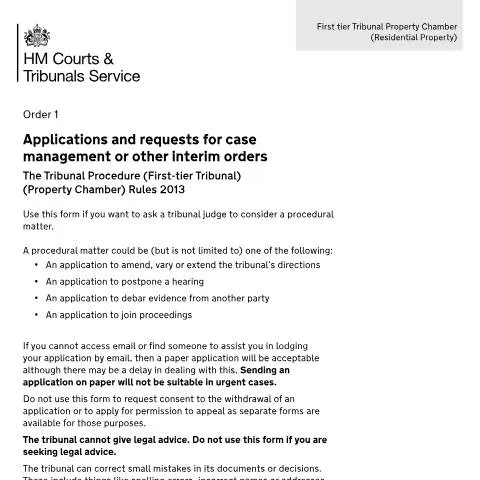
When Property Disputes Need Immediate Tribunal Intervention
Property chamber proceedings rarely follow a perfectly linear path. Whether it's a leasehold dispute that has escalated beyond initial expectations, a service charge challenge requiring urgent directions, or a right to manage case where procedural complications have emerged, parties often find themselves needing to request specific tribunal interventions mid-process. Form Order 1 serves as the gateway for these procedural applications to the First-tier Tribunal (Property Chamber), enabling parties to seek case management orders that can fundamentally alter the trajectory of their dispute.
This form addresses the practical reality that property disputes frequently require judicial oversight beyond the standard directions initially issued. From postponement requests driven by unavailable expert witnesses to applications seeking to debar evidence obtained through questionable means, Order 1 applications represent critical junctures where procedural fairness intersects with substantive case outcomes.
The Procedural Landscape: Understanding Interim Orders in Property Chamber Context
The First-tier Tribunal (Property Chamber) operates under the Tribunal Procedure (First-tier Tribunal) (Property Chamber) Rules 2013, which establish a comprehensive framework for case management powers. Form Order 1 specifically channels applications under these rules, distinguishing itself from the standard application forms used to initiate proceedings.
Unlike primary applications such as those for service charge disputes or leasehold enfranchisement, Order 1 applications are ancillary proceedings that arise within existing cases. This distinction is crucial because it affects both the procedural requirements and the tribunal's approach to determination. The tribunal already possesses jurisdiction over the underlying dispute, meaning Order 1 applications benefit from established case context and existing directions.
Categories of Interim Relief Available
The form explicitly acknowledges that procedural matters extend beyond its listed examples, reflecting the tribunal's broad case management powers. Common applications include:
- Amendments to directions: Modifying timescales for evidence exchange, altering inspection arrangements, or varying expert witness requirements
- Hearing postponements: Particularly relevant in complex leasehold cases where technical evidence preparation requires additional time
- Evidence debarment: Seeking to exclude material obtained in breach of directions or procedural requirements
- Joinder applications: Adding parties whose involvement becomes necessary as proceedings develop
- Disclosure orders: Compelling production of documents essential to case resolution
- Security for costs: In appropriate circumstances, though less common in property chamber proceedings
Strategic Timing and the Urgency Factor
Form Order 1 applications operate within tight procedural timeframes that reflect the tribunal's commitment to efficient case resolution. The form's emphasis on email submission over paper applications reveals the practical importance of speed in procedural applications. This preference stems from the reality that many Order 1 applications arise from developments requiring swift resolution to prevent prejudice to proceedings.
The ten-working-day availability window referenced in section 8 demonstrates how quickly tribunals may need to convene conference calls to address urgent applications. This compressed timeframe means that preparation quality becomes paramount – there's limited opportunity for iterative refinement once an application is submitted.
Email vs Paper Submission Considerations
The form's guidance on submission methods reflects practical realities of tribunal administration. Email submissions enable:
| Submission Method | Processing Speed | Suitable For | Limitations |
|---|---|---|---|
| Same-day acknowledgment typically | All applications, especially urgent matters | Requires digital literacy/access | |
| Paper | Several days minimum | Non-urgent applications only | Processing delays may prejudice case |
Consent Dynamics and Inter-Party Negotiations
Section 7 of Form Order 1 reveals a sophisticated understanding of litigation dynamics by distinguishing between consensual and contested applications. This distinction affects both processing speed and the tribunal's analytical approach.
Consensual applications benefit from streamlined processing because they eliminate the need for the tribunal to balance competing interests. However, obtaining genuine consent requires careful negotiation and often involves compromise on timing or scope. Parties seeking consent must provide written confirmation, creating an evidentiary trail that prevents later disputes about agreement terms.
Contested applications trigger a more complex process requiring service on opposing parties and opportunity for objection. This procedural requirement reflects natural justice principles while creating tactical considerations for applicants. The timing of application submission becomes crucial, as opponents receive advance notice that may influence their strategic positioning.
The Notice and Objection Process
When parties cannot secure consent, the form mandates service of the application on opponents with specific notification about objection rights. This requirement creates a mini-adversarial process within the broader proceedings, where:
- Objecting parties must simultaneously serve their objections on both the tribunal and the applicant
- The tribunal gains insight into all parties' positions before determining the application
- Applicants receive advance warning of opposition arguments, enabling reply preparation
Drafting the Application: Substance Over Form
Sections 5 and 6 of Form Order 1 require applicants to articulate both their specific request and supporting grounds. This dual requirement reflects the tribunal's need to understand not just what is sought, but why it should be granted. The quality of this drafting often determines application success.
The instruction to "briefly describe" the application creates tension with the need for comprehensive justification. Effective applications balance concision with completeness, ensuring that tribunal judges can quickly grasp the essential request while having sufficient detail to make informed decisions.
Evidence Requirements and Supporting Documentation
Note 5's reference to including supporting evidence acknowledges that procedural applications rarely succeed on assertion alone. The type of evidence varies significantly based on application nature:
- Postponement requests: Medical certificates, expert unavailability confirmations, or documentation of unforeseen circumstances
- Direction variations: Correspondence demonstrating practical difficulties or changed circumstances
- Evidence debarment: Documentation showing procedural breaches or compliance failures
- Joinder applications: Evidence of the proposed party's interest in the proceedings
Representative Involvement and Professional Dynamics
Section 4's detailed provisions for representative information reflect the reality that many property chamber proceedings involve professional representation, whether by solicitors, barristers, or specialist property consultants. The form's accommodation of representative details indicates the tribunal's recognition that procedural applications often arise from professional strategic assessments rather than lay party initiatives.
Representative involvement in Order 1 applications creates particular dynamics because professionals typically have superior understanding of procedural implications and tribunal preferences. This expertise advantage can be significant in applications where success depends on demonstrating compliance with previous directions or understanding of case law precedents.
The option to specify "other" relationships beyond standard applicant/respondent categories acknowledges the complex party structures common in property disputes, where management companies, freeholders, and leaseholder groups may all have distinct interests requiring procedural intervention.
Conference Call Procedures and Remote Determination
Section 8's focus on conference call availability reflects the tribunal's preference for resolving procedural matters efficiently without requiring physical hearings. This approach serves multiple policy objectives: reducing costs, accelerating resolution, and enabling judicial resources to focus on substantive determinations.
The ten-working-day window for availability creates practical challenges for parties with complex schedules or multiple representatives. Strategic consideration of this timeframe becomes essential, particularly in urgent applications where delay may defeat the application's purpose.
Practical Implications of Remote Determination
Conference call determination of Order 1 applications creates unique dynamics compared to written-only or face-to-face resolution:
- Immediacy: Parties can respond to judicial questions and address concerns in real-time
- Informality: The conversational nature may encourage more open discussion of practical solutions
- Efficiency: Multiple issues can be addressed sequentially without separate application processes
- Documentation: Outcomes must still be formally recorded, creating binding directions
Decision Implementation and Ongoing Case Management
The tribunal use section at Form Order 1's conclusion reveals the administrative framework supporting procedural determinations. The requirement for decision maker identification and dating creates an audit trail essential for subsequent appeal or review applications.
Successful Order 1 applications typically result in revised case management directions that supersede previous tribunal instructions. These variations become integral parts of the procedural framework governing the underlying dispute, affecting everything from evidence deadlines to hearing arrangements.
The binding nature of tribunal decisions on Order 1 applications means that parties must carefully consider the implications of their requests. Unintended consequences from successful applications can significantly impact case strategy, particularly regarding timing and evidence presentation opportunities.
Understanding Form Order 1's role within the broader property chamber framework enables parties to navigate procedural complexities effectively while maintaining focus on substantive dispute resolution. The form represents a crucial tool for case management that, when properly utilised, can significantly enhance prospects for fair and efficient determination of property disputes.
Tactical Considerations When Requesting Multiple Interim Orders
Applicants often benefit from submitting requests for several complementary interim orders simultaneously, particularly in complex property disputes where multiple procedural issues require immediate attention. The First-tier Tribunal (Property Chamber) permits bundling of related applications on Form Order 1, provided each request addresses distinct aspects of case management and demonstrates clear interconnection.
When seeking multiple orders, structure your application strategically. Begin with the most time-sensitive request—for instance, an urgent inspection order if property conditions are deteriorating rapidly—followed by supporting measures such as document disclosure orders or witness statement directions. This hierarchical approach helps tribunal judges understand the logical sequence of your procedural needs.
Consider the cumulative impact on opposing parties when requesting multiple orders. Tribunals scrutinise whether combined requests create disproportionate burden, particularly for unrepresented landlords or leaseholders with limited resources. Frame multiple applications as complementary efficiency measures rather than tactical pressure tactics. For example, combining a document disclosure order with extended time limits demonstrates procedural fairness whilst advancing case preparation.
Timing becomes crucial when multiple orders interact. If requesting both expert evidence directions and case management conferences, specify whether the conference should precede expert instruction to clarify scope, or follow to review findings. Similarly, when combining inspection orders with document disclosure, indicate whether tribunal access to premises should occur before or after reviewing relevant construction records or lease documentation.
Some combinations prove particularly effective in property disputes. Inspection orders paired with expert evidence directions allow comprehensive technical assessment of building defects or service charge disputes. Document disclosure orders combined with witness statement directions ensure parties can properly prepare evidence whilst maintaining procedural fairness. Case management conferences requested alongside complex direction orders provide opportunities for judicial clarification of procedural requirements.
Fill in your form directly online
No printing: type your details into the boxes of the official form, tick, then download the PDF ready to send.
- 1Type into the form boxes
- 2Tick in one click
- 3Save and download the PDF
Form Order 1 Variations Across Different Property Chamber Jurisdictions
The First-tier Tribunal (Property Chamber) encompasses multiple specialist jurisdictions, each with subtle variations in how Form Order 1 applications are processed and assessed. Understanding these jurisdictional differences proves essential for targeting your interim order request appropriately and maximising prospects of success.
In residential property cases—covering leasehold disputes, rent assessment, and housing act matters—tribunals typically demonstrate greater flexibility regarding inspection orders and expert evidence directions. Judges recognise that residential property conditions directly impact occupier welfare, justifying more interventionist case management approaches. Applications for urgent inspection orders in cases involving potential health hazards or structural defects generally receive expedited consideration, often within 7-10 working days rather than standard 21-day timeframes.
Land registration disputes present different procedural considerations. These cases frequently involve complex boundary disputes or adverse possession claims requiring detailed documentary analysis and site visits. Form Order 1 applications in this jurisdiction commonly request specialist surveyor appointments or joint expert instructions, given the technical nature of boundary determination. Tribunals often grant extended time limits for evidence preparation, recognising that historical land records may require extensive archival research.
Park homes jurisdiction demonstrates particular sensitivity to resident vulnerability, especially regarding elderly occupiers facing eviction proceedings. Interim applications frequently seek extended time limits or case management conferences to ensure residents understand complex legal proceedings. Tribunals may grant additional directions for independent advice access or simplified document formats, acknowledging that many park home residents lack legal representation.
Agricultural holdings cases involve seasonal considerations affecting inspection timing and expert evidence gathering. Form Order 1 applications must account for farming calendars, crop cycles, and weather dependencies when requesting site visits or agricultural expert instructions. Tribunals commonly grant flexible direction orders allowing inspection scheduling around harvest periods or livestock management requirements.
Right to manage and commonhold disputes often involve multiple leaseholders with conflicting interests. Case management orders frequently address representation issues, document sharing protocols among numerous parties, and coordination of expert evidence where building defects affect different property areas. Tribunals may grant directions for lead party appointment or consolidated evidence presentation to manage complex multi-party dynamics efficiently.
Strategic Use of Form Order 1 in Settlement Negotiations
Form Order 1 applications serve dual purposes in property disputes: advancing procedural case management whilst creating strategic leverage for settlement discussions. Experienced practitioners recognise that well-timed interim order requests can demonstrate case strength, clarify disputed issues, and encourage realistic negotiation positions from opposing parties.
Document disclosure orders prove particularly effective in exposing weak opponent positions. When landlords claim service charge reasonableness, applications for comprehensive financial record disclosure often reveal accounting irregularities or excessive management charges that strengthen tenant negotiating positions. Similarly, requests for inspection orders in building defect cases can prompt landlord settlement offers rather than risk tribunal findings of substantial disrepair.
Expert evidence directions create cost pressures encouraging settlement discussions. Once tribunals grant expert instruction orders, parties face significant additional expenses—typically £2,000-5,000 for building surveys or £1,500-3,000 for valuation reports. These prospective costs often motivate compromise discussions, particularly where dispute values are relatively modest compared to expert fees.
Case management conference requests provide structured settlement opportunities. Many tribunals incorporate settlement discussions into case management hearings, creating neutral environments for exploring compromise solutions. Applications for case management conferences can signal willingness to negotiate whilst maintaining procedural pressure through continued tribunal involvement.
Timing interim applications strategically enhances settlement prospects. Submitting Form Order 1 requests shortly before significant opponent deadlines—such as defence filing dates or disclosure obligations—creates time pressure encouraging settlement discussions. However, avoid tactics that appear purely obstructive, as tribunals may impose cost sanctions for unreasonable procedural behaviour.
Consider settlement implications when drafting interim order justifications. Frame applications in terms that highlight opponent weaknesses whilst maintaining reasonable positions. For instance, requesting inspection orders due to "landlord failure to provide adequate defect remediation evidence" suggests case strength whilst offering face-saving settlement opportunities through negotiated repair programmes rather than tribunal-imposed remedies.
Some interim orders facilitate structured settlement processes. Joint expert instruction applications can produce neutral technical assessments forming settlement negotiation foundations. Time extension requests may provide breathing space for mediation attempts or without-prejudice discussions. Document disclosure orders can reveal information enabling realistic damage assessments and compensation calculations.
Monitor opponent responses to Form Order 1 applications for settlement signals. Parties who consent to disclosure requests or inspection orders may indicate underlying case concerns. Conversely, vigorous opposition to routine procedural applications might suggest confidence in substantive positions or tactical delay strategies requiring adjusted settlement approaches.