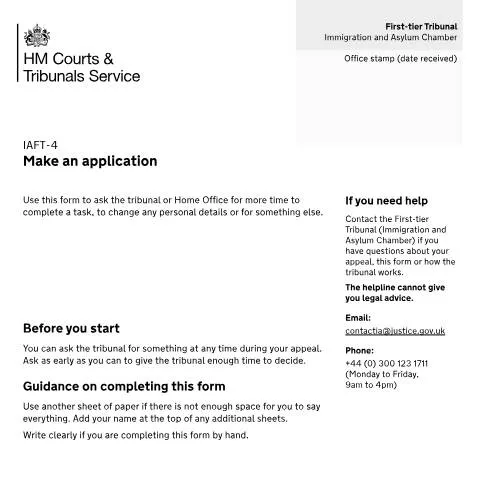
Navigating Urgent Requests in Immigration and Asylum Appeals
When facing tight deadlines in immigration proceedings or discovering errors in your tribunal paperwork, the IAFT-4 application form serves as your lifeline to the First-tier Tribunal Immigration and Asylum Chamber. This multi-purpose tool addresses everything from time extension requests to personal detail corrections, hearing adjustments, and even complex procedural directions to the Home Office.
The form's versatility becomes apparent when you consider its broad remit: appellants can simultaneously request additional time for evidence submission whilst correcting their registered address, or seek anonymity protection alongside a hearing postponement. Unlike single-purpose tribunal documents, IAFT-4 accommodates the complex, overlapping needs that frequently arise during immigration appeals.
Understanding when and how to deploy this application strategically can mean the difference between a properly prepared case and a missed opportunity. The tribunal emphasises submitting requests "as early as you can to give the tribunal enough time to decide", yet many appellants hesitate, unaware that applications can be made at any time during your appeal.
Who Files IAFT-4 Applications and Under What Circumstances
The primary users of IAFT-4 span the entire spectrum of immigration and asylum appellants currently engaged with the First-tier Tribunal. This includes individuals appealing Home Office decisions on visa refusals, asylum claims, deportation orders, and various immigration status determinations.
Asylum seekers frequently utilise this form when struggling to obtain crucial evidence from their country of origin within standard timeframes. Country conditions may prevent timely document retrieval, or trauma-related issues might require additional preparation time for giving evidence.
Family reunion cases often generate IAFT-4 applications when sponsors need to correct relationship details or update contact information following address changes. The form proves particularly valuable when family circumstances shift during lengthy appeal processes.
Detained appellants represent a distinct user category, with specific provisions allowing staff members to assist with form submission. Detention centres must facilitate access to this application process, recognising that confined individuals face unique challenges in managing their appeals.
Vulnerable Appellant Considerations
Appellants with mental health conditions, disabilities, or language barriers may require additional support when completing IAFT-4. The tribunal acknowledges these circumstances, particularly when considering time extension requests or hearing adjustment applications.
Unaccompanied minors present special cases where guardians or legal representatives typically handle IAFT-4 submissions. The form's flexibility accommodates varying levels of representative involvement whilst maintaining focus on the appellant's best interests.
Decoding the Application Categories and Their Strategic Uses
Section 2.1 presents seven distinct application types, each serving specific procedural purposes within immigration appeals. Understanding these categories' nuances enables more effective tribunal engagement.
Time Extension Requests
Time extensions represent the most commonly utilised IAFT-4 function. Appellants must specify exact timeframe requirements whilst demonstrating good reasons for additional time. The tribunal expects continuing compliance with original deadlines pending their decision, maintaining pressure even during extension consideration.
Successful time extension applications typically demonstrate circumstances beyond the appellant's control: delayed document translation, expert witness unavailability, or sudden changes in legal representation. Speculative requests lacking concrete justification face routine refusal.
Personal Detail Corrections
Name spelling errors, incorrect birth dates, or outdated addresses can seriously compromise appeal proceedings. The tribunal requires accurate records for proper case management, making correction applications both necessary and routine.
These corrections prove particularly crucial for appellants whose names appear differently across various official documents. Consistency between tribunal records, Home Office files, and supporting evidence prevents administrative complications that could delay hearings.
Hearing Modifications
Date changes, venue relocations, and accessibility requirements fall under this category. Medical appointments, religious observances, or interpreter unavailability may justify hearing rescheduling requests.
The tribunal balances individual needs against administrative efficiency, favouring early notification of hearing conflicts. Last-minute requests face scrutiny unless circumstances genuinely prevented earlier application.
| Application Type | Common Scenarios | Key Success Factors |
|---|---|---|
| Time Extensions | Evidence delays, expert reports, translation needs | Specific timeframes, ongoing compliance, clear justification |
| Detail Corrections | Name variations, address changes, contact updates | Supporting documentation, consistency across records |
| Hearing Adjustments | Medical conflicts, interpreter needs, venue access | Early notification, genuine necessity, alternative dates |
| Appeal Withdrawal | Settlement agreements, changed circumstances | Clear intention, understanding of consequences |
Advanced Applications: Anonymity, Fee Remissions, and Home Office Directions
The IAFT-4 form accommodates sophisticated procedural requests that extend beyond basic case management. These applications require careful consideration and substantial supporting evidence.
Anonymity Protection Requests
Anonymity applications address serious privacy concerns where public identification could endanger appellants or witnesses. The tribunal may publish names in publicly accessible documents, making anonymity crucial for sensitive cases.
Successful anonymity requests typically involve state persecution risks, where naming individuals could expose them to retaliation in their home countries. Family members, witnesses, or community contacts may require similar protection.
The application must demonstrate specific threats rather than general privacy preferences. Country expert evidence, threat assessments, or previous persecution documentation strengthens anonymity requests significantly.
Fee Remission Applications
Fee remission requests require evidence of financial inability to pay appeal fees. Asylum support numbers, local authority letters, or benefit entitlement documentation typically satisfy tribunal requirements.
The form specifically references asylum support numbers, acknowledging that many appellants receive government assistance during their cases. Local authority support letters provide alternative evidence for those outside the asylum support system.
Directions Against the Home Office
Perhaps the most complex IAFT-4 application involves requesting tribunal directions compelling Home Office action. These applications require "exact wording of what you want the tribunal to tell the Home Office to do" plus comprehensive justification.
Common direction requests include document disclosure, interview transcript provision, or decision-maker appearance requirements. Success depends on demonstrating procedural unfairness or incomplete Home Office compliance with existing obligations.
Submission Pathways and Processing Mechanics
The tribunal offers multiple submission routes, each with distinct advantages and considerations for different appellant circumstances.
Electronic Submission via Email
Email submission to [email protected] provides the fastest delivery method, with immediate confirmation of receipt. The tribunal requires appeal reference numbers in email subject lines for efficient case identification and processing.
Electronic submission proves particularly valuable for urgent applications where postal delays could compromise deadlines. Appellants can attach supporting documents directly, streamlining evidence presentation.
However, email submissions require reliable internet access and basic technical competency. Detained appellants or those in remote locations may face practical barriers to electronic submission.
Postal Submission Process
The Loughborough processing centre handles all postal IAFT-4 submissions through a centralised system. This route accommodates appellants without internet access whilst providing traditional documentation trails.
Postal timing becomes crucial for time-sensitive applications. Standard delivery takes several days, whilst recorded delivery provides proof of submission for critical deadlines. Appellants should factor postal delays into their application timing.
Detention Centre Procedures
Detained appellants receive special accommodation through staff assistance programmes. Immigration removal centres must facilitate IAFT-4 completion and submission, recognising the fundamental right to effective appeal participation.
Staff members can provide practical assistance with form completion, photocopying supporting documents, and ensuring proper submission. However, they cannot provide legal advice regarding application content or strategy.
Evidence Assembly and Supporting Documentation Strategy
Successful IAFT-4 applications depend heavily on appropriate supporting evidence tailored to specific request types. The tribunal expects concrete documentation rather than unsupported assertions.
Time Extension Evidence Requirements
Time extension requests benefit from third-party verification of delays or obstacles. Medical certificates, translation service quotes, expert availability letters, or legal representative confirmations provide objective justification.
Appellants should document their ongoing efforts to meet original deadlines, demonstrating good faith attempts rather than passive delay acceptance. Progress updates, correspondence with service providers, or partially completed work show continued engagement.
Personal Detail Correction Documentation
Correction requests require authoritative source documents establishing correct information. Birth certificates, marriage certificates, official identity documents, or previous tribunal correspondence provide verification.
Name variations across documents need explanation and reconciliation. Cultural naming conventions, translation differences, or administrative errors require clear documentation to prevent future confusion.
Hearing Adjustment Supporting Materials
Medical appointment letters, religious calendar references, or interpreter unavailability confirmations justify hearing change requests. The tribunal appreciates specific alternative dates rather than open-ended rescheduling requests.
Accessibility requirements need professional assessment documentation. Medical reports, occupational therapy evaluations, or disability benefit correspondence establish genuine accommodation needs.
Tribunal Decision-Making and Appellant Response Strategies
The tribunal's consideration process balances individual appellant needs against broader case management efficiency and fairness to other parties. Understanding these factors helps appellants frame more persuasive applications.
Grant and Refusal Patterns
Time extension grants typically favour requests with specific timeframes, clear justification, and evidence of ongoing compliance efforts. Vague or speculative extension requests face routine refusal, particularly when appellants show no progress toward original deadlines.
Personal detail corrections receive favourable treatment when supported by appropriate documentation. The tribunal recognises that accurate records serve everyone's interests, making correction applications relatively straightforward.
Hearing modification requests succeed when demonstrating genuine necessity rather than mere convenience. Medical emergencies, religious obligations, or interpreter unavailability generally justify rescheduling, whilst holiday preferences or work commitments typically fail.
Continuing Obligations Pending Decisions
The form explicitly warns appellants to "continue working on your appeal after you send this form in case the tribunal decides to refuse what you asked for". This requirement prevents tactical delay applications designed to buy additional time without justification.
Appellants must maintain dual timelines: their original deadlines plus any extended timeframes they've requested. Failure to meet original deadlines following application refusal can result in case dismissal or adverse cost orders.
Appeal and Review Options
IAFT-4 refusals can sometimes be challenged through fresh applications addressing tribunal concerns or changed circumstances. However, repeated applications on identical grounds may attract judicial criticism and potential cost consequences.
Upper Tribunal review remains available for procedural errors in IAFT-4 consideration, though substantive disagreement with tribunal discretion rarely succeeds on appeal. The focus should be on comprehensive initial applications rather than subsequent challenge strategies.
Practical Completion Guidelines and Common Pitfalls
Effective IAFT-4 completion requires attention to both procedural requirements and strategic presentation. The tribunal processes numerous applications daily, making clarity and completeness essential for positive consideration.
Section 1 identification details must match existing tribunal records exactly. Discrepancies in names, dates, or reference numbers can delay processing or result in applications being filed incorrectly. Appellants should reference previous tribunal correspondence to ensure consistency.
Section 2.2's explanation requirement demands specific, detailed justification rather than generic requests. Successful applications explain not just what appellants want, but why circumstances justify tribunal intervention and how granting the request serves broader case interests.
Multiple request applications need separate explanations for each element. Appellants combining time extensions with hearing changes must justify both requests independently, avoiding assumption that one justification covers all requests.
Additional sheet usage should include appellant names and appeal references on every page. Lost or misfiled continuation sheets can undermine otherwise strong applications, particularly in complex cases requiring extensive explanation.
The tribunal's emphasis on early application submission reflects practical case management needs. Late applications, particularly for hearing changes or time extensions, face increased scrutiny and potential refusal regardless of underlying merit. Strategic timing can significantly influence application success rates.
Understanding Your Eligibility Requirements for IAFT-4
Before submitting your IAFT-4 application, you must carefully assess whether you meet the specific eligibility criteria. The application process varies considerably depending on your current immigration status, nationality, and the particular circumstances that have led to your need for this form.
If you're applying as a dependent family member, your eligibility hinges on your relationship to the main applicant. Spouses and civil partners must provide comprehensive evidence of a genuine and subsisting relationship, including marriage certificates, joint financial commitments, and proof of cohabitation. For dependent children, age restrictions typically apply—generally under 18 at the time of application, though exceptions exist for children who remain financially dependent due to disability or other compelling circumstances.
The financial requirements can be particularly complex. If you're switching from a student visa, you'll need to demonstrate that you've maintained lawful status throughout your stay and haven't breached any conditions of your previous leave. This includes adhering to work restrictions, maintaining course attendance, and ensuring continuous residence without extended absences that might affect your application.
For those with existing settlement rights or indefinite leave to remain, the IAFT-4 may be relevant when applying for family members to join you. In such cases, you'll need to prove your own status is secure and that you can adequately maintain any dependants without recourse to public funds. This financial threshold varies based on family size—additional amounts are required for each dependent child beyond the first.
Certain nationalities may face additional scrutiny or requirements. If you're from a country where document verification is challenging, you may need to provide alternative forms of evidence or undergo additional security checks. The Home Office maintains country-specific guidance that can affect processing times and evidence requirements, so checking the most current information for your nationality is essential.
Common Pitfalls and How to Avoid Application Rejection
IAFT-4 applications face rejection for several recurring reasons, many of which are entirely preventable with careful preparation. Understanding these common pitfalls can save months of delays and additional fees associated with resubmission.
Document authenticity represents one of the most frequent stumbling blocks. All foreign documents must be officially translated by certified translators, and the Home Office maintains strict standards about which translation services they'll accept. Original documents or certified copies are typically required—photocopies or scanned versions often lead to immediate rejection. If you're providing documents from countries with different administrative systems, ensure they meet UK equivalency standards.
Financial evidence errors are particularly costly. Bank statements must cover the required period without gaps, showing consistent funds well above the maintenance threshold. Borrowed money or sudden large deposits shortly before application can raise suspicion and may require detailed explanation. If you're relying on employment income, ensure your employer's letter matches exactly with payslips and tax records—any discrepancies will be questioned.
The English language requirement catches many applicants off-guard. Even if you're fluent, you may need formal certification from an approved test provider. Some qualifications from English-speaking countries are accepted, but the list is specific and regularly updated. Assuming your degree from an overseas university automatically satisfies this requirement without checking the current accepted institutions list is a common mistake.
Timing errors frequently cause problems. Submitting your application too early—before meeting continuous residence requirements—or too late—after your current leave expires—can result in automatic refusal. The 28-day rule for switching categories is particularly strict; missing this window often means having to leave the UK and reapply from abroad, significantly complicating the process.
Address history discrepancies often trigger additional investigations. Every gap in your residential history must be explained, including temporary stays with friends or relatives. If you've moved frequently, ensure dates don't overlap impossibly or leave unexplained gaps. University accommodation, temporary housing, and even brief stays abroad must be accurately recorded with supporting evidence where possible.
After Submission: What to Expect During Processing
Once your IAFT-4 application is submitted, the processing timeline can vary significantly based on several factors beyond your control. Understanding what happens during this period helps manage expectations and prepares you for potential requests for additional information.
Initial processing involves document verification and preliminary eligibility checks. During this phase, the Home Office may contact your sponsors, employers, or educational institutions to verify information you've provided. This verification process can add weeks to your application timeline, particularly if any contacted parties are slow to respond or if there are discrepancies requiring clarification.
Biometric information processing occurs after your appointment at a UK Visa and Citizenship Application Services centre. Your fingerprints and photograph become part of your immigration record and are checked against various databases. Any issues with biometric quality or previous immigration history can trigger additional security checks, extending processing times considerably.
Medical examinations may be required depending on your circumstances and country of origin. If you're from a country where tuberculosis screening is mandatory, you'll need an approved medical examination before your application can proceed. These appointments must be booked with Home Office-approved panel physicians, and results typically take several weeks to process and verify.
Status updates during processing are limited, but you can track basic progress through the online system where you submitted your application. However, detailed information about where your application stands in the process or reasons for delays is rarely provided until a decision is reached. This uncertainty period requires patience, as frequent enquiries to the Home Office rarely expedite processing.
If additional evidence is requested during processing, you'll receive specific instructions about what to provide and the deadline for submission. These requests are time-sensitive—typically 10 working days—and failure to respond adequately can result in refusal based on insufficient evidence. Sometimes, the Home Office may request original documents even if you initially provided certified copies, requiring careful coordination if these documents are needed for other purposes.
Decision notification arrives via the method you specified in your application—usually email for online applications. This notification includes details about collection of your documents and, if successful, information about your new immigration status. Refused applications include detailed reasons for refusal and information about appeal rights or reapplication procedures, which vary depending on the specific grounds for refusal.