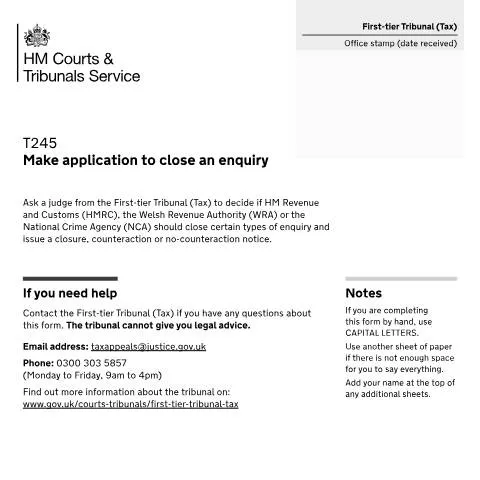
Navigating the T245 Form: A Vital Step Towards Resolving Tax Enquiries
Facing an inquiry from HM Revenue and Customs (HMRC) can be daunting, especially when the stakes involve your financial obligations. The T245 form, titled “Make an application to close an enquiry,” serves as a crucial instrument in this process. It allows taxpayers to formally request the closure of specific tax inquiries that HMRC, Welsh Revenue Authority (WRA), or the National Crime Agency (NCA) have initiated. Understanding this document’s purpose, completion process, and its implications is essential for individuals and businesses alike.
Understanding the Role of the T245 Form
The T245 form plays a significant role in resolving disputes between taxpayers and tax authorities. When a tax inquiry is initiated, it can lead to uncertainty and stress for the taxpayers involved. The T245 enables you to ask the First-tier Tribunal (Tax) to intervene and decide whether the inquiry should be closed. This can be critical for your peace of mind and financial planning.
Who Should Consider Submitting the T245?
- Individuals: If you are a taxpayer facing a self-assessment inquiry.
- Businesses: Companies or partnerships that have received similar inquiries.
- Trustees: Those managing trusts and facing tax inquiries.
Understanding who qualifies to submit the T245 form is crucial. Whether you are dealing with personal self-assessment inquiries or inquiries related to corporate taxes, the T245 is your entry point to seeking a resolution.
Step-by-Step Guide to Filling Out the T245
Completing the T245 effectively is vital for a smooth application process. Below are the detailed sections of the form and tips on how to navigate them.
Section 1: Type of Enquiry
In this section, you'll need to specify the type of inquiry you are dealing with. The T245 covers various inquiries, including:
- Personal self-assessment enquiry
- Corporation self-assessment enquiry
- Partnership self-assessment enquiry
- Non-resident Capital Gains Tax (NRCGT) return
- Stamp Duty Land Tax (SDLT)
Be sure to select the appropriate type of inquiry and provide the related reference number from HMRC, WRA, or NCA correspondence.
Section 2: Appellant’s Information
This section requires personal details, including your name, address, and contact information. If you are applying on behalf of an organization, include its name and your role. This clarity ensures the tribunal can reach you without delay.
Section 3: Representative Information
If you have a legal representative, you need to provide their information here. Remember that the tribunal will communicate solely with your appointed representative, so ensure they are authorized under the Legal Services Act 2007 to conduct tax litigation.
Why Accurate Details Matter
Filling out your personal details and any additional representatives accurately is paramount. Any discrepancies could result in delays or even the rejection of your application. Furthermore, if you have not received a response by a certain date, being able to track down where the issue lies is essential.
Crafting Your Argument: Why Close the Inquiry?
Section 4 allows you to articulate why you believe the inquiry should be closed. While it's optional to provide reasons, it's strongly recommended. Clear reasoning can significantly impact the tribunal's decision-making process. You should consider including:
- Legal grounds for closure
- Any undue delay or lack of evidence from HMRC
- Supporting documents that back your claim
Be prepared to explain your position succinctly yet thoroughly, as this section could be pivotal in persuading the tribunal.
Document Submission and Follow-Up
Once you have completed the T245 form, the next step is to submit it along with any relevant documents. Here are some vital points to consider:
Checklist for Document Submission
Before submitting, ensure you have:
- A copy of the most recent letter from HMRC, WRA, or NCA.
- Any other supporting documents that reinforce your application.
List all attached documents clearly in the application. Missing documents can lead to delays, which is why double-checking your submission is crucial.
Where and How to Submit
You will typically submit the T245 form to the First-tier Tribunal (Tax) through their designated channels, which you can find on their official website. Late submissions, especially as the inquiry deadline approaches, can jeopardize your chances of closure. Therefore, timely submission is critical.
What Happens After Submission?
Once your application is submitted, it enters the tribunal process. Typically, you should expect:
- A confirmation of receipt from the tribunal.
- Review and determination of your application, which can take several weeks.
- A decision communicated via your chosen method (either to you or your representative).
Response and Next Steps: What if Your Application is Denied?
In the event that your application for closure is denied, you have options. You are entitled to:
- Request a reconsideration of the tribunal’s decision.
- Prepare and submit a further appeal if new evidence becomes available.
- Seek legal advice to explore your options more thoroughly.
Understanding your recourse options prepares you for any outcome and helps you manage your expectations throughout the process.
Special Considerations for Unique Situations
There are several scenarios that may require extra attention when dealing with the T245 form:
Foreign Nationals
If you are a foreign national or non-resident, specific tax rules may apply, and you might need to consult with a legal advisor experienced in tax law to ensure all nuances are addressed appropriately.
Minors and Dependents
Applications made on behalf of minors or dependents must include additional documentation proving guardianship or parental authority. This ensures the tribunal has all required information to process the application.
Urgent Situations
In urgent cases where immediate closure of an inquiry is necessary, you may need to provide additional justifications or evidence that show why expedited processing is required. This could include significant financial hardship or impending deadlines related to tax obligations.
Fill in your form directly online
No printing: type your details into the boxes of the official form, tick, then download the PDF ready to send.
- 1Type into the form boxes
- 2Tick in one click
- 3Save and download the PDF
The Importance of Record-Keeping
Throughout the inquiry process and beyond, maintaining detailed records is paramount. Keep copies of all correspondence, submitted forms, and supporting documents. This will not only help in the event of a dispute but also assist in any future dealings with HMRC or the tribunal.
Final Thoughts on the Application Process
Completing the T245 form and navigating the inquiry closure process requires attention to detail and awareness of the administrative landscape. Each step plays a vital role in ensuring that your case is heard fairly and promptly. With preparation, understanding, and diligence, you can effectively advocate for a closure that serves your best interests.
Understanding the Enquiry Process and When to Use Form T245
Before diving into the specifics of Form T245, it's essential to grasp the broader context of tax enquiries in the UK. An enquiry into your tax return can be initiated by HM Revenue and Customs (HMRC) if they have concerns over the information provided or if they suspect discrepancies. Understanding the nature of these enquiries can help you ascertain when it is appropriate to apply to close one using Form T245.
Enquiries can be classified as either a “full enquiry” or a “limited enquiry.” A full enquiry occurs when HMRC seeks to examine all aspects of your tax return, often leading to a more comprehensive review of your finances. Conversely, a limited enquiry focuses on specific areas, such as particular items of income or deductions. The distinction between these types of enquiries is critical, as it influences not only your approach to resolution but also your eligibility to submit Form T245. If HMRC has informed you that your enquiry has been completed and you have settled any liabilities, the application can be submitted.
Moreover, the time frame within which you can challenge an enquiry is also framed by statutory periods. It's essential to be aware that this process is time-sensitive, as you generally have up to 30 days from the date of the closing letter from HMRC to submit Form T245. The sooner you act, the better your chances of achieving a satisfactory resolution, particularly if you believe HMRC's conclusions are unfounded.
Step-by-Step Guide to Completing Form T245
Completing Form T245 requires careful attention to detail and an understanding of the specific information HMRC is seeking. This form is designed to formally request that HMRC closes an enquiry into your tax affairs. Here’s a comprehensive step-by-step guide to help you through the process:
- Gather Relevant Documents: Before you start filling out Form T245, make sure you have all pertinent documentation at hand. This may include your tax return, correspondence with HMRC, and any supporting documents that address the concerns raised during the enquiry.
- Fill Out Your Personal Information: At the top of Form T245, you will need to provide your personal information including your name, address, and National Insurance number. Ensure that these details match those on your previous tax returns and any correspondence from HMRC.
- Specify the Enquiry Details: Clearly specify the nature of the enquiry, including the tax year and the reference number provided by HMRC. This part is crucial, as it ensures that HMRC can easily locate your file and process your request efficiently.
- State Your Reasons for Closure: In this section, articulate why you believe the enquiry should be closed. Include any corrective actions you have taken, evidence supporting your position, and a clear explanation addressing HMRC's concerns. Providing solid reasoning increases your likelihood of a successful closure.
- Sign and Date the Form: Once you have completed all sections of the form, ensure that you sign and date it. An unsigned or undated form can lead to unnecessary delays in processing your application.
- Submit the Form: Send your completed Form T245 to the address specified in the instructions. It’s advisable to send it via recorded delivery to ensure that you have proof of submission. Additionally, keep copies of everything for your records.
Thoroughness in each of these steps is vital. Incomplete or inaccurate submissions can lead to prolonged enquiries or potential penalties, underscoring the importance of diligence in the process.
Potential Outcomes After Submitting Form T245
After you submit Form T245, it’s crucial to understand the potential outcomes and what you can realistically expect from HMRC. The closure of an enquiry can lead to several scenarios, and being prepared for each can save you time and effort:
- Successful Closure: If HMRC agrees to close the enquiry, you will receive a written confirmation. This will typically include any adjustments to your tax liability based on the findings, or confirmation that no changes are necessary. It's essential to review this communication carefully, as it serves as the official conclusion of the matter.
- Further Information Requested: In some cases, HMRC may not be satisfied with the information provided in Form T245 and may request further documentation or clarification. If this occurs, respond promptly and comprehensively to avoid delays.
- Dispute Resolution: If HMRC disagrees with your request, you may have grounds to appeal their decision. This involves a more formal dispute resolution process, which can be more complex and may require additional legal advice or representation.
Understanding these outcomes will prepare you for the next steps in your interaction with HMRC. If you find yourself facing a dispute, consider reaching out to tax professionals who can guide you through the appeal process effectively.