Understanding the Official Financial Statement Form E for UK Family Law Proceedings
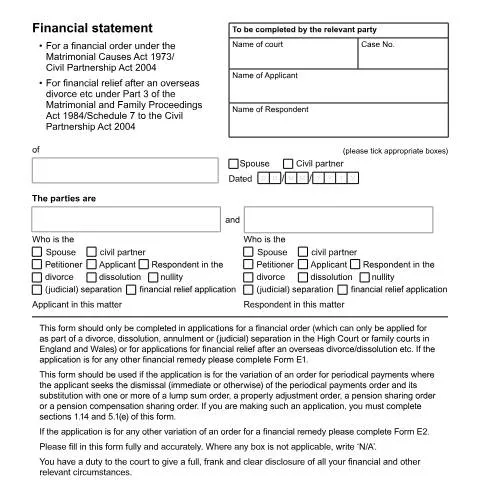
The Financial Statement for a Financial Order (commonly referred to as Form E) is an essential document used within the UK legal system, specifically under the jurisdiction of the HM Courts & Tribunals Service. It is designed to facilitate the disclosure of financial information in cases related to divorce, dissolution of civil partnerships, or applications for financial relief following overseas divorces or dissolutions.
Scope and Purpose of Form E
This form is exclusively applicable in proceedings for a financial order, which can only be initiated as part of divorce, dissolution, annulment, or judicial separation cases in the High Court or family courts in England and Wales. It is also used when requesting financial relief after an overseas divorce or civil partnership dissolution, under specific legal provisions.
The primary purpose of Form E is to provide a comprehensive, accurate, and transparent account of an individual's financial circumstances. This disclosure is crucial for the court to make informed decisions regarding financial arrangements, including property division, maintenance payments, pensions, and other financial remedies.
Who Should Complete Form E?
Parties involved in family law proceedings who seek financial orders are required to complete this form. This includes:
- The applicant or petitioner seeking financial relief or a variation of existing orders.
- The respondent or respondent in the case, providing their financial details.
It is important to note that this form is not used for other types of financial remedies outside the scope of divorce or civil partnership proceedings. For alternative applications, other forms such as Form E1 or Form E2 may be required.
Key Components of the Form
Form E is structured into several sections, each requiring detailed information:
Part 1: Personal and Family Details
- Full name, date of birth, occupation, and marital status.
- Details of children, including their ages, living arrangements, and educational considerations.
- Information about any health issues affecting the applicant or children.
- Details of current and future living arrangements, including whether the applicant lives with a new partner and their intentions.
Part 2: Financial Assets and Liabilities
This section requires comprehensive disclosure of all assets, liabilities, and financial interests, including:
- Real property, such as the family home or other land and buildings, with details of ownership, valuation, and mortgage information.
- Personal possessions, savings, investments, and pensions.
- Debts, loans, and other liabilities.
Supporting Documentation
Applicants must attach relevant documents to substantiate the information provided, such as:
Fill in your form directly online
No printing: type your details into the boxes of the official form, tick, then download the PDF ready to send.
- 1Type into the form boxes
- 2Tick in one click
- 3Save and download the PDF
- Property valuations, recent mortgage statements, and ownership documents.
- Bank statements, pension statements, and evidence of debts or liabilities.
Legal Obligations and Confidentiality
Completing Form E accurately and fully is a legal obligation. The form must be verified by a statement of truth, and any false or misleading information can have serious legal consequences, including allegations of contempt of court or fraud under the Fraud Act 2006.
Applicants have a duty to disclose all relevant financial information, and failure to do so may result in the court's orders being overturned or varied. The form and accompanying documents are subject to data protection laws, including the UK GDPR and the Data Protection Act 2018, ensuring the confidentiality and proper handling of personal data.
Conclusion
Form E is a vital tool in the UK family law system, enabling courts to assess financial circumstances thoroughly and fairly. Its detailed and truthful disclosure helps ensure that financial orders are just and equitable, reflecting the genuine financial position of each party. Anyone involved in proceedings requiring a financial order should prepare this form meticulously, seeking legal advice if necessary, to comply with legal requirements and facilitate a smooth resolution process.