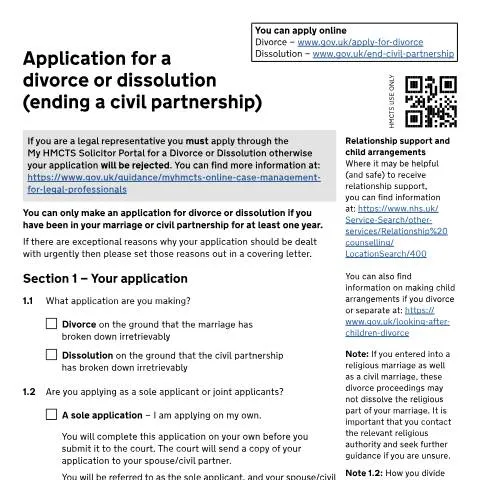
The D8 Divorce Application: Navigating the Legal Dissolution of Marriage and Civil Partnership
When a marriage or civil partnership reaches its end, the formal dissolution process begins with Form D8, the cornerstone document that initiates divorce or dissolution proceedings through HM Courts & Tribunals Service. This application serves as the legal gateway to ending a relationship that has broken down irretrievably, whether filed individually or jointly by both parties. The form's structured approach reflects the court's need for precise information whilst accommodating the emotional complexity of relationship breakdown.
The D8 application operates under the reformed divorce law system, which removed the requirement to assign blame whilst maintaining the fundamental principle that relationships must have lasted at least one year before dissolution can be sought. This threshold protects against hasty decisions whilst recognising that some marriages and civil partnerships cannot be salvaged.
Distinguishing Sole Applications from Joint Proceedings
The D8 form presents applicants with a fundamental choice that shapes the entire divorce process: pursuing a sole application or filing joint proceedings. This decision carries significant procedural implications beyond the obvious difference in cooperation levels.
In sole applications, the applicant completes the entire form independently before submission. The court subsequently serves a copy on the respondent spouse or civil partner, who receives formal notice of the proceedings. This approach suits situations where one party initiates divorce proceedings without prior agreement from their partner, or where communication has broken down completely. The terminology reflects this dynamic: the person filing becomes the "sole applicant" whilst their spouse becomes the "respondent."
Joint applications require both parties to collaborate on completing the D8 form before submission. Here, both individuals become co-applicants, designated as "applicant 1" and "applicant 2." The second applicant must complete Section 3 and provide their own statement of truth, demonstrating genuine mutual consent rather than mere acquiescence. This collaborative approach often signals that both parties have reached agreement about ending their relationship and may indicate smoother proceedings ahead.
| Application Type | Completion Method | Court Service | Typical Scenarios |
|---|---|---|---|
| Sole Application | Individual completion | Court serves respondent | Communication breakdown, unilateral decision |
| Joint Application | Collaborative completion | No service required | Mutual agreement, amicable separation |
The choice between sole and joint applications does not affect financial arrangements or property division, which require separate proceedings. The form explicitly notes that financial matters are "dealt with separately," preventing applicants from conflating divorce proceedings with monetary settlements.
Documentary Requirements and Certificate Verification
The D8 application demands specific documentary evidence that proves the legal existence of the marriage or civil partnership being dissolved. The court requires either the original marriage or civil partnership certificate or a certified copy from the registering authority. Standard photocopies are explicitly rejected, reflecting the court's need for authenticated documentation in legal proceedings.
For marriages and civil partnerships registered in England and Wales, replacement certificates can be ordered through the General Register Office at www.gro.gov.uk. Each certificate copy incurs a fee, and applicants should factor processing time into their divorce timeline. The form acknowledges that urgency may sometimes require flexibility: in exceptional circumstances, applicants can request permission to submit certificates at a later date using Form D11 application notice.
International marriages present additional complexity. When the original certificate appears in a foreign language, applicants must provide a certified translation. This translation must be either certified by a notary public or authenticated through a statement of truth by the translator. The court will not accept informal translations, regardless of the translator's qualifications, emphasising the legal weight carried by these documents.
The one-year minimum duration requirement applies from the date of marriage or civil partnership registration, not from when problems began. This legal threshold cannot be waived except in the most exceptional circumstances requiring urgent court intervention.
Emergency Applications and Urgent Circumstances
Whilst the standard process requires waiting one year after marriage or civil partnership, the D8 form acknowledges that exceptional situations may warrant urgent consideration. Applicants facing such circumstances must detail their reasons in a covering letter submitted alongside their D8 application.
The court evaluates emergency applications on a case-by-case basis, considering factors such as domestic violence, immigration status implications, or severe financial hardship. However, the threshold for proving "exceptional reasons" remains deliberately high, preventing routine circumvention of the one-year rule.
Personal Information Management and Confidentiality Protections
Section 2 of the D8 form addresses personal details with careful attention to safety and privacy concerns. Applicants can request that their contact details remain confidential from their spouse or civil partner, a provision particularly valuable in cases involving domestic abuse or harassment.
When confidentiality is requested, the court implements protective measures to prevent disclosure of the applicant's address and contact information. This safeguarding extends beyond the immediate divorce proceedings, recognising that relationship breakdown can create ongoing safety risks for vulnerable parties.
The form requires a UK address for service of documents, though business addresses are acceptable alternatives to home addresses. Applicants living overseas face additional complexity, as different rules govern international service of legal documents. The form wisely suggests seeking legal advice for such situations, acknowledging the procedural complications that can arise.
Name Changes and Identity Documentation
The D8 form accommodates the reality that individuals may use different names during and after marriage. Applicants can use their married name, birth name, or a double-barrelled combination, provided they explain any discrepancies with their marriage certificate.
Name changes occurring after marriage require supporting documentation such as change of name deeds or statutory declarations. The court needs this evidence to maintain accurate records and ensure proper identification throughout proceedings. Simple explanations may suffice for straightforward situations, but formal documentation provides clearer evidence of identity changes.
Legal Representation and Professional Obligations
The D8 form distinguishes between self-representing individuals and those with legal representation, imposing different procedural requirements on each group. Legal representatives must use the My HMCTS Solicitor Portal for divorce and dissolution applications, with paper submissions facing automatic rejection.
This digital requirement reflects the court system's modernisation efforts whilst ensuring legal professionals utilise appropriate channels for case management. The portal provides solicitors with enhanced case tracking capabilities and streamlined communication with court staff.
Self-representing applicants retain the option to file paper D8 forms or use the online divorce service at www.gov.uk/apply-for-divorce for marriages or www.gov.uk/end-civil-partnership for civil partnerships. The online service offers guided completion assistance and immediate validation of required information, potentially reducing processing delays.
Solicitor Information Requirements
When legal representation is involved, the D8 form captures essential details including the solicitor's name, reference number, and firm details. This information enables court communication with legal representatives rather than directly with applicants, streamlining case management whilst ensuring proper professional oversight.
The solicitor's reference number, whilst optional, aids in case tracking and file management within legal firms. Large practices handling multiple divorce cases benefit from this systematic approach to case identification and progress monitoring.
Religious Marriage Considerations and Parallel Proceedings
The D8 form includes a crucial warning about religious marriages that highlights a common misunderstanding among divorcing couples. Civil divorce proceedings may not automatically dissolve the religious aspects of marriage, leaving individuals technically married within their faith community despite legal divorce.
This distinction proves particularly significant for individuals belonging to religious communities with specific divorce requirements or prohibitions on remarriage for divorced persons. The form explicitly advises contacting relevant religious authorities for guidance, acknowledging that civil and religious law operate independently.
For Jewish couples, this might involve obtaining a get (religious divorce document). Muslim couples may need to navigate khula or mubarat procedures. Christian denominations vary in their recognition of civil divorce, with some requiring separate ecclesiastical proceedings. The D8 form's acknowledgment of these parallel systems demonstrates sensitivity to diverse religious practices whilst clarifying the limits of civil court jurisdiction.
Financial Applications and Cost Recovery Procedures
The D8 form explicitly separates divorce proceedings from financial arrangements, emphasising that property division and spousal support require separate legal action. This separation prevents applicants from assuming that divorce automatically resolves all relationship-related legal issues.
Cost applications must be filed using Form D11 application notice, available through government publications. This separate procedure allows one party to seek recovery of legal costs from the other, though success depends on specific circumstances and court discretion.
The form's emphasis on taking legal advice regarding financial matters reflects the complexity of property division, pension sharing, and spousal maintenance. These issues often prove more contentious and financially significant than the divorce itself, requiring specialist legal expertise to navigate effectively.
| Issue | Form Required | Timing | Court Consideration |
|---|---|---|---|
| Divorce/Dissolution | D8 Application | After 1 year minimum | Irretrievable breakdown |
| Financial Settlement | Separate application | During or after divorce | Fair division principles |
| Cost Recovery | D11 Application Notice | Within proceedings | Discretionary award |
Support Services and Child Arrangement Guidance
Recognising that divorce affects entire families, the D8 form provides signposting to relationship support services and child arrangement resources. The inclusion of NHS relationship counselling services acknowledges that some relationships might be salvageable with professional intervention.
The form's reference to safety considerations when accessing relationship support demonstrates awareness that domestic abuse situations require careful handling. Not all relationships are suitable for counselling or mediation, particularly where power imbalances or violence exist.
Child arrangement information directs divorcing parents toward resources for maintaining stable relationships with their children. The court system recognises that parental divorce creates significant disruption for children, and early access to guidance can prevent long-term emotional damage and reduce future legal disputes over contact and residence.
The Broader Legal Framework
The D8 application operates within the reformed divorce law system that eliminated fault-based grounds whilst maintaining judicial oversight of relationship dissolution. This balance between simplified procedures and legal safeguards reflects Parliament's intention to reduce conflict whilst preserving marriage as a legal institution requiring formal dissolution.
The form's structure reflects procedural efficiency goals whilst accommodating diverse personal circumstances. From straightforward mutual divorces to complex cases involving international elements, domestic abuse, or urgent circumstances, the D8 provides a flexible framework for initiating formal relationship dissolution.
Understanding the D8 application's role within the broader family court system helps applicants navigate divorce proceedings more effectively. Whilst the form itself initiates the process, successful completion requires careful attention to documentation requirements, procedural rules, and the distinction between divorce and related financial or child arrangement proceedings.
Special Circumstances and Complex Cases
Whilst Form D8 covers most standard divorce scenarios, certain circumstances require additional consideration or alternative approaches. Understanding these complexities can prevent delays and ensure you follow the correct procedure for your specific situation.
When Your Spouse Cannot Be Located
If you cannot locate your spouse to serve divorce papers, you'll need to demonstrate to the court that you've made reasonable efforts to find them. This involves more than a simple internet search. The court expects evidence of attempts including:
- Contacting last known employers through official channels
- Reaching out to mutual friends, family members, or former neighbours
- Checking with HM Revenue and Customs (though they won't provide addresses directly)
- Searching through professional bodies if your spouse held professional qualifications
- Examining social media platforms and professional networking sites
You'll need to file a Statement of Search (Form D13B) alongside Form D8, detailing every step you've taken. If the court accepts your evidence, they may grant permission for alternative service methods, such as placing a notice in a newspaper your spouse might reasonably see, or serving papers on a family member.
Divorce Involving Mental Capacity Issues
When your spouse lacks mental capacity to understand divorce proceedings, additional safeguards apply under the Mental Capacity Act 2005. You cannot simply proceed with Form D8 as normal. Instead, you must:
- Provide medical evidence of your spouse's incapacity from a qualified practitioner
- Notify the Court of Protection, which may appoint a litigation friend
- Ensure any appointed litigation friend receives all court documents
- Consider whether your spouse has an existing Lasting Power of Attorney for welfare decisions
The court will scrutinise these cases particularly carefully to protect the interests of the person lacking capacity. Proceedings typically take longer, and you may need additional legal representation to navigate the requirements properly.
International Elements and Jurisdiction
Form D8 includes specific questions about domicile and residence because not all marriages can be dissolved in English courts. The court must have jurisdiction, which generally requires:
- Both parties being domiciled in England and Wales, or
- Both parties being habitually resident in England and Wales for at least one year before the application, or
- Either party being domiciled in England and Wales and habitually resident for at least one year, or
- Either party being habitually resident in England and Wales for at least two years before the application
Post-Brexit, different rules may apply to marriages involving EU citizens, depending on when you married and where you've lived. If your marriage was celebrated abroad, you'll need to provide certified translations of foreign marriage certificates, properly apostilled if from non-Commonwealth countries.
Be particularly careful if divorce proceedings might be starting in another country simultaneously, as this can create complex legal conflicts requiring specialist advice.
Financial Implications During Divorce Proceedings
Filing Form D8 triggers more than just the legal dissolution of your marriage—it sets in motion a process that can significantly impact your financial situation. Understanding these implications helps you make informed decisions throughout the proceedings.
Fill in your form directly online
No printing: type your details into the boxes of the official form, tick, then download the PDF ready to send.
- 1Type into the form boxes
- 2Tick in one click
- 3Save and download the PDF
Automatic Financial Restrictions
Once you've submitted Form D8, certain automatic restrictions come into effect to protect both parties' financial interests. Neither spouse can:
- Dispose of or transfer any significant assets without court permission or written agreement
- Take out substantial loans using jointly owned property as security
- Cancel or surrender life insurance policies where the other spouse is a beneficiary
- Remove children from any existing private health or education schemes
These restrictions remain in place until decree absolute is granted or the court makes alternative orders. Breaching them can result in serious consequences, including being held in contempt of court.
Pension Considerations
Form D8 asks whether you intend to make a claim against your spouse's pension arrangements. This isn't just about immediate pension income—it covers all pension rights accrued during the marriage, including:
- Occupational pension schemes from current or former employers
- Personal pension plans and SIPPs (Self-Invested Personal Pensions)
- State pension entitlements and additional state pension
- Pension credits and protected rights from previous transfers
Pension sharing orders can only be made during divorce proceedings—you cannot return to court later to claim against pensions if you didn't preserve your right to do so in Form D8. Even if you're unsure about making a claim, it's generally advisable to preserve your options by indicating "yes" to the pension question.
For public sector pensions (NHS, teachers, civil service), special rules often apply, and you'll need to obtain Cash Equivalent Transfer Values (CETVs) to understand the true worth of pension benefits.
Property and Mortgage Obligations
Joint mortgages don't automatically change when you file for divorce. Both parties remain liable for mortgage payments regardless of who continues living in the property. This can create particular difficulties if:
- One spouse moves out but remains liable for mortgage payments on a property they no longer occupy
- The remaining spouse cannot afford mortgage payments alone
- Interest rates change significantly during lengthy proceedings
- Either party wants to remortgage or release equity
Consider informing your mortgage lender about the divorce proceedings early, as they may have specific procedures or requirements. Some lenders freeze accounts or restrict changes to mortgage terms once they're aware of divorce proceedings.
Tax Implications and HMRC Considerations
Divorce affects your tax status in several ways that many people overlook. During the tax year in which your decree absolute is granted:
- You can still claim married couple's allowance for the full tax year if either spouse was born before 6 April 1935
- Capital gains tax exemptions between spouses end from the date of decree absolute
- Any property transfers must be completed before decree absolute to avoid capital gains tax
- Your entitlement to certain tax credits and benefits may change
If you're self-employed or have complex financial arrangements, consider whether your Self Assessment (SA100) needs updating to reflect changed circumstances. HMRC may need notification of address changes, especially if you're receiving tax credits or Child Benefit.
Post-Divorce Considerations and Long-term Planning
Successfully completing Form D8 and obtaining your decree absolute marks the legal end of your marriage, but several important administrative and practical steps follow. Planning for these ensures you fully benefit from your new legal status and avoid future complications.
Updating Legal Documents and Registrations
Your decree absolute certificate becomes a crucial document for updating various records and entitlements. Priority updates should include:
- DVLA records for driving licence and vehicle registration—you can change your name and address simultaneously using form D1
- Passport applications through HM Passport Office, which requires original decree absolute documentation
- Electoral register updates through your local council's registration officer
- Banking and financial institutions, including investment accounts and insurance policies
- Professional bodies and licensing authorities if you hold professional qualifications
Some organisations require certified copies rather than photocopies of your decree absolute. The court that granted your divorce can provide these for a fee, or you can obtain them later through the General Register Office.
Will and Estate Planning Revisions
Divorce automatically revokes any gifts to your former spouse in your will under section 18A of the Wills Act 1837, but this doesn't mean your will automatically reflects your new intentions. Without updating your will:
- Gifts intended for your ex-spouse may pass to alternative beneficiaries or fall into residue
- Your ex-spouse may still be named as executor, creating practical complications
- Guardianship provisions for children may need revision
- Trust arrangements and powers of appointment require review
Consider whether your divorce affects any existing trusts, particularly if you're a beneficiary or have powers of appointment. Some trust deeds contain specific provisions about divorce that could affect your entitlements.
Children's Long-term Arrangements
While Form D8 addresses immediate child arrangements, longer-term planning often requires ongoing attention. This includes:
- Reviewing child maintenance arrangements if circumstances change significantly
- Updating school emergency contacts and authorised collection arrangements
- Ensuring both parents have access to medical information and can consent to treatment
- Planning for major decisions about education, including school choices and university funding
- Considering how future life changes (remarriage, relocation, career changes) might affect arrangements
Remember that Child Arrangements Orders made during divorce can be varied later if circumstances change substantially. The court's primary concern remains the welfare of the children, so arrangements that worked immediately after divorce may need adjustment as children grow or circumstances evolve.
Future Relationship Considerations
Your decree absolute clears the way for remarriage, but consider the implications carefully:
- Pre-nuptial agreements may be advisable to protect assets acquired since your divorce
- Existing spousal maintenance orders typically end upon remarriage
- Your children's inheritance rights need consideration if you're planning to remarry
- Pension sharing arrangements from your previous marriage remain unaffected by remarriage
If you're considering cohabitation rather than remarriage, be aware that cohabiting couples have far fewer legal protections than married couples, regardless of how long the relationship lasts.
Monitoring and Enforcement of Orders
Financial orders made during your divorce don't automatically enforce themselves. You'll need to monitor compliance and take action if your ex-spouse fails to meet their obligations:
- Spousal maintenance payments can be enforced through various court mechanisms
- Property transfer orders may require follow-up action if deadlines are missed
- Pension sharing orders require active implementation with pension scheme administrators
- Lump sum orders may need enforcement proceedings if payment is delayed
Keep detailed records of all payments and compliance with court orders. If enforcement action becomes necessary, you'll need evidence of non-compliance and the steps you've taken to resolve matters directly with your ex-spouse first.
Consider whether your circumstances have changed so significantly since the original orders that variation might be appropriate. Spousal maintenance, in particular, can often be varied upward or downward based on substantial changes in either party's financial circumstances.