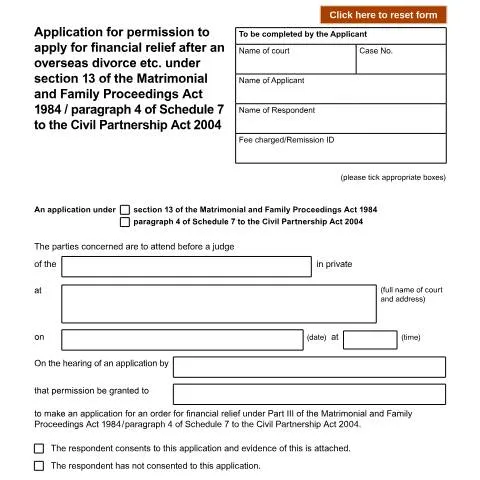
Understanding the D50E Application Form: Applying for Financial Relief Post-Overseas Divorce or Civil Partnership Dissolution in the UK
The Application for permission to apply for financial relief after an overseas divorce or civil partnership dissolution is a formal process managed by the HM Courts & Tribunals Service (HMCTS). This procedure is essential for individuals seeking to pursue financial claims within the UK legal framework following a divorce or civil partnership dissolution that occurred outside the United Kingdom. The form, designated as Form D50E, serves as an official request for judicial permission to proceed with such financial applications under specific legal provisions.
Purpose and Legal Context of the D50E Form
The primary objective of the D50E form is to obtain court approval for an applicant to initiate financial relief proceedings after an overseas divorce or civil partnership dissolution. This process is governed by two key pieces of legislation:
- Section 13 of the Matrimonial and Family Proceedings Act 1984
- Paragraph 4 of Schedule 7 to the Civil Partnership Act 2004
These statutes provide the legal framework that allows individuals to seek financial settlement or support orders from UK courts, even when the initial divorce or civil partnership termination occurred abroad. The application ensures that the UK court has the authority to hear and decide on financial matters, safeguarding the rights of parties involved.
Who Should Use the D50E Form and When
This form is intended for applicants who:
- Have undergone a divorce or civil partnership dissolution outside the UK;
- Wish to pursue financial relief claims within the UK jurisdiction;
- Require the court's permission to proceed with such claims under the relevant legal provisions.
It is particularly relevant in cases where the overseas dissolution was not recognized automatically for financial purposes in the UK, or where the applicant seeks to enforce or modify financial arrangements through UK courts.
Key Components and Procedure for Submission
Details Required in the Application
The applicant must provide essential information, including:
- Name of the court where the application is filed;
- Case number assigned to the proceedings;
- Full name of the applicant and respondent;
- Details of any fees charged or remission status;
- Indication of whether the respondent consents to the application;
- Date and time of the court hearing;
- Full address of the applicant’s solicitor, if represented.
Legal and Procedural Considerations
The applicant must attend a court hearing, which may be in private, to seek permission for the subsequent financial relief application. During this hearing, the judge will consider whether the conditions for granting permission are met, based on the information provided and the circumstances of the case.
If the respondent consents, this is documented and attached to the application. Conversely, if there is no consent, the court will proceed with a hearing to determine whether permission should be granted.
Fill in your form directly online
No printing: type your details into the boxes of the official form, tick, then download the PDF ready to send.
- 1Type into the form boxes
- 2Tick in one click
- 3Save and download the PDF
Implications for Applicants and Legal Practitioners
Obtaining permission via the D50E form is a crucial step in the process of pursuing financial claims following an overseas divorce or civil partnership dissolution. It ensures that the applicant’s case is formally recognized and that the court has jurisdiction to hear the matter. For legal practitioners, accurate completion and timely submission of this form are essential to facilitate the subsequent financial proceedings.
Failure to secure this permission may result in the applicant being unable to enforce financial claims through UK courts, potentially affecting their financial rights and obligations.
Summary
The D50E application form is a procedural tool designed to bridge the legal gap between overseas family law decisions and UK financial relief proceedings. It ensures that applicants can seek justice and enforce financial claims within the UK legal system following international family law cases. Understanding the purpose, requirements, and process associated with this form is vital for individuals and legal professionals involved in post-overseas divorce or civil partnership dissolution financial applications.