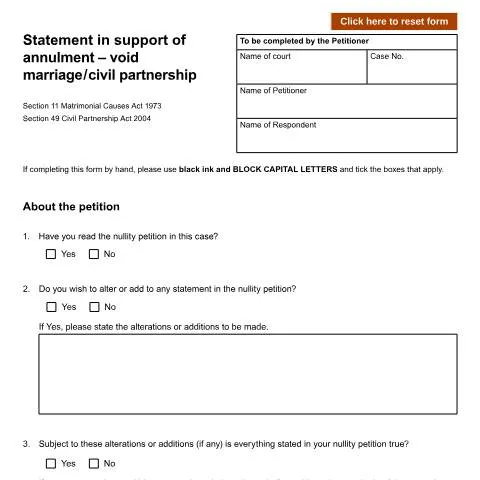
When Legal Foundations Crumble: The D80F Statement for Void Marriage Annulments
Marriage is meant to be a secure legal foundation, but sometimes that foundation proves to have been built on quicksand from the very beginning. When a marriage or civil partnership is declared void under English law, it means the union never legally existed at all—a fundamentally different concept from divorce or dissolution. The Form D80F Statement in support of annulment - void marriage/civil partnership serves as the petitioner's sworn declaration that underpins this profound legal assertion before HM Courts & Tribunals Service.
Unlike divorce proceedings that acknowledge a valid marriage has broken down, annulment proceedings assert that no valid marriage ever came into being. This distinction carries far-reaching implications for financial arrangements, inheritance rights, and the legal status of any children born during the union. The D80F form represents the petitioner's moment to crystallise their case before the court, transforming what might appear to be a straightforward administrative exercise into a document of considerable legal weight.
The Void Marriage Landscape: Understanding Section 11 and Section 49
The D80F form operates within the framework of two key pieces of legislation: Section 11 of the Matrimonial Causes Act 1973 for marriages and Section 49 of the Civil Partnership Act 2004 for civil partnerships. These sections define the narrow circumstances under which a marriage or civil partnership can be declared void, as opposed to voidable.
A void marriage is one that was never legally valid from the outset. The grounds are strictly limited and include situations where:
- The parties are within the prohibited degrees of relationship (too closely related)
- Either party was under the age of 16 at the time of the ceremony
- The marriage has not been duly solemnised according to legal requirements
- The parties have intermarried in disregard of certain requirements as to the formation of marriage
- At the time of the marriage, either party was already lawfully married or in a civil partnership
For civil partnerships, similar principles apply under Section 49, with the added complexity that the Civil Partnership Act 2004 introduced its own specific formalities and requirements. The D80F form must address whichever legislative framework applies to the particular union being challenged.
The Critical Distinction: Void vs Voidable
Understanding the difference between void and voidable marriages is crucial when completing Form D80F. A void marriage never existed legally, whilst a voidable marriage was valid until annulled. This distinction affects everything from the evidence required to the potential defences available to the respondent.
Void marriages require different forms and follow different procedural paths. The D80F specifically addresses void marriages and civil partnerships, meaning the petitioner must be confident that their circumstances fall within the strict statutory criteria for voidness rather than voidability.
Navigating the D80F: A Section-by-Section Analysis
The D80F form follows a logical progression that mirrors the court's analytical approach to void marriage cases. Each section serves a specific evidentiary purpose, building towards the petitioner's final request for annulment.
The Foundation: Questions 1-3 About the Petition
The opening questions establish the petitioner's relationship with their own nullity petition. Question 1 asks whether the petitioner has read their petition—seemingly obvious, but legally significant as it confirms personal knowledge of the case being advanced. Question 2 allows for amendments or additions, acknowledging that circumstances may have evolved or clarified since the original petition was filed.
Question 3 requires the petitioner to confirm the truth of their petition's contents, with an important caveat about statements not within personal knowledge. This distinction is crucial in void marriage cases, where some facts (such as the legal requirements for valid marriage ceremonies) may be matters of law rather than personal experience.
| Question | Purpose | Key Considerations |
|---|---|---|
| Question 1 | Confirms petition awareness | Establishes personal responsibility for case content |
| Question 2 | Allows petition modifications | Opportunity to strengthen or clarify the case |
| Question 3 | Verifies petition accuracy | Distinguishes personal knowledge from belief |
The Respondent's Acknowledgement: Signature Identification
A critical section of the D80F addresses the respondent's acknowledgement of service. If the respondent has personally signed their acknowledgement, the petitioner must attach a copy and identify the signature as genuinely belonging to their spouse or civil partner. This requirement serves multiple purposes: it confirms service has been properly effected, establishes the respondent's awareness of proceedings, and provides authentication of the respondent's identity.
The form specifically exempts cases where a solicitor has signed on behalf of the respondent, recognising the different evidentiary weight of professional representation versus personal acknowledgement.
The Statement of Truth: Legal Weight and Consequences
The Statement of Truth section transforms the D80F from a simple administrative form into a document carrying the full weight of court proceedings. By signing this section, the petitioner makes a formal declaration that could result in contempt of court proceedings if found to contain false statements.
This is not merely a bureaucratic formality. Contempt of court is a serious matter that can result in imprisonment, unlimited fines, or both. The warning at the bottom of the form serves as a stark reminder that family court proceedings, even those that might seem straightforward, operate within the full framework of judicial authority.
The Statement of Truth must be signed personally by the petitioner, not by their solicitor or representative. This personal responsibility reflects the court's recognition that annulment proceedings can have profound personal and financial consequences that extend far beyond the immediate parties.
Procedural Context: Where D80F Fits in Annulment Proceedings
The D80F form does not exist in isolation but forms part of a carefully structured legal process. It typically follows the initial nullity petition and the respondent's acknowledgement of service, serving as the petitioner's opportunity to confirm and potentially strengthen their case before the court considers whether to grant the annulment.
The Chronological Framework
Understanding when to complete and file Form D80F requires appreciation of the broader procedural timeline:
- Initial petition filed: The nullity petition sets out the grounds for claiming the marriage or civil partnership is void
- Service on respondent: The respondent must be formally notified of the proceedings
- Acknowledgement of service: The respondent confirms receipt and may indicate whether they intend to defend
- D80F filing: The petitioner files their statement in support, often alongside an application for decree nisi/conditional order
- Court consideration: The court reviews all documentation before deciding whether to grant the annulment
The timing of D80F submission can be crucial. Courts expect petitioners to file their supporting statement promptly after receiving the respondent's acknowledgement, particularly in undefended cases where expedition is often possible.
Defended vs Undefended Cases
The D80F form's significance varies considerably depending on whether the respondent intends to defend the proceedings. In undefended cases, the D80F may be the court's primary source of evidence supporting the annulment claim. The court will scrutinise the form carefully, as it represents the petitioner's final opportunity to present their case without oral evidence.
In defended cases, the D80F serves more as a foundation document, with the expectation that further evidence will emerge through the defence process. However, any inconsistencies between the D80F and later evidence can significantly undermine the petitioner's credibility.
Financial Implications and Cost Orders
The D80F form includes provision for the petitioner to seek a costs order against the respondent, reflecting the potential financial dimensions of annulment proceedings. This is not automatic—the petitioner must have specifically applied for costs in their original nullity petition to make this request in the D80F.
Cost considerations in void marriage cases can be particularly complex. Unlike divorce proceedings, where both parties typically bear their own costs unless exceptional circumstances apply, annulment cases may justify different approaches depending on the grounds for voidness and the respondent's conduct.
When Costs Orders May Be Appropriate
Courts may be more willing to make costs orders in void marriage cases where:
- The respondent was aware of impediments to valid marriage but proceeded anyway
- The respondent has unreasonably defended proceedings despite clear evidence of voidness
- The respondent's conduct has unnecessarily prolonged proceedings
However, petitioners should be aware that seeking costs can sometimes encourage defensive behaviour from respondents who might otherwise have allowed proceedings to progress undefended.
Common Challenges and Strategic Considerations
Completing Form D80F effectively requires careful attention to several potential pitfalls that can compromise annulment proceedings.
Evidence and Documentation
The most significant challenge in void marriage cases often lies in assembling sufficient evidence to prove the grounds for voidness. The D80F form itself provides limited space for detailed evidence, so petitioners must ensure their original petition was comprehensive and that any additional evidence is properly referenced.
Documentary evidence is typically crucial in void marriage cases. Marriage certificates, birth certificates, evidence of previous marriages, or documentation of ceremonial defects may all be relevant depending on the specific grounds being pursued.
Timing and Limitation Considerations
Unlike voidable marriages, void marriages can theoretically be challenged at any time, as they never legally existed. However, practical considerations around evidence preservation, witness availability, and the interests of any children can make timing strategically important.
The D80F form must be filed within specific timeframes set by court rules, typically linked to the respondent's acknowledgement of service. Missing these deadlines can result in the need for applications to extend time, adding cost and complexity to proceedings.
Post-Filing Procedures and Court Scrutiny
Once filed, Form D80F becomes part of the court record and subject to judicial scrutiny. The court's approach to reviewing D80F forms has evolved to balance efficiency with thoroughness, particularly given the legal significance of annulment decrees.
District Judges reviewing D80F forms typically focus on consistency between the form and the original petition, adequacy of evidence for the claimed grounds of voidness, and proper compliance with procedural requirements. Where deficiencies are identified, the court may request additional evidence or, in some cases, list the matter for a hearing.
The Path to Decree Absolute
Successful D80F submissions in undefended cases often lead directly to the grant of decree nisi (or conditional order for civil partnerships). However, the petitioner must still apply for decree absolute, which finally dissolves the legal relationship—or in void marriage cases, formally declares that no legal relationship ever existed.
This final step carries particular significance in void marriage cases, as it provides definitive legal clarity about the parties' status from the date of the original ceremony onwards. The decree absolute in void marriage cases operates retrospectively, confirming that the purported marriage or civil partnership was invalid from its inception rather than from the date of the decree.
Documentary Evidence and Supporting Materials for Form D80F
Successfully completing Form D80F requires careful assembly of documentary evidence that substantiates your grounds for annulment. The nature of evidence varies significantly depending on whether you're claiming the marriage or civil partnership is void or voidable, and the specific circumstances that render it invalid.
For void marriages based on prohibited degrees of relationship, you'll need to provide comprehensive family documentation. Birth certificates, adoption records, or family tree documentation may be required to demonstrate the familial connection that renders the marriage void under the Marriage Act 1949 or Civil Partnership Act 2004. When dealing with cases involving step-relationships or adoptive relationships, ensure you have both the original birth certificates and any relevant adoption orders or court documents that establish the legal family structure.
If your annulment claim centres on one party being under the legal age at the time of the ceremony, gather all relevant age-verification documents. This includes birth certificates, passports, or other official identification that clearly shows the date of birth. For marriages that took place abroad where different age requirements may have applied, you may need to obtain certified translations of foreign birth certificates and provide evidence of the legal marriage age requirements in the country where the ceremony occurred.
Cases involving lack of proper formalities require meticulous documentation of the ceremony itself. Obtain copies of the marriage certificate or civil partnership certificate, along with any correspondence with the registration authority. If the ceremony was conducted by someone not authorised to perform marriages or civil partnerships, gather evidence of their lack of authority at the time. This might include correspondence with religious organisations, local authorities, or professional bodies that can confirm the officiant's status on the specific date.
For annulments based on lack of capacity due to mental incapacity, medical evidence becomes crucial. Hospital records, psychiatric assessments, or GP notes from around the time of the ceremony can support your claim. However, be aware that medical confidentiality rules apply, and you may need to obtain proper consent or court orders to access some medical records. If the incapacity was temporary due to intoxication or medication, witness statements and any available medical records showing treatment or medication schedules around the ceremony date will be relevant.
Fill in your form directly online
No printing: type your details into the boxes of the official form, tick, then download the PDF ready to send.
- 1Type into the form boxes
- 2Tick in one click
- 3Save and download the PDF
When fraud or misrepresentation forms the basis of your annulment claim, compile all evidence of the deception. This might include correspondence, photographs, financial records, or witness statements that demonstrate the false representations made. For cases involving concealed previous marriages or civil partnerships, obtain official records from the relevant registration authorities. If the fraud involved false identity, gather documentation that proves the person's true identity and any evidence of the deception.
Duress claims require evidence of the pressure or coercion applied. This might include witness statements from family members or friends who observed the pressure, medical records showing stress-related illness, or any written communications that demonstrate the threats or coercion. In cases involving cultural or family pressure, statements from community leaders or cultural advisors may help explain the context and severity of the pressure applied.
Procedural Considerations and Court Interactions During D80F Processing
The submission of Form D80F initiates a formal court process that follows specific procedural rules under the Family Procedure Rules 2010. Understanding these procedures helps ensure your application progresses smoothly through the court system and avoids common delays or complications.
Once your D80F is submitted, the court will review the application for completeness and legal sufficiency. The court staff will check that all mandatory sections are completed, required documents are attached, and the appropriate fee has been paid or fee remission granted. If any elements are missing or unclear, you'll receive a notice requesting additional information or corrections. This initial review typically takes 2-3 weeks, though this can vary depending on court workload and the complexity of your case.
The court will then consider whether your statement provides sufficient grounds for annulment under English law. This isn't a full hearing but rather an assessment of whether your claimed grounds could potentially succeed if proven. If the court identifies legal issues with your grounds, you may receive a request for clarification or additional legal argument. Some applicants find it helpful to include brief legal references in their D80F statement, though this isn't mandatory for non-legally represented applicants.
Following the initial review, the court will issue directions for service of the annulment petition on your spouse or civil partner. The D80F statement forms part of the documentation that must be served, so accuracy and completeness at this stage are crucial. Once service is completed, your spouse or civil partner has a specified time limit to respond, typically 8 days if served within England and Wales, or longer if served abroad or if they seek an extension.
If your spouse or civil partner contests the annulment, the case may proceed to a contested hearing where your D80F statement will be scrutinised in detail. The court may require you to give oral evidence expanding on the written statement, and you should be prepared to answer detailed questions about the circumstances you've described. Cross-examination by your spouse's legal representative is possible in contested cases, making the accuracy and honesty of your D80F statement paramount.
In some cases, the court may order a case management hearing before any final hearing. This allows the judge to give directions about evidence, set timetables, and identify the key issues in dispute. Your D80F statement helps inform these directions, as it outlines your case and the evidence you intend to rely upon. Be prepared that the court may order additional evidence or expert reports based on the issues raised in your statement.
The court has discretionary powers to make interim orders during the annulment process. If your D80F statement raises concerns about financial arrangements, child welfare, or domestic abuse, the court may make temporary orders pending the final determination. Clearly explaining any urgent circumstances in your statement can help the court understand whether interim relief might be necessary.
Common Challenges and Practical Solutions When Completing D80F
Completing Form D80F presents several recurring challenges that applicants frequently encounter. Understanding these common pitfalls and practical solutions can significantly improve the quality of your application and reduce the likelihood of delays or complications.
One of the most frequent difficulties involves articulating complex personal circumstances within the structured format of the form. Many applicants struggle to convey the full context of their situation within the space constraints, particularly when multiple factors contribute to their annulment claim. The key is to focus on legally relevant facts rather than emotional or background details, however important they may seem personally. Structure your narrative chronologically where possible, and use clear, factual language rather than subjective interpretations or conclusions.
Language barriers can create significant challenges, particularly for applicants whose first language isn't English or who are dealing with events that occurred in other countries. While the court doesn't provide translation services, you may need to obtain certified translations of foreign documents or seek assistance from qualified translators for complex legal terminology. Some applicants benefit from having their completed D80F reviewed by someone fluent in legal English, though this person shouldn't complete the form on your behalf.
Gathering historical evidence presents another common challenge, especially for marriages or civil partnerships that occurred many years ago. Witnesses may have moved away or died, documents may be lost or destroyed, and memories may have faded. Start evidence gathering as early as possible, and consider alternative sources of information. For example, if original witnesses are unavailable, consider whether other family members or friends have relevant knowledge. Local archives, religious organisations, or community groups may hold records that could support your case.
Dealing with uncooperative former spouses or civil partners can complicate evidence gathering. If your former partner holds crucial documents or information, you may need to consider formal disclosure applications or seek the court's assistance in obtaining evidence. Document any attempts to obtain information voluntarily, as this demonstrates your reasonable efforts to the court. In extreme cases, the court has powers to draw adverse inferences from a party's failure to cooperate with reasonable requests for information.
Financial constraints often limit applicants' ability to obtain professional legal assistance, yet the complexity of annulment law can make self-representation challenging. Many courts offer limited legal advice services, and some areas have law centres or citizens' advice bureaux with family law expertise. Online resources from organisations like Citizens Advice or the Family Law legal aid charity provide guidance, though they can't replace individualised legal advice for complex cases.
Emotional difficulties in recounting traumatic or distressing events can make completing the D80F particularly challenging. Take breaks when needed, and consider whether having a trusted friend or family member present for support might help. However, ensure that any assistance doesn't compromise the accuracy or authenticity of your statement. The court understands that annulment cases often involve difficult personal circumstances, and a straightforward, honest account is more valuable than an overly polished narrative.
Technical issues with document preparation can cause unnecessary delays. Ensure all pages are clearly legible, properly numbered, and securely attached. If handwriting the form, use black ink and write clearly. For typed submissions, standard fonts and formatting make the document easier to process. Keep copies of everything you submit, and consider using recorded delivery for important documents to ensure they reach the court safely.
Timing considerations often create pressure for applicants, particularly when other legal proceedings or personal circumstances create urgency. While it's important to submit your D80F as soon as reasonably possible, rushing the completion can lead to errors or omissions that cause more significant delays later. Plan your evidence gathering systematically, and don't hesitate to contact the court if you need clarification about deadlines or procedures.