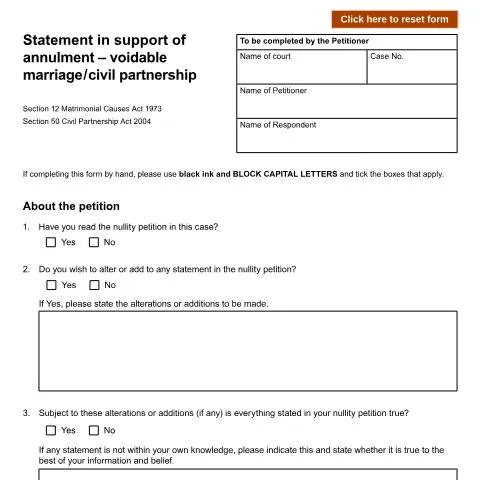
Understanding Form D80G: The Statement in Support of Annulment
The Form D80G plays a critical role in legal proceedings surrounding the annulment of a voidable marriage or civil partnership in the UK. This form is particularly tailored for petitioners who seek to support their annulment petition by providing additional details regarding the circumstances surrounding their marriage or partnership. Understanding its nuances is essential for anyone navigating this complex area of law.
The Legal Framework: Matrimonial Causes Act and Civil Partnership Act
The foundations for the annulment process are grounded in the Matrimonial Causes Act 1973 and the Civil Partnership Act 2004. These acts stipulate the grounds under which a marriage or civil partnership may be annulled, essentially declaring it null and void. A voidable marriage or civil partnership is one that is valid until annulled by court order. The Form D80G specifically addresses situations where the petitioner's claim is based on one of the legally defined grounds for annulment.
In particular, Section 12 of the Matrimonial Causes Act 1973 lays out various facts that justify nullity, including situations where one party did not genuinely consent to the marriage or civil partnership, or was suffering from mental incapacity at the time of the union. Understanding these legal underpinnings is crucial for accurately completing the D80G form.
Who Should File Form D80G: Profiles of Petitioners
The D80G form is required for petitioners who wish to annul a voidable marriage or civil partnership based on specific grounds. Potential petitioners may include:
- Individuals unaware of critical information: Those who may have discovered after the ceremony that their partner was suffering from a communicable disease or was pregnant by another person.
- Parties unable to give valid consent: Individuals whose partners were under mental incapacity or otherwise unable to consent during the wedding or partnership registration.
- Transgender individuals: Those who have transitioned and need to address the implications of their partner’s gender status at the time of the marriage or civil partnership.
Each of these circumstances can affect how the form is completed, which emphasises the need for precise information and understanding of personal situations.
Deconstructing the Form: Key Sections and Common Pitfalls
The D80G form comprises several sections that require clarity and honesty. Below, we explore its main sections and highlight common areas where petitioners may falter:
Initial Information
The form begins with basic details including the name of the court, case number, and the names of both the petitioner and respondent. It’s essential to ensure that all names are spelled correctly and that the details are consistent with other legal documents.
Petition Review and Statements
In this section, you are asked whether you have read and understood the nullity petition and if you wish to make any alterations. Miscommunication in this area can lead to complications, so it’s advisable to review the petition thoroughly before answering. The question of truthfulness regarding the statements made in the petition is pivotal; any inaccuracies can undermine the integrity of your claim.
Awareness of Alleged Facts
Petitioners must specify when they became aware of the alleged facts supporting their annulment claim. This retrospective assessment is crucial for establishing timelines that align with legal requirements.
Living Arrangements Post Wedding
This section explores whether the petitioner and respondent lived together after the marriage, including details of accommodation arrangements. Precision in dates and living conditions is necessary, as it helps the court assess the relationship dynamics and separation circumstances.
Grounds for Nullity
Here, petitioners must indicate whether they were aware of specific facts at the time of the union that could invalidate the marriage or civil partnership. Clarity in this area is vital, particularly around sensitive topics like communicable diseases or mental incapacity. Misinterpretation could invalidate the petition.
A Detailed Timeline: From Petition to Court Decision
Understanding the timeline for filing and processing the D80G form is essential for all petitioners. The key stages include:
- Filing the Petition: The annulment petition must be filed within a specific timeframe, typically three years from the date of the marriage or civil partnership.
- Completing the D80G Form: This usually happens shortly after filing the annulment petition, as both documents are interconnected.
- Providing Further Evidence: If applicable, additional evidence supporting the claims made in the annulment petition should be gathered and submitted.
- Court Hearing: The court will schedule a hearing, allowing both parties to present their cases. The timeline may vary depending on court availability.
- Decision Issuance: After the hearing, the court will issue its decision, which may include an annulment order.
Monitoring this timeline ensures that all necessary steps are completed promptly, preventing unnecessary delays in the annulment process.
Administrative Processing: Navigating the Bureaucracy
After submission, the Form D80G enters the administrative processing phase. Understanding how to effectively track your application is paramount. Here’s how to stay abreast of proceedings:
- Contact the Court: Regular follow-ups with the court where the petition was filed can provide updates on the status of your application.
- Documentation Tracking: Maintain copies of all submitted documents, including the D80G form, as well as any receipts or confirmations received.
- Prepare for Court Appearance: If required, be ready to present further evidence or statements during the court hearing.
Essential Documentation: Preparing Your Case
The successful processing of the Form D80G hinges on the availability of adequate supporting documentation. Depending on the circumstances surrounding the annulment, petitioners should gather:
- Proof of Marriage/Civil Partnership: Original marriage or civil partnership certificate.
- Medical Evidence: Documentation supporting claims regarding health issues, including any relevant diagnoses or statements from healthcare professionals.
- Correspondence: Any emails or letters that may support claims about the relationship and circumstances leading up to the annulment petition.
Organising these documents before submission can streamline the process and enhance the strength of the annulment application.
Final Steps: What Comes After Submission?
Once the D80G form is submitted and the annulment petition is filed, several outcomes may arise:
- Annulment Granted: If the court finds valid grounds for annulment, a decree will be issued, officially nullifying the marriage or civil partnership.
- Further Court Orders: The court may also order costs to be paid by one party, depending on the circumstances surrounding the annulment.
- Appeal Process: If the decision is contested, petitioners may pursue an appeal, leading to additional legal proceedings.
Understanding these potential outcomes can prepare petitioners for the various paths their applications may take.
Understanding the Grounds for Annulment in Voidable Marriages and Civil Partnerships
Annulment serves as a formal declaration that a marriage or civil partnership is null and void, meaning it was never legally valid. In the UK, voidable marriages and civil partnerships can be annulled based on specific grounds outlined in the Matrimonial Causes Act 1973 and the Civil Partnership Act 2004. It’s crucial to understand these grounds to determine whether you might qualify for an annulment under Form D80G.
The essential grounds for annulment include:
- Lack of Consent: If one party did not freely consent to the marriage or partnership due to coercion, fraud, or undue influence, this can be grounds for annulment. For example, if one partner was misled about the other’s identity or intentions, they may argue for annulment.
- Incapacity: If either party was unable to understand the nature of the marriage or partnership at the time of the ceremony, due to mental health issues or significant intoxication, this may constitute a valid ground for annulment.
- Non-consummation: A marriage can be annulled if it has not been consummated. This refers to the inability or refusal of one party to engage in sexual relations. It’s imperative to note that this ground applies only to heterosexual marriages and not to civil partnerships.
- Existing Marriage or Civil Partnership: If either party is already married or in another civil partnership at the time of the new ceremony, this renders the second marriage or partnership voidable.
Each of these grounds has specific implications and may require substantial evidence when applying for annulment. For instance, proving incapacity may entail submitting medical records or expert testimony. Understanding these complexities is vital when filling out Form D80G, as the grounds listed will guide how you present your case.
Completing Form D80G: Step-by-Step Guidance
Form D80G is designed to support your application for annulment in cases of voidable marriages and civil partnerships. Completing this form accurately is crucial to ensure your application is processed without unnecessary delays. Here’s a step-by-step guide to assist you in filling out Form D80G effectively.
Fill in your form directly online
No printing: type your details into the boxes of the official form, tick, then download the PDF ready to send.
- 1Type into the form boxes
- 2Tick in one click
- 3Save and download the PDF
Step 1: Personal Information Begin by providing your full name, address, and contact details. It’s essential to ensure that your National Insurance number is included to avoid any confusion regarding your identity in official records.
Step 2: Details of the Marriage or Civil Partnership Indicate the date and place of the marriage or civil partnership. Be precise about whether the relationship was registered as a marriage or civil partnership, as this distinction can impact the annulment process.
Step 3: Grounds for Annulment Clearly state the grounds on which you seek annulment. The more detailed your explanation, the stronger your application will be. For example, if you are citing incapacity, provide relevant details surrounding your circumstances at the time of the marriage.
Step 4: Supporting Evidence Attach any supporting documents that substantiate your claims. This may include witness statements, medical records, or any other relevant evidence. Remember, the burden of proof lies with you, so comprehensive documentation is instrumental.
Step 5: Legal Declarations Finally, ensure that you complete all necessary declarations affirming the truthfulness of your statements. Failing to provide accurate information can result in delays or rejection of your application.
Once completed, submit your Form D80G to the relevant court location. Make sure to keep a copy for your records and consider sending the application through recorded delivery for confirmation of receipt.
The Role of Legal Representation in Annulment Processes
While it’s possible to complete the annulment process without legal representation, engaging a solicitor can significantly alleviate the stress and complexity involved. A solicitor who specializes in family law can provide valuable guidance and help navigate the intricacies of the annulment procedure.
Benefits of Legal Representation:
- Personalized Advice: A solicitor can assess your specific situation, ensuring that you understand your options, potential outcomes, and any risks involved in your application.
- Document Preparation: Legal professionals are adept at preparing and reviewing necessary documentation. This includes not only Form D80G but also any supplementary evidence or statements required to strengthen your case.
- Representation in Court: If your annulment case progresses to court, having a solicitor represents your interests can be invaluable. They can present your case effectively, argue on your behalf, and respond to any challenges posed by the opposing party.
When to Seek Legal Advice: It’s advisable to consider legal representation particularly if:
- Your case involves complex issues such as financial arrangements or child custody.
- You anticipate that the annulment may be contested by your partner.
- You feel uncomfortable navigating legal jargon, court procedures, or compiling necessary documentation.
Ultimately, while legal representation entails additional costs, it can provide peace of mind and potentially expedite the annulment process. Always ensure that the solicitor you choose is qualified and experienced in family law matters, particularly those involving annulments.