When Marriage or Civil Partnership Never Existed: Understanding Form D8N Nullity Applications
Discovering that your marriage or civil partnership may not be legally valid can be profoundly unsettling. Perhaps you've learned that your spouse was already married, or that crucial legal requirements weren't met during your ceremony. Unlike divorce or dissolution, which ends a valid relationship, nullity declares that the legal union never existed in the first place. Form D8N serves as your formal application to HM Courts & Tribunals Service to seek this declaration, effectively asking the court to rule that your marriage or civil partnership was void from the outset or should be treated as never having taken place.
The distinction matters enormously. A decree of nullity doesn't merely end your relationship—it establishes that, in the eyes of the law, no valid marriage or civil partnership ever occurred. This can have significant implications for property rights, inheritance, pension entitlements, and your legal status moving forward. The court won't grant nullity lightly; you must demonstrate specific grounds that render the union invalid under English and Welsh law.
Void Versus Voidable: The Critical Legal Distinction
Form D8N addresses two fundamentally different scenarios, each requiring distinct legal approaches and evidence. Understanding which category applies to your situation determines both your prospects of success and the documentation you'll need to provide.
Void Marriages and Civil Partnerships
A void union never achieved legal validity from the moment it was supposedly created. These relationships are automatically invalid, regardless of whether either party was aware of the impediment. Common grounds include:
- Bigamy: One party was already married or in a civil partnership when the ceremony took place
- Prohibited degrees of relationship: The parties are too closely related by blood or adoption
- Same-sex marriage before legal recognition: Ceremonies conducted before the Marriage (Same Sex Couples) Act 2013 came into force
- Failure to comply with marriage formalities: Ceremonies conducted without proper legal authority or in unauthorised venues
For void unions, the court has no discretion—if you prove the impediment existed, nullity must be granted. However, you still need formal court recognition to clarify your legal status definitively.
Voidable Marriages and Civil Partnerships
Voidable unions were initially valid but contain defects that allow one party to seek nullity. These relationships remain legally binding until a court grants a decree. The grounds are more restrictive and often involve personal circumstances at the time of the ceremony:
- Lack of consent: Due to duress, mistake, or unsoundness of mind
- Mental disorder: One party was unfit for marriage due to mental illness
- Venereal disease: One party had a communicable venereal disease unknown to the other
- Pregnancy by another: The wife was pregnant by someone other than her husband at the time of marriage
Crucially, voidable marriages and civil partnerships cannot be annulled if the applicant has acted in a way that suggests acceptance of the union after discovering the impediment. This principle of approbation means timing becomes critical—delaying your application after learning the facts could bar your claim entirely.
Navigating the Application Process: Section-by-Section Guidance
Form D8N follows a logical progression through three main sections, each requiring careful attention to detail and supporting documentation. The court scrutinises these applications rigorously, as nullity represents a more serious finding than straightforward divorce or dissolution.
Section 1: Establishing Your Legal Foundation
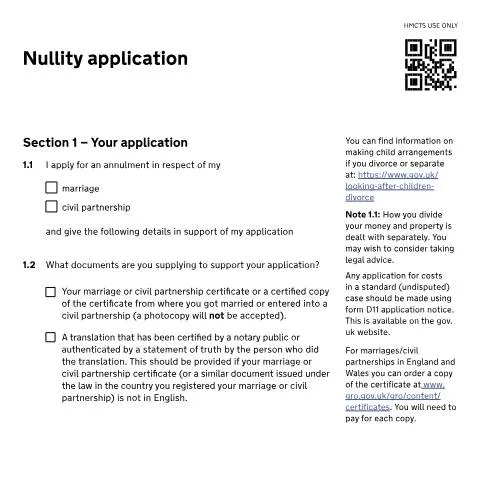
Your initial declaration sets the tone for the entire application. You must clearly state whether you're seeking nullity of a marriage or civil partnership, then provide detailed grounds supporting your claim. This isn't merely a box-ticking exercise—the court expects a coherent narrative explaining why your union should be declared invalid.
The documentary requirements are non-negotiable. You must provide your original marriage or civil partnership certificate, or a certified copy from the issuing authority. Photocopies are explicitly rejected, reflecting the court's need for authenticated evidence in these serious proceedings. If your certificate isn't in English, you'll need a certified translation by a notary public or one authenticated by statement of truth from the translator.
| Document Type | Acceptable Format | Additional Requirements |
|---|---|---|
| Marriage Certificate (UK) | Original or certified copy from General Register Office | Order online at gro.gov.uk (fee applies) |
| Overseas Certificate | Original or certified copy from issuing authority | Must comply with local legal requirements |
| Foreign Language Certificate | Original plus certified translation | Translation by notary public or statement of truth |
Section 2: Your Personal Details and Representation
Accuracy in personal details proves crucial, as any discrepancies between your application and supporting documents can delay proceedings or raise questions about identity. The form accommodates name changes since marriage or civil partnership, but requires explanation or supporting documentation for any variations not directly related to the union itself.
The confidentiality provisions deserve particular attention. If you fear harassment, domestic violence, or other safety concerns, you can keep your contact details confidential by completing separate form C8. This prevents your spouse or civil partner from accessing your current address through court records, though you'll still need to ensure they receive proper notice of proceedings through alternative arrangements.
Solicitor representation, while not mandatory, often proves valuable given the complex legal principles involved. The form accommodates both traditional solicitors and other authorised persons under the Legal Services Act 2007, including barristers and licensed conveyancers with litigation rights.
Section 3: Respondent Information and Service Requirements
Providing accurate details for your spouse or civil partner—the respondent—ensures they receive proper notice of your application. The court requires their current address, and increasingly expects email contact details to facilitate electronic service. You must confirm that only the respondent has access to any email address you provide, preventing inadvertent disclosure to third parties.
Service outside England and Wales triggers different procedural requirements. If your spouse or civil partner lives abroad, you'll typically need to arrange service yourself, often through solicitors in their jurisdiction or via diplomatic channels. This can significantly extend timescales and increase costs, particularly in countries that don't recognise English court processes readily.
Financial Implications and Ancillary Considerations
Form D8N focuses purely on the nullity application itself, but successful nullity can have far-reaching financial consequences that require separate consideration. The form explicitly notes that money and property division are dealt with separately, often requiring additional applications and potentially different legal principles than those applied in divorce proceedings.
Unlike divorce, where the court has wide discretionary powers to redistribute assets fairly, nullity can leave parties in a more precarious position. If your marriage or civil partnership never legally existed, you may have fewer automatic rights to property acquired during the relationship, pension sharing, or spousal maintenance. This makes early legal advice particularly important—waiting until after nullity is granted may limit your options for financial protection.
The interaction with child arrangements also requires careful handling. While nullity doesn't affect the legal status of children born during the relationship—they remain legitimate regardless of their parents' marital status—practical arrangements for residence, contact, and financial support still need resolution. The government's guidance at gov.uk/looking-after-children-divorce provides starting points, though the absence of a valid marriage or civil partnership can complicate some procedural aspects.
Procedural Timelines and Court Processing
Unlike the relatively standardised timescales for uncontested divorce applications, nullity proceedings can vary significantly in duration depending on the complexity of your case and whether the respondent contests your application. The court must be satisfied that your grounds are legally sound and factually proven, often requiring more detailed evidence than straightforward relationship breakdown.
Uncontested nullity applications—where your spouse or civil partner doesn't dispute your grounds—typically progress more smoothly, but still require judicial consideration of the legal merits. The judge must be satisfied that nullity is appropriate based on the evidence presented, regardless of whether both parties agree to the outcome.
Contested cases can extend for months or even years, particularly if complex factual disputes arise about events at the time of marriage or civil partnership. Issues like mental capacity, duress, or the validity of overseas ceremonies often require expert evidence and detailed legal argument that significantly extends proceedings.
The Role of Costs Applications
Standard nullity applications include provisions for costs recovery using form D11 application notice, available through the gov.uk website. However, costs in family proceedings are handled differently than in commercial litigation. The court generally expects each party to bear their own costs unless there are exceptional circumstances, such as unreasonable conduct that unnecessarily prolongs proceedings.
Fill in your form directly online
No printing: type your details into the boxes of the official form, tick, then download the PDF ready to send.
- 1Type into the form boxes
- 2Tick in one click
- 3Save and download the PDF
In contested nullity cases, costs can escalate rapidly, particularly if expert evidence becomes necessary to establish grounds like mental incapacity or the validity of foreign marriage formalities. Early case management and realistic assessment of prospects becomes crucial to avoid disproportionate legal expenses.
Special Circumstances and Complex Cases
Certain nullity applications present additional complications that require specialist handling beyond the standard D8N process. These situations often benefit from preliminary legal advice before submitting your application, as procedural missteps can prove difficult to rectify later.
International Elements
Marriages or civil partnerships with international elements—whether conducted abroad, involving foreign nationals, or where parties now live in different countries—can raise complex jurisdictional questions. English courts can only grant nullity if they have proper jurisdiction over the case, which isn't automatic simply because you're now resident in England and Wales.
The recognition of foreign divorce or nullity decrees also affects your ability to seek nullity in England. If your spouse has already obtained divorce or nullity elsewhere, you may be barred from pursuing English proceedings, even if you disagree with the foreign court's decision.
Mental Capacity Issues
Applications based on mental disorder or lack of consent due to mental incapacity require particularly careful handling. The court needs clear medical evidence about the relevant party's mental state at the time of the ceremony, not their current condition. Historical medical records, expert psychiatric assessments, and witness evidence about behaviour around the time of marriage or civil partnership become crucial.
Where the respondent currently lacks mental capacity, additional procedural steps apply, including potential involvement of the Court of Protection and appointment of litigation friends to protect their interests.
After Nullity: Legal Status and Moving Forward
A successful nullity application results in a decree of nullity that formally declares your marriage or civil partnership never existed. This differs fundamentally from a divorce decree that ends a valid relationship—nullity treats you as having never been married or in a civil partnership for legal purposes.
The implications extend beyond your immediate relationship status. Inheritance rights, pension entitlements, immigration status, and various statutory protections tied to marriage or civil partnership may be affected. Some rights acquired during the relationship might be preserved through other legal mechanisms, but this requires careful analysis of your specific circumstances.
For future relationships, your legal status reverts to single rather than divorced, which can have implications for subsequent marriages, particularly in jurisdictions that treat divorced and single persons differently. However, you'll still need to disclose the nullity decree in various official contexts, as it represents part of your legal history even though the underlying relationship is treated as never having existed.
The finality of nullity also means that, unlike divorce proceedings where reconciliation can halt the process, you cannot simply withdraw a nullity application if you change your mind. Once the court has examined the evidence and concluded that grounds exist, it must grant the decree regardless of any subsequent change of heart by either party.