Understanding the Application for Reconsideration of Provisional Orders in the Scottish Courts and Tribunals Service
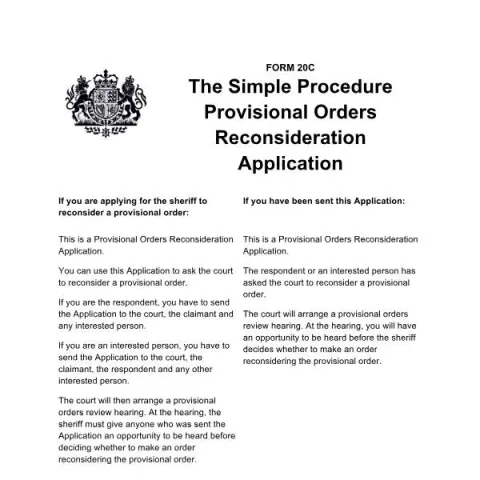
The Form 20C, titled The Simple Procedure Provisional Orders Reconsideration Application, is an official document used within the Scottish legal system. It allows parties involved in a case to request the sheriff court to review and potentially alter a provisional order previously issued. This article aims to clarify when and how this form should be used, what information it requires, and the steps involved in submitting such an application.
What Is a Provisional Order and When to Use Form 20C
A provisional order is a temporary court order issued during a legal process, often to safeguard assets or prevent certain actions before a final decision. Common types include orders freezing assets, preventing property transactions, or restricting removal of goods. These are typically made under specific legislation such as the Debtors (Scotland) Act 1987 or the Debt Arrangement and Attachment (Scotland) Act 2002.
The Form 20C is used when a party, whether the respondent or an interested person, believes that the provisional order should be reconsidered by the court. This might be due to new evidence, a change in circumstances, or other grounds that justify a review of the original decision.
Who Can Submit the Application and To Whom
The application process varies depending on your role in the case:
- Respondent: The party against whom the provisional order was made must send the application to the court, the claimant, and any interested persons.
- Interested Person: Any individual or organisation with a stake in the case must send the application to the court, the claimant, the respondent, and other interested parties.
Once received, the court will arrange a review hearing, providing all parties an opportunity to be heard before deciding whether to modify or revoke the provisional order.
Key Sections of the Application Form
Part A: About the Case
- Sheriff Court: Specify the court handling the case.
- Claimant and Respondent: Names of the parties involved.
- Case Reference Number: Unique identifier for the case.
Part B: About You
- Your Full Name: Including any middle names or trading names.
- Your Role: Indicate whether you are the respondent or an interested party.
Part C: Details of the Application
- Type of Provisional Order: Select the relevant order type, such as an arrestment, inhibition, or interim attachment.
- Date of the Original Order: When the provisional order was made.
- Requested Action: How you want the court to reconsider the order, e.g., revoke, vary, or confirm.
- Reason for Reconsideration: The grounds on which you believe the court should review the provisional order.
How to Submit the Application
The completed Form 20C should be sent to the sheriff court that issued the original provisional order. It is essential to clearly state the case reference number and ensure all relevant parties are notified as per the instructions. The court will then schedule a review hearing, where all parties will have the opportunity to present their case.
Fill in your form directly online
No printing: type your details into the boxes of the official form, tick, then download the PDF ready to send.
- 1Type into the form boxes
- 2Tick in one click
- 3Save and download the PDF
Points of Attention and Practical Advice
- Timeliness: Submit the application promptly, especially if the provisional order has a limited duration or if there are deadlines for reconsideration.
- Clear Grounds: Provide a detailed explanation of why the order should be reconsidered, supported by relevant evidence or legal grounds.
- Notification: Ensure that all parties involved are properly notified of the application to avoid procedural delays.
- Legal Assistance: Consider consulting a solicitor if you are unsure about the grounds for reconsideration or the correct procedure.
In summary, Form 20C is a crucial procedural document for parties seeking to challenge or modify provisional orders within the Scottish legal framework. Proper completion and timely submission can significantly influence the outcome of the case, ensuring that provisional measures align with the evolving circumstances of the parties involved.