The Critical Role of Form D80 in Adultery-Based Divorce Proceedings
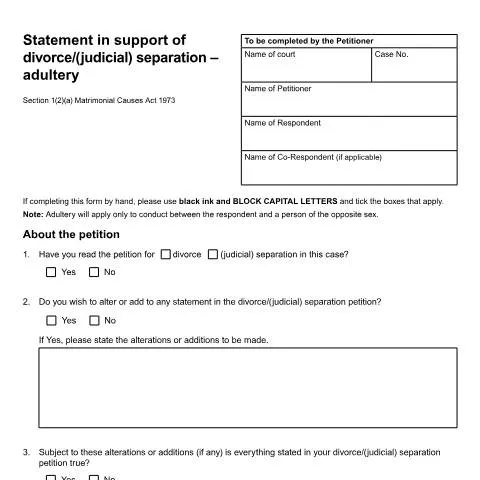
When a marriage breaks down due to adultery, the legal pathway to divorce in England and Wales requires more than simply filing a petition. The petitioner must substantiate their claims through Form D80A, a detailed statement that transforms allegations into legally admissible evidence. This document, governed by Section 1(2)(a) of the Matrimonial Causes Act 1973, serves as the cornerstone of adultery-based divorce applications issued before the significant family law reforms of April 2022.
Unlike other divorce grounds that rely primarily on the passage of time or mutual consent, adultery allegations demand concrete evidence and careful legal positioning. The D80A statement bridges the gap between a petitioner's personal knowledge of their spouse's infidelity and the court's requirement for verifiable facts that can withstand legal scrutiny.
Understanding the Adultery Framework Under Pre-2022 Legislation
The D80A form operates within a specific legal framework that defined adultery as voluntary sexual intercourse between a married person and someone of the opposite sex who is not their spouse. This narrow definition, rooted in traditional matrimonial law, excluded same-sex relationships and required proof of actual sexual intercourse rather than emotional affairs or other forms of infidelity.
Under the pre-April 2022 system, petitioners faced a dual burden: proving that adultery occurred and demonstrating that they found it intolerable to live with the respondent. This intolerability test created a crucial legal hurdle, as courts required evidence that the adultery itself made cohabitation impossible, not merely that the marriage had other problems.
| Legal Requirement | Evidence Standard | Common Pitfalls |
|---|---|---|
| Proof of adultery | Clear factual basis with dates and circumstances | Vague allegations without specific incidents |
| Intolerability | Direct connection to the adultery | Citing general marital problems instead |
| Knowledge timeline | Specific date when adultery was discovered | Approximate or unclear discovery dates |
| Cohabitation after discovery | Detailed account of any continued living arrangements | Failing to explain reconciliation attempts |
Navigating the Form's Critical Sections and Evidence Requirements
The Petition Verification Process
Questions 1-3 of the D80A form establish the foundation of the legal case by requiring petitioners to confirm their divorce petition's accuracy. This seemingly straightforward section contains important legal implications. When answering whether everything in the petition is true, petitioners must distinguish between facts within their personal knowledge and information based on belief or third-party sources.
For instance, if a petitioner discovered their spouse's affair through a private investigator's report, they cannot state the investigator's findings as personal knowledge. Instead, they must indicate these facts are true "to the best of my information and belief" and identify the source. This distinction protects against perjury charges while ensuring the court understands the evidence's nature.
Articulating the Adultery Allegations
Question 4 demands the most careful consideration, requiring petitioners to state their reasons for alleging adultery. Courts expect specific, factual statements rather than emotional accusations or general suspicions. Effective responses typically include:
- Concrete observations: "I discovered my spouse in our matrimonial bedroom with [name] on [specific date]"
- Documentary evidence: References to photographs, hotel receipts, or electronic communications
- Witness statements: Third-party observations from family, friends, or professional investigators
- Admissions: Direct confessions from the respondent or co-respondent
The form provides multiple date fields, recognising that adultery often involves ongoing relationships rather than single incidents. Petitioners should list all known occasions chronologically, providing as much detail as their knowledge permits.
The Discovery Timeline and Its Legal Consequences
Question 5 addresses when the petitioner first learned of the adultery, creating a crucial legal timestamp. This date affects several aspects of the case, including the six-month time limit for filing divorce proceedings based on adultery. Under the former system, petitioners who continued living with their spouse for more than six months after discovering adultery could not rely on that adultery as grounds for divorce.
The intolerability question (Question 6) requires careful consideration of the legal standard. Courts have consistently held that intolerability must stem from the adultery itself, not from pre-existing marital problems. Petitioners who answer "No" to this question cannot proceed with an adultery-based divorce, regardless of other evidence.
Post-Discovery Cohabitation and Reconciliation Attempts
Question 7 addresses one of the most sensitive aspects of adultery cases: whether spouses attempted reconciliation after the discovery. The law recognised that discovering adultery often triggers complex emotional responses, and couples might attempt to rebuild their relationship before concluding that divorce is inevitable.
The form's reference to "same household" acknowledges modern living arrangements where separated couples might maintain the same address for financial or childcare reasons. Petitioners must provide detailed explanations of their domestic circumstances during any periods of continued cohabitation, including:
- Sleeping arrangements and whether spouses shared a bedroom
- Meal preparation and eating arrangements
- Social activities and whether the couple presented as reconciled
- Financial arrangements and bill-paying responsibilities
- Childcare duties and parental coordination
Courts scrutinise these arrangements because extended cohabitation after discovering adultery can undermine claims of intolerability. However, brief reconciliation attempts or practical arrangements that don't constitute genuine cohabitation typically don't prejudice the case.
Documentary Evidence and Signature Authentication
The D80A form includes specific provisions for signature identification, reflecting the importance of documentary evidence in adultery cases. When respondents sign acknowledgment of service forms or other documents that constitute admissions of adultery, petitioners must authenticate these signatures through personal knowledge.
The form's checkbox system allows petitioners to identify signatures from multiple sources, typically including:
- Paragraph 9(a) acknowledgment: Where respondents admit adultery in their formal court response
- Attached documents marked 'C': Additional evidence such as signed confessions, emails, or letters
Signature identification requires genuine personal knowledge of the respondent's handwriting. Petitioners cannot authenticate signatures based on assumptions or similarities to other documents unless they have direct experience with their spouse's signing habits.
The Statement of Truth and Perjury Implications
The D80A form concludes with a formal Statement of Truth, carrying the same legal weight as sworn testimony in court. The warning about contempt proceedings reflects the serious consequences of providing false information, including potential imprisonment for up to two years.
This section requires careful attention to several elements:
- Full legal name: Must match the name used in the divorce petition exactly
- Personal signature: Cannot be signed by representatives or solicitors on behalf of the petitioner
- Accurate dating: Must reflect the actual date of signing, not submission or filing dates
The Statement of Truth applies to all information provided in the form, creating personal liability for every factual assertion. Petitioners should review their responses carefully, ensuring they can substantiate each claim if challenged in court.
Court Processing and Case Management Considerations
Once submitted, D80A forms undergo judicial review as part of the broader divorce application assessment. Courts examine these statements for legal sufficiency, factual consistency, and compliance with procedural requirements. The reviewing judge considers whether the alleged facts, if proven, would satisfy the legal test for adultery-based divorce.
Common reasons for judicial queries or rejections include:
- Insufficient factual detail: Vague allegations that don't establish specific instances of adultery
- Timeline inconsistencies: Contradictions between discovery dates and cohabitation periods
- Intolerability gaps: Failure to connect the adultery to the breakdown of cohabitation
- Documentation deficiencies: Missing signature identifications or incomplete evidence references
When courts identify deficiencies, they typically issue requests for additional information or amended statements rather than immediately dismissing applications. This process can extend case timelines significantly, particularly when petitioners lack legal representation to guide their responses.
Strategic Considerations for Self-Representing Petitioners
The D80A form's complexity often challenges self-representing petitioners who must navigate legal standards without professional guidance. Successful completion requires understanding both the technical requirements and the strategic implications of each response.
Key strategic considerations include:
Evidence Preservation and Organisation
Before completing the D80A, petitioners should compile and organise all available evidence systematically. This includes photographing relevant documents, securing electronic communications, and obtaining witness contact information. The form's structure suggests the types of evidence courts find persuasive, helping petitioners focus their preparation efforts.
Co-Respondent Involvement Decisions
The form accommodates cases involving named co-respondents, though petitioners must weigh the benefits against potential complications. Naming a co-respondent can strengthen adultery allegations but may complicate proceedings if the third party contests involvement or counter-sues for costs.
Cost Recovery Positioning
The form's final section addresses cost recovery from respondents, requiring petitioners to have specifically requested costs in their original petition. This procedural requirement highlights the importance of comprehensive initial applications, as retrospective cost claims face significant hurdles.
Understanding these strategic dimensions helps petitioners make informed decisions about their approach while ensuring their D80A statements support their broader divorce objectives effectively. The form's role extends beyond mere fact-gathering to encompass tactical positioning that can influence both the immediate proceedings and any subsequent financial or children-related applications.
Completing Section-Specific Requirements and Common Pitfalls
The D80 form's structured sections each serve distinct legal purposes, and understanding their specific requirements prevents costly delays in your divorce or judicial separation proceedings. Section 1 requires your full legal name exactly as it appears on your marriage certificate, not shortened versions or nicknames you might commonly use. If your name has changed since marriage through deed poll or other legal process, you must provide supporting documentation alongside the D80.
The marriage details section demands particular precision. The date must match your marriage certificate exactly – even minor discrepancies like "15th June" versus "15 June" can trigger queries from the court office. If you married abroad, ensure you're using the UK-recognised date format rather than the local format from your country of marriage. The place of marriage should include the full address where possible, particularly for registry office ceremonies where multiple venues might exist in the same town.
When completing the respondent's details, accuracy becomes crucial for service of proceedings. An incorrect address can delay your case by months whilst attempts are made to locate your spouse. If your spouse has moved and you're unsure of their current address, you cannot simply guess – the court requires you to demonstrate reasonable efforts to locate them, potentially involving instructing process servers or making applications for alternative service methods.
The children section often causes confusion, particularly regarding which children to include. You must list all children of the family under 18, including stepchildren who have been treated as children of the family, regardless of their biological parentage. However, adult children should not be included unless they have disabilities requiring ongoing support. For each child, provide their full name, date of birth, and current living arrangements with sufficient detail to demonstrate their welfare has been considered.
Financial information requires careful attention to accuracy and completeness. Whilst the D80 doesn't demand full financial disclosure – that comes later in ancillary relief proceedings if pursued – you must provide a fair summary of assets, debts, and income. Deliberately understating assets or income can have serious consequences later, potentially affecting any financial settlement and damaging your credibility with the court.
Fill in your form directly online
No printing: type your details into the boxes of the official form, tick, then download the PDF ready to send.
- 1Type into the form boxes
- 2Tick in one click
- 3Save and download the PDF
The grounds for divorce section must align precisely with your chosen fact. If citing unreasonable behaviour, each allegation should be specific, factual, and demonstrate behaviour that makes continued cohabitation unreasonable. Vague statements like "we grew apart" won't suffice – you need concrete examples such as "The respondent repeatedly returned home after midnight without explanation, causing significant distress." For adultery, you need only admit the fact occurred; graphic details are unnecessary and inappropriate.
Interaction with Other Court Forms and Parallel Proceedings
The D80 rarely exists in isolation within family court proceedings, and understanding its relationship with other forms prevents procedural complications. If you're simultaneously applying for ancillary relief (financial orders), you'll need Form A alongside your D80. The timing of these applications can significantly impact costs, as joint applications often prove more economical than separate proceedings initiated months apart.
For cases involving children, separate applications under the Children Act 1989 might be necessary if you cannot reach agreement on arrangements. Forms C100 (for child arrangements orders) or C79 (for financial provision for children) may run parallel to your D80 proceedings. The family court expects consistency between these applications – contradictory statements about children's welfare or living arrangements between forms can undermine your credibility.
If domestic violence features in your case, you might need to consider non-molestation orders (Form FL401) or occupation orders before or during your divorce proceedings. The evidence you provide in these applications can support your D80 if citing unreasonable behaviour, but the court expects coherent narratives across all documentation rather than contradictory accounts.
International elements add complexity requiring additional forms. If your spouse lives abroad, Form D11 becomes necessary to seek permission for alternative service methods. For cases involving foreign assets or marriages that took place overseas, you may need to provide certified translations of foreign documents, apostilled certificates, or sworn affidavits confirming the validity of foreign marriages under UK law.
The interaction between D80 proceedings and other legal matters requires careful coordination. If criminal proceedings are ongoing against your spouse, particularly for domestic violence offences, the timing of your divorce application might need adjustment to avoid prejudicing either case. Similarly, if bankruptcy proceedings affect either party, this can impact both the divorce timeline and any associated financial claims.
Mediation requirements increasingly influence D80 proceedings, particularly where children are involved. Whilst not mandatory for divorce itself, courts expect evidence of mediation attempts for children matters. The Mediation Information and Assessment Meeting (MIAM) exemptions that might apply to your case should be considered before submitting your D80, as they can affect the overall case management directions you receive.
Post-Submission Case Management and Procedural Timelines
Once your D80 reaches the family court office, a specific procedural timeline begins that differs significantly from the streamlined no-fault process introduced in April 2022. Understanding these stages helps you prepare for each phase and respond appropriately to court directions. The initial administrative check typically takes 2-3 working days, during which court staff verify that all required documents are present and fees paid correctly.
If your application passes initial scrutiny, the court issues the petition and supporting documents to your spouse via post to their last known address. This service must be acknowledged within prescribed timeframes – typically 8 days for service within England and Wales, extending to 21 days for international service. If your spouse fails to acknowledge service, you'll need to file Form D13b (affidavit of service) demonstrating proper delivery, potentially requiring evidence from postal services or process servers.
The acknowledgment of service stage reveals crucial information about how your case will proceed. Your spouse can indicate whether they intend to defend the proceedings, cross-petition for divorce on different grounds, or defend any proposed arrangements for children or finances. A defended divorce based on pre-April 2022 grounds can extend proceedings significantly, potentially requiring witness statements, disclosure of evidence, and even court hearings to determine disputed facts.
Assuming undefended proceedings, your next step involves applying for decree nisi using Form D84. This application typically follows 2-3 weeks after acknowledgment of service, provided no defense has been filed. The court lists your case for consideration by a district judge, who reviews the evidence to determine whether the ground for divorce has been established. For straightforward cases, this happens "on the papers" without requiring your attendance.
The decree nisi hearing represents a critical juncture where technical defects in your D80 might surface. Insufficient particulars of unreasonable behaviour, inadequately proven adultery, or incomplete evidence of separation periods can result in the judge refusing decree nisi or directing further evidence. Understanding these requirements from the D80 stage prevents such complications later in proceedings.
Between decree nisi and decree absolute lies a mandatory waiting period of six weeks and one day, during which financial matters should ideally be resolved. The court retains jurisdiction over financial claims until decree absolute, but this jurisdiction can be lost if not properly preserved. Applications for financial orders must typically be made before decree absolute, making this period crucial for protecting your future financial position.
Case management directions issued alongside decree nisi often require specific actions within defined timeframes. These might include filing financial statements, attending mediation sessions, or providing further evidence about children's arrangements. Failure to comply with these directions can result in your case being struck out or delayed, emphasizing the importance of understanding court expectations from the outset when completing your D80.
The final decree absolute application using Form D36 marks the end of your marriage legally, but timing this application requires strategic consideration. Once decree absolute is granted, your ability to make financial claims becomes significantly restricted, making it essential to resolve or at least formally preserve any financial disputes before taking this final step.