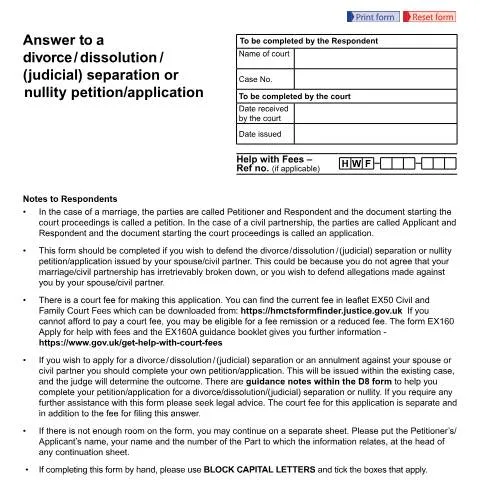
Navigating the Complexities of the D8B Form: A Practical Guide
When relationships break down, the process of separation can become overwhelming. One of the critical steps for individuals wishing to defend against a divorce, judicial separation, or nullity petition is filling out the D8B Form. This document, governed by the HM Courts & Tribunals Service, plays a crucial role in the legal proceedings that follow the initial petition filed by a spouse or civil partner.
Understanding the D8B Form's Role in Legal Proceedings
The D8B Form is not just a simple document; it represents the respondent's official answer to a petition previously lodged in court. It enables the respondent to articulate their position and contest the claims made by the petitioner. The necessity of this form becomes apparent when one considers that, without it, the court may proceed with the case based solely on the petitioner’s assertions. As a result, responding promptly and accurately is vital for protecting one's legal rights.
Additionally, legal terms such as 'petitioner' (the person who initiates the divorce proceedings) and 'respondent' (the individual responding to the petition) are defined in the form itself. Distinguishing between these roles is essential for navigating the legal landscape effectively.
Historical Context and Legal Framework
The legislative foundation for the D8B Form hinges on the broader context of family law in the UK. The dissolution of marriage and civil partnerships has been subject to various acts, with the Divorce, Dissolution and Separation Act 2020 marking a significant change in the way courts handle such applications. The introduction of no-fault divorce principles allows for a more straightforward legal process, but the D8B Form remains vital in cases where one party disputes the dissolution.
Understanding past legislation helps contextualize the D8B Form. For example, the Matrimonial Causes Act 1973 previously required one spouse to demonstrate fault in order to obtain a divorce. This historical requirement shaped many people's perceptions of divorce, leading to more adversarial relationships. The D8B Form thus serves as a tool for those who feel wronged by the petitioner's claims.
Preparation: Collecting Relevant Documentation and Information
Before tackling the D8B Form, respondents should gather essential documentation and information. Having these ready can significantly streamline the process. Here’s a checklist of key items:
- Case Number: This reference number is crucial as it identifies the specific legal proceedings.
- Name of Court: Knowing where the petition was filed is mandatory for correctly completing the form.
- Details of the Petitioner: Full name and any other relevant information relating to the spouse or civil partner who has filed the petition.
- Personal Statement: A clear articulation of why you dispute the petition, which should be articulated in the form’s statement of case.
- Evidence Supporting Your Position: Any documentation that can back up your claims or objections.
Being organized not only aids in filling out the form but also demonstrates to the court that you are serious about defending your position.
Completing the D8B Form: Step-by-Step Guidance
Completing the D8B entails several specific parts, each requiring careful attention to detail. Below is a breakdown of the various sections within the form:
- Initial Declaration: Respondents must indicate whether they agree that the marriage or civil partnership has irretrievably broken down. This is a significant statement that could affect the proceedings.
- Stating Your Case: In this section, you must detail your reasons for defending the petition. This may include counterarguments against claims made by the petitioner.
- Financial Hardship Claims: If your objection to the divorce is based on potential financial harm, you are required to elaborate on how this could impact you.
- Costs: Here, you indicate whether you wish to claim costs from the petitioner, or if you prefer not to pursue this option.
- Special Assistance: If you require additional support during court appearances, you must specify your needs here.
Each part of the D8B Form plays a role in shaping the court's understanding of your position, making it essential to complete each section carefully and thoroughly.
Where the D8B Fits into the Broader Legal Process
Understanding the D8B Form's place in the overall divorce process helps to grasp its importance fully. After the D8B is submitted, the court will review both the petition (D8) and the response (D8B). This review process may lead to a hearing where both parties can present their cases. The judge will evaluate the arguments and decide the outcome.
Moreover, if disputes arise that cannot be resolved through the D8B, additional mediation or court hearings may be required. Therefore, the D8B is not merely a stand-alone document but a pivotal component within a larger framework of legal proceedings.
Special Circumstances: Unique Considerations and Challenges
Respondents may find themselves in unique situations that complicate their response to a divorce petition. For instance, if one party is living abroad, they may face challenges related to jurisdiction and the service of documents. In such cases, understanding international family law and seeking legal advice becomes imperative.
Additionally, situations involving children or financial complexities can lead to further complications. For example, if the respondent is a parent and the divorce affects custody arrangements, they may need to focus on aspects such as child welfare and support obligations in their response.
Furthermore, respondents may wish to seek special accommodations if they have disabilities or other needs that require attention during court proceedings. Making these needs known through the D8B is crucial for ensuring a fair process.
After Submission: What Comes Next?
Once the D8B Form has been filed with the court, several key steps follow. The court will review the form at its next available sitting, and all parties will receive notification regarding future proceedings.
Respondents should be prepared to attend court hearings if required. During these hearings, they will have the opportunity to present their case alongside any supporting evidence they may have gathered. It is vital to remain attentive to court dates and ensure all documents are submitted in accordance with court rules.
If a resolution is reached, either through negotiation or a ruling from the judge, the proceedings will then move towards finalizing the divorce or separation. If disputes persist, further evidence collection and additional hearings may be necessary.
Legal Support: Importance of Seeking Professional Guidance
Given the complexities involved in filling out the D8B Form and navigating the divorce proceedings, seeking legal advice is highly recommended. A solicitor specializing in family law can provide valuable insights and assistance tailored to your situation.
Legal professionals can help ensure that the D8B Form is completed accurately and that your voice is heard during the proceedings. They can also advise on potential outcomes, alternative dispute resolutions, and strategies to protect your interests throughout the process.
Conclusive Thoughts on Managing Divorce Proceedings
Successfully navigating the process of responding to a divorce petition using the D8B Form requires a detailed understanding of both the legal landscape and one's personal circumstances. By gathering relevant information, accurately completing the form, and being prepared for court proceedings, respondents can effectively advocate for themselves during this challenging time.
In conclusion, while the D8B Form may initially seem like a daunting document, it is a critical tool for individuals seeking to defend their rights in the face of a divorce petition. Armed with knowledge and support, respondents can approach their situation with confidence.
Understanding the Grounds for D8B Applications
When responding to a divorce, judicial separation, or nullity petition using Form D8B, it is paramount to understand the various grounds upon which these applications can be made. The grounds for divorce under English law are delineated in the Matrimonial Causes Act 1973 and can significantly impact the proceedings. Typically, the sole ground for divorce is the irretrievable breakdown of the marriage, which must be evidenced by one of the following facts:
Adultery: This occurs when one spouse has voluntary sexual intercourse with a person of the opposite sex outside the marriage, which the petitioner finds intolerable.
Unreasonable Behaviour: This is a broad category that can encompass a range of behaviours deemed unacceptable by one spouse, leading to the breakdown of the marriage. Examples include verbal abuse, financial irresponsibility, or lack of support.
Desertion: If one spouse has deserted the other for a continuous period of at least two years, the deserted spouse can base their petition on this fact.
Separation for Two Years with Consent: Should both parties have lived separately for at least two years and mutually consented to the divorce, this ground can be used.
Separation for Five Years: In cases where one spouse has been living apart from the other for five years, the petitioner can file for divorce without the need for the other spouse's consent.
Understanding these grounds is crucial as they not only form the basis of the petition but also influence the court’s approach to issues such as financial settlements, custody arrangements, and other ancillary matters. A comprehensive understanding is beneficial when drafting your response on Form D8B, as you may need to provide detailed explanations or counterclaims based on these grounds.
Financial Implications and Considerations
Responding to a divorce or dissolution petition using Form D8B goes beyond merely contesting the grounds; it also has significant financial implications that must be carefully navigated. It is critical to address financial matters upfront, as they can heavily influence the overall outcome of the proceedings. Here are key financial considerations to keep in mind:
Fill in your form directly online
No printing: type your details into the boxes of the official form, tick, then download the PDF ready to send.
- 1Type into the form boxes
- 2Tick in one click
- 3Save and download the PDF
Financial Disclosure: When responding to the D8B application, the court may require both parties to complete a financial disclosure form, often referred to as Form E. This disclosure should transparently outline each party's income, assets, liabilities, and financial commitments. Failing to disclose information can adversely affect your case.
Matrimonial Assets: The division of assets is often contentious in divorce proceedings. Under the Matrimonial Causes Act, the court aims for a fair distribution of assets. This includes everything acquired during the marriage, such as property, savings, and pensions. If you are contesting aspects of asset division, provide compelling evidence in your response to support your position.
Spousal Maintenance: Consider whether you may be entitled to spousal maintenance (also referred to as alimony) or whether you may be required to pay it. Factors influencing maintenance include the length of the marriage, the age and health of both parties, and the financial needs and income of both spouses.
Child Maintenance: If there are children involved, it is essential to address child maintenance arrangements. The Child Maintenance Service (CMS) provides a framework for determining the amount payable based on the non-residential parent’s income. Failure to adequately address child maintenance may complicate custody negotiations and lead to further disputes.
Court Fees and Costs: Filing a Form D8B may incur court fees, which can vary. Be aware of these costs and ensure that you are prepared for any additional expenses that may arise during the proceedings. There may be options for fee exemptions; for instance, if you receive certain benefits, you might qualify for a fee waiver.
Navigating the financial landscape in conjunction with the legal aspects can be complicated but is necessary to ensure a fair outcome. Seeking legal advice may help in articulating your financial situation accurately in your D8B response.
The Role of Mediation in Divorce Proceedings
Mediation can play a crucial role in resolving disputes amicably and efficiently during divorce proceedings. When responding to a D8B application, understanding the options for mediation and its potential benefits can be advantageous. Here’s what you need to know about mediation in the context of divorce:
What is Mediation?: Mediation is a voluntary process where an independent third-party mediator helps both spouses communicate effectively to reach mutually satisfactory agreements about their divorce. This may encompass matters such as asset division, child custody, and financial obligations.
Court Requirement for Mediation: Before filing an application for a court order regarding children or financial disputes, there is typically a requirement to attend a Mediation Information and Assessment Meeting (MIAM). This ensures that both parties explore mediation as an option before resorting to court proceedings. Completing this step prior to your D8B response may demonstrate your willingness to resolve matters amicably.
Advantages of Mediation: Engaging in mediation has numerous benefits. It can lead to quicker resolutions, reduce legal costs, and help maintain a cooperative relationship, particularly important when children are involved. Mediation allows for more flexible solutions that a court may not be able to provide. Additionally, any agreements made during mediation can be formalized into a court order if necessary.
Preparing for Mediation: If mediation is pursued, preparation is key. Key documents and information regarding your financial position and any proposals regarding children should be organized beforehand. This preparation will facilitate a more productive discussion and increase the chances of reaching an agreement.
Outcome and Court Orders: Any agreement reached through mediation can be made legally binding by applying for a court order. It’s essential to ensure that any terms regarding financial settlement and child arrangements are documented formally to protect your rights and interests going forward.
By considering mediation as part of your response to a D8B application, you may uncover paths to resolution that mitigate the stress and costs typically associated with divorce proceedings. Embracing mediation can signify a constructive approach to what is often an emotionally charged process.