When Legal Proceedings Require Your Voice: Understanding COP10 Applications
In the complex world of Court of Protection proceedings, situations frequently arise where individuals with a legitimate interest find themselves on the sidelines of cases that could fundamentally affect their rights or relationships. The COP10 application notice for applications to be joined as a party serves as the formal gateway for those who need to participate actively in ongoing proceedings but weren't initially included as parties.
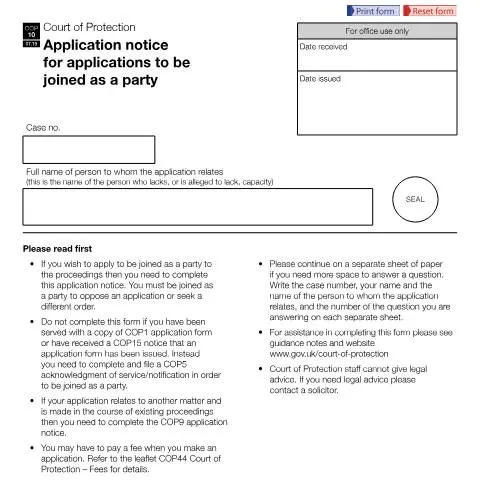
This HM Courts & Tribunals Service document addresses a specific procedural gap: when someone discovers that Court of Protection proceedings are underway concerning a person they have connections with, but they haven't been formally notified or included. Unlike situations where you receive a COP1 application form directly or a COP15 notice, the COP10 becomes necessary when you learn of proceedings through other channels and need to request party status rather than simply acknowledge service.
The distinction is crucial. Being a mere observer or interested party carries no legal weight in Court of Protection matters. Only formal parties can oppose applications, seek different orders, or present evidence that the court must consider. This procedural requirement reflects the court's need to maintain clear boundaries around who has standing to participate in decisions affecting vulnerable individuals.
Identifying Your Grounds for Intervention
The COP10 application requires applicants to articulate both their connection to the person lacking capacity and their interest in the proceedings. These dual requirements serve different purposes and demand careful consideration.
Your connection might be familial—perhaps you're an adult child not initially consulted about your parent's care arrangements, or a sibling who disagrees with proposed property sales. Alternatively, professional relationships can justify intervention: care providers, medical professionals, or financial advisors may have legitimate concerns about proposed orders affecting their ongoing responsibilities.
However, connection alone isn't sufficient. The court must understand your specific interest in the proceedings' outcome. This interest typically falls into several categories:
- Financial stake: You stand to gain or lose from proposed property transactions or financial arrangements
- Care responsibility: Proposed residence or care decisions would directly affect your caregiving obligations
- Professional duty: Your professional responsibilities create conflicts with proposed orders
- Welfare concern: You possess information suggesting proposed arrangements aren't in the person's best interests
The application form's structure reflects the court's need to assess whether your participation would genuinely assist proceedings or merely complicate them. Courts are particularly receptive to applications where the potential party possesses unique knowledge or perspective not otherwise available to existing parties.
Timing Considerations and Strategic Positioning
Unlike many court procedures, COP10 applications don't operate within rigid timeframes, but timing remains strategically important. Early intervention allows fuller participation in evidence gathering and case development, whilst late applications may face greater scrutiny regarding why earlier involvement wasn't sought.
The court's discretion in granting party status means applicants must demonstrate that their participation serves the proceedings' broader purposes rather than pursuing purely personal interests. This assessment becomes more stringent as proceedings advance, particularly if substantial case management orders are already in place.
Navigating Opposition and Alternative Orders
The COP10 form requires explicit positions on three critical questions: whether you consent to existing applications, oppose them, or propose different orders entirely. These aren't mutually exclusive positions, and your responses shape both your party status prospects and your subsequent role in proceedings.
| Position | Court Expectations | Evidence Requirements |
|---|---|---|
| Consent | Minimal disruption to existing timeline | Explanation of why party status necessary despite agreement |
| Opposition | Detailed grounds with legal or factual basis | Supporting evidence addressing best interests principles |
| Alternative Order | Practical, implementable proposals | Comprehensive evidence supporting alternative approach |
Opposition grounds must address the Mental Capacity Act 2005's best interests framework. Simply disagreeing with family decisions or preferring different arrangements isn't sufficient. Courts expect evidence-based challenges addressing the person's wishes, beliefs, values, and welfare considerations.
When proposing alternative orders, specificity matters enormously. Vague suggestions for "better care arrangements" carry little weight compared to detailed proposals with identified providers, costings, and implementation timelines. The court must understand exactly what you're proposing and why it better serves the protected person's interests.
Evidence Requirements and Supporting Documentation
COP10 applications must include all supporting evidence at submission. This requirement differs from many civil proceedings where evidence can be filed progressively. The court needs complete information to assess both party status and the merits of your positions simultaneously.
Evidence should address two distinct areas: your standing to participate and the substantive issues you raise. Standing evidence might include correspondence demonstrating your relationship, professional credentials, or documentation of your involvement in the person's affairs. Substantive evidence supports your positions on existing applications or alternative proposals.
The Intersection with Existing Procedural Frameworks
Understanding when COP10 applies requires grasping its relationship with other Court of Protection procedures. The form's opening guidance explicitly distinguishes scenarios requiring different approaches, but practical situations often blur these boundaries.
If you've received a COP1 application form directly, you're already recognised as someone entitled to notice. Your response should use COP5 acknowledgment procedures rather than seeking party status through COP10. This distinction reflects your existing procedural rights versus needing to establish them.
Similarly, receiving a COP15 notice indicates the court has identified you as someone entitled to notification about application issuance. Again, COP5 procedures apply rather than COP10 applications.
The boundary becomes complex when you've received informal notification—perhaps family members mentioned proceedings, or you learned through professional networks. If you haven't received formal court documents, COP10 typically provides the appropriate route to participation.
For situations involving existing proceedings where you need to make separate applications (perhaps seeking disclosure or interim orders), COP9 application notices serve different purposes than COP10's party status focus. Understanding these procedural distinctions prevents inappropriate form usage that could delay your participation.
Cost Implications and Financial Responsibilities
COP10 applications carry both immediate fee obligations and ongoing cost risks that applicants must understand before proceeding. The court's fee structure, detailed in leaflet COP44, applies to party status applications, though fee remission may be available in appropriate circumstances.
More significantly, party status brings potential liability for other parties' costs if the court considers your conduct unreasonable. This risk extends beyond unsuccessful applications to behaviour during proceedings—pursuing hopeless arguments, failing to engage constructively with case management, or unnecessarily prolonging proceedings can trigger adverse costs orders.
Practical Completion and Submission Strategies
The COP10's completion requires strategic thinking beyond simply answering questions. Your responses create the foundation for your entire participation in proceedings, and poorly articulated positions can undermine otherwise valid concerns.
Section 2's questions about your connection and interest demand precision rather than emotion. Courts respond to factual descriptions of relationships and clear explanations of how proceedings affect your legitimate interests. Personal feelings about family dynamics or preferences for different care arrangements need translation into legally relevant concerns.
When describing opposition grounds or alternative orders, structure your responses around the best interests checklist from the Mental Capacity Act 2005. Address the person's past and present wishes, beliefs and values they held when they had capacity, and other factors they would consider if able to do so. This framework demonstrates understanding of the court's decision-making approach.
The witness statement requirement (using COP24 forms) allows detailed evidence presentation beyond the application notice's limited space. Use this opportunity to provide chronological accounts of your involvement, detailed proposals for alternative arrangements, or comprehensive challenges to existing evidence.
Service Requirements and Court Expectations
COP10 applications must include sufficient copies for service on all existing parties—a requirement that necessitates contacting the Court Enquiry Service on 0300 456 4600 to determine current party numbers. This administrative step often reveals the proceedings' complexity and helps gauge the court's workload in your case.
The court's subsequent service of your application on all parties triggers their opportunity to respond to your party status request. Existing parties may oppose your joinder, particularly if they view your participation as potentially disruptive or unnecessary. Understanding this dynamic helps frame your application to address likely concerns proactively.
Beyond Application Submission: Managing Court Decisions
Once submitted, COP10 applications enter the court's discretionary assessment process. Unlike some procedural applications with clear entitlement criteria, party status decisions involve judicial evaluation of whether your participation would assist the proceedings' proper conduct.
Courts consider several factors beyond your stated grounds: the proceedings' current stage, existing party representation, potential for delay, and whether your interests are adequately represented by current parties. Your application's success often depends on demonstrating unique value rather than simply legitimate interest.
If granted party status, you acquire full procedural rights—receiving all court documents, participating in hearings, filing evidence, and making applications. These rights carry corresponding obligations for constructive engagement with case management and other parties.
Refused applications don't necessarily end your involvement options. Courts may grant limited participation rights, allow evidence submission without party status, or suggest alternative approaches to raising your concerns. Understanding these intermediate positions helps evaluate whether appealing refusal decisions serves your underlying interests.
The COP10 process ultimately reflects the Court of Protection's balance between inclusive decision-making and manageable proceedings. Success requires demonstrating that your participation genuinely advances the protected person's interests rather than simply asserting your right to be heard. This standard demands careful preparation, clear articulation of your position, and realistic assessment of what you can contribute to reaching the best possible outcome for the person at the centre of these crucial proceedings.
Strategic Considerations for Different Types of Applicants
The approach to completing Form COP10 varies significantly depending on your relationship to the protected person and the nature of your interest in the proceedings. Understanding these distinctions is crucial for presenting a compelling application that demonstrates clear grounds for joinder.
Family Members and Close Relatives
Family members often have the strongest presumptive case for joinder, particularly when they can demonstrate genuine concern for the protected person's welfare or where family dynamics directly impact the court's decisions. Spouses and civil partners typically enjoy a presumption of interest, especially in cases involving property transactions or care arrangements that affect the family home.
Adult children seeking joinder must articulate their specific interest beyond general family concern. This might include situations where they are potential beneficiaries of the protected person's estate, where they have been providing unpaid care, or where they possess unique knowledge of the protected person's previously expressed wishes. The court will scrutinise whether their involvement serves the protected person's best interests rather than their own financial or personal agenda.
Siblings and other relatives face a higher threshold, particularly if they have had limited recent contact with the protected person. However, strong cases can be made where the relative has historical significance in the person's life, possesses relevant information about their values and preferences, or where other closer family members are absent or unsuitable.
Professional and Care Relationships
Healthcare professionals, social workers, and care providers occupy a unique position in COP10 applications. Their professional relationship with the protected person can provide valuable insights into capacity assessments and welfare decisions, but they must navigate potential conflicts between their professional duties and their role as a party to proceedings.
Care home managers or senior care staff may seek joinder where significant decisions about the resident's care arrangements or funding are under consideration. They should emphasise their professional observations of the person's capabilities, preferences, and responses to different care approaches, whilst being mindful that their employer's commercial interests must not influence their position.
Former attorneys under lasting powers of attorney who have been removed or who have resigned may seek joinder to provide context about the protected person's previous wishes or to address allegations about their conduct. Such applications require careful handling, as the court will be alert to potential conflicts of interest or attempts to relitigate previous decisions.
Creditors and Financial Stakeholders
Commercial creditors and financial institutions face particular challenges when applying for joinder, as the court prioritises the protected person's welfare over creditor interests. However, legitimate cases arise where significant financial decisions directly impact both the protected person's assets and third-party rights.
Banks holding joint accounts or providing mortgage facilities may need party status where the protected person's mental capacity affects the validity of financial arrangements or where urgent decisions about property sales or refinancing are required. Such applicants must demonstrate that their involvement will assist rather than complicate the court's decision-making process.
Business partners or co-directors may require joinder where the protected person's shares or business interests are integral to ongoing commercial operations. The court will expect clear evidence that the applicant's involvement serves the protected person's financial interests and that alternative arrangements for managing the business relationship are inadequate.
Timing and Procedural Implications of Late Applications
The timing of your COP10 application can significantly impact both its prospects of success and the procedural consequences that follow. Understanding these temporal dynamics is essential for strategic case management and avoiding unnecessary complications or costs.
Fill in your form directly online
No printing: type your details into the boxes of the official form, tick, then download the PDF ready to send.
- 1Type into the form boxes
- 2Tick in one click
- 3Save and download the PDF
Early Applications and Case Management Benefits
Applications submitted at the earliest stages of proceedings typically receive more favourable consideration, as they allow for comprehensive case management from the outset. Early joinder enables effective coordination of evidence gathering, reduces the risk of duplicated expert assessments, and ensures all relevant perspectives inform the court's initial directions.
The court particularly values early applications where the proposed party can contribute to capacity assessments or where their involvement might obviate the need for separate proceedings. For instance, a family member with detailed knowledge of the protected person's previous wishes might provide evidence that reduces reliance on expensive expert testimony about best interests.
Early applicants also benefit from the court's initial case management directions, which establish timetables for evidence and hearings that accommodate all parties' needs. Late joiners may find themselves constrained by existing court orders or forced to seek variations that delay proceedings and increase costs for all involved.
Mid-Proceeding Applications and Evidential Challenges
Applications made after initial directions but before final hearings require careful justification of why earlier application was not possible or appropriate. Common grounds include newly discovered information about the protected person's circumstances, changes in their condition that affect capacity or best interests, or the emergence of previously unknown assets or relationships.
Mid-proceeding applicants must address the court's concern about disrupting established case management timetables. This typically requires demonstrating that their contribution is essential rather than merely helpful, and that their involvement will not necessitate significant adjournments or additional expert evidence.
The evidential burden increases for mid-proceeding applications, as applicants must not only establish their interest in joining but also explain why this interest was not apparent earlier. Courts are particularly scrutinous where commercial or family disputes appear to be driving the application rather than genuine concern for the protected person's welfare.
Last-Minute Applications and Exceptional Circumstances
Applications made immediately before or during hearings face the highest threshold for success and require exceptional circumstances to justify the disruption to proceedings. Such circumstances might include the discovery of a previously unknown lasting power of attorney, the emergence of a close family member who was genuinely unaware of the proceedings, or significant changes in the protected person's medical condition.
Last-minute applicants should consider whether their concerns can be addressed through alternative means, such as providing witness statements or expert evidence without becoming a formal party. The court may be willing to receive relevant information without granting full party status, particularly where this avoids adjournment of scheduled hearings.
Where exceptional circumstances do justify late joinder, applicants must typically accept the existing case management timetable and procedural framework. This may mean having limited time to prepare their case or being unable to commission independent expert evidence, making the quality and comprehensiveness of their initial evidence particularly crucial.
Financial Implications and Cost Considerations
Joining Court of Protection proceedings as a party through Form COP10 carries significant financial implications that extend far beyond the initial application fee. Understanding these cost structures and potential liabilities is essential for making informed decisions about whether to seek party status or explore alternative means of involvement.
Direct Costs and Fee Structure
The immediate costs of a COP10 application include not only the court fee but also legal representation costs, which are often essential given the complexity of Court of Protection procedure. Solicitor costs in this jurisdiction typically reflect the specialised nature of mental capacity law, with hourly rates often exceeding those in general civil litigation.
Self-represented applicants face particular challenges in Court of Protection proceedings, as the evidential requirements and procedural complexities often exceed those manageable without professional assistance. While the court makes allowances for litigants in person, the technical nature of capacity assessments and best interests analysis typically requires expert input that generates costs even for unrepresented parties.
Additional costs may arise from the need to commission expert evidence, particularly medical or psychiatric assessments that support your case for joinder or address substantive issues in the proceedings. These costs can be substantial, with consultant psychiatrists' reports often costing several thousand pounds, and must be factored into your overall budget for involvement in the case.
Cost Protection and Recovery Mechanisms
The Court of Protection operates different cost rules from general civil litigation, with greater emphasis on protecting the protected person's estate from unnecessary legal costs. However, successful parties may recover their reasonable costs from unsuccessful opponents, making the strategic assessment of your case's merits crucial for cost management.
Protective costs orders are available in appropriate cases, particularly where applicants can demonstrate limited financial means or where their involvement serves the public interest rather than personal financial gain. Such orders can cap your liability for adverse costs, providing important protection against potentially ruinous legal bills if your application fails.
The court's approach to costs often reflects its assessment of whether parties have acted reasonably and proportionately in their involvement in proceedings. Parties who pursue unrealistic positions, fail to engage constructively with case management directions, or unnecessarily prolong proceedings may face adverse costs orders that exceed their own legal expenses.
Funding Options and Financial Support
Legal aid is rarely available for Court of Protection proceedings, making private funding arrangements crucial for most applicants. However, various funding options exist that can make participation more accessible, particularly for applicants with legitimate but limited financial resources.
Conditional fee arrangements (CFAs) with after-the-event insurance can provide access to legal representation without upfront costs, though the availability of such arrangements depends on the strength of your case and the likelihood of cost recovery. Insurance premiums and success fees must be carefully evaluated against potential cost exposure and the likelihood of success.
Family members may consider pooling resources to fund representation, particularly where multiple relatives share similar concerns about the protected person's welfare. However, such arrangements require clear agreements about decision-making authority and cost sharing to avoid conflicts that could undermine the effectiveness of their involvement.
Some solicitors offer fixed-fee arrangements for straightforward COP10 applications, providing cost certainty for the initial stages of involvement. However, the unpredictable nature of Court of Protection proceedings means that most cases eventually require hourly billing arrangements, making ongoing cost monitoring and budget management essential for all parties.