When Mental Capacity Law Meets Personal Liberty: The Complex World of DOL10 Applications
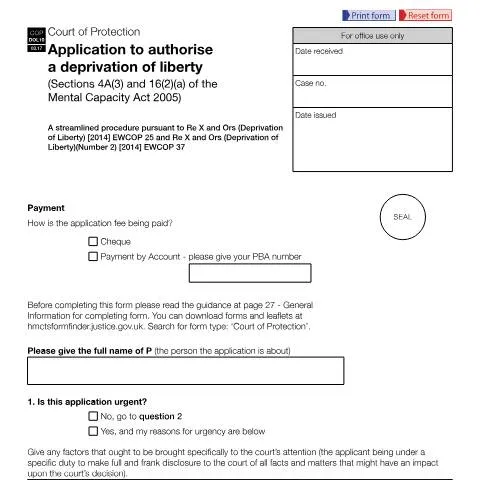
In the intricate landscape of mental capacity law, few documents carry as much weight as Form COP DOL10. This application represents one of the most significant interventions the Court of Protection can make in someone's life: the formal authorisation to deprive a person of their liberty. Unlike standard care arrangements or even sectioning under the Mental Health Act 1983, a DOL10 application addresses the grey area where necessary care becomes restrictive enough to constitute a deprivation of liberty under Article 5 of the European Convention on Human Rights.
The form emerged from landmark cases like Re X and Ors (Deprivation of Liberty) [2014] EWCOP 25, which established streamlined procedures for what had become an overwhelming number of applications following the Supreme Court's decision in P v Cheshire West and Chester Council. This ruling dramatically lowered the threshold for what constitutes a deprivation of liberty, transforming thousands of care arrangements overnight into situations requiring court authorisation.
The Acid Test: When Care Becomes Deprivation
The Cheshire West judgment introduced the "acid test" for deprivation of liberty: is the person subject to continuous supervision and control, and are they free to leave? If both answers point to restriction, a DOL10 application becomes necessary regardless of the person's compliance, contentment, or the care quality. This has profound implications for supported living arrangements, residential care, and even some family situations.
Consider a young adult with learning disabilities living in supported accommodation. They may be happy, well-cared for, and unable to understand the concept of leaving. However, if staff supervise them continuously and they cannot leave unaccompanied, this arrangement legally constitutes a deprivation of liberty requiring court authorisation through Form COP DOL10.
Navigating the Dual Assessment Framework: Capacity and Medical Certification
Form COP DOL10 demands two distinct but interconnected assessments that often confuse applicants unfamiliar with mental capacity law. The framework reflects the Court of Protection's jurisdiction under sections 4A(3) and 16(2)(a) of the Mental Capacity Act 2005, requiring both a capacity assessment and medical evidence of "unsoundness of mind" - a term that harks back to older mental health legislation but remains legally necessary.
The Capacity Assessment Requirement
Section 1 of Annex A requires confirmation that P (the person the application concerns) lacks capacity to consent to the proposed arrangements. This assessment must follow the Mental Capacity Act's statutory principles: assuming capacity unless proven otherwise, taking all practical steps to help the person make the decision, and accepting that unwise decisions don't automatically indicate incapacity.
The assessment typically accompanies Form COP3, though the DOL10 accepts "other evidence of capacity" in specific circumstances. Crucially, if the COP3 isn't completed by a registered medical practitioner, additional medical evidence becomes mandatory. This dual requirement often catches social workers and care coordinators off-guard, particularly in urgent applications where time constraints make obtaining comprehensive assessments challenging.
Medical Evidence and the "Unsoundness of Mind" Threshold
The requirement for medical diagnosis of "unsoundness of mind" serves a specific legal purpose beyond the capacity assessment. This terminology, while archaic, ensures the application meets European Convention requirements for lawful detention. The medical evidence must come from a registered medical practitioner and provide a clear diagnostic framework for the person's mental disorder or learning disability.
In practice, this might involve a consultant psychiatrist's report for someone with dementia, a learning disability specialist's assessment for someone with autism, or a neurologist's evaluation for someone with acquired brain injury. The key distinction lies in providing medical rather than purely social evidence for the necessity of restrictive arrangements.
Applicant Profiles and Institutional Responsibilities
Understanding who can and should submit DOL10 applications reveals much about the form's practical operation. The application process reflects the legal duty placed on various bodies to seek authorisation rather than implement potentially unlawful restrictions.
| Applicant Type | Typical Scenarios | Key Considerations |
|---|---|---|
| Local Authority | Supported living, residential care, emergency placements | Statutory duty under Care Act 2014; must demonstrate best interests process |
| NHS Trust/Foundation Trust | Hospital settings, community treatment, learning disability services | Often concurrent with treatment decisions; may involve Mental Health Act interface |
| Clinical Commissioning Group | Commissioned care packages, continuing healthcare arrangements | Funding responsibility creates legal obligation to seek authorisation |
| Family Members | Home care with restrictions, family carer arrangements | Must demonstrate necessity and proportionality; court scrutinises family dynamics |
Local Authority Applications: The Majority Pathway
Local authorities submit the vast majority of DOL10 applications, reflecting their statutory duties under the Care Act 2014 and their role in arranging care for adults lacking capacity. These applications often arise during care transitions: moving from family home to supported living, hospital discharge planning, or responding to changed circumstances in existing placements.
The form requires detailed information about P's current living arrangements, including tenancy agreements and authority to sign legal documents. This reflects the court's concern that deprivation of liberty shouldn't be used to circumvent proper legal processes for accommodation arrangements. Local authorities must carefully consider whether they need separate court authority for tenancy matters alongside the DOL10 application.
NHS Applications: Medical Complexity and Treatment Interface
NHS applications typically involve more complex medical scenarios where treatment decisions intersect with liberty restrictions. These might include long-term hospital patients awaiting discharge, individuals requiring specialist medical interventions, or people whose medical needs create inherent restrictions on their freedom.
The form specifically asks about existing Mental Health Act provisions - detention, Community Treatment Orders, or guardianship. This reflects the complex legal landscape where different statutory frameworks might apply to the same person. The court must ensure that DOL10 authorisation doesn't conflict with existing mental health legislation or treatment requirements.
Crafting the Application: From Draft Orders to Supporting Evidence
Section 2 of the form demands applicants specify the exact nature of the order sought and attach a draft - a requirement that often proves more challenging than anticipated. The draft order must be precise enough to authorise specific restrictions while flexible enough to accommodate necessary changes in care arrangements.
Defining Proportionate Restrictions
Effective draft orders balance specificity with practicality. Rather than seeking blanket authorisation for "deprivation of liberty," successful applications detail particular restrictions: supervision requirements, limitations on leaving unaccompanied, security measures, or constraints on visitors. The court expects evidence that each restriction serves a legitimate purpose in P's best interests.
For example, an application for someone with dementia might seek authority for: "Continuous supervision within the care home and grounds; prevention from leaving unaccompanied; use of door sensors and CCTV for safety monitoring; and structured activity programmes with escort support for community access."
Duration and Review Considerations
While the form notes that authorisations will be reviewed annually, applicants must consider whether shorter review periods are appropriate. This decision should reflect P's circumstances, the likelihood of change in their condition, and the nature of restrictions imposed. Progressive conditions like dementia might warrant longer initial periods, while acquired brain injuries or mental health conditions might benefit from more frequent review.
The court increasingly expects applications to demonstrate how restrictions might be reduced over time, particularly for younger adults or those with conditions that may improve with appropriate support and intervention.
Evidence Compilation and the Best Interests Framework
Annex A's evidence requirements extend far beyond the basic capacity and medical assessments. Section 4 demands comprehensive documentation of care planning processes, reflecting the court's expectation that deprivation of liberty represents a last resort following thorough best interests consideration.
Care Planning Documentation
The required care or support plan must demonstrate how proposed restrictions serve P's best interests while minimising liberty restrictions. This involves detailed analysis of alternative arrangements considered and rejected, consultation with relevant people in P's life, and clear rationale for why less restrictive options won't meet P's needs.
Best interests assessments require particular attention to P's past and present wishes, values, and beliefs. The court scrutinises whether assessors have genuinely engaged with P's perspective and involved appropriate family members, friends, or advocates in the decision-making process.
Transition Planning and Accommodation Issues
Section 3 addresses practical arrangements that often determine application success. The court needs clear information about P's current living situation, reasons for any proposed moves, and how P has responded to changes. Rushed applications following emergency placements often fail because inadequate transition planning suggests the deprivation of liberty wasn't properly considered in advance.
Questions about tenancy agreements reflect growing judicial concern about the interface between capacity law and housing rights. The court may refuse applications where accommodation arrangements haven't been properly addressed through appropriate legal channels.
Urgency Applications and the Streamlined Procedure
Question 1's urgency provisions reflect the practical reality that care crises don't wait for court timetables. However, claiming urgency triggers enhanced scrutiny and specific procedural requirements that applicants must understand thoroughly.
Defining Genuine Urgency
The court distinguishes between administrative convenience and genuine urgency requiring immediate intervention. Acceptable urgency typically involves immediate risk to P's safety, emergency hospital admissions requiring ongoing restrictions, or situations where delay would cause significant harm to P's physical or psychological wellbeing.
Poor planning doesn't constitute urgency. Applications claiming urgency because of impending care home placements arranged months in advance, or routine transitions that could have been anticipated, face judicial criticism and potential cost consequences for applicants.
The Streamlined Procedure Framework
References to Re X and Ors (Deprivation of Liberty) [2014] EWCOP 25 and its sequel establish streamlined procedures for straightforward cases meeting specific criteria. These procedures can significantly reduce court processing times but require careful attention to eligibility requirements and documentation standards.
Streamlined applications typically involve uncontested cases where P lacks litigation capacity, all relevant parties consent to the proposed arrangements, and the restrictions are clearly necessary and proportionate. The procedure isn't automatic - applicants must demonstrate their case meets streamlined criteria while providing all required evidence.
Payment Mechanisms and Administrative Processing
The form's payment section reflects the Court of Protection's fee structure and the practical realities of institutional applications. Understanding payment options and their implications helps ensure smooth application processing without unnecessary delays.
Payment by Account Systems
The Payment by Account (PBA) system serves regular applicants like local authorities and NHS trusts, allowing streamlined fee processing for multiple applications. PBA numbers must be current and have sufficient funds; insufficient balances can delay application processing significantly.
Organisations new to DOL10 applications often underestimate the administrative burden of maintaining PBA accounts and ensuring adequate funding for potentially large numbers of applications. The post-Cheshire West landscape has seen some authorities submitting hundreds of applications annually.
Fee Exemptions and Remissions
While the form doesn't detail fee exemption procedures, the Court of Protection operates remission schemes for applicants meeting specific criteria. Family members on low incomes, individuals receiving certain benefits, or cases involving exceptional circumstances may qualify for reduced or waived fees.
However, fee exemptions require separate applications with detailed financial disclosure, potentially delaying urgent cases if not considered in advance.
Post-Application Procedures and Judicial Oversight
Submitting Form COP DOL10 initiates a judicial process extending far beyond simple administrative approval. Understanding post-application procedures helps applicants prepare for ongoing court involvement and ensures compliance with any orders granted.
The court may request additional evidence, order independent assessments, or require case management hearings before determining applications. Complex cases involving family disputes, uncertain medical prognoses, or novel legal issues may require full hearings with expert evidence and legal representation for multiple parties.
Successful applications result in court orders with specific conditions and review requirements. Applicants must understand their ongoing obligations to report significant changes in P's circumstances, comply with any monitoring requirements, and prepare for periodic reviews of the authorisation.
The Court of Protection retains ongoing jurisdiction over authorised deprivations of liberty, meaning that circumstances changing after the initial order may require further applications or variations. This creates an ongoing relationship between applicants and the court that extends well beyond the initial DOL10 submission, emphasising the importance of robust systems for monitoring and reporting on authorised arrangements.