Navigating the COP DLB Form: Understanding Its Critical Role
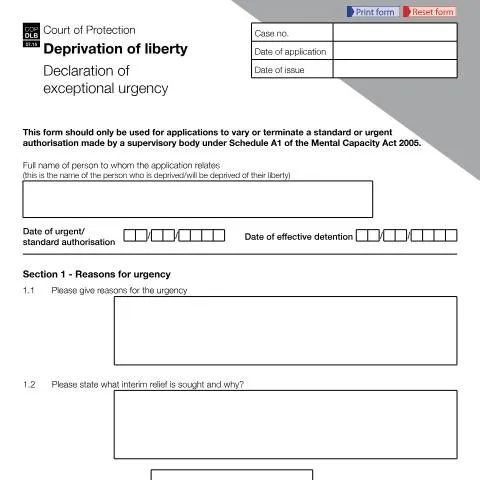
In the realm of legal proceedings concerning the deprivation of liberty, the COP DLB Form emerges as a vital tool for those seeking urgent intervention. This form, officially titled the Deprivation of Liberty - Declaration of Exceptional Urgency, primarily serves to facilitate applications for interim relief under exceptional circumstances. Understanding its context within the legal framework is crucial for individuals who find themselves needing to act swiftly in such sensitive situations.
When Time is of the Essence: Recognizing Urgency
In circumstances where a person's liberty may be at risk, understanding the criteria that define urgency is fundamental. The form specifically caters to cases that demand immediate judicial attention, bypassing the usual timelines typically associated with court submissions. This urgency may arise from factors such as:
- Health Risks: Situations where a delay could exacerbate physical or mental health conditions.
- Risk of Harm: Scenarios in which there is a potential threat to the individual’s safety or well-being.
- Legal Complications: Instances where immediate action is necessary to address potential breaches of rights or legal standards.
Specific Examples of Urgency
To illustrate, consider a case where an individual is detained in a care facility without proper authorization. If there are indications that the individual is suffering due to the lack of legal oversight, a COP DLB form can be expedited to seek judicial relief. The urgency of the matter is paramount—inaction could lead to irreversible harm.
Detailed Breakdown of Completing the COP DLB Form
Completing the COP DLB form requires attention to detail and a clear understanding of the necessary information. Each section of the form is designed to capture specific aspects of the application:
Section 1: Reasons for Urgency
In this section, applicants must clearly articulate the reasons necessitating urgent intervention. Providing detailed explanations, including supporting evidence if available, is critical to facilitate a swift response from the court. Key points to address include:
- The specific circumstances leading to the sense of urgency.
- The implications of delay on the individual involved.
Section 2: Proposed Timetable
Here, the applicant outlines an ideal timeframe for the application process. This section is particularly important as it reflects the urgency of the situation. Indicating expected timelines helps the court prioritize cases effectively.
- Specify whether relief is sought immediately or within a certain number of hours/days.
- Indicate if an abridgement of time is required for lodging acknowledgments of service.
Section 3: Service of the Application
Properly serving the application is not just a procedural formality; it ensures all relevant parties are informed. This section necessitates listing all individuals and organizations that have received a copy of the form, which may include:
- The relevant person affected by the deprivation of liberty.
- The managing authority of the place of detention.
- The supervisory body overseeing the individual's care.
Clearly documenting how and when each party was served—whether via fax, email, or in person—provides a comprehensive record that may be essential for later proceedings.
Understanding Distinctions: COP DLB vs. Other Related Forms
While the COP DLB form is pivotal in urgent scenarios, it is essential to distinguish it from other forms that might be relevant in similar contexts. For instance:
| Form | Purpose | Usage Context |
|---|---|---|
| COP DLB | Urgent application for deprivation of liberty | Exceptional circumstances requiring swift judicial intervention |
| COP C1 | General application to the Court of Protection | Standard applications regarding mental capacity |
| COP DLB1 | Notification form for deprivation of liberty | Regular reporting on ongoing deprivation authorizations |
Understanding these distinctions ensures that individuals apply the correct form in the appropriate circumstances, thereby reducing the risk of delays and complications in their cases.
Preparing Supporting Documentation: Essential Justifications
Substantiating an application for urgent relief demands careful preparation of supporting documents. The key is to align each document with the specific reasons for urgency outlined in the form. Common types of documentation include:
Health Assessments
Documentation from healthcare professionals detailing the individual’s physical and mental health status can substantially bolster an application. These assessments should:
- Clearly articulate the health risks associated with continued detention.
- Include recommendations for immediate action based on the patient's condition.
Legal Certifications
In certain instances, obtaining legal opinions or certifications that validate the urgency of intervention may be beneficial. This could include:
- Letters from solicitors outlining potential breaches of rights.
- Statements reflecting any ongoing legal proceedings relevant to the case.
Supporting Witness Statements
Including testimonies from family members, care staff, or independent advocates can provide additional perspectives on the individual's circumstances, emphasizing the urgency of the situation.
Submitting the COP DLB Form: Channels and Procedures
The submission of the COP DLB form is a critical step in the application process. Applicants have various channels available, each with distinct implications for processing times and formalities:
Online Submissions
When submitting online, ensure that all documents are digitized and compliant with data protection standards as per the Data Protection Act 2018 and UK GDPR. Online submissions often lead to quicker processing times due to reduced handling delays.
Paper Submissions
For those opting for paper submissions, it’s advisable to utilize recorded delivery services to confirm receipt. This method can provide peace of mind, albeit with potentially longer processing times. The following should be considered:
- Prepare multiple copies of the completed form.
- Ensure all supporting documents are included in the envelope.
In-Person Submissions
Submitting the form in person can be beneficial in urgent cases, enabling immediate dialogue with court officials. However, this channel is typically reserved for critical situations where quick resolution is paramount. Considerations include:
- Arriving well before the court's operational hours to accommodate potential delays.
- Bringing additional copies of the form to leave with court management.
Following Up: Understanding the Administrative Process
Once the COP DLB form has been submitted, it is essential to understand how the administration processes these applications. Typically, the court will prioritize applications marked as urgent, yet applicants should remain proactive in monitoring their progress:
Tracking Case Progress
To track the progress of the application, individuals can:
- Contact the court directly with their case number for updates.
- Consult legal representatives for insights into expected timelines and potential next steps.
Responding to Court Decisions
Upon receiving a decision from the court, it is critical to review the outcome carefully. If the application is granted, instructions regarding the next steps will be outlined. However, in cases of refusal:
- Evaluate the court's reasons for denial, as this may provide avenues for appeal or further action.
- Consider consulting a legal advisor to explore options for reapplication or supplementary support.
Addressing Potential Challenges: Errors and Omissions
Errors in the COP DLB form can lead to delays or even outright refusals. Being meticulous in the preparation and submission phases is crucial. Common pitfalls to avoid include:
- Incomplete fields or sections, particularly regarding reasons for urgency.
- Failure to serve all relevant parties as required, which could invalidate the proceedings.
- Missing or inadequate supporting documentation that fails to substantiate claims of urgency.
In cases where a mistake is identified, promptly communicating with the court is essential. Applications to amend the submitted form can sometimes be made, but understanding the specific protocols involved is vital.
Conclusion: Empowering Action in Urgent Situations
Ultimately, the COP DLB form serves as a critical mechanism for safeguarding individual rights in urgent situations where deprivation of liberty is at stake. Being well-informed about its function, completion, submission, and follow-up processes can empower applicants to navigate these challenging circumstances with greater confidence and efficiency. By taking proactive steps and understanding the nuances of this form, individuals can effectively advocate for themselves or their loved ones, ensuring timely judicial intervention when it matters most.
Understanding Deprivation of Liberty Safeguards (DoLS) in the UK
Deprivation of Liberty Safeguards (DoLS) provide legal protection for individuals who are unable to make decisions about their care or treatment due to a lack of mental capacity. This framework was established under the Mental Capacity Act of 2005, ensuring that any care or treatment provided to individuals who are deemed to lack capacity is in their best interests and is not overly restrictive. Understanding the nuances of DoLS is critical, especially when considering Form COP DLB for declarations of exceptional urgency.
In circumstances where a person's liberty is restricted, it is imperative to assess whether the restrictions are lawful. The key principle behind DoLS is that the individual's rights are protected, and their liberty should only be deprived when it is necessary and proportionate. This becomes particularly crucial when it comes to urgent situations, where immediate actions may be required to safeguard the well-being of the individual.
Local authorities and care providers play significant roles in assessing situations that might trigger a DoLS application. They must ensure that they follow proper procedures, which involve detailed assessments by trained professionals, including social workers or healthcare practitioners, who evaluate the mental capacity of the individual and the necessity of the proposed care arrangements. If a situation arises that requires urgent intervention, practitioners must act swiftly, and this is where the Form COP DLB comes into play.
When to Use Form COP DLB: Criteria and Process
Form COP DLB is specifically designed for scenarios where there is an immediate risk to an individual's health and welfare, necessitating a swift application to a court for a decision regarding the deprivation of liberty. The circumstances under which this form should be used are typically categorized by the urgency and nature of the situation.
The criteria for using Form COP DLB include scenarios where:
- The individual is in a care setting where a decision must be made promptly to prevent harm.
- There is no time to apply for a standard DoLS authorisation, typically taking longer to process.
- The individual’s safety is at immediate risk, and any delay could result in significant harm.
To initiate the process, the applicant—often a care provider or local authority—must complete the form, providing detailed information about the individual, the circumstances leading to the urgent application, and the specific reasons for the deprivation of liberty. Supporting evidence, such as medical assessments and witness statements, is crucial in establishing the urgency and justifying the need for immediate action.
Once the form is submitted, it is crucial to be aware of the potential timelines involved. The court will typically prioritize urgent applications, but the speed of the process can vary based on the court’s workload and the complexity of the case. Ensuring that all requisite information is clearly presented can facilitate a more efficient review and decision-making process by the court.
Post-Application: Steps to Follow After Submitting Form COP DLB
After submitting Form COP DLB, the successful applicant must remain engaged with the process and be prepared for subsequent steps. As the court processes the application, it may require further information or clarification on specific points to ensure the individual's rights are upheld. This phase is vital in maintaining transparency and ensuring that the court has all necessary information to make an informed decision.
During this period, it is also advisable to keep all stakeholders informed, including family members or advocates of the individual, if appropriate. Communication is key, as it helps manage expectations and provides support to those involved during what can be a stressful time.
Assuming the court grants the application, there will be specific conditions outlined that must be adhered to regarding the individual’s care and treatment. This may include regular reviews of the situation to ensure that the deprivation of liberty remains justified and necessary. The court may also impose requirements for periodic reporting back to ensure compliance with the outlined conditions.
If the court denies the application, it is essential to understand the reasoning behind the decision. The applicant may have the right to appeal or to submit a new application later if circumstances change. Familiarity with the appeals process as well as the ability to adapt to changing situations will be crucial for the ongoing care and support of the individual in question.
Finally, documenting the entire process, from the initial application to the court’s response, is crucial for both legal protection and for ongoing assessments of the individual's needs. This can serve as invaluable information for future proceedings or reviews, ensuring that all actions taken are in the individual's best interests and compliant with legal requirements.