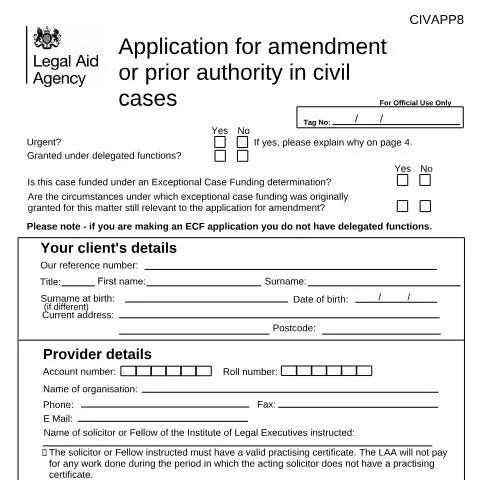
When Civil Legal Aid Needs Adjustment: Understanding the CIV APP8 Amendment Process
Legal representation rarely follows a straight path. What begins as a straightforward family dispute may evolve into complex proceedings requiring specialist counsel. A housing matter initially assessed at £5,000 might balloon into a multi-track claim demanding significantly more resources. In the intricate world of civil legal aid, the CIV APP8 application form serves as the crucial mechanism for adapting certificates to match the evolving reality of legal proceedings.
This Legal Aid Agency document addresses a fundamental challenge within publicly funded legal services: how to maintain appropriate funding levels and scope when circumstances change. Unlike criminal legal aid where amendments follow different procedures, civil cases demand careful justification for any deviation from the original certificate terms. The CIV APP8 form bridges the gap between initial assessments and the practical demands that emerge as cases develop.
The form's versatility reflects the complex nature of civil litigation itself. Whether seeking authority to instruct Queen's Counsel for a clinical negligence trial, expanding scope to cover additional family proceedings, or simply changing solicitor due to irreconcilable differences, the CIV APP8 provides the administrative framework for these adjustments. Each amendment type carries distinct requirements, timelines, and approval thresholds that practitioners must navigate carefully.
The Regulatory Framework: From LASPO to Current Practice
The Legal Aid, Sentencing and Punishment of Offenders Act 2012 fundamentally reshaped civil legal aid provision, creating a more restrictive landscape where amendments require increasingly robust justification. The CIV APP8 form operates within this framework, implementing the Civil Legal Aid (Merits Criteria) Regulations 2012 and the detailed provisions of the Funding Code.
Schedule 1 of LASPO defines which civil matters remain within scope for legal aid. When practitioners seek amendments through CIV APP8, they must demonstrate continued compliance with these statutory criteria. This creates particular complexity for cases spanning multiple areas of law or evolving beyond their original classification. A housing possession case that develops discrimination elements, for instance, requires careful navigation of different evidential requirements.
Exceptional Case Funding (ECF) adds another layer of complexity. Cases funded under ECF determinations face additional scrutiny when seeking amendments, as practitioners must show the exceptional circumstances justifying original funding remain relevant to the proposed changes. The form explicitly addresses this scenario, requiring detailed explanation of how original ECF criteria continue to apply.
The regulatory emphasis on proportionality means amendment applications face rigorous cost-benefit analysis. The Legal Aid Agency examines whether proposed changes represent value for public money, considering factors like prospects of success, potential benefit to the client, and availability of alternative remedies. This scrutiny has intensified following periodic reviews highlighting concerns about cost escalation in publicly funded cases.
Delegated Functions and Authority Limits
The relationship between delegated functions and amendment applications creates important practical considerations. Providers operating under delegated functions can make certain amendments without prior authority, but the CIV APP8 form clarifies that ECF applications fall outside this delegation. This distinction affects timing and approval processes, particularly in urgent cases where delays could prejudice client interests.
Decoding Amendment Categories: From Simple Changes to Complex Restructuring
The CIV APP8 form categorises amendments into distinct types, each governed by different approval criteria and evidential requirements. Understanding these categories helps practitioners select appropriate applications and prepare compelling justifications.
| Amendment Type | Complexity Level | Key Requirements | Typical Processing Time |
|---|---|---|---|
| Change of solicitor | Low-Medium | Detailed reasons, complaint documentation if applicable | 10-15 working days |
| Costs limitation increase | Medium-High | Breakdown of future costs, justification for additional work | 15-20 working days |
| Scope expansion | High | Merits assessment, proportionality analysis | 20-30 working days |
| Form of service change | Medium-High | Evidence of continued eligibility, procedural compliance | 15-25 working days |
Changes to other party details represent the most straightforward amendments, typically approved administratively where the change reflects factual updates rather than substantive case development. However, even these seemingly simple changes can trigger broader reviews if they affect the fundamental nature of proceedings.
Prior authority applications for counsel instruction require particular attention to the Legal Aid Agency's counsel guidelines. The form demands justification not just for instructing counsel generally, but for the specific level of counsel proposed. Instructions for Queen's Counsel in clinical negligence cases, for example, require demonstration that the complexity or value justifies the additional expense over junior counsel.
Scope Limitation Modifications
Expanding scope limitations often represents the most challenging amendment category. The Legal Aid Agency scrutinises whether additional proceedings genuinely advance client interests or merely extend litigation unnecessarily. Family cases seeking to add private law children proceedings must satisfy strict evidential requirements around domestic abuse or child welfare concerns.
The form's detailed provisions for family proceedings requiring evidence of child abuse or domestic abuse reflect legislative requirements under regulations 33 and 34 of the Civil Legal Aid (Procedure) Regulations 2012. Practitioners must provide specific documentary evidence meeting prescribed criteria, with the Legal Aid Agency maintaining strict interpretations of what constitutes acceptable proof.
Navigating Exceptional Case Funding Amendments
Cases funded under Exceptional Case Funding face unique challenges when seeking amendments through CIV APP8. The form explicitly addresses ECF scenarios, recognising that changes to exceptionally funded cases require careful evaluation of whether original exceptional circumstances remain applicable.
The Legal Aid Agency treats ECF amendments with heightened scrutiny, reflecting the principle that exceptional funding should remain truly exceptional. Practitioners must demonstrate not only that the proposed amendment meets standard merits criteria but also that it aligns with the exceptional circumstances justifying original funding. This creates a two-tier test that can prove challenging to satisfy.
Connected matters rule applications under paragraph 46 of Part 1 of Schedule 1 require particular attention in ECF contexts. The form demands detailed explanation of how additional proceedings connect to the originally funded exceptional matter, with the Legal Aid Agency examining whether the connection genuinely justifies extended exceptional funding or whether separate assessment is more appropriate.
Timing considerations become critical in ECF amendment applications. Unlike standard civil legal aid where some amendments can proceed under delegated functions, ECF cases require prior authority for all changes. This can create practical difficulties in fast-moving litigation where immediate action is necessary to protect client interests.
Documentation Requirements for ECF Amendments
ECF amendment applications must include comprehensive documentation linking proposed changes to original exceptional circumstances. This typically involves updating the original ECF1 application to reflect current case development while maintaining coherent justification for exceptional funding. The Legal Aid Agency examines whether circumstances have changed sufficiently to undermine the exceptional nature of the case.
Clinical Negligence and Specialist Proceedings: Category-Specific Considerations
The CIV APP8 form's contract category selection reflects the specialised nature of different civil proceedings, with clinical negligence, housing, and immigration cases each presenting distinct amendment challenges. Clinical negligence amendments often involve significant cost increases as cases develop from initial investigations to full liability and quantum assessments.
Clinical negligence cases frequently require multiple amendments as expert evidence emerges and case complexity becomes apparent. Initial certificates may cover liability investigation only, with subsequent CIV APP8 applications seeking authority for quantum experts, counsel instruction, and expanded scope to cover complex medical issues. The Legal Aid Agency applies specialist expertise in assessing these applications, considering factors like case value, complexity, and prospects of success.
Housing cases present different amendment patterns, often requiring scope expansion as possession proceedings develop into disrepair counterclaims or human rights challenges. The form's housing category encompasses various proceedings types, from straightforward possession defences to complex public law challenges against local authority housing decisions.
| Case Category | Common Amendment Requests | Key Assessment Factors |
|---|---|---|
| Clinical Negligence | Expert instruction authority, costs increases, counsel instruction | Case value, complexity, expert necessity |
| Housing | Scope expansion, counterclaim authority, human rights elements | Proportionality, alternative remedies, public interest |
| Immigration | Appeal authority, judicial review scope, fresh claim coverage | Prospects of success, Article 8 considerations, country guidance |
| Family | Private law additions, fact-finding hearing coverage, expert instruction | Child welfare, domestic abuse evidence, court directions |
Immigration and asylum cases face particular complexity due to rapidly changing country guidance and evolving legal precedents. CIV APP8 applications in immigration cases must address how developments in country conditions or legal interpretation affect original assessments, with the Legal Aid Agency considering factors like fresh evidence availability and prospects of success under current guidance.
Mental Health and Community Care Specialisms
Mental health proceedings often require urgent amendments as client circumstances change or court directions emerge requiring additional expert evidence. The form's mental health category encompasses various proceedings from Mental Health Act appeals to Court of Protection matters, each with distinct procedural requirements affecting amendment applications.
Community care cases frequently develop beyond initial assessments as local authority decision-making processes unfold and care needs become clearer. CIV APP8 applications must demonstrate how proposed amendments serve the client's care interests while maintaining proportionality with likely outcomes.
Strategic Timing and Procedural Compliance
The timing of CIV APP8 applications can significantly impact approval prospects and case progression. The Legal Aid Agency expects practitioners to anticipate likely developments and submit applications with sufficient notice to avoid delays in proceedings. However, the unpredictable nature of litigation means some amendments require urgent consideration.
The form includes specific provisions for urgent applications, recognising that some circumstances demand immediate action to protect client interests. Urgent applications receive expedited processing but require compelling justification for the urgency claim. The Legal Aid Agency distinguishes between genuine urgency arising from court directions or developing circumstances and poor case management leading to last-minute applications.
Court allocation and case management considerations feature prominently in amendment assessments. The form requires details of court track allocation and case progression, with the Legal Aid Agency examining whether proposed amendments align with court expectations and case management directions. Fast-track and multi-track cases face different scrutiny levels, reflecting their distinct procedural demands and cost implications.
Practitioners must balance timing considerations with thorough application preparation. Rushed applications lacking detailed justification face higher refusal rates, potentially causing greater delays than careful preparation would have involved. The Legal Aid Agency's processing times vary by amendment type and complexity, with urgent applications potentially processed within days while complex scope expansions may require several weeks.
Settlement Considerations and Case Conclusion Projections
The form's requirement for case conclusion projections reflects the Legal Aid Agency's emphasis on proportionality and cost control. Practitioners must assess realistically whether proposed amendments represent value for money given likely case outcomes, including settlement prospects and trial alternatives.
Settlement negotiations can significantly affect amendment applications, particularly those seeking cost increases or scope expansions. The Legal Aid Agency examines whether parties have explored settlement opportunities and whether proposed amendments genuinely advance resolution prospects or merely extend litigation unnecessarily.
Documentation Standards and Evidence Requirements
Successful CIV APP8 applications depend heavily on comprehensive supporting documentation that substantiates requested amendments. The Legal Aid Agency's assessment process relies on written evidence, making document quality and completeness crucial to approval prospects.
CAFCASS reports, counsel's opinions, and expert reports feature prominently in family and clinical negligence amendments. The form specifically references these document types, reflecting their importance in justifying scope expansions or cost increases. However, practitioners must ensure these documents directly support the amendment request rather than merely providing general case background.
Change of solicitor applications require particular attention to documentation standards, especially where client dissatisfaction motivates the change. The form demands evidence of complaint procedures and outcomes, with the Legal Aid Agency examining whether relationship breakdown genuinely necessitates solicitor change or whether alternative resolution is possible.
Cost breakdown documentation becomes critical for limitation increase applications. The Legal Aid Agency expects detailed analysis of how existing limits have been reached and realistic projections of future expenditure. Vague estimates or inflated projections face scrutiny, with practitioners required to justify every element of proposed additional costs.
Evidential Requirements for Domestic Abuse and Child Welfare Cases
Family proceedings involving domestic abuse or child welfare concerns face stringent evidential requirements reflecting the serious nature of these allegations and their impact on legal aid eligibility. The CIV APP8 form incorporates specific sections addressing these requirements, implementing regulations 33 and 34 of the Civil Legal Aid (Procedure) Regulations 2012.
Domestic abuse evidence must meet prescribed criteria including police reports, medical records, or court findings. The Legal Aid Agency maintains strict interpretation of what constitutes acceptable evidence, with practitioners required to provide original documents rather than summaries or extracts. Time limits on evidence validity add further complexity, particularly in cases where abuse occurred some years previously.
Child welfare evidence requirements vary depending on the specific risk factors involved. The form distinguishes between different types of child abuse evidence and their respective documentation requirements, with practitioners required to provide detailed explanation of how evidence supports the amendment request.
Processing Pathways and Decision-Making Structures
The Legal Aid Agency's processing of CIV APP8 applications follows established pathways reflecting case complexity and amendment type. Understanding these pathways helps practitioners set realistic expectations and plan case progression accordingly.
Simple amendments like administrative changes or minor cost increases often receive delegated decision-making, with regional offices empowered to approve straightforward applications. More complex amendments requiring policy interpretation or significant resource allocation escalate to specialist decision-makers with relevant expertise.
Contract category routing ensures applications reach appropriate specialist teams. Clinical negligence applications route to teams with medical expertise, while immigration cases reach decision-makers familiar with current country guidance and legal developments. This specialisation improves decision quality but can affect processing times during periods of high demand.
The form's reference number system facilitates tracking and correspondence, with practitioners able to monitor application progress through established channels. However, the Legal Aid Agency discourages frequent status enquiries, preferring practitioners to allow reasonable processing time before seeking updates.
Appeal rights apply to refused CIV APP8 applications, though the appeal process varies depending on the amendment type and refusal grounds. Practitioners must consider whether appeal prospects justify the additional time and resources involved, particularly in cases where alternative approaches might achieve similar outcomes more efficiently.
Quality assurance measures within the Legal Aid Agency include regular review of amendment decisions and analysis of approval patterns. This ongoing monitoring helps identify inconsistencies and ensures decision-making aligns with policy objectives while maintaining appropriate standards across different case types and regional offices.