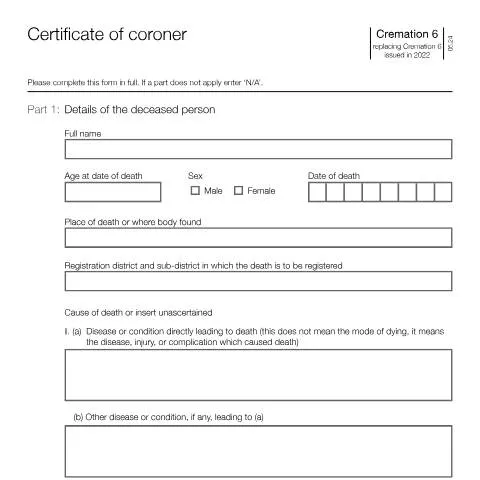
When Death Requires Coronial Authority: Understanding the Certificate of Coroner
In England and Wales, certain deaths cannot proceed to cremation through the standard medical certification route. When a coroner has conducted or initiated an investigation into a death under the Coroners and Justice Act 2009, or when a death has occurred outside the British Islands, the Certificate of coroner becomes the essential document authorising cremation. This specialised certificate, designated as Cremation 6, serves as both a medical record and legal authorisation, replacing the standard medical certificates typically required for cremation.
The certificate addresses a critical gap in the cremation process: ensuring that bodies subject to coronial jurisdiction can be cremated without compromising ongoing investigations or legal proceedings. Unlike routine deaths certified by attending physicians, these cases require the coroner's explicit confirmation that the body is no longer needed for investigative purposes.
The Coronial Investigation Framework and Cremation Authority
Coroners in England and Wales operate under a statutory duty established by the Coroners and Justice Act 2009. When a death is reported to a coroner—typically involving sudden, unexplained, violent, or suspicious circumstances—they must determine whether a formal investigation is necessary. The Certificate of coroner emerges from this process, serving two distinct scenarios.
The first scenario covers deaths where the coroner has conducted or initiated an investigation under section 1 of the Coroners and Justice Act 2009. This encompasses cases where the coroner has assumed jurisdiction but has concluded that the body is no longer required for investigative purposes. The investigation may be ongoing, but physical examination of the remains is complete.
The second scenario addresses deaths occurring outside the British Islands where no coronial investigation is deemed necessary. This typically involves British nationals who die abroad under circumstances that would not normally trigger a coronial investigation if the death had occurred domestically. The certificate confirms that repatriated remains can proceed to cremation without further coronial oversight.
Jurisdictional Boundaries and International Deaths
The distinction between deaths within and outside the British Islands carries significant procedural implications. The British Islands, for coronial purposes, encompass England, Wales, Scotland, Northern Ireland, the Isle of Man, and the Channel Islands. Deaths beyond these territories may require diplomatic coordination and additional documentation before cremation can be authorised.
For expatriates and travellers, this provision ensures that families can proceed with cremation arrangements in the UK without bureaucratic delays, provided the death circumstances do not warrant further investigation.
Medical Certification Requirements and Hazardous Implant Protocols
The certificate demands comprehensive medical information, reflecting the coroner's responsibility to maintain accurate death records. The cause of death section follows the World Health Organization's International Classification of Diseases format, requiring a sequential chain of medical conditions leading to death.
Part I of the medical certification requires four potential entries: the immediate cause of death, and up to three antecedent conditions that contributed to the fatal sequence. This differs markedly from a simple cause of death statement, demanding medical precision about the pathological process.
| Medical Section | Requirement | Example |
|---|---|---|
| I(a) Direct cause | Disease/condition directly causing death | Respiratory failure |
| I(b) Antecedent condition | Condition leading to I(a) | Pneumonia |
| I(c) Antecedent condition | Condition leading to I(b) | Chronic obstructive pulmonary disease |
| I(d) Antecedent condition | Condition leading to I(c) | Long-term smoking |
| Part II | Contributing conditions | Diabetes mellitus |
Hazardous Implant Management Under Cremation Regulations
The Cremation (England and Wales) Regulations 2008 mandate specific attention to hazardous implants, addressed in Part 1, sections III through V of the certificate. Regulation 16(c)(ii) requires identification and management of devices that could pose risks during cremation, including pacemakers, radioactive implants, and specialised orthopaedic devices such as the 'Fixion' intramedullary nailing system.
The certificate requires explicit confirmation of implant removal or, if removal has not occurred, detailed specification of device type and anatomical location. This information enables crematorium operators to implement appropriate safety protocols, potentially including delayed cremation to allow radioactive decay or specialised handling procedures.
Obtaining the Certificate: Process and Participants
The Certificate of coroner can only be issued by a qualified coroner or, in some jurisdictions, by assistant coroners acting under delegated authority. The process typically begins when cremation arrangements are initiated for a death under coronial jurisdiction.
Funeral directors usually coordinate the certificate request, liaising between bereaved families and the coroner's office. However, the certificate cannot be issued until the coroner has completed all necessary examinations and investigations related to the death. This may include post-mortem examinations, toxicology testing, or witness statements, depending on the case circumstances.
Documentation Requirements and Supporting Evidence
Before issuing the certificate, coroners must verify the deceased's identity and confirm that all investigative requirements have been satisfied. This typically involves:
- Formal identification of the deceased by a qualified person
- Completion of any ordered post-mortem examinations
- Receipt of outstanding test results, including toxicology reports
- Confirmation that the body is no longer required for legal proceedings
- Verification of registration district details for death registration purposes
The coroner must also ensure that the cause of death can be accurately certified. In cases where the cause remains unascertained despite investigation, this must be explicitly stated on the certificate, though cremation can still proceed.
Legal Authority and Acceptance by Crematoria
The Certificate of coroner carries the full legal authority of the issuing coroner's office and serves as sufficient authorisation for cremation under English and Welsh law. Crematoria are legally obligated to accept valid certificates and cannot demand additional medical certification once a coroner has assumed jurisdiction over a death.
The certificate's legal weight stems from the coroner's statutory authority under the Coroners and Justice Act 2009. Unlike medical practitioners who certify routine deaths, coroners are judicial officers with investigative powers, lending additional legal certainty to their certification decisions.
Validation and Verification Procedures
Crematorium operators must verify the certificate's authenticity, checking the coroner's signature, official stamp, and jurisdiction area. The certificate includes specific fields for the coroner's area, enabling verification that the issuing coroner has appropriate jurisdiction over the death.
Modern coroner services increasingly use security features to prevent fraudulent certificates, though specific security measures are not publicly disclosed for obvious reasons. Crematorium operators maintain direct contact channels with coroner offices to verify questionable certificates.
Registration Coordination and Administrative Integration
Part 3 of the certificate addresses post-cremation notification requirements under the Births and Deaths Registration Act 1926. This section, completed by crematorium registrars, creates an official record of the cremation for registration purposes.
The notification system ensures integration between cremation records and civil registration, maintaining the administrative chain from death occurrence through final disposition. This coordination proves essential for estate administration, insurance claims, and genealogical research.
Timing and Registration District Coordination
The certificate must specify the registration district and sub-district where the death will be registered, ensuring coordination between coronial and civil registration systems. This information enables registrars to locate and update appropriate death records following cremation.
Delays in certificate issuance can affect registration timelines, particularly where families need death certificates for legal or financial purposes. However, cremation generally cannot proceed until the coroner's certificate is available, regardless of external pressures.
Exceptional Circumstances and Certificate Variations
Certain deaths present unique challenges for coronial certification, requiring specialised approaches within the standard certificate framework. Mass casualty incidents, for instance, may involve modified certification procedures while maintaining the essential legal requirements.
Deaths involving national security considerations or ongoing criminal investigations may require additional coordination between coroners and other authorities. The certificate process accommodates these complexities while ensuring families can proceed with cremation arrangements when appropriate.
International Repatriation and Diplomatic Considerations
When certifying deaths that occurred outside the British Islands, coroners may need to coordinate with foreign authorities, diplomatic missions, or international transport companies. The certificate must satisfy both UK cremation requirements and any international documentation standards applied during repatriation.
These cases often involve additional documentation, including foreign death certificates, embassy attestations, and transport permits. The Certificate of coroner serves as the final UK authorisation, confirming that all international requirements have been satisfied.
Professional Standards and Quality Assurance
Coroners issuing cremation certificates operate under professional standards maintained by the Chief Coroner for England and Wales. These standards ensure consistency in certification practices across different coronial areas while accommodating local procedural variations.
The certificate format underwent revision in 2022, reflecting evolving medical understanding and regulatory requirements. The current version incorporates enhanced implant safety provisions and clearer medical certification requirements, improving both accuracy and crematorium safety.
Training requirements for coroners include specific modules on cremation certification, ensuring appropriate understanding of both medical and legal requirements. This specialised knowledge proves crucial given the certificate's dual role as medical record and legal authorisation.
The integration of coronial services with broader death certification systems continues evolving, with digital initiatives potentially streamlining future certificate processes while maintaining essential legal safeguards and medical accuracy standards.
When Multiple Certificates May Be Required
Whilst the coroner typically issues a single certificate following conclusion of proceedings, certain circumstances may necessitate additional certificates or supplementary documentation. Understanding when multiple certificates might be needed can prevent delays in settling the deceased's affairs.
International requirements often trigger the need for multiple certificates. If the deceased held assets abroad, foreign banks, insurance companies, or property registries may require their own certified copies. Some jurisdictions, particularly those outside the Commonwealth, may not recognise standard UK coroner certificates without additional authentication through the Foreign, Commonwealth & Development Office (FCDO) apostille process.
Complex estate situations frequently demand multiple certificates. When the deceased owned property in different jurisdictions within the UK—perhaps a residence in England and rental property in Scotland—separate probate applications may require individual certificates. Similarly, if the deceased held accounts with multiple financial institutions, each may retain an original certificate for their records whilst processing estate claims.
Insurance complications can also necessitate additional certificates. Life insurance policies, particularly those with accidental death clauses, may require specific certification details. Some insurers distinguish between certificates issued following natural death inquests versus those resulting from accident or suicide verdicts, potentially affecting claim processing or payout amounts.
Employment-related death benefits often have distinct certification requirements. Occupational pension schemes may need certificates specifically addressing whether death occurred during active employment or resulted from work-related circumstances. Some schemes maintain separate processes for deaths occurring on company premises versus those happening elsewhere.
Legal proceedings can generate demands for additional certificates. If the death triggers potential civil litigation—such as medical negligence claims or workplace accident cases—solicitors may require multiple certified copies for court filings, expert witness instructions, and disclosure processes. Criminal proceedings following suspicious deaths may similarly necessitate additional certification.
Timing considerations affect certificate availability. Coroners typically cannot issue certificates until all proceedings conclude. If an inquest opens but gets adjourned pending police investigations, families may need interim certificates for immediate practical purposes. The Registrar of Deaths may issue temporary death certificates for urgent matters, though these carry limitations on their acceptance by various institutions.
Regional Variations and Jurisdictional Differences
The coroner system operates differently across UK jurisdictions, creating variations in certificate procedures and requirements that can significantly impact families dealing with cross-border complications.
England and Wales share largely harmonised coroner procedures under the Coroners and Justice Act 2009, though local variations exist. Senior coroners in different areas may have distinct practices regarding certificate timing, particularly for complex cases. Metropolitan areas like London often have more streamlined processes due to higher caseloads, whilst rural coroners may provide more personalised service but potentially longer processing times.
Welsh language considerations add complexity in Wales. Coroners must provide certificates in Welsh when requested, though this may extend processing times if translation services are required. Families have statutory rights to receive all coroner communications in Welsh, including certificates and accompanying documentation.
Scotland operates an entirely different system through the procurator fiscal service. Scottish death certificates following suspicious deaths are issued by the Crown Office and Procurator Fiscal Service (COPFS) rather than coroners. These certificates may not be directly equivalent to English coroner certificates, potentially creating complications for UK-wide estate administration or insurance claims.
Northern Ireland maintains its own coroner system with distinct procedures. Northern Ireland coroners operate under different legislation, and their certificates may contain different information or formatting compared to those issued in England and Wales. This becomes particularly relevant for families with assets or connections across multiple UK jurisdictions.
Cross-border complications frequently arise when deaths occur away from the deceased's normal residence. If someone dies in Scotland but lived in England, determining which jurisdiction's procedures apply can be complex. The location of death typically determines the investigating authority, but subsequent certificate requirements may vary depending on where estate administration occurs.
Military deaths present unique jurisdictional challenges. Service personnel dying abroad may be subject to military coroner procedures, whilst those dying in civilian circumstances within the UK follow standard coroner processes. Military coroners issue certificates under different authorities, which may require additional authentication for civilian purposes.
Maritime deaths create particular complications. Deaths occurring in UK territorial waters fall under coroner jurisdiction, but those in international waters may require certificates from the Maritime and Coastguard Agency or flag state authorities. These variations can significantly impact subsequent administrative processes.
Aviation incidents similarly involve multiple authorities. The Air Accidents Investigation Branch (AAIB) may conduct parallel investigations alongside coroner proceedings, potentially affecting certificate timing and content. International flights create additional complexity regarding which jurisdiction's procedures apply.
Digital Systems and Future Developments
The coroner system is gradually embracing digital transformation, with significant implications for how certificates are issued, authenticated, and used across various administrative processes.
Electronic certificate systems are being piloted in several coroner areas. Digital certificates offer enhanced security features including blockchain verification and tamper-evident formatting. However, acceptance varies significantly across institutions, with some traditional organisations still requiring physical certificates despite digital alternatives being legally equivalent.
The Ministry of Justice has outlined plans for nationwide digital coroner systems by 2025, though implementation timelines remain uncertain. Proposed features include real-time case tracking for families, automated certificate generation upon case conclusion, and integrated sharing with other government departments including HMRC and DWP.
Current digital initiatives focus on improving case management rather than certificate issuance. Many coroners now use electronic systems for evidence management and scheduling, but certificate production remains largely manual. This creates potential bottlenecks during peak periods or when coroner staff are unavailable.
Authentication challenges pose significant obstacles to digital adoption. Traditional raised seals and watermarked paper provide obvious security features, whilst digital certificates require sophisticated verification systems. Not all organisations accepting coroner certificates have invested in digital authentication capabilities.
Data protection considerations affect digital certificate systems significantly. The Data Protection Act 2018 and UK GDPR impose strict requirements on personal data processing, including sensitive information contained in coroner certificates. Digital systems must ensure appropriate access controls whilst maintaining usability for legitimate purposes.
Integration with other government systems offers potential benefits but creates technical challenges. Linking coroner systems with DVLA databases could automatically cancel driving licences upon death certification, whilst integration with HMRC systems could trigger estate tax processes. However, such integration requires substantial technical investment and careful privacy safeguards.
International recognition of digital certificates remains problematic. Whilst UK digital certificates may be legally valid, foreign jurisdictions may not recognise their authenticity without additional authentication. This particularly affects families dealing with overseas assets or international legal proceedings.
Backup systems become crucial in digital environments. Traditional paper certificates provide inherent redundancy, whilst digital systems require robust backup and recovery procedures. Coroners must maintain alternative issuance methods for system failures or cyber security incidents.
Training requirements increase significantly with digital adoption. Coroner staff must understand both legal requirements and technical procedures for digital certificate issuance. Recipients also need guidance on accessing, storing, and presenting digital certificates to various organisations.
Future developments may include artificial intelligence assistance for certificate generation, automated cross-referencing with other government databases, and enhanced analytics for identifying patterns in death circumstances. However, the sensitive nature of coroner work means human oversight will remain essential regardless of technological advancement.