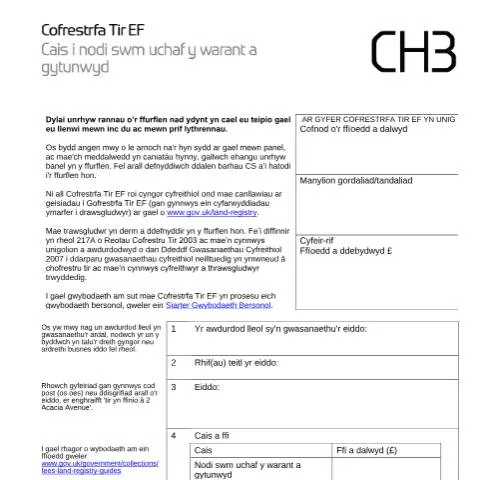
Understanding the CH3 Form: Securing Maximum Charge Amounts in Registered Mortgages
When mortgage lenders and borrowers need to formally establish or modify the maximum sum secured by a registered charge, the CH3 form serves as the official mechanism for recording this agreement with HM Land Registry. This Welsh-language document, officially titled "Legal charges: security," addresses a specific but crucial aspect of property financing that can significantly impact both lenders' security positions and borrowers' future borrowing capacity.
The CH3 form becomes particularly relevant in scenarios where the original mortgage documentation may have been unclear about maximum liability, or where parties wish to increase or decrease the secured amount following renegotiation. Unlike standard mortgage registrations, this form specifically deals with post-registration modifications to the security amount, making it an essential tool in the evolving landscape of property finance.
When Property Professionals Encounter Maximum Charge Variations
The need for a CH3 application typically arises in several distinct circumstances within the property and lending sectors. Remortgage scenarios frequently trigger this requirement when borrowers seek additional borrowing against their property, but the existing charge doesn't cover the new higher amount. Similarly, when lenders conduct portfolio reviews and discover that registered charges lack specific maximum figures, they may initiate CH3 applications to clarify their security position.
Commercial lending arrangements often necessitate CH3 submissions when business expansion requires increased facility limits. Property development projects present another common scenario, where initial charges may prove insufficient as project costs escalate or additional phases are approved. In these cases, the CH3 form provides the legal mechanism to adjust the registered security without requiring complete re-mortgaging.
Legal practitioners regularly encounter situations where inherited charges from company acquisitions or property transfers contain ambiguous security amounts. The CH3 process allows for retrospective clarification, ensuring that all parties understand their exact positions and obligations under the registered charge.
Navigating the Form's Core Components and Technical Requirements
The CH3 form's structure reflects HM Land Registry's standardised approach to charge modifications, with each panel serving a specific evidentiary purpose. Panel 1 requires identification of the local authority serving the property, which becomes crucial for council tax and business rates verification. Where multiple authorities might have jurisdiction, applicants must specify the authority to which they typically pay council tax or business rates.
Panel 2 demands precise title number identification, accepting multiple numbers where properties span several registered titles. This precision proves essential as HM Land Registry's systems rely on exact title matching for processing applications.
| Panel Section | Information Required | Common Issues |
|---|---|---|
| Property Description (Panel 3) | Full address with postcode or alternative description | Incomplete postcodes or vague property boundaries |
| Application and Fee (Panel 4) | Maximum charge amount and payment method | Incorrect fee calculations or payment method selection |
| Existing Charge Details (Panel 5) | Date, lender name, and registration date | Multiple charges requiring clear identification |
Panel 5 presents particular complexity when dealing with multiple charges of the same date to identical lenders. The form explicitly requires clear identification through reference numbers or other distinguishing markers in the first column, preventing confusion during registration processing.
Professional Submission Requirements and Key Account Details
Panel 7 establishes the submission credentials and contact arrangements, with distinct requirements for professional customers versus individual applicants. Professional customers, including solicitors and licensed conveyancers, must provide their unique key numbers, enabling access to HM Land Registry's digital services and direct debit arrangements.
The email address provision carries particular significance, as HM Land Registry increasingly relies on electronic communication. For conveyancers, email addresses become essential for receiving deletion warning letters, making accurate provision crucial for ongoing professional compliance.
Decoding the Legal Framework and Registration Implications
The CH3 form operates within the broader framework of the Land Registration Act 2002 and the Land Registration Rules 2003, specifically addressing provisions for charge modifications under established regulatory procedures. Rule 217A of the Land Registration Rules 2003 defines "conveyancer" broadly, encompassing individuals authorised under the Legal Services Act 2007 to provide reserved legal services relating to land registration.
The form's legal weight extends beyond simple administrative recording. Once processed, the registered maximum charge amount becomes legally binding on all parties, affecting the lender's priority position and the property owner's ability to secure additional borrowing. This binding nature makes accuracy in completion absolutely critical, as errors can result in loss of Land Registration Act 2002 security provisions.
Data protection considerations under the Data Protection Act 2018 and UK GDPR govern the personal information processing inherent in CH3 applications. HM Land Registry's Personal Information Charter outlines how submitted data will be processed, stored, and potentially disclosed under section 66 of the Land Registration Act 2002, which makes most registry documents publicly available for inspection and copying.
Public Access and Information Exclusion Procedures
The public accessibility of CH3 documents creates potential concerns for applicants who may wish to keep certain financial information confidential. The form's warning section specifically addresses this issue, directing applicants to Form EX1 applications under rule 136 of the Land Registration Rules 2003 for excluding potentially harmful information from public inspection.
This exclusion process requires separate application and justification, typically involving commercially sensitive information or personal circumstances that could create security risks if publicly disclosed. Professional advisers often coordinate EX1 applications alongside CH3 submissions to ensure comprehensive protection of client interests.
Fee Structure and Payment Processing Mechanisms
HM Land Registry's fee structure for CH3 applications follows their standard scale fees, calculated according to the maximum charge amount being registered. The form accommodates two primary payment methods: traditional cheques payable to 'Land Registry' and direct debit arrangements for established professional customers.
Direct debit arrangements require prior agreement with HM Land Registry and typically form part of broader professional service packages. These arrangements offer faster processing and automatic fee deduction, making them particularly attractive for high-volume practitioners. However, they require accurate account details in panel 7 and sufficient account balances at processing time.
Fee calculation errors represent a common source of application delays, particularly where applicants miscalculate scale fees or fail to account for recent fee increases. HM Land Registry provides current fee guides through their government collections, which practitioners should consult immediately before submission to ensure accuracy.
Application Processing and Post-Submission Procedures
Once submitted, CH3 applications enter HM Land Registry's standard processing workflow, typically taking several weeks for completion depending on current workloads and application complexity. The registry's processing includes verification of the existing charge details, confirmation of applicant authority, and integration of the new maximum amount into the relevant title register.
During processing, HM Land Registry may raise requisitions seeking clarification or additional information. These typically address discrepancies between submitted information and existing register entries, unclear property descriptions, or insufficient supporting evidence for the claimed agreement between lender and borrower.
Professional monitoring of application progress becomes crucial, particularly where time-sensitive transactions depend on successful registration. HM Land Registry's portal services provide real-time updates for professional customers, enabling proactive management of any arising issues.
Registration Completion and Certificate Issuance
Successful CH3 processing results in updated register entries showing the agreed maximum charge amount, with corresponding official copies reflecting the new position. These updated registers serve as definitive proof of the security arrangement and become essential documents for future property transactions or refinancing activities.
The timing of registration completion can significantly impact related transactions, particularly where completion depends on confirmed security positions. Professional practitioners often coordinate CH3 applications with broader transaction timelines, ensuring registration occurs before critical completion dates.
Fraud Prevention and Verification Safeguards
The CH3 form incorporates robust fraud prevention warnings, reflecting HM Land Registry's commitment to maintaining register integrity. The warning section specifically references the Fraud Act 2006, with maximum penalties of ten years' imprisonment or unlimited fines for dishonest submissions intended to secure advantage or cause loss.
These provisions require genuine agreement between lenders and borrowers regarding maximum charge amounts, preventing unilateral modifications that could prejudice either party's interests. The signature requirements in panel 9 reinforce this protection, ensuring appropriate authority for submissions whether made by professional representatives or individual applicants.
Professional practitioners face additional responsibilities under these provisions, as their signatures confirm both factual accuracy and appropriate client authority. This dual responsibility makes thorough client verification and documentation essential before CH3 submission, protecting both professional and client interests in subsequent disputes.
Types of Legal Charges and Their Specific Registration Requirements
The Companies House CH3 form accommodates various categories of legal charges, each with distinct registration requirements and implications for company operations. Understanding these classifications proves essential for accurate completion and compliance with statutory obligations.
Fixed charges represent the most straightforward category, typically securing specific identified assets such as freehold or leasehold property, plant and machinery, or intellectual property rights. When registering a fixed charge on the CH3 form, companies must provide precise asset descriptions, including any relevant title numbers for registered land or patent registration numbers for intellectual property. The charge holder gains immediate security over the specified assets, preventing disposal without consent.
Floating charges present more complexity in their registration requirements. These charges hover over a class of assets that may change in the ordinary course of business, such as stock, work in progress, or book debts. The CH3 form requires careful description of the asset class covered, noting any restrictions on the company's ability to deal with these assets. Floating charges typically crystallise upon specific events—appointment of an administrator, cessation of business, or breach of charge terms—converting to fixed charges over assets then held.
All monies charges secure not just the principal debt but all present and future obligations owed to the charge holder. When completing section 4 of the CH3 form for such charges, companies must indicate this broader security scope rather than specifying a fixed sum. This type of charge commonly appears in banking relationships where multiple facilities operate under a single security arrangement.
Specific asset categories require tailored approaches on the CH3 form. Aircraft charges must reference the aircraft's registration marks and comply with Civil Aviation Authority requirements. Ship mortgages require vessel registration details and may involve concurrent registration with the Maritime and Coastguard Agency. Intellectual property charges need precise identification of patents, trademarks, or copyright works, including registration numbers where applicable.
Book debt charges, particularly relevant for invoice discounting or factoring arrangements, require careful description of the debt collection procedures and any notification requirements to debtors. The CH3 form should clearly indicate whether the charge operates as a legal assignment or equitable charge, affecting the charge holder's rights against third-party debtors.
Cross-border charges involving assets in multiple jurisdictions require consideration of local registration requirements alongside the UK CH3 filing. Companies must ensure compliance with foreign security registration systems while meeting UK statutory obligations. The charge description should clearly identify which assets fall within UK jurisdiction for enforcement purposes.
Enforcement Rights and Remedies Under Registered Charges
Registration of legal charges through the CH3 system establishes a framework of enforcement rights that vary significantly depending on charge type, asset category, and specific terms negotiated between parties. Understanding these enforcement mechanisms proves crucial for both charge holders seeking security and companies managing their secured obligations.
Possession and sale rights form the cornerstone of charge enforcement. Fixed charges over real property typically grant charge holders the right to take possession and sell the secured property upon default. However, these rights operate within strict legal parameters—charge holders must follow proper notice procedures and cannot take possession without court approval in cases involving residential property or where the company remains in occupation for business purposes.
For floating charges, enforcement rights remain dormant until crystallisation occurs. Upon crystallisation, typically triggered by formal demand, appointment of receivers, or cessation of business, the charge holder gains fixed security over assets then comprised in the floating charge class. The timing of crystallisation can significantly impact recovery prospects, particularly where asset values fluctuate or disposal has occurred in the ordinary course of business prior to crystallisation.
Receivership appointments represent a powerful enforcement tool available to qualifying charge holders. Administrative receivers may be appointed under charges created before 15 September 2003, whilst fixed charge receivers can be appointed over specific assets regardless of charge creation date. The receiver's powers, derived from the charge instrument and statute, typically include asset collection, management, and disposal rights. Companies must cooperate with appointed receivers, providing access to books, records, and physical assets as required.
Priority of enforcement between competing charge holders follows established legal principles that can significantly affect recovery outcomes. Fixed charges generally rank ahead of floating charges over the same assets, regardless of creation date. However, floating charges created before 15 September 2003 benefit from priority over preferential debts, whilst later charges rank behind prescribed categories including employee wages, holiday pay, and certain pension contributions.
The prescribed part regime, introduced under the Enterprise Act 2002, reserves a portion of floating charge realisations for unsecured creditors. This mechanism reduces floating charge recoveries where proceeds exceed £10,000, with the reserved amount calculated on a sliding scale reaching a maximum of £800,000. Charge holders must factor these statutory deductions into recovery calculations and enforcement timing decisions.
Court-based enforcement procedures provide alternative routes where contractual remedies prove insufficient. Charge holders may apply for possession orders, sale orders, or appointment of Law of Property Act receivers where charge terms permit. These procedures offer stronger legal foundation but involve additional time, cost, and procedural requirements compared to contractual enforcement methods.
Asset tracing and recovery becomes particularly relevant where companies have disposed of charged assets improperly. Fixed charge holders may pursue tracing claims against disposal proceeds or assert proprietary claims over substitute assets. Floating charge holders face greater challenges due to the company's ordinary course dealing rights prior to crystallisation, though recovery may be possible where disposals breach charge restrictions or occur after crystallisation without consent.
Enforcement against book debts involves direct collection from underlying debtors following proper notice procedures. Charge holders must navigate data protection requirements when accessing debtor information and ensure compliance with consumer credit regulations where applicable. Assignment perfection may require debtor notification, affecting collection timing and administrative burden.
Discharge Procedures and Post-Registration Modifications
The lifecycle of registered charges extends beyond initial registration, encompassing various modification, partial release, and discharge scenarios that require careful navigation of Companies House procedures and statutory requirements. Understanding these processes ensures proper maintenance of the charges register and avoids potential legal complications.
Full discharge procedures commence when secured obligations are satisfied completely, requiring formal documentation and registration to clear the charges register. Charge holders must execute appropriate discharge instruments—typically a deed of release or discharge certificate—confirming satisfaction of all secured obligations. These documents should reference the original charge registration number and provide clear confirmation that no further sums remain outstanding under the security.
Companies House form CH4 facilitates registration of charge satisfaction, requiring submission within prescribed timeframes to maintain register accuracy. The form requires details of the original charge, satisfaction date, and supporting documentation evidencing discharge. Failure to register satisfaction leaves the charge appearing active on public records, potentially affecting future borrowing capacity and creating confusion for prospective lenders or purchasers.
Partial releases present more complex procedural challenges, particularly where charges secure multiple obligations or cover extensive asset portfolios. Charge holders may agree to release specific assets from security whilst maintaining charges over remaining assets. Such arrangements require careful documentation identifying released assets precisely and confirming continued security over retained assets. The release documentation should address any impact on security priority and ensure adequate security remains for outstanding obligations.
Substitution of security allows replacement of charged assets with alternative security without requiring full discharge and re-registration. This mechanism proves particularly valuable in refinancing transactions or where companies need to dispose of charged assets for operational reasons. Substitution deeds must clearly identify replacement assets and confirm equivalent or improved security value for the charge holder's protection.
Variation of charge terms, whilst not requiring new registration in most cases, should be documented properly to avoid enforcement complications. Material variations affecting charge scope, priority, or enforcement rights may necessitate legal advice regarding registration requirements. Companies should maintain comprehensive records of all charge variations to ensure clarity during any subsequent enforcement proceedings.
Administrative corrections address errors in original registration details, such as incorrect asset descriptions, wrong charge amounts, or clerical mistakes in party names. Companies House provides mechanisms for correcting minor errors, though significant corrections may require court applications or formal variation procedures. Early identification and correction of registration errors prevents complications during charge enforcement or asset disposal transactions.
Merger and acquisition scenarios require careful consideration of charge continuation and registration obligations. Charges may transfer automatically to successor entities in some circumstances, whilst others require formal assignment and re-registration procedures. Due diligence processes should identify all registered charges and ensure appropriate continuation or discharge arrangements form part of transaction documentation.
Crystallisation registration for floating charges, whilst not mandatory, provides public notice of the charge conversion to fixed security. Some charge holders choose to file crystallisation notices to establish clear priority dates and prevent subsequent dealing by the company. However, crystallisation can occur automatically upon specified events without formal registration, making charge terms and trigger events crucial for enforcement timing.
International enforcement considerations arise where charged assets are located outside the UK or where charge holders seek recognition of UK security interests in foreign jurisdictions. Discharge procedures may need to address foreign registration requirements and ensure complete clearance of security interests across all relevant jurisdictions. Legal advice often proves essential for complex cross-border security arrangements.