Understanding the Official UK Court Form D80B: Statement in Support of Divorce or Dissolution Based on Unreasonable Behaviour
The UK legal system provides specific procedures and documentation for individuals seeking to end their marriage or civil partnership through divorce, dissolution, or judicial separation. One such document is the official form designated as D80B, titled Statement in Support of Divorce / Dissolution / (Judicial) Separation – Unreasonable Behaviour. This form plays a critical role in the legal process, particularly when the petitioner (the person initiating the divorce) relies on unreasonable behaviour as the ground for separation. This article offers a comprehensive overview of the form’s purpose, how to complete it, and its significance within the UK family law framework.
Purpose and Legal Context of the D80B Form
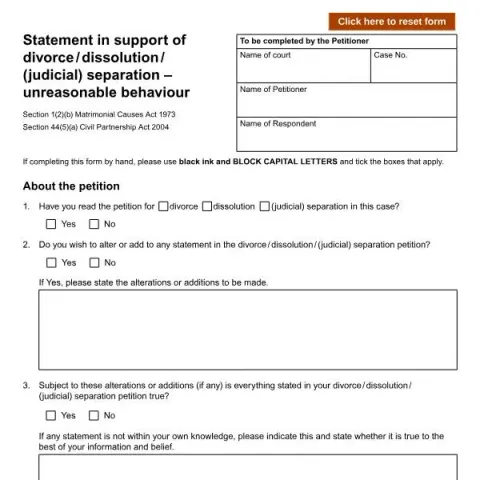
The D80B form is an official document used in UK courts to substantiate a petition for divorce, dissolution of a civil partnership, or judicial separation, based on the respondent's (the other party’s) unreasonable behaviour. Under the Matrimonial Causes Act 1973 and the Civil Partnership Act 2004, unreasonable behaviour is a common ground for divorce when one party claims that the respondent's conduct has made it intolerable to continue living together.
The form serves as a detailed statement supporting the petitioner’s allegations, which are then considered by the court when deciding whether to grant the divorce or separation order. Its primary function is to provide factual evidence regarding the respondent's behaviour, which the petitioner believes justifies the breakdown of the relationship.
Who Completes the D80B Form and When?
The D80B form is to be completed by the petitioner—the individual seeking the divorce or separation. It is typically submitted alongside the initial divorce petition, which contains the basic details of the case, including the petitioner’s and respondent’s names and the grounds for divorce.
The form is usually filled out after the petitioner has initiated proceedings by filing the relevant divorce or dissolution petition. It is essential that the petitioner accurately and truthfully completes the form, as it forms part of the court’s evidence in assessing the grounds for ending the marriage or civil partnership.
How to Fill Out the D80B Form: Step-by-Step Guide
1. Basic Case Information
- Case Number and Court Name: Fill in the official case number and the court’s name where the proceedings are ongoing.
- Parties’ Names: Clearly state the full names of the petitioner and respondent, using BLOCK CAPITAL LETTERS if completing by hand.
2. About the Petition
- Reading the Petition: Confirm that you have read the original petition for divorce or separation.
- Alterations or Additions: Indicate if you wish to make any changes to the statement in the original petition, and specify these if applicable.
- Truthfulness: Affirm that all statements in the petition are true to the best of your knowledge and belief.
3. Detailing Unreasonable Behaviour
- Impact on Health: If the respondent’s behaviour has affected your health, describe the effects in this section.
- Continuity of Behaviour: State whether the respondent’s behaviour is ongoing or if it has ceased, providing the date of the last incident if applicable.
- Living Arrangements: If you have lived at the same address as the respondent since the last incident, specify the address, dates, and arrangements for sharing accommodation.
4. Supporting Evidence
If the respondent has signed an acknowledgment of service, you may need to attach a copy to your statement and tick the relevant box. If a solicitor has signed on behalf of the respondent, you do not need to attach or refer to the acknowledgment.
Legal and Procedural Considerations
The D80B form must be completed with honesty and precision, as making false statements can lead to proceedings for contempt of court. The petitioner must sign the statement of truth, affirming that the information provided is accurate. The form is then submitted to the court as part of the divorce or separation process.
It is important to note that the court will assess the evidence presented through this form alongside other documentation to decide whether the grounds for divorce based on unreasonable behaviour are met. The process aims to ensure that the decision is based on truthful and relevant information, safeguarding the integrity of family law proceedings.
Fill in your form directly online
No printing: type your details into the boxes of the official form, tick, then download the PDF ready to send.
- 1Type into the form boxes
- 2Tick in one click
- 3Save and download the PDF
After Submission
Once the form has been filed and the court has reviewed the case, the proceedings continue according to the court’s schedule. If the respondent disputes the allegations, they may be required to respond formally. Otherwise, the court may proceed to grant the divorce, dissolution, or judicial separation based on the evidence provided, including the statements in the D80B form.
In summary, the D80B form is a vital document within the UK family justice system, enabling petitioners to formally present their case for divorce or separation on the grounds of unreasonable behaviour. Accurate completion and adherence to procedural rules are essential to ensure a smooth process and a fair outcome.