Navigating the Request for Detailed Assessment Hearing: An In-Depth Guide
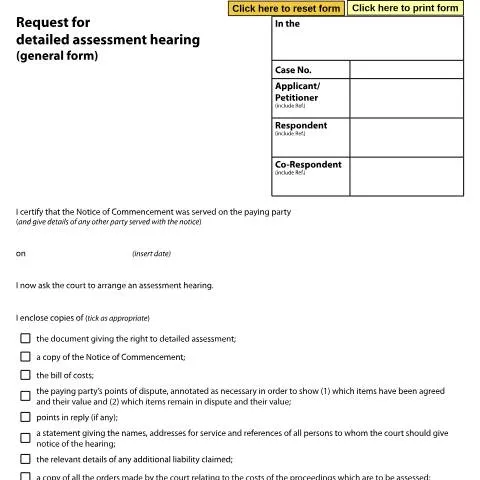
Engaging with the legal system can often feel daunting, particularly when it comes to the intricacies of court procedures. One such instance is the submission of a Request for Detailed Assessment Hearing using Form D258. This form plays a pivotal role in resolving disputes related to costs incurred during legal proceedings. Grasping the nuances of this document is essential for anyone involved in a case where costs are under scrutiny. Below, we delve into the specifics of who may need to file this request, the context in which it is used, and how to ensure that the form is correctly completed and submitted.
Understanding the Context: Who Engages with Form D258?
The Request for Detailed Assessment Hearing is primarily relevant to parties who have incurred legal costs and find themselves in a position where these costs are contested. Typically, the following groups may be involved:
- Applicants/Petitioners: Individuals or entities that have initiated legal proceedings and are seeking to recover costs.
- Respondents: Parties that have been served with the costs claim and may dispute the amount claimed.
- Co-Respondents: Additional parties who may have a vested interest in the costs being assessed.
For example, if a claimant has pursued a personal injury case and has incurred significant legal fees, they may file Form D258 to request a detailed assessment of those costs when the opposing party disputes the bill. Additionally, exceptions may apply in cases where costs were agreed upon previously or are governed by specific court orders. Understanding these distinctions can help clarify who should be actively involved in submitting this form.
The Role of Form D258 in Legal Proceedings
Form D258 is not merely a formality; it functions as a request to the court to determine the lawful amount of costs due for detailed assessment. This takes place after a bill of costs has been served to the paying party, which could be the respondent or co-respondent. The process involves several crucial steps, starting from the initial service of the Notice of Commencement to the eventual hearing.
Key Steps in the Process
- Notice of Commencement: Before filing Form D258, the applicant must serve a Notice of Commencement to the paying party, signifying that a costs assessment is impending.
- Submission of Form D258: The applicant completes Form D258, detailing the case number, names of parties involved, and any necessary supporting documents.
- Hearing Scheduling: The court will schedule a detailed assessment hearing, where both parties will present their arguments regarding the costs.
The hearing often involves discussions on various components of the bill of costs, allowing the court to dissect the items claimed and adjudicate on their validity. Specific attention will be paid to any points of dispute raised by the paying party, which will require the applicant to illustrate which fees are undisputed and which remain under contention.
Preparing for Submission: Documentation Essentials
Completing Form D258 involves not only filling out the necessary sections but also ensuring that all relevant documentation is attached. This is crucial for a smooth assessment process. Below is a list of the key documents that should accompany the form:
- Bill of Costs: The itemized statement outlining all incurred legal fees.
- Notice of Commencement: Evidence that the paying party has been notified of the assessment process.
- Points of Dispute: Any objections raised by the paying party regarding specific items in the bill.
- Court Orders: Copies of any existing court orders related to the costs in question.
- Supporting Evidence: Documents such as fee notes and receipts relevant to disputed items.
Document Preparation: A Closer Look
When preparing your documents, it is essential to ensure that all items are clearly annotated. For instance, when addressing the points of dispute from the paying party, consider outlining:
| Item | Agreed Value | Disputed Value |
|---|---|---|
| Solicitor Fees | £500 | £200 |
| Court Fees | £100 | £50 |
Further, including a statement with the names, addresses, and references of all persons who should receive notice of the hearing is vital. This ensures that all parties are aware and can prepare accordingly for the assessment.
Legal Framework: The Importance of Compliance
Understanding the legal basis for the Request for Detailed Assessment Hearing is critical. Form D258 is governed under the Civil Procedure Rules, which outline the procedure for making costs claims and how disputes should be handled. In particular, the rules set forth the requirements for serving notices, submitting documents, and attending hearings.
Additionally, compliance with the Data Protection Act 2018 and the UK GDPR is paramount, especially regarding the handling of personal data within these documents. When completing Form D258, avoid including sensitive information that is unnecessary for the court’s assessment.
Key Regulations to Consider
- Civil Procedure Rules 1998: This sets the groundwork for procedural fairness and efficiency in civil matters.
- Costs Practice Direction: This document provides guidance on how costs should be assessed in various scenarios.
Understanding these regulations can help ensure that your request for detailed assessment is compliant and stands the best chance of being favourably adjudicated by the court.
Navigating the Hearing: What to Expect
Upon successful submission of Form D258 and the accompanying documentation, the court will arrange a hearing. This hearing serves as an opportunity for both parties to argue their case regarding the disputed costs. Preparation for this stage is essential.
Effective Preparation Strategies
- Review All Documents: Ensure you have a thorough understanding of the bill of costs, points of dispute, and any evidence you intend to present.
- Organize Your Arguments: Plan how you will address each disputed item succinctly and clearly.
- Anticipate Counterarguments: Be prepared for the opposing party's arguments and have responses ready.
During the hearing, the court will evaluate the evidence presented and make determinations based on the claims submitted. The judge will generally provide a ruling on which costs are recoverable and may issue orders regarding payment. Understanding the implications of this phase can significantly affect the outcome of the cost recovery process.
Post-Hearing Considerations: Navigating Results
Following the hearing, the court will issue a decision, which could either uphold the full costs, a portion of the costs, or deny the claim altogether. It is crucial to understand the implications of each potential outcome:
- Full Costs Awarded: If the court decides in your favour, the paying party will be liable to pay the full amount of the costs as assessed.
- Partial Costs Awarded: In this scenario, the paying party will need to pay only the agreed or assessed amount, which may necessitate further negotiation or clarity on outstanding costs.
- No Costs Awarded: If the court finds against the applicant, it may result in the applicant not recovering any of the claimed costs, leading to further financial implications.
Each of these potential outcomes can lead to further steps, including appeals or additional negotiations. Understanding your next steps in response to the court's ruling is essential for effective navigation of the legal landscape.
Final Thoughts: Empowering Your Legal Journey
Engaging with the court system regarding cost assessments can be complex, but utilizing Form D258 effectively can streamline the process. By understanding the form's role, preparing thoroughly, and complying with relevant regulations, individuals can advocate more effectively for their interests. Ultimately, being informed and prepared will empower you in your legal journey, especially when dealing with cost disputes.
Fill in your form directly online
No printing: type your details into the boxes of the official form, tick, then download the PDF ready to send.
- 1Type into the form boxes
- 2Tick in one click
- 3Save and download the PDF
Understanding the Purpose of a Detailed Assessment Hearing
A detailed assessment hearing is a crucial stage in the legal process, particularly within the context of civil litigation. This type of hearing typically occurs after a costs order has been made, and one party is dissatisfied with the amount of costs awarded. The purpose of the detailed assessment hearing is to scrutinize the costs claimed by the receiving party, ensuring they are reasonable and proportionate to the work undertaken. This ensures that the expenses incurred during litigation are justifiable and adhere to the standards set by the courts.
During this hearing, the costs judge will examine the bills submitted by the receiving party, which may include hourly rates, the number of hours worked, disbursements, and any additional expenses. The detailed assessment hearing allows for arguments on both sides, where the paying party can challenge specific items on the bill, and the receiving party must justify their claims. It's essential for both parties to prepare thoroughly, as the outcome of this hearing can significantly impact the financial burden on the paying party.
Preparing for a Detailed Assessment Hearing
Preparation for a detailed assessment hearing is paramount to ensure the best possible outcome. Here are key steps that both parties should consider:
- Gather Evidence: Collect all relevant documentation that supports your position. This includes the original costs order, time sheets, invoices, correspondence, and any previous court orders related to costs.
- Review the Costs Bill: Ensure that the costs bill has been accurately drafted. The receiving party should verify that all items are legitimately incurred and appropriately categorized. Conversely, the paying party should meticulously inspect the bill to identify any discrepancies or excessive charges.
- Legal Representation: Engage a solicitor or a costs draftsman if necessary. They can provide expertise in presenting your case effectively. Legal professionals will understand the nuances involved and can advocate on your behalf, which is particularly beneficial if you're unfamiliar with court procedures.
- Prepare Your Arguments: Clearly outline the reasons why the costs should be reduced (for the paying party) or upheld (for the receiving party). This will involve understanding the applicable case law and statutory guidelines that govern costs recovery.
- Practice Your Presentation: If you intend to represent yourself, rehearse your arguments and the key points you wish to communicate. This practice will help you articulate your position confidently during the hearing.
By diligently preparing for the hearing, parties can significantly influence the outcome, achieving a resolution that aligns with their expectations and financial capabilities.
Common Challenges During Detailed Assessment Hearings
While understanding the process and preparing adequately can enhance your chances of a favorable outcome, various challenges may arise during a detailed assessment hearing. Being aware of these potential issues will allow you to navigate them more effectively:
- Complexity of Costs: Legal costs can be intricate and multifaceted. The nature of the work involved, the amount of time spent, and the rates applied may all vary. Successfully arguing for or against these aspects requires a solid grasp of legal billing practices and court expectations.
- Disputes Over Reasonableness: One of the most contentious issues in a detailed assessment hearing is the reasonableness of the costs claimed. The paying party may argue that certain costs are disproportionate to the work performed. The receiving party must be prepared to demonstrate that their costs are necessary and reasonable based on the complexity of the case.
- Time Constraints: Detailed assessment hearings may be time-sensitive, often requiring a quick turnaround on submissions and presentations. Parties should be prepared to meet tight deadlines and work efficiently to compile their arguments and evidence.
- Costs Consequences: The financial implications of the hearing can be significant. If the paying party successfully challenges a portion of the costs, they may reduce their liability substantially. However, if the receiving party is successful in defending their costs, they could recoup the full amount, including any additional costs incurred in the hearing.
Recognizing these challenges and preparing strategies to address them can make a considerable difference in the effectiveness of your case during a detailed assessment hearing.