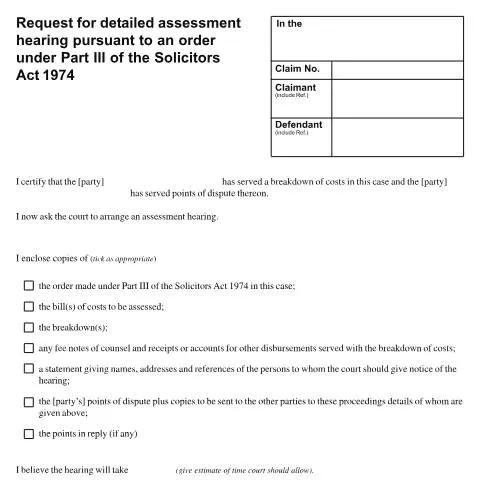
Understanding the Request for a Detailed Assessment Hearing under Part III of the Solicitors Act 1974
The Request for a detailed assessment hearing under Part III of the Solicitors Act 1974 is a formal procedure in the United Kingdom designed to resolve disputes over legal costs. Managed by the HM Courts & Tribunals Service, this process allows parties involved in legal proceedings to have their costs assessed and verified by the court, ensuring transparency and fairness in legal billing.
Purpose and Scope of the Procedure
This process is initiated when one party in a legal dispute seeks a detailed review of the costs claimed by the other party, typically following the submission of a bill of costs. The bill may include legal fees, disbursements, and other expenses related to the case. If there is a disagreement over the amount or nature of these costs, either the claimant or the defendant can request a court hearing to scrutinize the bill in detail.
The Part III of the Solicitors Act 1974 provides the statutory framework for this assessment, aiming to prevent overcharging and ensure that costs are reasonable and proportionate to the work performed. The court’s role is to examine the costs, hear disputes, and determine the appropriate amount payable, if any adjustments are necessary.
Who Can Request a Detailed Assessment?
Typically, either the claimant (the party who has incurred costs and seeks to recover them) or the defendant (the party who disputes the costs) can apply for a detailed assessment. The request is usually made after the costs have been served and any points of dispute have been communicated between parties.
In practice, the party requesting the assessment must submit Form N258C, which is a formal application to the court. This form includes details such as the case number, the parties involved, and the specific costs to be assessed.
Key Components of the Application
When preparing the application, the party must include several essential documents and information:
- A copy of the court order made under Part III of the Solicitors Act 1974.
- The bill(s) of costs to be assessed.
- A breakdown of the costs, detailing the work done and expenses incurred.
- Any fee notes of counsel and receipts or accounts for other disbursements served with the breakdown.
- A statement with the names, addresses, and references of the persons to whom the court should give notice of the hearing.
- The points of dispute, along with copies sent to the other parties involved.
- Any points in reply, if applicable.
Arranging and Conducting the Hearing
The court will schedule a hearing based on the information provided in the application. The applicant is required to estimate the duration of the hearing, which helps the court allocate appropriate time. The proceedings are usually held at the court office during standard business hours, and all correspondence should be addressed to the Court Manager, referencing the case number.
During the hearing, the court examines the costs, considers the points of dispute, and hears arguments from both parties. The judge then makes a ruling on the reasonableness of the costs, which may involve approving, disallowing, or adjusting the amounts claimed.
Fill in your form directly online
No printing: type your details into the boxes of the official form, tick, then download the PDF ready to send.
- 1Type into the form boxes
- 2Tick in one click
- 3Save and download the PDF
Legal and Administrative Considerations
Part III assessment proceedings are governed by the rules set out in the Solicitors Act 1974 and are administered by the HM Courts & Tribunals Service. Parties should ensure that all documents are properly prepared and served in accordance with court rules. The process is designed to be transparent, with clear procedures for submitting evidence and arguments.
It is important to note that the application must be filed and the hearing scheduled within specific timeframes. The applicant should also be prepared to pay a court fee, which is specified in the relevant court fee schedule.
Conclusion
The request for a detailed assessment hearing under Part III of the Solicitors Act 1974 is a vital mechanism for ensuring the fairness of legal costs. Managed by the HM Courts & Tribunals Service, it provides a structured process for parties to resolve disputes over costs, promoting transparency and accountability in legal billing practices. Proper understanding and adherence to the procedural requirements are essential for a successful application and hearing.