When Your LLP Disappears: The Reality of Struck-Off Limited Liability Partnerships
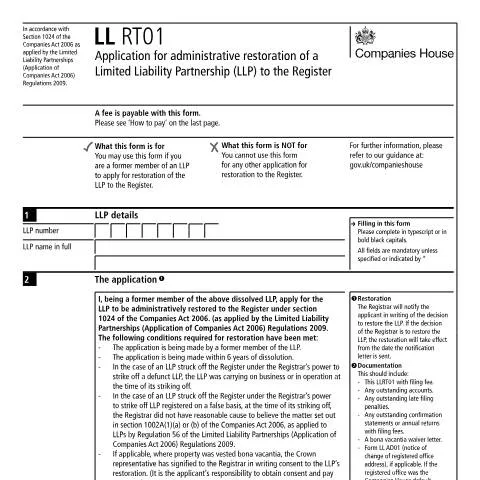
Picture this scenario: you're a former member of a Limited Liability Partnership that was once thriving, handling client work and generating revenue. Then life intervened—perhaps the pandemic disrupted operations, or administrative obligations simply fell through the cracks. Before you knew it, your LLP had been struck off the Companies House register for failing to file accounts or confirmation statements. Now, months or even years later, you discover there's unfinished business, outstanding contracts, or assets that need addressing. This is where Form LL RT01 becomes your lifeline back to legitimate business status.
The administrative restoration process via LL RT01 represents one of the most critical yet underutilised procedures available to former LLP members. Unlike the more complex and expensive court-based restoration route, this administrative pathway offers a relatively straightforward mechanism to resurrect a dissolved Limited Liability Partnership—provided you understand the intricate conditions and act within the statutory timeframe.
The Six-Year Window: Understanding Your Restoration Timeline
Time is absolutely critical when considering LLP restoration. The six-year deadline from the date of dissolution creates an immovable boundary that catches many former members off guard. This isn't six years from when you first realised the LLP was struck off, or six years from when you decided you needed it back—it's six years from the actual dissolution date recorded at Companies House.
The dissolution typically occurs through one of two mechanisms under the Companies Act 2006 as applied to LLPs. Most commonly, the Registrar exercises powers under section 1000 to strike off what appears to be a defunct LLP—usually triggered by consistent failure to file annual accounts or confirmation statements. Less frequently, dissolution occurs under section 1002A when the LLP was registered on a false basis, though this creates additional restoration hurdles regarding the Registrar's reasonable belief criteria.
What makes this timeline particularly treacherous is that many former members remain unaware of the dissolution until they attempt to conduct business, open bank accounts, or deal with third parties who discover the LLP's struck-off status. By then, precious months or years of the six-year window may have already elapsed.
Calculating Your Remaining Time
To determine your remaining restoration window, you'll need to identify the exact dissolution date from the Companies House register. This information appears on the public record and forms the starting point for your six-year countdown. Former members should also consider that preparation time for gathering required documentation can extend several weeks or months, particularly if dealing with complex affairs or missing records.
Who Holds the Keys: Eligibility and the Former Member Requirement
The restoration application can only be submitted by someone who was a former member of the dissolved LLP immediately before dissolution. This seemingly straightforward requirement carries significant implications that often surprise those attempting restoration.
A former member, in LLP terms, refers to someone who held membership rights and obligations under the LLP agreement at the time of striking off. This typically includes designated members who had enhanced responsibilities for filing requirements, as well as ordinary members who participated in the business but weren't designated for administrative duties.
Complex Membership Scenarios
Several situations can complicate the former member requirement. If a member resigned or was removed from the LLP before dissolution but after the last filed confirmation statement, their status becomes ambiguous. Companies House records might not reflect the change, creating uncertainty about who qualifies as a former member.
Similarly, when members died before dissolution, their personal representatives cannot typically use LL RT01, as they weren't members themselves. Such cases often require the more complex court restoration route, highlighting why understanding eligibility early is crucial.
Corporate members present another layer of complexity. If a company was a member of the dissolved LLP, that company (assuming it still exists) can apply for restoration through its authorised representatives, but the application must clearly establish the corporate member's continuing legal existence and authority to act.
The Paper Trail: Essential Documentation for Successful Restoration
Administrative restoration demands meticulous documentation that brings the LLP's records completely up to date. This isn't simply about completing LL RT01—it's about constructing a comprehensive filing package that satisfies all outstanding obligations from the dissolution date.
| Document Category | Requirements | Timing Considerations |
|---|---|---|
| Outstanding Accounts | All dormant or full accounts from dissolution date | May require professional preparation if records are incomplete |
| Confirmation Statements | Any annual returns or CS01 forms due since last filing | Must reflect accurate member and address details |
| Address Changes | Form LL AD01 if registered office changed | Evidence required for appropriate address if previously using Companies House default |
| Email Updates | Form EM01 for registered email changes | Ensures future communications reach the LLP |
The Bona Vacantia Complexity
One of the most challenging documentation requirements involves bona vacantia—the legal principle that dissolved company assets pass to the Crown. When an LLP is struck off, any remaining assets automatically vest in the Crown's representative (typically the Treasury Solicitor in England and Wales, or equivalent bodies in Scotland and Northern Ireland).
Obtaining a bona vacantia waiver letter requires direct engagement with the relevant Crown representative's office. This process involves declaring all assets that existed at dissolution and may require payment of fees or asset values to the Crown. The complexity increases significantly if the dissolved LLP held substantial assets, intellectual property rights, or ongoing contractual obligations.
Many applicants underestimate this requirement, assuming that because they believe the LLP had no assets, no waiver is needed. However, even seemingly worthless assets like domain names, small bank balances, or potential future income streams can constitute bona vacantia property requiring formal clearance.
Financial Reckonings: Penalties, Fees, and Outstanding Obligations
Restoration through LL RT01 demands settling all financial obligations that existed at dissolution, creating what many former members discover is a substantial and unexpected bill. The financial requirements extend far beyond the basic restoration fee, encompassing historical penalties, late filing charges, and individual fines imposed on members.
Late filing penalties accumulate based on the period between when documents were due and when the LLP was dissolved. For accounts, this can amount to hundreds or thousands of pounds depending on the LLP's filing history. Confirmation statement penalties follow similar patterns, though typically at lower individual amounts.
Individual Member Financial Responsibilities
A particularly challenging aspect involves relevant person obligations under section 1025(6A) and (6B) of the Companies Act 2006. These provisions require that each relevant person—typically designated members and those with significant control—must have paid any outstanding fines or financial penalties imposed on them personally in relation to LLP matters.
These individual penalties often stem from criminal prosecutions for failure to file documents or comply with statutory requirements. The penalties remain linked to the individual rather than the LLP itself, meaning personal settlement is required regardless of who applies for restoration. This can create situations where restoration becomes impossible if one relevant person refuses to pay their penalties or cannot be located.
Name Games: When Your Original LLP Name Is No Longer Available
LLP names operate under strict uniqueness requirements, and the period between dissolution and restoration attempts can see another entity register an identical or similar name. This creates one of the restoration process's most frustrating practical challenges—discovering that your carefully built brand identity is no longer available.
Section 4 of LL RT01 addresses this scenario by allowing applicants to specify an alternative name. However, this alternative must still comply with all standard naming requirements under sections 54 and 55 of the Companies Act 2006, including restrictions on sensitive words and expressions that might suggest government connections or regulated activities.
The Temporary Number Name Solution
If no suitable alternative name is proposed and the original name remains unavailable, the Registrar will restore the LLP using its registration number as a temporary name. This creates a 14-day window post-restoration during which the LLP must file a name change using Form LL NM01.
Failure to change from the number name within this 14-day period constitutes a criminal offence under the Limited Liability Partnerships Act 2000. This strict timeline often catches newly restored LLPs off guard, particularly if key members are unavailable or if the name change process encounters unexpected complications.
The Administrative Machinery: Processing and Decision-Making
Once submitted, LL RT01 applications undergo detailed scrutiny by Companies House restoration teams. Unlike standard incorporation processes that follow relatively predictable timescales, restoration applications involve case-by-case assessment that can extend over several weeks or months.
The Registrar's decision-making process examines each condition listed in section 3 of the form methodically. This includes verifying former member status, confirming the six-year deadline compliance, assessing whether the LLP was genuinely carrying on business at dissolution, and ensuring all documentation requirements are satisfied.
Communication and Decision Outcomes
The Registrar communicates restoration decisions in writing to the applicant. Successful restoration takes effect from the date the notification letter is sent, not when it's received or when any subsequent actions are taken. This timing mechanism can be crucial for determining when post-restoration obligations begin and when the restored LLP can recommence operations.
Unsuccessful applications typically receive detailed explanations of deficiencies, often allowing for resubmission once issues are addressed. However, this process consumes valuable time within the six-year window, emphasising the importance of comprehensive initial applications.
Beyond Restoration: Immediate Post-Revival Obligations and Strategic Considerations
Successful LLP restoration through LL RT01 creates immediate compliance obligations that many restored entities overlook in their relief at regaining legal status. The restoration doesn't pause the ongoing clock of statutory requirements—confirmation statements, accounts filing, and other obligations resume with potentially compressed deadlines.
Post-restoration, the LLP must also consider its commercial position. Contracts that existed at dissolution may have been frustrated or terminated due to the LLP's struck-off status. Relationships with banks, suppliers, and clients require rebuilding, often involving explanations of the dissolution and restoration process.
Professional indemnity insurance and other coverage typically lapses when an LLP is struck off, leaving potential gaps in protection that need immediate attention. Banking relationships almost certainly require re-establishment, as accounts are usually frozen or closed when dissolution is detected.
Strategic Timing Considerations
The timing of restoration applications often involves strategic considerations beyond mere urgency. Tax year implications, accounting period management, and coordination with other business activities can influence when restoration is most advantageous. Some former members delay applications to align restoration with natural business cycles or to complete preparatory work that positions the restored LLP for immediate effective operation.
However, these strategic delays must always be balanced against the absolute six-year deadline and the risk that documentation requirements become more complex or expensive over time. The restoration process represents a unique opportunity to return a dissolved LLP to active status through administrative rather than judicial means—an opportunity that, once lost, may never return under such favourable conditions.
Understanding Restoration Eligibility and Legal Prerequisites
Before submitting form LL RT01, partnerships must meet specific statutory requirements that determine whether restoration is legally permissible. The eligibility criteria extend beyond simple administrative oversight and encompass substantive legal conditions that Companies House evaluates rigorously.
The primary eligibility test requires that the LLP was struck off the register within the preceding six years from the date of your restoration application. This timeframe is absolute and non-negotiable—partnerships dissolved more than six years ago cannot be restored through the LL RT01 process and must explore alternative legal routes, potentially involving court applications under different statutory provisions.
Crucially, the LLP must have been carrying on business or in operation at the time of striking off, or have been carrying on business within three months of that date. This "business activity" test prevents restoration of dormant shells created solely for speculative purposes. Companies House interprets "carrying on business" broadly to include active trading, holding assets, maintaining contracts, or engaging in preparatory activities toward commercial operations.
Administrative compliance forms another cornerstone of eligibility. The partnership must demonstrate that striking off occurred due to failure to file required documents rather than voluntary dissolution or regulatory action. Common scenarios include missing annual returns, failure to notify changes in designated members, or non-submission of accounts where required by partnership agreements or regulatory frameworks.
The restoration application must originate from parties with legitimate standing. Eligible applicants include former designated members, creditors with outstanding claims, shareholders in corporate members, or other parties demonstrating sufficient interest in the partnership's restoration. Each category requires specific supporting evidence—former members need proof of their previous status, while creditors must substantiate their claims with relevant documentation such as invoices, contracts, or court judgments.
Partnerships subject to regulatory oversight face additional scrutiny. Those operating in financial services, legal practice, healthcare, or other regulated sectors must often obtain clearance from relevant regulatory bodies before restoration becomes viable. For instance, LLPs previously authorised by the Financial Conduct Authority may need to address regulatory compliance issues that contributed to their striking off.
Joint applicants must coordinate their submissions carefully, as Companies House requires consistency across all supporting documentation and statements. Where multiple parties apply simultaneously, any contradictions in their accounts of events or business activities can delay processing or result in rejection.
Strategic Timing Considerations and Restoration Planning
The timing of restoration applications significantly impacts both the likelihood of success and the practical implications for the restored partnership. Understanding these temporal dynamics enables applicants to optimise their approach and anticipate potential complications.
Early restoration applications—submitted within months of striking off—generally face fewer complications than those filed years later. Recent dissolutions mean that business records remain readily accessible, former members are easier to contact, and creditor situations remain relatively straightforward. However, rushing the application without proper preparation can prove counterproductive if essential documentation remains incomplete or statutory requirements are misunderstood.
The six-year limitation period creates strategic pressure points that applicants must navigate carefully. As this deadline approaches, the urgency increases, but so does the complexity of gathering historical evidence and addressing accumulated issues. Partnerships nearing this threshold should prioritise rapid but thorough preparation, potentially engaging professional advisors to accelerate the process whilst maintaining accuracy.
Tax considerations introduce additional timing complexities that extend beyond the restoration process itself. HMRC maintains separate procedures for addressing tax obligations of dissolved partnerships, and successful restoration may trigger retrospective compliance requirements. The timing of restoration affects which tax years require attention and how penalties or interest charges are calculated on outstanding obligations.
Business continuity planning becomes critical for partnerships intending to resume operations post-restoration. The gap between dissolution and restoration creates practical challenges—contracts may have lapsed, professional registrations might require renewal, bank accounts will likely need reactivation, and staff may have sought alternative employment. Planning for these operational aspects should commence alongside the restoration application to minimise disruption once Companies House grants approval.
Creditor notification requirements vary depending on the restoration timeline. Partnerships restored within certain periods must notify known creditors of the restoration, providing opportunities for claims to be made. Strategic timing can influence the scope of these notification obligations and the practical impact on the restored entity's financial position.
The interaction between restoration timing and limitation periods for legal claims creates additional considerations. Restoration may revive claims that were previously time-barred due to the partnership's dissolution, whilst simultaneously creating new limitation periods for matters arising during the dissolution period. Legal advice becomes particularly valuable for partnerships with complex commercial relationships or potential liability exposures.
Market conditions and commercial opportunities also influence optimal timing decisions. Partnerships in rapidly evolving sectors may find that delayed restoration undermines their competitive position, whilst those in stable markets might benefit from thorough preparation even if this extends the timeline. The cost of delay must be weighed against the risks of premature submission with incomplete documentation.
Post-Restoration Compliance Obligations and Operational Restart
Successful restoration through LL RT01 marks the beginning rather than the end of the compliance journey, as restored partnerships face immediate and ongoing obligations that require careful attention to maintain good standing with Companies House and other regulatory bodies.
The restoration effective date triggers automatic compliance deadlines that partnerships must meet regardless of their operational readiness. Annual return obligations resume based on the partnership's original incorporation anniversary, not the restoration date, meaning that filing deadlines may arrive unexpectedly soon after restoration. Partnerships restored near their annual return due date face immediate pressure to compile and submit required information, often while simultaneously addressing other restart priorities.
Address and member information must be updated promptly to reflect current circumstances. The registered office address becomes particularly critical as it serves as the official communication point for Companies House correspondence and statutory notices. Partnerships operating from different premises post-restoration must file appropriate notifications, whilst ensuring that the registered office remains accessible for official mail delivery throughout business hours.
Designated member appointments require immediate attention, as dissolution may have affected the status or availability of previous office holders. The partnership must maintain at least two designated members at all times, with specific responsibilities for statutory compliance and external communications. Where former designated members are unavailable or unwilling to resume their roles, new appointments must be made and properly documented through appropriate Companies House forms.
Financial record-keeping obligations extend beyond simple bookkeeping to encompass statutory requirements that vary based on the partnership's activities and size. Partnerships engaged in regulated activities may face enhanced record-keeping standards, whilst those meeting certain thresholds must maintain accounting records to specific professional standards even if not required to file public accounts.
Banking and financial service relationships typically require comprehensive renewal following restoration. Banks commonly close accounts of dissolved entities, necessitating fresh applications that may involve enhanced due diligence procedures. The gap in banking relationships can create practical challenges for collecting outstanding debts, paying creditors, or managing ongoing financial obligations that accumulated during the dissolution period.
Professional indemnity insurance and other business protections need immediate review and potential renewal. Coverage that lapsed during dissolution may not automatically reinstate upon restoration, leaving the partnership exposed to liability gaps. Professional service partnerships face particular scrutiny from insurers, who may require detailed explanations of the dissolution circumstances and current risk profiles before offering new terms.
Regulatory authorisations and professional memberships often require separate restoration applications with relevant bodies. Financial services partnerships must address Financial Conduct Authority requirements, whilst legal practices need Solicitors Regulation Authority clearance. These parallel processes can extend well beyond the Companies House restoration timeline and may impose additional conditions or restrictions on the partnership's activities.
Employment law considerations become relevant where partnerships intend to rehire former staff or engage new employees. Dissolution may have terminated employment contracts, creating potential claims or obligations that require careful legal assessment. TUPE regulations might apply in specific circumstances, whilst pension scheme obligations could have continued despite the partnership's dissolution.
Intellectual property rights and commercial contracts require systematic review to determine their status following restoration. Some agreements may have terminated automatically upon dissolution, whilst others might have continued with different legal consequences. Patent and trademark registrations typically remain valid despite partnership dissolution, but may require ownership updates to reflect the restored entity's status.
The interaction between restoration and ongoing legal proceedings creates complex scenarios that partnerships must navigate carefully. Claims involving the dissolved partnership may have continued against other parties or been stayed pending restoration outcomes. Understanding these legal positions and taking appropriate action becomes essential for protecting the partnership's interests and managing potential liabilities effectively.