Understanding the Official Notice to Defender in Scottish Family Law: When and How to Use Form 49.14-C
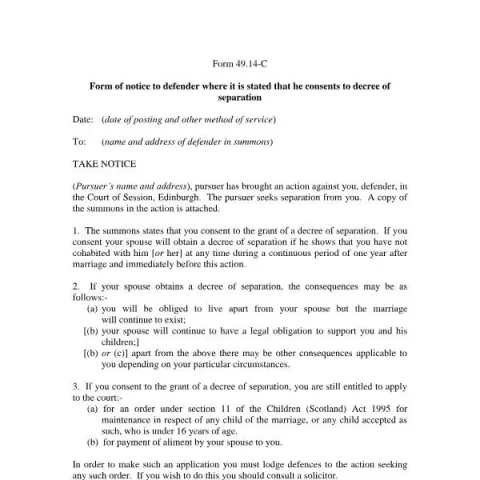
The Form 49.14-C is an official document issued by the Scottish Courts and Tribunals Service, specifically designed for use within family law proceedings relating to separation. Its primary purpose is to formally notify a defendant (the spouse or partner being sued) that the pursuer (the person initiating the action) has brought a petition for separation and that the defendant's consent to the decree of separation is being sought. This article aims to clarify the circumstances in which this form is used, the essential information it contains, and the proper procedures for its transmission.
When to Use Form 49.14-C
This form is applicable in cases where one spouse or partner has initiated legal proceedings for separation in the Court of Session, Edinburgh, and the other party (the defender) is being formally notified of the action. Specifically, it is used when the pursuer requests the court to obtain a decree of separation based on the defender's consent. The consent indicates that the defender agrees that the marriage or civil partnership should be legally recognized as separated, provided certain conditions are met.
The form is particularly relevant in situations where:
- The parties have agreed to live apart without dissolving the marriage or partnership.
- The defender consents to the decree, which simplifies the legal process and can expedite the separation proceedings.
- The case involves a straightforward separation where no disputes over support or maintenance are contested at this stage.
Key Information Required in the Notice
The form contains several essential sections that the court or legal representative must complete before serving it to the defender:
- Date and Method of Service: The date when the notice is sent or delivered, and the method used (e.g., postal, personal service).
- Recipient Details: The name and address of the defender, as listed in the summons.
- Notification of Action: A clear statement that the pursuer has initiated a legal action seeking separation, with a copy of the summons attached.
- Explanation of Consent: The notice explains that the defender's consent to the decree means they agree that the marriage has not cohabited for at least one year immediately prior to the application, which is a legal requirement for the decree.
- Legal Consequences: The notice outlines the potential implications of granting the decree, including the obligation to live apart and ongoing support responsibilities.
- Further Legal Rights: The defender is informed that even if they consent, they retain the right to apply for child maintenance or other orders under relevant legislation.
- Instructions for Consent: The form provides guidance on how to complete and return the notice if the defender consents, including the address for submission.
- Timeframes: The notice specifies the period within which the defender must respond—generally 21 days from the date of service or seven days if served before the summons is called in court.
- Withdrawal of Consent: Instructions are provided for the defender to revoke their consent, should they choose to do so, by notifying the court in writing.
Procedure for Transmitting the Notice
The completed notice must be sent to the Deputy Principal Clerk of Session at the address specified in the form: 2 Parliament Square, Edinburgh EH1 1RQ. The transmission can be performed either by mailing the document or delivering it in person at the court office. It is crucial to adhere to the designated timeframes to ensure the defender's rights are protected and the legal process remains valid.
Typically, the notice should be sent within 21 days after the defender has been served with the summons. If service occurs before the summons is called in court, the defender has seven days to respond after the call. The date of service is determined based on the date shown at the top of the notice or, if served by post, the day after the post date.
Fill in your form directly online
No printing: type your details into the boxes of the official form, tick, then download the PDF ready to send.
- 1Type into the form boxes
- 2Tick in one click
- 3Save and download the PDF
Points of Attention and Legal Advice
Given the legal significance of this notice, it is advisable for both parties to seek legal advice before completing or responding to the form. The defender should understand the legal implications of consenting to a decree of separation, including ongoing support obligations and the potential impact on future arrangements. Consulting a solicitor, Citizens Advice Bureau, or a qualified legal adviser can help ensure that the defender's rights are fully protected.
In summary, Form 49.14-C serves as an official and formal method to notify a defendant of a separation action and to record their consent. Proper completion and timely transmission are essential steps in the legal process, ensuring clarity and fairness for all parties involved in Scottish family law proceedings.