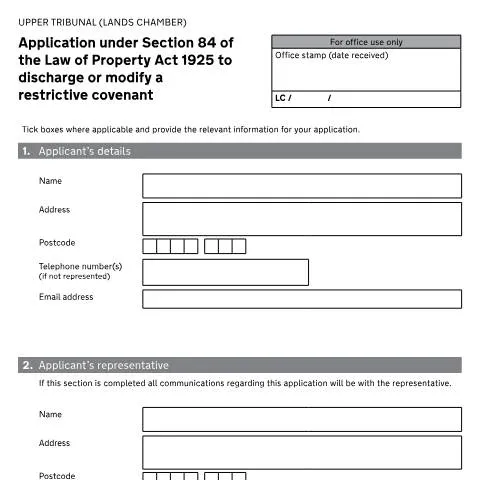
Understanding the Application Process for Discharging or Modifying a Restrictive Covenant under Section 84 of the Law of Property Act 1925
The application outlined in Form T379 is a formal procedure managed by the Upper Tribunal (Lands Chamber) to seek the discharge or modification of a restrictive covenant affecting land in England and Wales. This process is vital for landowners or interested parties who wish to alter restrictions that limit how they can use or develop their property, provided certain legal conditions are met.
Scope and Purpose of the Application
The primary purpose of this application is to request the Tribunal to either remove or amend restrictions that have been imposed on land, which are typically found in deeds, conveyances, or other legal documents. These restrictions, known as covenants, may restrict land use, building activities, or other property rights. Importantly, the Tribunal's authority is limited to discharging or modifying covenants that are negative in nature; positive covenants, which require ongoing action or expenditure, are outside its jurisdiction.
Who Can Submit an Application?
Applicants are usually landowners or individuals with a legal or beneficial interest in the land subject to the restriction. They must provide detailed information about their interest, such as whether they hold the land on a freehold or leasehold basis, and whether they have contractual rights related to the property. If other parties hold an interest in the land, their details and consent are required, especially if the application is made without their agreement.
Key Components of the Application
Details of the Land and Interests
The application requires precise identification of the land concerned, including its postal address, Land Registry title number, and a recent copy of the title plan. If relevant, applicants should also include details of adjacent or nearby land in which they hold an interest, marked accordingly on the plan.
Identification of Restrictions
The applicant must clearly state the restrictions they seek to discharge or modify. This involves quoting the exact wording of each restriction, referencing the original document that imposed it, and providing copies of these documents. The nature and origin of the restrictions are critical for the Tribunal to assess the application.
Interest and Consent
Applicants need to declare their interest in the land, whether freehold, leasehold, or other contractual rights. Additionally, any other parties with an interest in the land, such as landlords or joint owners, must be identified. Consent from these parties, if applicable, should be included to confirm agreement with the application.
Legal Grounds and Supporting Evidence
The application must specify the legal grounds under Section 84(1) of the Law of Property Act 1925 for discharging or modifying the restriction. This includes providing a comprehensive statement of case, detailing all relevant facts and reasons supporting the application. Supporting documents, such as planning permissions or other relevant legal instruments, should be enclosed if applicable.
Considerations and Next Steps
Applicants should be aware that the Tribunal will consider whether the restriction is obsolete, burdensome, or unnecessary for the protection of the benefit of other landowners. The process involves careful review of the submitted evidence and may include hearings or further correspondence.
Fill in your form directly online
No printing: type your details into the boxes of the official form, tick, then download the PDF ready to send.
- 1Type into the form boxes
- 2Tick in one click
- 3Save and download the PDF
It is recommended that applicants seek legal advice or consult a professional, such as a solicitor or surveyor, to ensure all procedural requirements are met and that the application is properly prepared.
References and Further Information
For detailed guidance, applicants can refer to the official instructions provided with Form T379 and consult the Upper Tribunal (Lands Chamber) rules. The Land Registry and legal professionals can also offer assistance in preparing the necessary documentation and understanding the implications of discharging or modifying covenants.
Overall, this application process facilitates the lawful and structured modification of land restrictions, supporting landowners in managing their property rights effectively within the framework of UK property law.