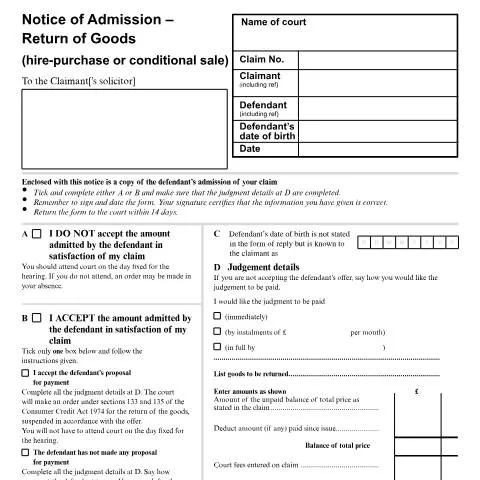
Navigating the Notice of Admission - Return of Goods: Understanding Form N228
In the intricate web of consumer rights and responsibilities, the process of returning goods under a hire-purchase or conditional sale agreement can often feel daunting. The Notice of Admission - Return of Goods (Form N228) emerges as a crucial instrument in this context, particularly when a dispute arises between a claimant and a defendant regarding such agreements. This document is pivotal not only for fulfilling legal formalities but also for ensuring that the interests of the parties involved are adequately represented and safeguarded.
The Importance of Context in Using Form N228
Form N228 is frequently employed within the jurisdiction of the HM Courts & Tribunals Service, specifically in cases dealing with hire-purchase and conditional sale agreements. Often, the circumstances surrounding the use of this notice can vary widely, thus shaping its importance in different scenarios. Understanding when and how to utilise this document is essential for both claimants and defendants.
What Triggers the Need for Form N228?
- Default on Payments: When a defendant fails to adhere to the payment terms stipulated in a hire-purchase agreement.
- Consumer Rights Violations: Instances where the goods received do not meet the expectations of quality or specification as per the agreement.
- Legal Action Initiation: A claimant must submit this form if they are proceeding to retrieve goods while simultaneously ensuring their legal rights are preserved.
Decoding the Document: Key Sections of Form N228
In understanding how to leverage Form N228 effectively, it is imperative to break down its integral sections. Each component has a specific role that contributes to the overall functionality of the notice.
Claimant and Defendant Information
The document requires the claimant's name and the details of the court where the claim is filed, along with identifying information about the defendant, which may include their birth date. This initial section establishes the parties involved and clarifies the legal context of the claim.
Admission of Claim
Central to Form N228 is the admission section, where the defendant indicates whether they accept or reject the claim amount. Specifically:
- Acceptance of Claim: If the defendant accepts the amount, the claimant can decide on the proposed payment terms, potentially avoiding a court appearance.
- Rejection of Claim: If there is a dispute over the claim amount, the claimant must appear in court for the hearing.
Judgment Details: The Financial Breakdown
One of the critical components of Form N228 is the section dedicated to judgment details. This part requires careful attention as it outlines the financial implications for both parties:
| Description | Amount (£) |
|---|---|
| Outstanding Balance of Total Price | Specify the amount |
| Payments Made Since Claim Issuance | Deduct from total |
| Total of Court Fees | Insert amount |
| Solicitor’s Costs on Issuing Claim | Insert amount if applicable |
| Total Costs | Sum of all applicable fees |
Claimants must ensure that the amounts are accurately recorded to avoid disputes over fees and costs later on.
Critical Instructions for Submission
The instructions accompanying Form N228 are essential for compliance and proper execution of legal requirements. Claimants must pay close attention to the following:
Submission Timeline
The completed form must be returned to the court within 14 days of receiving the notice of admission. This timeline is critical; failure to comply may result in adverse legal consequences for the claimant.
Signature Requirement
A signed declaration of the information correctness is mandatory. By signing, the claimant affirms the authenticity of the provided details, reinforcing the legal weight of the document.
Understanding Your Options: Decisions After Admission
Once the admission of the claim is acknowledged by the defendant, the claimant faces several choices regarding how to proceed.
Accepting the Proposal for Payment
If the defendant makes a payment proposal that the claimant accepts, the court will issue an order under the Consumer Credit Act 1974, which may enable the return of goods under specified conditions. This pathway often simplifies the process and reduces the need for further court appearances.
Rejecting the Proposal for Payment
In scenarios where the proposal is deemed insufficient or unacceptable, the claimant can outline their objections clearly on the form. This enables the court to consider these objections when determining the payment terms.
Interrelationships with Other Legal Documents
Form N228 does not exist in isolation; it is part of a broader legal framework encompassing various documents and processes.
Related Legal Instruments
- Claim Form (N1): Initiates the claim and sets the stage for the subsequent legal process.
- Defence Form (N9): The defendant's response to the claim, which may include their admission or denial.
- Judgment Form (N225): Issued after a court hearing, detailing the judge's ruling on the case.
Complementary Procedures
It is essential for both parties to understand how Form N228 interacts with potential hearings and other procedural steps, especially if the matter escalates to court.
Avoiding Common Misinterpretations and Pitfalls
Misunderstandings surrounding the use of Form N228 can lead to significant complications. Being aware of these potential pitfalls is vital.
Misunderstanding the Admission Process
One common misconception is that an admission by the defendant equates to outright acceptance of liability. It is crucial for claimants to remember that the defendant may still dispute the amount owed or the terms of payment.
Failing to Provide Complete Information
Incompleteness can lead to delays or rejections of the claim. It is vital to ensure that all necessary sections are filled out comprehensively and accurately.
Real-World Implications of Form N228
Understanding and effectively utilizing Form N228 can significantly impact the outcome of disputes in hire-purchase and conditional sale agreements. Its implications extend beyond mere legal formalities; they affect financial liabilities, consumer rights, and ultimately, the relationship between consumers and suppliers.
Consumer Protection Rights
Proper use of Form N228 aligns with the principles set forth in consumer protection legislation, ensuring that claimants can assert their rights efficiently. Being informed about the legal landscape can empower consumers against unfair practices.
Supplier Obligations
For suppliers, a clear understanding of the processes surrounding Form N228 can foster better compliance with legal obligations, ensuring that they address disputes effectively and maintain positive customer relations.
Conclusion: Empowering Legal Navigation with Form N228
In summary, Form N228 serves as a vital tool for navigating the complexities of returning goods under hire-purchase or conditional sale agreements within the UK legal framework. Understanding its structure, importance, and potential pitfalls equips both claimants and defendants with the knowledge necessary to handle disputes effectively. Engaging with this document thoughtfully not only aids in resolving immediate issues but also reinforces broader consumer rights in the marketplace.
Understanding the Hire-Purchase Agreement under UK Law
The Hire-Purchase (HP) agreement is a widely used financial arrangement within the UK, allowing individuals to acquire goods by paying in instalments over time while retaining the option to purchase the item at the end of the term. This form of conditional sale has legal implications that often require careful consideration of terms and conditions laid out in the agreement such as the total cost, interest rates, and the rights of both the purchaser and the vendor.
Under the Consumer Credit Act 1974, a Hire-Purchase agreement is classified as a type of regulated credit agreement, which means it must adhere to specific requirements. This includes providing clear information to the borrower about the total cost of the transaction, ensuring that the terms are fair, and allowing consumers the right to withdraw from the agreement within a set cooling-off period. If a consumer feels that the terms of the hire purchase were misrepresented, they may have grounds for a formal complaint, which can be escalated through the Financial Ombudsman Service if unresolved.
It's essential for consumers to understand their rights regarding repossession and termination of the contract. If a consumer defaults on payments, the creditor has the right to reclaim the goods, but this must be conducted within the legal framework of the Consumer Credit Act. Moreover, a consumer is protected from such actions until they have paid at least one-third of the total amount payable under the agreement.
The Process of Filing a Notice of Admission
Filing a Notice of Admission related to a return of goods under a Hire-Purchase or conditional sale agreement involves specific procedural steps that must be accurately followed to ensure compliance with UK law.
Firstly, it’s crucial to determine whether the item in question falls under the terms of the Hire-Purchase agreement. If so, the next step is to complete Form N228 accurately. This form acts as a formal notification to the court regarding your intention to admit to the claim made against you and to address the return of goods.
Once you have filled out the N228 form, it should be submitted to the relevant court, typically the county court, along with any necessary accompanying documentation. Important to note is that the filing can incur a fee, and it's advisable to check the HM Courts & Tribunals Service website for the latest fee schedule and exemptions that may apply based on your financial circumstances.
When completing Form N228, ensure that all sections are filled out in clear and precise language, including your name, address, and details about the hire purchase agreement itself. Additionally, provide a concise explanation for your admission and any supporting evidence or documents that validate your claim.
After submission, a court date will be set, during which both parties will present their cases. Make sure to prepare by gathering all relevant documents, including the original hire purchase agreement, payment receipts, and correspondence with your creditor. Engaging with a solicitor specialising in consumer credit may also be beneficial to navigate through this process effectively.
Implications of Data Protection in the Notice of Admission Process
In the context of filing a Notice of Admission, adherence to the Data Protection Act 2018 and UK GDPR is paramount. When dealing with personal information required for Form N228, individuals must ensure that their data is processed legally, fairly, and transparently. This includes safeguarding sensitive data from unnecessary exposure during court procedures.
When submitting the N228 form, personal data such as your National Insurance number, address, and financial details will be collected. It is your responsibility to confirm that the information provided is accurate and relevant. If any personal data is shared with third parties during the court proceedings, consent should be obtained wherever applicable, or anonymisation techniques should be employed to protect your identity.
Furthermore, individuals have rights under the GDPR to request access to their data held by organisations involved in the court process, including the creditor and the court itself. If you believe your data is being processed incorrectly or without consent, you have the right to lodge a complaint with the Information Commissioner’s Office (ICO), which oversees data protection compliance in the UK.
Ultimately, ensuring compliance with data protection regulations not only protects your personal information but can also affect the outcome of your case, as breaches may lead to invalidation of evidence or claims made against you.