Navigating the Investment Hearing: When Court-Held Compensation Meets Long-Term Financial Planning
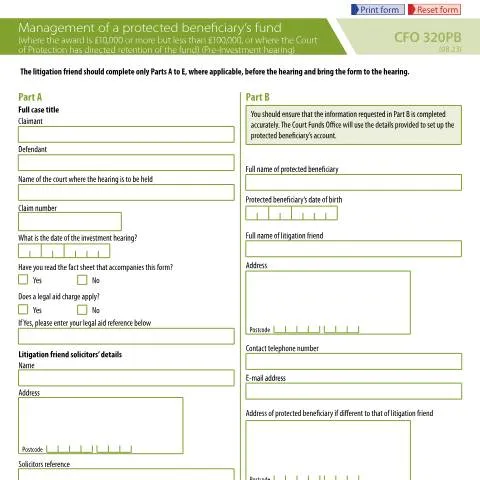
When a personal injury settlement or compensation award reaches the Court Funds Office, the journey toward securing a protected beneficiary's financial future enters a critical phase. The CFO 320PB form represents the pivotal moment where litigation friends must make strategic decisions about fund management at the investment hearing—decisions that could significantly impact the beneficiary's long-term financial security.
This pre-hearing documentation process applies specifically to awards ranging from £10,000 to just under £100,000, or larger sums where the Court of Protection has explicitly directed retention within the court system. The form serves as both a planning tool and a formal record of investment intentions, bridging the gap between legal settlement and prudent financial stewardship.
Unlike routine administrative forms, the CFO 320PB requires litigation friends to engage with complex financial concepts whilst navigating strict judicial oversight. The stakes are particularly high given that investment decisions made at this stage will typically govern fund management for years, potentially decades, affecting the beneficiary's quality of life and long-term care provisions.
The Litigation Friend's Strategic Preparation: Beyond Basic Form Completion
The form's structure deliberately front-loads the litigation friend's responsibilities, requiring completion of Parts A through E before attending the investment hearing. This pre-hearing preparation phase demands careful consideration of the beneficiary's circumstances, both current and projected.
Part A establishes the procedural foundation, capturing essential case identifiers and hearing logistics. The legal aid charge question proves particularly significant, as any outstanding legal aid debt will influence available investment capital. Litigation friends must ensure their legal aid reference number is accurate, as the Court Funds Office will verify these details directly with the Legal Aid Agency.
Part B's account setup information extends beyond simple data collection. The Court Funds Office uses these details to establish the protected beneficiary's investment account within their secure systems. Critical attention must be paid to address accuracy—any discrepancies between the litigation friend's address and the beneficiary's residence could complicate future correspondence and payment arrangements.
Immediate Financial Needs Assessment
Part C introduces the first major strategic decision point: whether to request immediate or regular payments from the fund. This section requires litigation friends to balance immediate care needs against long-term investment growth potential.
| Payment Type | Typical Applications | Evidence Requirements |
|---|---|---|
| One-off payment | Immediate equipment needs, property adaptations, care setup costs | Detailed cost estimates, supplier quotations |
| Regular payments | Ongoing care costs, living expenses, therapy sessions | Care plans, projected annual costs, provider contracts |
The judge retains absolute discretion over these payment requests, making robust justification essential. Litigation friends should prepare comprehensive evidence packages, including detailed cost breakdowns and professional assessments of the beneficiary's needs.
Investment Strategy Selection: Balancing Risk Against Time Horizon
Part D represents the form's most complex section, where litigation friends must navigate investment options that will fundamentally shape the fund's growth trajectory. The Court Funds Office offers a structured framework based on the beneficiary's likely access requirements and risk tolerance.
The Equity Index Tracker Fund option introduces market-based growth potential but requires careful consideration of the beneficiary's circumstances. The form's tiered approach reflects sophisticated financial planning principles:
- Option ONE (up to 65% equity investment): Suitable for young beneficiaries with minimal immediate access needs and extended time horizons
- Option TWO (50% equity investment): Balances growth potential with moderate accessibility requirements
- Option THREE (regular access required): Prioritises liquidity over aggressive growth
- Option FOUR (special account only): Conservative approach focusing on capital preservation
The litigation friend's statement regarding equity investment acceptance carries significant weight. While ticking 'No' doesn't guarantee funds will remain in low-risk accounts, it provides the judge with crucial insight into the litigation friend's comfort level with market-based investments.
Age-Related Investment Considerations
The beneficiary's age profoundly influences appropriate investment strategy. Young children with severe injuries may benefit from aggressive growth strategies, given their extended time horizons. Conversely, teenage beneficiaries approaching majority may require more conservative approaches to ensure fund availability for transitional needs like further education or independent living setup.
Judicial Decision-Making Process: Understanding the Court's Perspective
The form's judicial section reveals the structured approach judges employ when making investment decisions. This transparency helps litigation friends understand how their submissions will be evaluated and what additional factors the court considers.
Judges must balance multiple competing interests: maximising long-term growth potential, ensuring adequate liquidity for the beneficiary's needs, and maintaining appropriate risk levels given the beneficiary's circumstances. The court's decision-making process typically involves:
- Reviewing the beneficiary's age, condition, and projected lifespan
- Assessing immediate and ongoing care requirements
- Evaluating the litigation friend's investment preferences and risk tolerance
- Considering market conditions and long-term economic projections
- Ensuring compliance with Court of Protection investment principles
The judge's authority to override litigation friend preferences reflects the court's paramount duty to protect the beneficiary's interests. This judicial discretion ensures that investment decisions align with professional financial management standards rather than potentially uninformed preferences.
Documentation Requirements and Evidence Standards
The form's emphasis on supporting documentation reflects the Court Funds Office's rigorous verification processes. Bank statement requirements serve multiple purposes: confirming account legitimacy, verifying account holder identity, and ensuring payment routing accuracy.
Recent bank statements (within three months) must clearly display the account details provided on the form. Online banking screenshots typically prove insufficient—litigation friends should request formal statements from their banking provider. Building society passbook photocopies may be acceptable if they clearly show current account details and recent activity.
Common Documentation Pitfalls
Experience reveals several recurring documentation issues that can delay investment hearings:
- Providing business account details instead of personal accounts for litigation friends
- Submitting statements where account names don't precisely match form entries
- Including joint account details without clarifying signatory arrangements
- Presenting foreign currency accounts without addressing conversion implications
Post-Hearing Fund Management: Ongoing Responsibilities and Procedures
The investment hearing represents a beginning rather than conclusion of the litigation friend's involvement with fund management. Once investment instructions are finalised, the Court Funds Office implements the judge's directions through their established investment protocols.
Regular monitoring becomes essential, particularly for funds with equity components. The Court Funds Office provides periodic statements showing fund performance, but litigation friends should actively track investment progress against the beneficiary's evolving needs.
Future payment applications require separate court applications rather than direct requests to the Court Funds Office. This additional layer of judicial oversight ensures continued protection of the beneficiary's interests whilst maintaining appropriate access to funds for legitimate needs.
Investment Review Triggers
Several circumstances may necessitate investment strategy reviews:
| Trigger Event | Typical Response | Application Process |
|---|---|---|
| Significant medical deterioration | Increase liquidity, reduce risk exposure | Medical evidence, care plan updates |
| Approaching majority | Conservative shift, preparation for handover | Capacity assessments, transition planning |
| Major market volatility | Rebalancing, risk reassessment | Financial analysis, expert recommendations |
Special Circumstances: Court of Protection Directions and Complex Cases
The form's reference to Court of Protection directions acknowledges that some cases transcend standard investment frameworks. When awards exceed £100,000 but the Court of Protection specifically directs retention within the court system using child-fund management principles, additional complexities emerge.
These directions typically arise in cases involving adults with significant cognitive impairments or complex care needs requiring ongoing judicial oversight. The Court of Protection's involvement ensures that investment decisions align with the beneficiary's best interests whilst maintaining appropriate professional management standards.
Litigation friends managing such cases must coordinate between multiple judicial bodies: the original compensating court, the Court Funds Office, and the Court of Protection. This tri-party oversight provides enhanced protection but requires careful navigation of potentially conflicting requirements.
Cross-Border Considerations
When beneficiaries reside outside England and Wales, additional complications may arise regarding fund management and payment arrangements. The Court Funds Office can accommodate international payments, but litigation friends must ensure compliance with both UK investment regulations and destination country financial rules.
Currency fluctuation risks become particularly relevant for beneficiaries requiring regular payments in foreign currencies. The court may consider currency hedging strategies or alternative payment arrangements to protect against exchange rate volatility.
Professional Collaboration: Working with Financial Advisers and Legal Teams
While litigation friends bear ultimate responsibility for form completion and investment decisions, professional guidance often proves invaluable. Financial advisers specialising in court-managed funds can provide sophisticated analysis of investment options and their implications for the beneficiary's long-term financial security.
The form's complexity suggests that litigation friends should consider professional consultation, particularly for larger funds or beneficiaries with complex needs. However, the litigation friend retains decision-making authority and cannot delegate their statutory responsibilities to professional advisers.
Legal teams familiar with Court Funds Office procedures can provide valuable guidance on form completion and investment hearing preparation. Their experience with similar cases often reveals practical considerations that might otherwise be overlooked.
The investment hearing represents a critical juncture where careful preparation, strategic thinking, and professional collaboration converge to secure the beneficiary's financial future. The CFO 320PB form serves as both roadmap and record of this essential process, demanding thorough completion and thoughtful consideration of long-term implications. Success requires balancing immediate needs against future requirements, conservative prudence against growth potential, and personal preferences against professional judgment—all under the watchful eye of judicial oversight designed to protect society's most vulnerable members.
Understanding the Court of Protection's Role in Fund Management
The Court of Protection operates under the Mental Capacity Act 2005 as the specialist judicial body overseeing financial affairs for adults who lack mental capacity. When managing a protected beneficiary's fund, the Court maintains ultimate supervisory authority, even when appointing deputies or property and affairs attorneys.
The Court's jurisdiction extends beyond simple fund management to encompass complex investment decisions, property transactions, and long-term financial planning. Deputies must understand that their authority derives directly from a Court order, which typically specifies the scope and limitations of their powers. These orders often distinguish between general management powers—such as paying household bills and managing day-to-day expenses—and restricted transactions requiring specific Court approval.
Court-appointed deputies face particular obligations when managing funds exceeding £21,000, triggering enhanced reporting requirements under the Office of the Public Guardian's (OPG) supervision framework. The Court expects deputies to demonstrate active fund management rather than passive preservation, meaning funds should generate appropriate returns whilst protecting the beneficiary's capital base.
Property and affairs lasting powers of attorney (LPAs) registered before the beneficiary lost capacity may continue operating under Court oversight, but attorneys must navigate the interaction between their original authority and any subsequent Court orders. The Court can restrict or expand LPA powers depending on the beneficiary's evolving needs and circumstances.
Significant transactions—typically those exceeding £10,000 or involving property sales—require prior Court approval through specific application procedures. The Court assesses whether proposed transactions serve the beneficiary's best interests, considering their known wishes, feelings, beliefs, and values alongside objective financial considerations.
The Court maintains detailed case files documenting all fund management decisions, creating an auditable trail of financial stewardship. Deputies must preserve comprehensive records demonstrating compliance with Court orders and justifying all expenditure decisions. These records become particularly crucial during annual reporting cycles or when seeking Court approval for major financial decisions.
Investment Strategies and Portfolio Management for Protected Funds
Managing investment portfolios for protected beneficiaries requires balancing capital preservation with income generation, whilst adhering to strict fiduciary duties. The Court of Protection expects deputies to adopt prudent investment strategies appropriate to the beneficiary's circumstances, life expectancy, and ongoing care requirements.
Diversification forms the cornerstone of acceptable investment approaches for court funds. Deputies should typically avoid concentrating investments in single asset classes, geographical regions, or individual securities. The Court generally favours balanced portfolios combining government bonds, corporate bonds, equities, and potentially property investments through regulated collective investment schemes.
Risk assessment becomes particularly complex when managing funds for beneficiaries with degenerative conditions or uncertain life expectancy. Deputies must project future care costs, potential residential care fees, and medical expenses whilst ensuring sufficient liquidity for immediate needs. The Court may require specific provisions for anticipated major expenditure, such as property adaptations or specialist equipment purchases.
Ethical investment considerations increasingly influence Court decisions, particularly when beneficiaries previously expressed strong moral or religious convictions. Deputies should document any known ethical preferences and consider excluding investments conflicting with the beneficiary's established values. Environmental, social, and governance (ESG) factors may become relevant when consistent with the beneficiary's historical investment approach.
Professional investment management often becomes necessary for substantial portfolios, but deputies retain ultimate responsibility for investment decisions. The Court expects deputies to monitor professional managers actively, reviewing performance reports, fee structures, and investment mandates regularly. Switching investment managers requires careful documentation of reasons and expected benefits to the beneficiary.
Currency exposure presents additional considerations for beneficiaries with international assets or family connections abroad. Deputies managing foreign investments must consider exchange rate risks and potential complications arising from different regulatory frameworks. The Court may require specific hedging strategies or geographical diversification limits depending on the beneficiary's circumstances.
Income tax planning within investment strategies requires careful coordination with the beneficiary's overall tax position. Deputies should optimise tax-efficient investment vehicles, such as Individual Savings Accounts (ISAs) or Premium Bonds, whilst ensuring compliance with annual contribution limits and eligibility criteria.
Regulatory Compliance and Professional Standards in Fund Administration
Fund administration for protected beneficiaries operates within a complex regulatory framework combining Court of Protection requirements, Financial Conduct Authority (FCA) regulations, and professional body standards. Deputies must navigate these overlapping compliance obligations whilst maintaining clear audit trails for all financial decisions.
The Office of the Public Guardian (OPG) maintains supervisory oversight through annual reporting requirements, periodic reviews, and investigation procedures. Deputies managing funds exceeding specified thresholds face enhanced scrutiny, including detailed financial reporting, investment justifications, and expenditure analysis. The OPG's visiting officers may conduct unannounced inspections, particularly following complaints or unusual financial activity patterns.
Anti-money laundering (AML) obligations apply to fund management activities, requiring deputies to implement appropriate due diligence procedures when establishing new financial relationships. Customer Due Diligence (CDD) requirements become particularly complex when acting on behalf of protected persons, as deputies must provide documentation evidencing both their own identity and their legal authority to act.
Data protection compliance under UK GDPR and the Data Protection Act 2018 requires careful handling of the beneficiary's personal and financial information. Deputies must implement appropriate technical and organisational measures protecting sensitive data whilst ensuring necessary information sharing with professional advisers, healthcare providers, and family members occurs lawfully.
Professional indemnity insurance becomes essential for deputies, particularly those managing substantial funds or complex investment portfolios. The Court may require evidence of adequate insurance cover before approving deputy appointments or authorising specific transactions. Insurance policies should cover professional negligence, breach of fiduciary duty, and administrative errors affecting fund management.
Conflicts of interest require careful identification and management throughout the deputy relationship. Deputies must avoid situations where their personal interests conflict with the beneficiary's welfare, including family business arrangements, property transactions, or investment decisions benefiting the deputy's other interests. The Court expects deputies to declare potential conflicts proactively and seek prior approval for transactions raising conflict concerns.
Record-keeping standards extend beyond basic financial documentation to encompass decision-making processes, consultation records, and best interests assessments. Deputies should maintain contemporaneous notes of significant decisions, including alternatives considered, professional advice received, and factors influencing final choices. These records become crucial evidence during Court reviews or OPG investigations.
Regulatory changes affecting fund management require ongoing monitoring and implementation. Recent developments include enhanced cyber security requirements, updated AML procedures, and evolving Court guidance on investment approaches. Deputies must stay informed about regulatory changes and adapt their procedures accordingly, potentially requiring professional development or additional training.