Understanding RTM Companies and Their Enforcement Powers
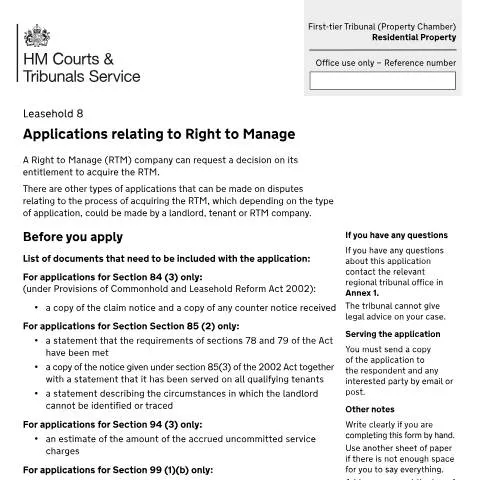
When leaseholders in England and Wales decide to take control of their building's management through a Right to Manage (RTM) company, they often encounter complex procedural requirements and potential disputes. The Leasehold 8 form serves as the primary gateway to the First-tier Tribunal (Property Chamber) for resolving these disputes under the Commonhold and Leasehold Reform Act 2002.
This tribunal application addresses eight distinct scenarios where RTM companies, landlords, or qualifying tenants need judicial intervention. From establishing basic entitlement to manage through to enforcing compliance with statutory requirements, each application type carries specific documentation requirements and procedural nuances that can determine success or failure.
The stakes are considerable: RTM companies typically represent multiple leaseholders who have invested time, money, and considerable effort to establish their right to manage. A poorly prepared application can delay the process by months, incur substantial legal costs, and potentially undermine the entire RTM initiative.
Eight Distinct Pathways Through the RTM Tribunal Process
The Leasehold 8 form covers applications under eight different statutory provisions, each addressing specific challenges that arise during the RTM process:
| Section | Application Type | Who Can Apply | Key Purpose |
|---|---|---|---|
| Section 82(5) | Reasonable costs determination | RTM Company | Dispute over information provision costs |
| Section 84(3) | RTM entitlement decision | RTM Company | Establish right to manage |
| Section 85(2) | Missing landlord application | RTM Company | Proceed when landlord untraceable |
| Section 87B(1) | Cost liability order | Landlord | Recover costs from RTM company |
| Section 94(3) | Service charge fund transfer | RTM Company | Determine accrued uncommitted charges |
| Section 99(1)(b) | Lease approval authority | Various parties | Obtain approval powers under leases |
| Section 107 | Compliance order | Various parties | Enforce statutory requirements |
| Schedule 6, Para 5(3) | Early RTM exercise | RTM Company | Resume RTM within four years |
The Most Common Applications in Practice
Section 84(3) applications represent the most frequent use of this form, typically arising when landlords dispute an RTM company's entitlement claim. The RTM company must demonstrate compliance with all procedural requirements, including proper service of the claim notice and satisfaction of the qualifying criteria for both the building and participating tenants.
Section 85(2) applications address the particular challenge of absent landlords—a surprisingly common issue in leasehold property. When an RTM company cannot locate or identify the landlord to serve the required notices, this application provides a judicial pathway to proceed, but requires rigorous evidence of the search efforts undertaken.
Critical Documentation Requirements by Application Type
The tribunal operates under strict evidential standards, and missing or inadequate documentation frequently leads to application dismissal. Each application type demands specific supporting materials that must be submitted alongside the completed form.
For Section 84(3) Entitlement Applications
These applications require both the original claim notice served on the landlord and any counter-notice received in response. The claim notice must demonstrate compliance with the prescribed format under the 2002 Act, including accurate identification of all participating tenants and proper calculation of the requisite majority.
Counter-notices often form the crux of disputes, as landlords frequently challenge RTM entitlement on technical grounds such as building qualification criteria, tenant eligibility, or procedural defects in the claim notice. The tribunal will scrutinise both documents for compliance with statutory requirements and service provisions.
For Section 85(2) Missing Landlord Applications
The documentation burden here is particularly onerous. Applicants must provide:
- A detailed statement confirming compliance with sections 78 and 79 of the Act
- A copy of the section 85(3) notice served on all qualifying tenants
- Comprehensive evidence of attempts to trace the landlord
The "statement describing circumstances" must be thorough and evidenced. Tribunals expect to see Land Registry searches, company house investigations, attempts to contact known addresses, and engagement with managing agents or other intermediaries who might have landlord contact details.
For Financial and Compliance Applications
Section 94(3) applications require an estimate of accrued uncommitted service charges—funds collected but not yet allocated to specific expenditure. This often involves forensic analysis of service charge accounts, particularly where landlords have been reluctant to provide financial information.
Section 107 compliance applications must include the original notice that has been ignored, along with evidence of service and the expiry of the compliance period. These applications often arise when landlords fail to transfer management responsibilities or provide required information following a successful RTM claim.
Navigating the Application Process and Respondent Requirements
The Leasehold 8 form requires careful attention to procedural requirements that extend beyond mere completion. Applicants must serve copies on all respondents and interested parties, a requirement that can prove complex in multi-party RTM disputes.
Identifying Respondents and Interested Parties
The respondent is typically the party against whom the application is made—usually the landlord in RTM entitlement disputes, or the RTM company in cost recovery applications. However, identifying all interested parties requires more careful consideration.
Interested parties may include individual leaseholders who are not part of the RTM company, superior landlords in complex lease structures, and managing agents who have contractual relationships affected by the RTM process. The tribunal expects applicants to demonstrate they have considered all potentially affected parties.
Service Requirements and Timing Considerations
Service must be by email or post, with the tribunal requiring evidence that proper service has been achieved. This becomes particularly challenging in Section 85(2) applications where the landlord is missing—applicants must serve known addresses and may need to consider alternative service methods through the tribunal's directions.
The form itself provides no specific timeframes, but the underlying statutory provisions often impose strict deadlines. Section 84(3) applications, for example, must typically be made within specific periods following service of counter-notices, making prompt and accurate completion essential.
When RTM Companies Face Financial Exposure
The tribunal process under Leasehold 8 can expose RTM companies to significant financial liabilities, particularly through Section 87B(1) applications where landlords seek to recover costs incurred due to RTM claim notices.
Understanding Cost Liability Risks
RTM companies can face substantial legal and professional costs if their claim notice is found to be invalid or if they withdraw their claim after causing the landlord to incur expenses. These costs can include solicitors' fees, surveyor costs for building assessments, and administrative expenses related to reviewing and responding to the RTM claim.
The tribunal has broad discretion in determining what constitutes reasonable costs, but landlords must demonstrate that expenses were necessarily incurred as a direct consequence of the RTM company's actions. Speculative or excessive legal costs are unlikely to be awarded.
Section 94(3) and Financial Transition Issues
When RTM companies successfully acquire management rights, they become entitled to service charge funds held by the previous managing party. However, disputes frequently arise over the quantum of these funds, particularly regarding uncommitted balances and reserve funds.
The tribunal must determine not only the amount due but also practical arrangements for transfer. This can involve detailed forensic accounting, especially where service charge accounts have been poorly maintained or where there are disputes over expenditure commitments made prior to the RTM acquisition.
Practical Completion Strategies and Common Procedural Pitfalls
Successful completion of the Leasehold 8 form requires understanding both the explicit requirements and the tribunal's practical expectations. The form's structure reflects the tribunal's need for complete information to make informed decisions without unnecessary case management conferences.
Section 1 Selection and Its Consequences
The choice of application type in Section 1 is irreversible once submitted and determines the entire evidential framework for the case. Applicants sometimes select the wrong provision, particularly confusing Section 84(3) entitlement applications with Section 85(2) missing landlord applications.
Each selection triggers specific documentation requirements and procedural pathways. A Section 107 compliance application, for instance, requires evidence of prior notice and non-compliance, while a Section 99(1)(b) approval application focuses on lease interpretation and the scope of required consents.
Multi-Applicant Scenarios and Representative Authority
RTM companies often involve multiple directors or members, creating complexity around who can legitimately make tribunal applications. The form requires clear identification of the applicant's capacity and, where multiple parties are involved, signed authorisation from each participant.
Representative appointments under Section 2.5 carry particular significance, as the tribunal will correspond exclusively with appointed representatives. This can create difficulties if representatives become unavailable or if there are disputes within the RTM company about legal representation.
Property Information and Jurisdictional Requirements
Section 3's property information requirements connect to fundamental jurisdictional questions about whether the tribunal has authority to hear the application. The property must qualify under the RTM provisions, which exclude certain commercial premises and impose specific structural requirements.
Accurate property description becomes crucial where buildings have complex structures or mixed-use elements that might affect RTM eligibility. The tribunal needs sufficient information to understand the physical and legal structure of the property to determine its jurisdiction.
Managing Tribunal Expectations and Case Progression
The First-tier Tribunal (Property Chamber) operates under significant case volume pressures, making complete and accurate initial applications essential for efficient case progression. Incomplete applications face immediate administrative rejection or prolonged case management processes that delay final determination.
The Tribunal's Assessment Process
Upon receipt, tribunal staff conduct an initial completeness check focusing on mandatory fields and required documentation. Applications that pass this initial screening are allocated to tribunal judges for case management directions, while incomplete submissions are returned with specific deficiency notices.
The tribunal cannot provide legal advice but will issue case management directions where procedural clarification is needed. However, substantive legal deficiencies in applications—such as fundamental misunderstanding of the applicable statutory provisions—typically result in application dismissal rather than remedial directions.
Response Timeframes and Hearing Procedures
Once properly submitted, applications typically progress through standard case management timetables. Respondents usually receive 28 days to file responses, with subsequent directions for evidence exchange and, where necessary, hearing arrangements.
Many RTM applications can be determined on paper submissions alone, particularly straightforward Section 84(3) entitlement cases where the facts are not in dispute. However, complex cases involving missing landlords, financial disputes, or compliance issues frequently require oral hearings to resolve evidential conflicts.
The tribunal's decision-making process reflects the technical nature of RTM law and the practical importance of clear, enforceable orders. Successful applicants typically receive detailed determinations that provide clear guidance for implementing the tribunal's decision, whether that involves financial transfers, management handovers, or compliance with specific statutory requirements.
Documentation and Evidence Requirements for RTM Applications
Assembling comprehensive documentation forms the backbone of a successful RTM application using Form Leasehold 8. The tribunal requires specific evidence categories, each serving distinct purposes in demonstrating eligibility and procedural compliance.
Property ownership evidence must include official Land Registry title documents for each participating flat. These documents verify leasehold ownership and identify any restrictions or charges that might affect RTM eligibility. Where properties have been recently purchased, completion statements or exchange contracts may suffice temporarily, though formal title registration remains preferable.
Lease documentation requires particular attention to detail. Each lease must clearly demonstrate the property qualifies as a "long lease" under the Commonhold and Leasehold Reform Act 2002—typically meaning an original term exceeding 21 years. Crucially, leases must grant exclusive possession of individual dwellings rather than shared accommodation arrangements. Tribunal panels scrutinise lease clauses relating to service charges, maintenance obligations, and any management company provisions that might complicate RTM transfer.
Service charge accounts and management records provide context for the application, though poor financial management by existing landlords cannot alone justify RTM acquisition. However, documented patterns of service charge disputes, delayed maintenance, or inadequate consultation procedures may support the case for resident-controlled management.
The statutory notice requirements demand meticulous record-keeping. RTM companies must retain proof of service for all notices served on qualifying tenants, landlords, and other relevant parties. This includes recorded delivery receipts, email delivery confirmations, or witness statements for hand-delivered notices. The tribunal may reject applications where notice procedures appear defective, regardless of substantive merits.
Fill in your form directly online
No printing: type your details into the boxes of the official form, tick, then download the PDF ready to send.
- 1Type into the form boxes
- 2Tick in one click
- 3Save and download the PDF
Building insurance documentation becomes particularly relevant where existing policies might transfer to the RTM company or require renegotiation. Insurance certificates, claims histories, and renewal schedules help demonstrate continuity of coverage during management transition periods.
Professional surveys or structural reports, whilst not mandatory, can strengthen applications where they identify management-related maintenance deficiencies. However, these must clearly link building condition issues to management failures rather than normal wear and deterioration.
Financial Implications and Cost Management Strategies
RTM acquisition involves both immediate application costs and ongoing management expenses that qualifying tenants must carefully evaluate before proceeding with Form Leasehold 8 submissions.
Tribunal application fees represent the most visible initial cost, though fee structures may vary depending on case complexity and hearing requirements. The Ministry of Justice sets standard fees for property tribunal applications, with potential additional charges for oral hearings or expert witness procedures. Unsuccessful applicants may face liability for respondents' reasonable legal costs, creating significant financial exposure.
RTM company establishment costs extend beyond simple incorporation fees. Professional legal advice becomes essential for drafting appropriate articles of association, ensuring compliance with RTM-specific regulations, and structuring governance arrangements suitable for resident directors with varying experience levels. Accountancy setup costs include establishing appropriate bookkeeping systems, VAT registration where applicable, and professional indemnity insurance arrangements.
Insurance transitions require careful financial planning. Existing building insurance policies typically remain with current landlords unless specifically transferred, necessitating new comprehensive coverage from RTM acquisition dates. Insurance premiums may increase where RTM companies lack established claims histories or professional management credentials that insurers favour.
Service charge budgeting becomes the RTM company's responsibility, requiring detailed analysis of historical expenditure patterns and forward planning for major works programmes. Resident directors must balance cost control objectives against legal obligations for proper building maintenance and statutory compliance requirements.
Professional management considerations involve evaluating whether RTM companies require external managing agents or can operate through volunteer resident directors. Professional management typically costs 10-15% of annual service charge income plus VAT, though this varies considerably based on building size, complexity, and service requirements. Self-management may reduce costs but demands significant time commitments from resident volunteers and carries personal liability risks.
Reserve fund management becomes crucial for RTM companies, particularly where previous landlords maintained inadequate reserves for major repairs or improvements. Establishing appropriate reserve levels requires professional surveying advice and may necessitate increased service charges during initial RTM periods.
Debt recovery and arrears management procedures must be established, as RTM companies inherit responsibility for collecting service charges from all leaseholders, including non-participating tenants who opposed the original application. This requires appropriate legal frameworks and may involve county court proceedings against persistent defaulters.
Post-Acquisition Management Responsibilities and Compliance Framework
Successfully obtaining RTM through Form Leasehold 8 applications triggers extensive ongoing obligations that resident directors must understand before assuming management control.
Statutory compliance requirements encompass multiple regulatory frameworks. Health and safety legislation demands regular risk assessments, fire safety compliance, and appropriate maintenance of common areas. The Regulatory Reform (Fire Safety) Order 2005 places specific duties on RTM companies as "responsible persons" for fire safety in residential buildings, requiring competent professional advice and regular equipment testing.
Gas safety obligations under the Gas Safety (Installation and Use) Regulations 1998 mandate annual safety checks for any gas installations in common areas, with appropriate certification and record-keeping requirements. Similarly, electrical installations require periodic testing and certification under BS 7671 wiring regulations, with failure to maintain appropriate standards potentially creating personal liability for RTM company directors.
Service charge consultation procedures follow detailed statutory frameworks under Section 20 of the Landlord and Tenant Act 1985. RTM companies must properly consult leaseholders before undertaking qualifying works exceeding specified thresholds, following prescribed notice periods and consideration procedures. Failure to comply may limit cost recovery through service charges, creating budget shortfalls that resident directors must address.
Financial reporting obligations include preparing annual accounts, filing appropriate returns with Companies House, and providing detailed service charge expenditure statements to leaseholders. The Commonhold and Leasehold Reform Act 2002 grants leaseholders specific rights to inspect RTM company accounts and supporting documentation, requiring transparent bookkeeping practices.
Insurance claim management becomes the RTM company's responsibility, including liaison with loss adjusters, coordination of emergency repairs, and ensuring appropriate interim arrangements during major incident recovery periods. Directors must understand policy terms, excess arrangements, and claim notification procedures to protect the building's interests effectively.
Contractor procurement and management requires establishing appropriate tendering procedures, contract terms, and performance monitoring arrangements. RTM companies often benefit from framework agreements with regular service providers, though these must comply with any consultation requirements for longer-term arrangements.
Dispute resolution procedures must address conflicts between leaseholders, complaints about service standards, and disagreements over expenditure priorities. RTM companies should establish clear governance procedures, regular general meetings, and appropriate escalation processes to maintain resident cohesion and operational effectiveness.
Record keeping extends beyond financial accounts to include maintenance logs, contractor certifications, insurance correspondence, and leaseholder communications. These records support ongoing management decisions and provide essential evidence for any future tribunal proceedings or insurance claims.