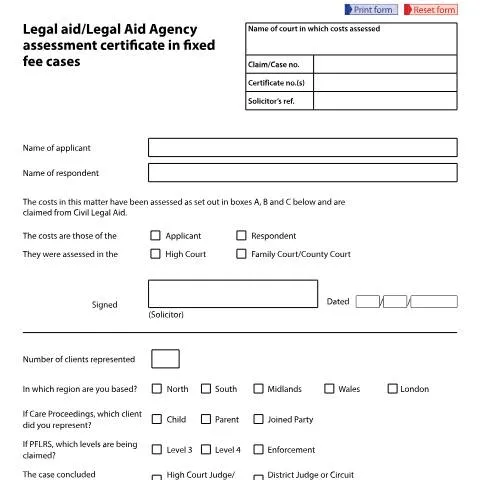
Understanding the EX80B Assessment Certificate in Legal Aid Family Cases
When family court proceedings conclude with legal aid funding, solicitors must navigate a complex cost recovery system that determines what expenses can be claimed from the Legal Aid Agency and what amounts may be recovered from opposing parties. The EX80B assessment certificate serves as the crucial document that formalises these cost determinations in cases where fixed fees apply, creating a clear financial record that satisfies both the court and funding requirements.
This certificate becomes particularly vital in family proceedings where multiple funding streams may apply simultaneously. Unlike standard litigation where costs typically flow from one party to another, family cases often involve public funding arrangements that require careful segregation of different cost categories. The EX80B provides this essential breakdown, ensuring that legal aid payments, inter-partes costs, and assessment fees are properly accounted for and claimed through the appropriate channels.
Scope and Application of Fixed Fee Assessments
The EX80B certificate applies specifically to family proceedings where the Legal Aid Agency operates a fixed fee structure rather than hourly billing arrangements. This system covers a substantial portion of publicly funded family work, including care proceedings, private family law representation schemes (PFLRS), and certain types of domestic violence cases where standard fee scales have been established.
Care Proceedings and Client Representation
In care proceedings, the certificate must specify which party the solicitor represented, as this affects both the fee scale and the potential for cost recovery. The options include:
- Child representation - Often involving guardian ad litem arrangements with specific fee structures
- Parent representation - Subject to means testing and different fixed fee bands
- Joined party representation - Covering grandparents, relatives, or other parties granted legal aid
Each category carries different implications for the assessment process, as children's representatives may claim enhanced rates in complex cases, while parent representation typically follows standard fixed fee bands unless exceptional circumstances apply.
PFLRS Level Classifications
Under the Private Family Law Representation Scheme, practitioners can claim different levels of fixed fees depending on the case complexity and stage reached. The certificate identifies which levels are being claimed:
| Level | Typical Case Types | Fee Structure |
|---|---|---|
| Level 3 | Standard private law children matters | Fixed fee per case stage |
| Level 4 | Complex private law cases | Higher fixed fee with potential enhancements |
| Enforcement | Breach of court orders | Separate fixed fee structure |
The Assessment Process and Escape Cases
While most legal aid family work operates under fixed fee arrangements, certain cases may qualify as "escape cases" where the standard fee proves inadequate for the work genuinely required. The EX80B certificate includes a specific declaration for escape case status, which fundamentally alters how costs are calculated and claimed.
Criteria for Escape Case Designation
Escape case status typically applies where the case involves exceptional complexity, unusually lengthy proceedings, or circumstances that could not reasonably have been anticipated when the fixed fee was set. Common examples include:
- Care proceedings extending beyond 40 weeks due to expert evidence requirements
- Cases involving multiple experts across different disciplines
- International elements requiring extensive foreign law research
- Cases with significant documentary disclosure running to thousands of pages
When escape case status is granted, the assessment moves from fixed fee to detailed assessment principles, requiring comprehensive justification of all costs claimed and potentially leading to significantly different financial outcomes.
Cost Categories and Recovery Mechanisms
The certificate's structure reflects the complex interplay between different funding sources in family proceedings. Understanding these categories is essential for practitioners seeking to maximise legitimate cost recovery while ensuring compliance with legal aid regulations.
Part A: Inter-Partes Cost Recovery
Part A captures costs that may be recoverable from opposing parties, even in family proceedings where cost orders are less common than in other litigation areas. This section excludes pre-certificate costs and assessment costs themselves, focusing on:
- Profit costs - The solicitor's time and expertise charges
- Counsel's fees - Barrister representation costs
- Disbursements - Court fees, expert witness costs, and other third-party expenses
- VAT - Applied according to the firm's VAT status and registration
The amounts entered here must align with either the court's cost order or the Legal Aid Agency's standard fee schedules, depending on the specific circumstances of the case conclusion.
Part B: Legal Aid Agency Costs
This section represents the core of most claims, covering costs payable directly by the Legal Aid Agency under the certificate. The breakdown distinguishes between:
- Base profit costs - Either the standard fixed fee or the assessed amount in escape cases
- Advocacy costs - Separate provision for in-house advocacy work
- Enhancement on costs - Additional payments for cases meeting complexity criteria
- Counsel's fees - Barrister costs funded through legal aid
- Disbursements - Necessary expenses approved under the certificate
Enhancement claims require particular attention, as they must be supported by evidence of exceptional complexity, urgency, or other factors that justify payment above the standard fixed fee.
Regional Variations and Court Hierarchies
The certificate requires specification of both the geographic region and court level where assessment took place, reflecting the fact that family court administration varies significantly across England and Wales. Regional differences affect administrative procedures, local practice directions, and sometimes the interpretation of cost rules.
Geographic Considerations
The five regions specified - North, South, Midlands, Wales, and London - each operate under slightly different administrative arrangements. London cases often involve higher fixed fees reflecting local salary costs, while Wales may have additional considerations around Welsh language requirements that can affect both costs and assessment procedures.
Court Level Impact on Assessments
The court where proceedings concluded significantly affects both the assessment process and potential cost recovery:
| Court Level | Typical Judge | Assessment Implications |
|---|---|---|
| High Court | High Court Judge | Detailed assessment more likely; higher counsel fees justified |
| County Court | Circuit Judge | Standard fixed fee assessment usual |
| Family Court | District Judge | Summary assessment common; limited enhancement opportunities |
Completion Requirements and Certification Standards
The EX80B must meet strict completion requirements to satisfy both court and Legal Aid Agency processing systems. Incomplete or incorrectly completed certificates can lead to significant delays in payment and may require fresh assessment procedures.
Essential Documentation Elements
Every certificate must include complete case identification details, including the claim or case number, certificate number where multiple certificates apply, and solicitor's reference for internal tracking. The certificate number system allows for multiple assessments within the same proceedings, which commonly occurs in lengthy care cases where interim assessments may be required.
Solicitor signature and dating requirements are strictly enforced, with the signature confirming that the costs claimed are accurate and have been properly assessed according to the applicable fee scales. The date must reflect when the assessment was completed, not when the certificate was prepared or submitted.
Court Sealing and Authentication
The certificate requires official court sealing to become effective for payment purposes. This involves presentation to the appropriate court office with supporting documentation, payment of any required court fees, and processing through the court's administrative systems. The seal date becomes crucial for determining payment timelines and any subsequent challenge periods.
Court sealing serves multiple purposes beyond simple authentication - it creates an official record of the assessment, establishes the court's approval of the cost breakdown, and triggers various administrative processes within both the court system and Legal Aid Agency payment mechanisms.
Assessment Costs and Fee Recovery
Part C of the certificate addresses the often-overlooked area of assessment costs themselves - the expenses incurred in having costs assessed and certified. These costs can be substantial in complex cases and may be recoverable in certain circumstances, making accurate completion of this section financially significant.
Components of Assessment Costs
Assessment costs typically include the court fee for the assessment process, which varies depending on the amount being assessed and the court level involved. Additional costs may include solicitor time spent preparing assessment documentation, attending assessment hearings, and liaising with court staff to resolve queries or discrepancies.
In cases where Part A costs are being recovered from opposing parties, the assessment costs may also be recoverable, subject to the court's discretion and the specific terms of any cost order made. This creates a potential additional revenue stream that practitioners should not overlook when completing the certificate.
Post-Assessment Procedures and Compliance
Once sealed, the EX80B certificate triggers various administrative processes and compliance requirements. Understanding these post-assessment obligations helps ensure smooth payment processing and avoids potential complications that could delay or jeopardise cost recovery.
The sealed certificate must be submitted to the Legal Aid Agency within specified timeframes, accompanied by supporting documentation that varies depending on the case type and cost categories claimed. Failure to meet submission deadlines can result in interest penalties or, in extreme cases, forfeiture of the right to claim certain cost elements.
Record retention requirements mandate that practitioners maintain detailed file records for several years after case conclusion, as the Legal Aid Agency may conduct post-payment audits to verify the accuracy of claims made. These audits can result in recovery proceedings if discrepancies are identified, making accurate certificate completion and comprehensive record-keeping essential risk management practices.
The certificate system also interfaces with broader legal aid compliance monitoring, including annual reporting requirements and quality assurance procedures that can affect a firm's ongoing legal aid contracting status. Consistent accuracy in EX80B completion therefore serves both immediate financial interests and longer-term practice sustainability objectives.
Eligibility Assessment Process and Income Thresholds for EX80B Applications
The Legal Aid Agency applies stringent financial eligibility criteria when assessing EX80B applications for family proceedings under fixed fee arrangements. Your gross monthly income forms the primary assessment benchmark, with current thresholds typically set around £2,657 for applicants without dependants. However, these figures fluctuate annually and vary significantly based on your household composition and specific circumstances.
For applicants with dependent children, the Agency applies enhanced income disregards. Each dependent child under 15 years attracts an additional monthly allowance of approximately £295, whilst children aged 15-17 receive around £354 per month. These adjustments recognise the financial burden of supporting dependants whilst pursuing essential legal proceedings.
Capital limits present another crucial hurdle. The Agency examines your savings, investments, property equity, and other assets excluding your primary residence up to £8,000 equity and essential household items. Disposable capital exceeding £3,000 typically disqualifies applicants from legal aid, though certain protected assets remain exempt from calculations.
Employment status significantly influences your assessment outcome. Self-employed applicants face additional scrutiny regarding business accounts, profit margins, and declared income over the preceding 12 months. The Agency may request detailed business records, including profit and loss statements, bank statements, and accountant-prepared documentation spanning considerable periods.
Means testing extends beyond basic income verification. The Agency considers partner income where applicable, regardless of marital status, if you cohabit as a couple. This joint assessment can substantially impact eligibility, particularly where one partner earns significantly more than the applicant. However, certain circumstances allow for individual assessment, including domestic abuse situations or relationship breakdown proceedings.
Exceptional funding provisions exist for cases falling marginally outside standard criteria but demonstrating compelling circumstances. These discretionary assessments require comprehensive justification and typically involve senior Legal Aid Agency decision-makers reviewing complex financial arrangements or unusual hardship situations.
Documentation Requirements and Evidence Standards for Fixed Fee Proceedings
Form EX80B demands extensive supporting documentation to substantiate your financial circumstances and legal aid entitlement. The Legal Aid Agency maintains strict evidence standards, rejecting applications lacking proper verification or containing incomplete information. Understanding these requirements prevents costly delays and potential application refusal.
Income verification requires multiple evidence sources depending on your employment status. Employed applicants must provide recent payslips covering the preceding three months, alongside P60 certificates for the most recent tax year. Bank statements spanning three months demonstrate consistent income patterns and identify any irregular payments affecting your assessment.
Self-employed individuals face substantially more complex documentation requirements. You must submit business bank statements, profit and loss accounts, balance sheets where applicable, and evidence of National Insurance contributions. The Agency scrutinises business expenses claims, requiring receipts and invoices supporting deductions claimed against gross income. Professional accountant certification strengthens applications but isn't mandatory for all self-employed applicants.
Benefit recipients must provide award letters, payment schedules, and evidence of any changes to entitlements within the preceding six months. Universal Credit claimants should include their most recent monthly statements accessed through their online journal, clearly showing payment amounts and any deductions applied.
Capital documentation encompasses bank statements for all accounts, building society passbooks, investment portfolios, and property valuations where relevant. The Agency examines transaction histories identifying unusual transfers, large deposits, or attempts to artificially reduce apparent wealth. Premium bonds, ISAs, and pension funds may require specific valuation evidence depending on their current values.
Family proceedings often involve complex asset arrangements requiring specialist documentation. Matrimonial home valuations, business partnership agreements, trust fund arrangements, and overseas assets all demand detailed evidence. The Agency may request additional expert valuations for unusual assets or complex financial structures.
Documentary authenticity remains paramount throughout the assessment process. The Legal Aid Agency reserves rights to verify information directly with employers, benefit agencies, and financial institutions. Providing false or misleading information constitutes fraud, potentially resulting in prosecution and permanent disqualification from legal aid schemes.
Specialist Considerations for Different Family Proceeding Types Under Fixed Fee Arrangements
Fixed fee legal aid arrangements under EX80B applications vary considerably depending on the specific family proceeding type you're pursuing. Each category attracts different fee structures, scope limitations, and procedural requirements that directly influence your application approach and expected outcomes.
Domestic abuse proceedings receive prioritised treatment within the legal aid framework, often bypassing standard financial eligibility criteria where evidence of abuse exists. The Agency recognises various evidence forms including police reports, medical records, court injunctions, and professional witness statements from social services or healthcare providers. However, evidence must typically be dated within specified timeframes, usually 24 months preceding your application, unless ongoing proceedings justify extended periods.
Child arrangement orders represent another significant category attracting fixed fee coverage. These proceedings involve determining where children live and how much time they spend with each parent following relationship breakdown. The Agency considers the child's welfare paramount, potentially approving legal aid for cases involving parental alienation, international child abduction risks, or complex contact disputes requiring urgent court intervention.
Financial remedy proceedings in divorce cases operate under distinct fixed fee arrangements covering property division, spousal maintenance, and pension sharing orders. These cases often involve substantial assets requiring detailed financial disclosure and expert valuations. The Legal Aid Agency may limit coverage to specific aspects of complex financial cases, requiring careful scope definition within your EX80B application.
Care proceedings involving local authority intervention attract different assessment criteria and fee structures. Parents facing potential child removal proceedings typically qualify for legal aid regardless of financial circumstances, recognising the fundamental rights at stake. However, the Agency distinguishes between public law proceedings initiated by local authorities and private family disputes between individuals.
Forced marriage protection proceedings receive enhanced legal aid provision reflecting their urgent nature and human rights implications. The Agency fast-tracks these applications and may waive standard documentation requirements where immediate protection is necessary. Similar provisions apply to female genital mutilation protection orders and other culturally-specific safeguarding measures.
Appeal proceedings against initial court decisions operate under separate fixed fee arrangements with distinct time limits and scope restrictions. The Agency assesses appeal prospects before approving representation, requiring legal opinions on reasonable chances of success. This pre-approval process can delay proceedings but ensures public funds target viable cases with genuine appeal prospects.
Cross-border family cases involving international elements attract complex fee arrangements reflecting increased work requirements and specialist expertise needs. These cases may involve Hague Convention proceedings, international child abduction, or enforcement of foreign court orders within UK jurisdiction. The Agency considers additional factors including translation requirements, international legal expertise, and extended procedural timescales when assessing fixed fee appropriateness.