When Patent Protection Lapses: Understanding the Critical Window for Restoration
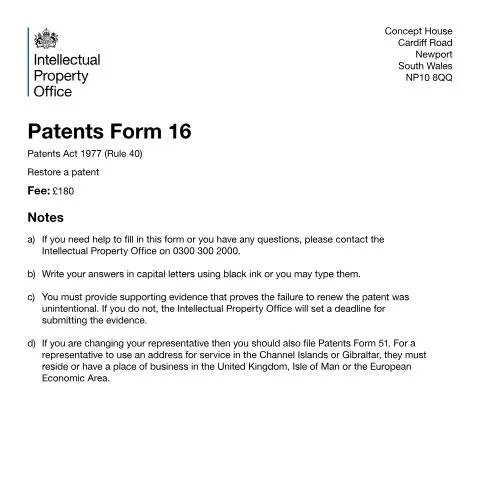
Patent holders in the UK face a sobering reality when their intellectual property rights expire due to missed renewal deadlines. The Patents Act 1977 provides a narrow but vital lifeline through the restoration process, governed by Rule 40 and administered via Patents Form 16 (PF16). This mechanism serves patent owners whose rights have lapsed not through strategic abandonment, but through genuine oversight or circumstances beyond their control.
The restoration pathway emerges most commonly in scenarios where patent holders have relocated without updating their correspondence address, experienced administrative disruptions during company restructuring, or encountered postal delays affecting critical renewal notices. Unlike patent renewal, restoration carries both procedural complexity and evidential requirements that demand careful preparation and strategic timing.
Patent restoration operates within strict temporal boundaries. The Intellectual Property Office permits restoration applications only within specific timeframes following expiry, making swift action essential once the lapse is discovered. The £180 fee represents just the administrative cost – the true investment lies in assembling compelling evidence of unintentional failure and navigating the procedural requirements effectively.
Decoding Form PF16: Section-by-Section Navigation Through Patent Restoration
Patents Form 16 follows a structured approach that builds from basic identification through to authorization and payment processing. Each section serves specific evidential and administrative purposes within the broader restoration framework.
Patent Identification and Ownership Details
Section 2 requires the precise patent number as recorded in the UK patent register. This differs from application numbers or international filing references – only the granted UK patent number suffices. The Intellectual Property Office maintains strict validation protocols, rejecting applications with incorrect or incomplete patent identifiers.
Section 3 demands the full legal names of all registered patent owners at the time of expiry. Where ownership has transferred since the original grant, the current registered proprietors must be listed exactly as they appear in the official register. Joint ownership requires all parties to be named, and any discrepancies trigger additional verification procedures.
Applicant Authority and Representative Arrangements
The distinction between patent owners and restoration applicants in sections 3 and 4 accommodates various commercial realities. Patent management companies, licensing entities, or legal successors may initiate restoration on behalf of registered owners, provided proper authorization exists.
Representative arrangements in section 5 carry specific geographical restrictions. While the form permits Channel Islands or Gibraltar addresses for service, the representative must maintain substantive presence within the UK, Isle of Man, or European Economic Area. This requirement reflects post-Brexit adjustments to legal representation rules and prevents purely nominal appointments.
| Representative Location | Additional Requirements | Acceptable Evidence |
|---|---|---|
| UK mainland | None beyond registration | Business registration or residential proof |
| Isle of Man | EEA business presence | Company registration certificate |
| Channel Islands/Gibraltar | UK/IoM/EEA residence or business | Dual address verification required |
Authorization Confirmation and Contact Protocols
Section 7's authorization checkbox carries legal significance beyond mere form completion. The signature and date create formal declaration that the applicant possesses legitimate authority to seek restoration. False declarations constitute grounds for rejection and potential legal consequences under intellectual property legislation.
Contact details in section 8 facilitate case management throughout the restoration process. The Intellectual Property Office prioritizes email communication for efficiency, though telephone contact proves valuable for complex evidential discussions or urgent procedural clarifications.
The Evidential Foundation: Proving Unintentional Patent Lapse
Patent restoration hinges entirely on demonstrating that the failure to renew occurred without deliberate intent. The Intellectual Property Office applies rigorous scrutiny to these claims, recognizing that restoration effectively extends monopoly rights beyond their intended expiry.
Categories of Acceptable Evidence
Administrative oversight represents the most straightforward category for evidential support. Documentation showing systematic renewal processes, calendar systems, or professional management arrangements helps establish that the lapse contradicted normal business practices. Email threads, diary entries, or professional correspondence demonstrating active patent management strengthen these cases considerably.
External circumstances beyond the patent holder's control form another recognized category. Postal disruptions, address changes during company relocations, or staff transitions affecting patent administration can justify restoration applications. The key lies in demonstrating both the disruption's occurrence and its direct causal relationship to the missed renewal.
Personal circumstances affecting individual patent holders – illness, family emergencies, or travel disruptions – require particularly detailed documentation linking the circumstances to the administrative failure.
Evidential Standards and Documentation Requirements
The Intellectual Property Office expects contemporaneous evidence wherever possible. Retrospective explanations carry less weight than documentation created at the time of the relevant events. Medical certificates, travel itineraries, or business correspondence timestamped around the renewal deadline provide compelling support for restoration applications.
Where initial evidence proves insufficient, the Office issues formal deadlines for supplementary material. These deadlines carry strict enforcement – failure to respond results in automatic application rejection without further consideration. The evidential threshold increases with patent age and commercial value, reflecting the Office's balancing of restoration rights against legal certainty for third parties.
Submission Pathways: Digital Versus Postal Processing Routes
Form PF16 offers dual submission routes reflecting modern administrative preferences while maintaining traditional postal accessibility. Each pathway carries distinct procedural requirements and processing characteristics that influence case management strategies.
Online Submission Through the IP Account System
Digital submission via the Intellectual Property Office's online platform provides immediate confirmation and integrated payment processing. The system requires account creation or login through the manage-intellectual-property service portal, establishing secure document transmission and case tracking capabilities.
Online processing typically reduces initial handling times, though complex evidential packages may still require manual review. The system accepts multiple file formats for supporting documentation, though PDF remains preferred for consistency and accessibility across review teams.
- Immediate submission confirmation with unique reference numbers
- Integrated payment processing eliminating separate fee transactions
- Automatic case status updates through account dashboards
- Secure document storage for future reference or amendments
Traditional Postal Submission to Newport
Postal submission to Concept House in Newport maintains accessibility for applicants preferring paper-based processes or lacking digital infrastructure. This route requires separate payment arrangements through the dedicated fee payment system or traditional banking methods.
Physical submission allows for original document inclusion where authenticity questions might arise with scanned copies. However, processing times extend due to manual handling requirements and separate payment verification procedures.
Payment Mechanisms and Financial Considerations
The £180 restoration fee represents a standardized charge regardless of patent type, duration of lapse, or evidential complexity. This fee structure simplifies budgeting while ensuring consistent revenue recovery for administrative processing costs.
Digital Payment Integration
Online submissions benefit from immediate payment processing through the secure fees portal at fees.ipo.gov.uk. The system generates 10-character reference codes providing audit trails and confirmation of successful transactions. These codes must be retained for case reference and potential dispute resolution.
Traditional Banking and Deposit Account Options
Established patent practitioners often utilize IPO deposit accounts for streamlined fee management across multiple cases. These accounts enable immediate fee deduction upon form submission, eliminating payment processing delays that might affect application timing.
Bank transfer options accommodate international applicants or those preferring direct banking relationships. The specific account details provided – sort code 20-18-23, account number 80531766 – ensure proper fee allocation within the Office's financial systems. SWIFT and IBAN details facilitate international transfers while maintaining compliance with UK banking regulations.
Processing Timelines and Decision Frameworks
Patent restoration applications undergo multi-stage assessment combining administrative verification, evidential review, and legal analysis. Understanding these stages helps applicants prepare appropriate responses and manage commercial expectations during the restoration process.
Initial Administrative Processing
Form validation occurs within days of submission, checking patent number accuracy, fee payment confirmation, and basic completeness requirements. Administrative deficiencies trigger immediate correspondence requesting corrections within specified deadlines. Simple errors like incorrect patent numbers or insufficient payment halt processing until rectified.
Evidential assessment follows successful administrative validation. Patent examination teams review supporting documentation against established restoration criteria, often requesting additional evidence or clarification. This stage varies significantly in duration depending on evidence quality and case complexity.
Legal Assessment and Third Party Considerations
The Intellectual Property Office considers broader legal implications beyond the immediate application. Patent restoration affects third parties who may have commenced competing activities during the lapse period, requiring careful balancing of restoration rights against commercial certainty.
Complex cases may involve public consultation periods allowing third party representations against restoration. These procedures extend processing times but ensure comprehensive consideration of all relevant interests before final determination.
Strategic Timing and Commercial Implications
Patent restoration timing carries significant commercial consequences extending beyond mere rights recovery. Market dynamics, competitor activities, and licensing arrangements all influence optimal restoration strategies and procedural approaches.
Early restoration applications generally receive more favorable consideration than those submitted near deadline limits. This preference reflects the Office's interpretation that prompt action demonstrates genuine oversight rather than strategic delay tactics. Commercial patent holders benefit from systematic monitoring procedures identifying lapses quickly and enabling swift restoration applications.
The restoration process creates temporary uncertainty affecting licensing negotiations, enforcement actions, and investment decisions. Patent holders must communicate restoration status clearly to existing licensees and potential commercial partners to maintain business relationships during the administrative process.
International patent families require coordinated restoration strategies where UK rights form part of broader territorial protection. Timing misalignments between different jurisdictions can create exploitable gaps in protection coverage.
Successful restoration reinstates patent rights from the original expiry date, providing retroactive protection but potentially creating liability for activities undertaken during the lapse period. This retroactive effect requires careful legal analysis of competitor activities and market developments occurring during the restoration process.
Patent Restoration Timeline and Critical Deadlines
Understanding the precise timeline for patent restoration is crucial, as the Intellectual Property Office operates under strict statutory deadlines that cannot be extended once exceeded. The restoration window begins immediately upon lapse and remains open for a maximum period, though acting swiftly significantly improves your prospects.
For patents that lapsed due to non-payment of renewal fees, you have up to 19 months from the original due date to file Form 16 and restore the patent. This period includes the initial six-month grace period during which late payment was possible with additional fees. However, this timeline varies depending on the specific circumstances of lapse.
If your patent lapsed during the fourth year (first renewal due), the restoration deadline falls 19 months after the fourth anniversary of the filing date. For patents lapsing in subsequent years, calculate from the respective anniversary date when the renewal fee became due. The IPO will not accept restoration applications beyond these statutory limits, regardless of circumstances.
Critical considerations affect your timeline strategy. Patents approaching their twentieth year cannot be restored beyond the absolute expiry date, even if the 19-month window theoretically extends past this point. Additionally, if third parties have begun exploiting your invention during the lapse period, earlier restoration helps establish clearer grounds for potential infringement proceedings.
The IPO typically processes straightforward restoration applications within 8-12 weeks from receipt of complete documentation. However, complex cases involving detailed evidence submissions or requests for hearings can extend processing times to 4-6 months. During peak periods, particularly following the January self-assessment deadline when many businesses review their IP portfolios, processing may experience additional delays.
Consider submitting your restoration application well before any critical commercial deadlines. If you're planning licensing negotiations, product launches, or enforcement actions, factor in potential processing delays and the possibility that the IPO may request additional evidence or clarification.
Third Party Rights and Commercial Implications During Lapse
The period between patent lapse and restoration creates a complex legal landscape where third party rights may emerge, potentially complicating your restoration and subsequent enforcement efforts. Understanding these implications helps you assess both the urgency of restoration and potential commercial consequences.
During lapse, your invention enters a temporary public domain status. Competitors may legitimately begin manufacturing, selling, or importing products that would otherwise infringe your patent rights. Crucially, acts commenced in good faith during the lapse period may continue even after restoration, subject to specific conditions under the Patents Act 1977.
Section 28A of the Patents Act provides protection for parties who, during the lapse period, began in good faith to do an act that would constitute infringement, or made serious and effective preparations to do such an act. These parties may continue their activities after restoration, though they cannot license this right to others or significantly expand their operations beyond what was planned during lapse.
This protection applies only to acts commenced during lapse, not to new activities begun after restoration. However, determining what constitutes "serious and effective preparations" often involves complex factual analysis. Courts consider factors including financial commitments made, manufacturing arrangements established, and the extent of planning undertaken during the lapse period.
From a commercial perspective, delayed restoration can permanently erode your patent's value. Competitors who enter the market during lapse may establish customer relationships, distribution networks, or market positions that prove difficult to displace, even after restoration grants you renewed exclusivity over new market entrants.
Monitor competitor activity during any lapse period through market surveillance, patent watch services, or industry intelligence. Document any potentially infringing activities, as this evidence may prove valuable for subsequent enforcement actions against parties who cannot claim section 28A protection.
Consider the broader IP landscape when evaluating restoration urgency. If your patent forms part of a larger portfolio protecting related innovations, lapse of one patent may weaken your overall competitive position, even if individual competitor actions fall within section 28A protections.
International Considerations and Patent Family Management
Patent restoration in the UK often occurs within the context of international patent families, where corresponding applications or grants exist in multiple jurisdictions. Managing restoration across different patent systems requires careful coordination, as each jurisdiction operates under distinct legal frameworks and procedural requirements.
European patents designating the UK present particular complexity. If your European patent (EP) has lapsed in the UK due to non-payment of renewal fees to the IPO, restoration follows UK national procedures regardless of the patent's status in other designated states. Conversely, if the European patent lapses at the European Patent Office due to non-payment of EPO renewal fees, this affects all designated countries simultaneously, requiring restoration through EPO procedures rather than national restoration applications.
For patents filed under the Patent Cooperation Treaty (PCT), restoration issues typically arise during the national phase. If your UK national phase patent lapses, restoration affects only UK rights, leaving corresponding patents in other jurisdictions unaffected. However, coordinating restoration timing across multiple jurisdictions may prove strategically important for maintaining consistent global protection.
Consider the commercial significance of different markets when prioritizing restoration efforts. If the UK represents a key manufacturing or sales territory for your technology, urgent restoration may be essential. Alternatively, if other major markets remain protected and UK commercial activity is limited, you might evaluate restoration against broader portfolio management costs.
Currency fluctuations and international fee structures influence restoration economics. UK restoration fees are set in pounds sterling, but if your patent portfolio spans multiple currencies, exchange rate movements may affect the relative cost-effectiveness of restoration versus refiling strategies in different jurisdictions.
Licensing agreements often include territorial scope covering multiple jurisdictions. Patent lapse in one territory may trigger licensing agreement provisions requiring fee adjustments, territory modifications, or other contractual consequences. Review international licensing arrangements before proceeding with restoration to understand potential commercial implications.
Due diligence in corporate transactions frequently examines patent portfolio status across all relevant jurisdictions. Lapsed patents, even if subsequently restored, may attract scrutiny regarding IP management practices and portfolio quality. Maintain comprehensive records of restoration proceedings and evidence demonstrating reasonable care in patent portfolio management.
Professional representation requirements vary between jurisdictions. While UK patent restoration can be handled directly by patent owners, many international jurisdictions require local professional representation. Coordinate restoration efforts through experienced patent attorneys familiar with cross-border patent family management to ensure consistent and effective proceedings across all relevant territories.