Understanding the Welsh Government's Guardianship Application Form Under the Mental Health Act 1983 (Section 7)
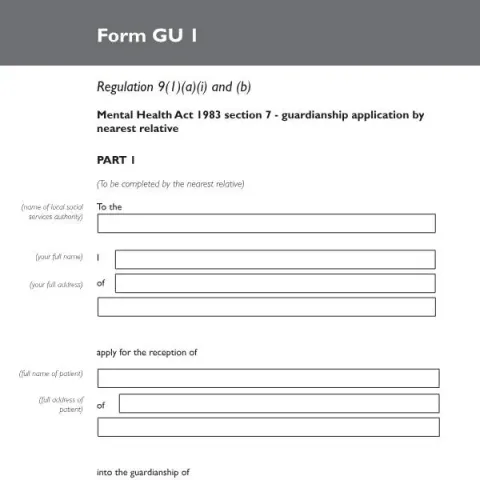
The Welsh Government has provided a specific form, designated as Form GU 1, to facilitate applications for guardianship under Section 7 of the Mental Health Act 1983. This legal process allows a nearest relative to seek authority to care for an individual who may lack the capacity to make decisions about their mental health treatment. This article aims to clarify the purpose, eligibility criteria, and step-by-step procedures involved in completing this form, ensuring applicants understand their responsibilities and the legal context.
Purpose and Scope of the Form
Form GU 1 is an official document used by a nearest relative to apply for guardianship over a person detained or requiring care under the Mental Health Act 1983. The form is designed to be submitted to the relevant local social services authority, which reviews and processes guardianship applications to ensure that the individual's welfare and legal rights are protected.
This application form is part of the legal framework that allows a responsible family member or close relative to take a formal role in managing the mental health care of an individual who may be unable to make decisions independently. It is particularly relevant where less restrictive alternatives are insufficient, and legal guardianship is deemed necessary for the person's well-being.
Eligibility and Who Can Apply
The applicant must be the nearest relative of the individual requiring guardianship, as defined under the Act. Typically, this includes parents, spouses, civil partners, children, siblings, or other close relatives. If the applicant is not the local social services authority, they must demonstrate their willingness to act as guardian by completing Part 2 of the form.
In addition, the applicant must confirm their relationship to the individual and provide evidence of their status, such as being the patient's nearest relative or having legal authority from a court. The application also requires confirmation that the applicant has seen the individual within the last 14 days to attest to their current condition.
Step-by-Step Procedure for Completing the Form
Part 1: Application by the Nearest Relative
- Identify the relevant details: Fill in the name and address of the local social services authority, your full name, address, and details of the patient, including their full name and address.
- Specify guardianship details: Clearly state the intention to apply for guardianship of the individual under Part 2 of the Mental Health Act 1983.
- Provide relationship information: Indicate your relationship to the patient and confirm that you are the nearest relative or have legal authority to act on their behalf.
- Medical confirmation: Confirm that you have seen the patient within the last 14 days, and that the application is based on two medical recommendations in the prescribed form.
Part 2: Consent and Declaration by the Proposed Guardian
- Willingness to act: The proposed guardian must confirm their willingness to undertake guardianship responsibilities and verify their details.
- Relationship confirmation: Specify the relationship (e.g., parent, spouse) and provide reasons if applicable.
- Legal authority: Indicate whether the applicant is the nearest relative or has been authorized by a court, attaching relevant documentation if necessary.
- Medical acquaintance: Confirm the patient's date of birth or age, and state when the last contact occurred.
Important Legal and Procedural Considerations
Completing and submitting Form GU 1 is a formal legal process, and applicants should ensure all information is accurate and complete. The form must be signed and dated by both the applicant and the proposed guardian where applicable. It is essential to include medical recommendations supporting the guardianship application, which must be in the prescribed format and signed by qualified medical practitioners.
Once submitted, the local social services authority reviews the application, considering the medical advice and the applicant's relationship to the individual. The authority may request additional information or clarification before making a decision. The entire process is governed by statutory procedures designed to safeguard the rights and welfare of the individual concerned.
Post-Submission Steps and Legal Implications
After the application is accepted, guardianship arrangements are formalized through legal orders issued by the relevant authorities. The guardian then assumes responsibility for the individual's care and decision-making, in accordance with the provisions of the Mental Health Act 1983. It is important for guardians to understand their legal duties, including safeguarding the individual's rights and ensuring appropriate treatment and support.
Fill in your form directly online
No printing: type your details into the boxes of the official form, tick, then download the PDF ready to send.
- 1Type into the form boxes
- 2Tick in one click
- 3Save and download the PDF
Applicants and guardians should also be aware of the review procedures and the possibility of applying for the termination or variation of guardianship orders if circumstances change.
In summary, Form GU 1 is a vital legal instrument that enables close relatives to seek guardianship under the Mental Health Act 1983, ensuring that individuals with mental health needs receive appropriate care while respecting their legal rights and dignity.