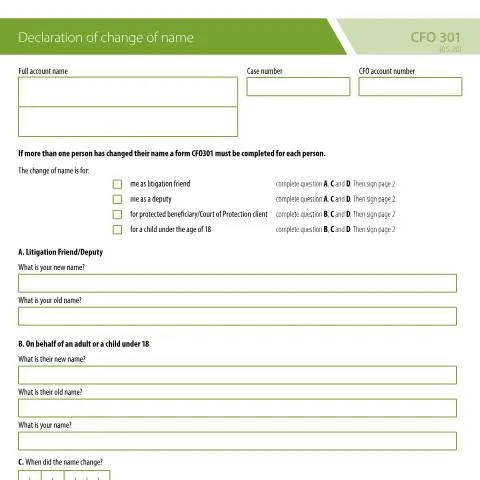
When Court Funds Meet Life Changes: The CFO 301 Declaration Process
Life transitions rarely pause for administrative convenience. When someone with funds held by the Court Funds Office undergoes a name change—whether through marriage, deed poll, or other legal means—the bureaucratic machinery requires formal notification. The CFO 301 form serves as the official bridge between personal transformation and institutional record-keeping, ensuring that substantial sums held in court accounts remain properly attributed to their rightful owners.
This declaration process touches diverse circumstances: adults changing names independently, children whose names are altered by parental decision, protected beneficiaries under Court of Protection supervision, and the various representatives who act on their behalf. Each scenario carries distinct procedural requirements, reflecting the Ministry of Justice's careful approach to safeguarding vulnerable parties while maintaining accurate financial records.
The Court Funds Ecosystem and Name Change Implications
The Court Funds Office operates as a secure repository for money arising from legal proceedings, settlements, and court-ordered payments. These funds might represent compensation awards, inheritance disputes resolved through litigation, or damages from personal injury claims. When account holders undergo name changes, the administrative stakes extend beyond simple record correction—they involve maintaining the legal chain of custody for potentially substantial financial assets.
Account holders fall into distinct categories, each with specific notification requirements:
- Direct beneficiaries who control their own accounts and can execute name changes independently
- Protected beneficiaries under Court of Protection oversight, whose affairs are managed due to mental incapacity
- Minor beneficiaries whose accounts are administered until they reach majority
- Litigation friends and deputies who represent others' interests in legal proceedings
The CFO 301 form acknowledges these varying relationships by requiring different completion pathways depending on who initiates the name change and on whose behalf.
Navigating the Three-Path Declaration Structure
The form's design reflects the complexity of court fund management by offering three distinct completion routes. Understanding which path applies prevents processing delays and ensures proper legal authority is demonstrated.
Path One: Litigation Friends and Deputies Acting for Themselves
When litigation friends or deputies undergo personal name changes, they complete sections A, C, and D. This scenario typically arises when someone appointed to represent another party's interests—perhaps a parent acting as litigation friend for a child, or a deputy appointed by the Court of Protection—experiences their own life change. The form requires their old name, new name, the date of change, and the method by which the change occurred.
The distinction matters because these individuals hold dual roles: they are account stakeholders in their representative capacity while maintaining separate personal identities. Their name change affects their authority to act on behalf of the beneficial owner, making proper documentation essential for continued account management.
Path Two: Changes Affecting Protected Persons
Section B addresses name changes for protected beneficiaries or Court of Protection clients—individuals whose mental capacity limitations prevent them from managing their own affairs. This path also covers children under 18, who similarly lack legal capacity to execute name changes independently.
Here, the form captures both the beneficiary's old and new names plus the representative's identity. This dual documentation creates an audit trail showing who initiated the change and on what authority, crucial for maintaining proper oversight of vulnerable persons' assets.
Universal Requirements: Timing and Evidence
Regardless of pathway, sections C and D apply universally. Section C establishes the precise date when the name change became effective—critical for determining which name applies to transactions occurring around the transition period. Section D identifies the legal mechanism: marriage certificate, deed poll, or other specified document.
The requirement for certified copies rather than originals reflects standard court practice, ensuring document authenticity while allowing applicants to retain their primary evidence.
Documentary Evidence and Certification Requirements
The CFO 301 process demands more than simple assertion—it requires verifiable proof that meets legal standards. The form specifically mentions three common name change methods, each carrying different evidential requirements.
| Change Method | Primary Document | Additional Considerations |
|---|---|---|
| Marriage | Marriage certificate | Must show both old and new names clearly |
| Deed Poll | Enrolled or statutory declaration | Private deed polls require additional witnessing evidence |
| Other legal process | Court order or statutory provision | May include gender recognition certificates or foreign documents with translations |
Certification standards follow established legal protocols. Documents must be certified by individuals authorised to witness affidavits—a deliberately restricted category ensuring proper verification. The acceptable witness list includes Commissioners for Oaths, practicing solicitors specified under the Legal Services Act 2007, certain court officials, circuit or district judges, Justices of the Peace, and designated county court officials.
This restriction serves multiple purposes: it ensures witnesses understand their legal responsibilities, provides recourse if false certification occurs, and maintains consistency with broader court procedures where sworn statements require similar authentication.
The Witness Declaration Process and Legal Safeguards
The CFO 301's witness requirements extend beyond simple identity verification to encompass legal accountability. The declaration section requires the applicant to state explicitly whether they are signing for themselves or on behalf of another person, creating distinct legal obligations depending on their status.
Personal declarations carry straightforward liability—the signatory affirms their own identity and authority to request the name change. Representative declarations involve additional complexity, as the signatory must demonstrate both their own identity and their legal authority to act for the beneficial owner.
The witness must observe the actual signing, verify the signatory's identity, and provide their own professional credentials. This physical presence requirement—despite digital alternatives available for many government processes—reflects the high-value nature of court funds and the potential for fraud in name change scenarios.
Professional Witness Categories and Their Significance
The witness list reflects a careful balance between accessibility and security. Legal professionals like solicitors and Commissioners for Oaths bring technical expertise and professional indemnity coverage. Judicial officers including circuit judges and Justices of the Peace carry institutional authority and understanding of court procedures. Court officials appointed specifically for witnessing purposes provide convenient access while maintaining proper oversight.
Notably absent from the list are common alternatives like doctors or bank managers, who might witness other official documents. This restriction emphasises the form's legal rather than administrative character—it functions as a quasi-judicial declaration requiring appropriate professional oversight.
Multiple Name Changes and Administrative Coordination
The form explicitly states that multiple name changes require separate CFO 301 submissions for each affected person. This requirement reflects both practical database limitations and legal precision—each individual's name change constitutes a distinct legal event requiring separate documentation and verification.
This approach creates coordination challenges in family situations where multiple court fund beneficiaries change names simultaneously. Consider divorced parents with children who have court fund accounts: if the mother reverts to her maiden name while changing her children's surnames to match, three separate CFO 301 forms would be required despite the changes arising from a single family decision.
Processing implications include:
- Each form requires individual witness verification, potentially involving multiple professional appointments
- Separate certified copies of supporting documents for each submission, increasing costs
- Possible processing delays if forms are submitted at different times or contain inconsistent information
- Coordination requirements with ongoing legal proceedings that might reference the old names
The Court Funds Office customer helpline at 0300 0200 199 can provide guidance on managing multiple simultaneous changes, potentially suggesting optimal submission timing or documentation strategies.
Privacy Considerations and Data Protection Compliance
The CFO 301 process operates within the framework of the Data Protection Act 2018 and UK GDPR, creating specific obligations for both applicants and the Court Funds Office. The form references detailed privacy notices available through the government website or directly from the CFO, acknowledging that name change data requires careful handling given its sensitive nature.
Name changes often reveal personal circumstances that individuals might prefer to keep private—divorce, gender transition, escape from domestic violence, or family reconciliation. The court funds context adds financial dimensions to this sensitivity, as account balances might indicate the nature of underlying legal proceedings or personal circumstances.
Data retention periods for CFO 301 submissions likely extend beyond standard administrative timeframes, given the permanent nature of court records and the potential for future legal challenges regarding account ownership. This extended retention creates ongoing privacy implications that applicants should understand.
Third-party access considerations include potential disclosure in related legal proceedings, audit processes, or investigations into financial impropriety. While normal data protection principles apply, court-related information often carries broader disclosure obligations than purely administrative records.
Submission Channels and Processing Expectations
The Court Funds Office provides multiple submission routes, each with distinct characteristics affecting processing speed and applicant convenience. The Sunderland address serves as the primary postal destination, while DX 328004 Sunderland 19 offers document exchange services for legal professionals with access to that network.
Email submission to [email protected] presents apparent convenience but requires careful consideration of document security. Certified copies and witness signatures create particular challenges for electronic submission—scanning quality must preserve document integrity, and digital signatures may not satisfy the physical presence requirements for witness verification.
Processing Timeline Factors
While the form doesn't specify processing timeframes, several factors influence how quickly name changes take effect in court fund records:
- Document completeness—missing sections or inadequate certification trigger return correspondence and delays
- Witness verification—the CFO may need to confirm witness credentials, particularly for less common professional categories
- Account complexity—funds subject to ongoing legal proceedings or court supervision require additional internal coordination
- Supporting document clarity—foreign certificates, complex deed polls, or unusual name change methods may require specialist review
The customer helpline provides status updates and can expedite processing where urgent circumstances exist—for example, when name changes affect time-sensitive legal proceedings or benefit payments linked to court fund accounts.
Successful processing results in updated account records that reflect the new name across all court fund documentation. This change cascades through related systems, ensuring that future statements, payment instructions, and legal correspondence use the correct identity. For representatives like litigation friends and deputies, the change also updates their authorisation records, maintaining their ability to act on behalf of beneficial owners while reflecting their own identity changes.
Documentation Requirements and Evidence Standards
The Court Funds Office maintains stringent documentation standards for name change applications, reflecting its role as custodeholder for significant sums. Your evidence package must demonstrate both the legitimacy of your identity change and provide clear audit trails for financial compliance purposes.
For deed poll name changes, the Court Funds Office requires sight of the original enrolled deed poll certificate, not photocopies. If your deed poll was executed through the Royal Courts of Justice, you'll need the official sealed document bearing the court's stamp. Private deed polls, whilst legally valid, may require additional supporting documentation such as statutory declarations or witness statements to satisfy the office's enhanced verification procedures.
Marriage or civil partnership certificates must be certified copies issued by the General Register Office or equivalent registrar. The Court Funds Office particularly scrutinises overseas marriage certificates, which typically require apostille certification under the Hague Convention or consular authentication. Scottish or Northern Irish certificates follow slightly different validation procedures, so specify your jurisdiction when submitting documentation.
For divorce-related name reversions, decree absolute documents serve as primary evidence. However, the Court Funds Office may request additional confirmation if there's a significant time gap between your divorce and the name change request. This reflects their obligation to prevent fraudulent claims on dormant accounts where beneficial ownership might be disputed.
Fill in your form directly online
No printing: type your details into the boxes of the official form, tick, then download the PDF ready to send.
- 1Type into the form boxes
- 2Tick in one click
- 3Save and download the PDF
Gender recognition certificates issued under the Gender Recognition Act 2004 carry special evidential weight, as they create a new legal identity retrospectively. The Court Funds Office treats these applications with particular sensitivity, often expediting processing times whilst maintaining robust verification procedures.
Supplementary evidence becomes crucial when primary documents contain discrepancies or insufficient detail. Bank statements, utility bills, or council tax notices spanning several months can establish a pattern of name usage. Professional membership certificates, employment records, or educational qualifications may also strengthen your application, particularly for complex cases involving multiple name changes or lengthy time periods.
The Court Funds Office maintains detailed records of documentation standards, which occasionally evolve in response to fraud prevention measures or regulatory changes. Recent enhancements include heightened scrutiny of digital documents and increased requirements for wet-signature confirmations on supporting statements.
Processing Timescales and Priority Categories
Understanding the Court Funds Office's internal processing hierarchy helps set realistic expectations for your name change application. Standard applications typically require 4-6 weeks for completion, though this baseline assumes complete documentation and straightforward circumstances.
Priority processing applies to specific categories of applicant. Urgent medical circumstances, where immediate access to funds is required for treatment, may qualify for expedited handling within 10-15 working days. Similarly, time-sensitive legal proceedings involving the funds can trigger accelerated processing, though you'll need supporting evidence from your solicitor or the relevant court.
Complex estate matters involving multiple beneficiaries or disputed inheritance claims naturally extend processing times. The Court Funds Office must coordinate with probate registries, potentially involving cross-referencing with wills and succession planning documents. These cases may require 8-12 weeks, particularly where overseas elements or trust structures are involved.
Bulk applications from legal firms representing multiple clients follow specialised procedures. Whilst individual cases within the bulk submission maintain standard timescales, the administrative overhead of processing large batches can create delays during peak periods, particularly around the end of the financial year when many firms submit accumulated applications.
The Court Funds Office operates reduced services during court vacation periods, typically affecting July-August and December-January processing times. Planning your application submission around these periods can prevent unnecessary delays, particularly for non-urgent matters.
Status updates on your application are available through the Court Funds Office telephone enquiry service, though they typically only provide meaningful updates after the initial 3-week assessment period. Written status requests are discouraged unless exceptional circumstances apply, as they can actually slow processing by diverting administrative resources.
Appeals or reconsiderations of rejected applications follow separate timescales entirely. The Court Funds Office allows 28 days for you to address deficiencies in your original submission, after which a fresh application may be required. This appeals window is strictly enforced, reflecting the office's need to maintain efficient case management across thousands of annual applications.
Financial Implications and Account Management Considerations
Name changes within the Court Funds Office system carry several financial implications beyond the immediate administrative aspects. Understanding these consequences helps ensure your funds remain properly managed throughout the transition process.
Interest accrual continues normally during name change processing, with payments calculated and credited under your new identity once the change is confirmed. However, any interest payments scheduled during the processing window may be held pending completion of your name change, particularly for substantial sums where additional verification is required.
Investment portfolios held within court funds require special consideration during name changes. The Court Funds Office must coordinate with investment managers to ensure continuous beneficial ownership records, which can temporarily restrict trading activities or portfolio rebalancing. For actively managed funds, this may impact investment performance during volatile market periods.
Tax implications vary depending on your specific circumstances and the nature of your court funds. Income tax obligations typically transfer seamlessly to your new identity, but Capital Gains Tax considerations may be more complex, particularly for funds held across multiple tax years. The Court Funds Office cannot provide tax advice, so consultation with qualified advisers is recommended for substantial holdings.
Banking arrangements for fund withdrawals require updating independently of the Court Funds Office name change process. Your bank must be notified of your name change through their own procedures before the Court Funds Office can process payments to accounts bearing your new name. This coordination requirement can extend the overall timeline for accessing your funds post-name change.
Legacy fund arrangements, particularly those established under historical court orders or trust deeds, may contain specific provisions governing name changes. The Court Funds Office must review these foundational documents to ensure compliance with original intentions, which occasionally reveals restrictions or additional requirements not immediately apparent from standard processing procedures.
Fee structures for court fund management remain unchanged following name changes, but the administrative overhead of processing your request may impact future fee calculations for complex accounts. The Court Funds Office operates on cost-recovery principles, so unusual administrative burdens may be reflected in subsequent charging arrangements, though this typically affects only the largest or most complex holdings.
International compliance considerations become relevant for funds with overseas connections or beneficiaries subject to foreign tax obligations. Name changes may trigger reporting requirements under various international agreements, potentially affecting the timing and methodology of fund distributions. The Court Funds Office coordinates with relevant authorities to ensure compliance, but this coordination can extend processing times for internationally connected accounts.