When Companies House Requires External Approval for Sensitive Company Names
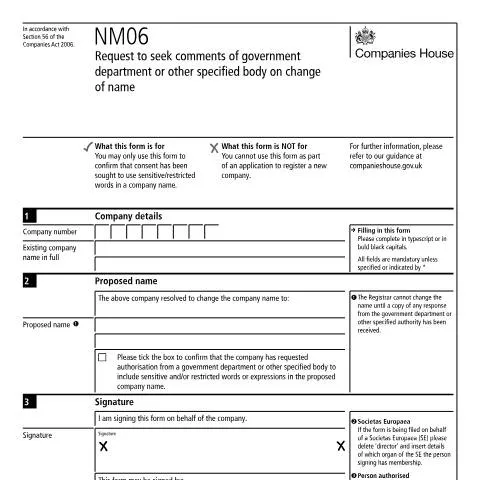
Changing a company name in the UK isn't always straightforward. When directors wish to incorporate sensitive or restricted words into their new company name—terms like "Royal," "Government," "University," or "Charity"—they must first obtain approval from relevant government departments or specified bodies. The NM06 form serves as formal confirmation to Companies House that this crucial preliminary step has been completed.
This process reflects the UK's careful approach to corporate nomenclature, ensuring that company names don't mislead the public or inappropriately suggest official connections. Unlike standard name changes that can proceed directly through form NM01, companies proposing sensitive terminology must navigate this additional regulatory layer before the Registrar can approve their application.
The Regulatory Framework Behind Sensitive Word Restrictions
Section 56 of the Companies Act 2006 provides the legal foundation for this process, establishing that certain words and expressions require prior approval from designated authorities. This legislation emerged from decades of experience with companies attempting to adopt names that could confuse consumers or falsely imply government endorsement.
The system operates through a network of specified bodies with expertise in particular sectors. For instance, the Department for Education oversees educational terminology, whilst the Cabinet Office handles words suggesting government connection. Each authority maintains its own criteria and assessment procedures, creating a complex landscape that companies must navigate carefully.
The NM06 form essentially acts as a bridge between this approval process and Companies House's name change procedures. It confirms that companies have completed their due diligence with the appropriate authorities, allowing the Registrar to proceed with confidence that all regulatory requirements have been satisfied.
Understanding the Scope and Limitations of Form NM06
The form's official guidance emphasises a crucial distinction: NM06 can only be used to confirm that consent has been sought for sensitive or restricted words in a company name change. It serves no purpose in new company registration processes, where different procedures apply through the standard incorporation forms.
This limitation reflects the form's specific role within the broader Companies House ecosystem. Existing companies seeking name changes follow a different pathway from those incorporating for the first time, with NM06 addressing the particular challenges faced by established businesses wishing to rebrand using sensitive terminology.
| Scenario | Correct Form | Key Requirement |
|---|---|---|
| Standard company name change | NM01 | Special resolution required |
| Name change with sensitive words | NM01 + NM06 | Prior approval from specified body |
| New company with sensitive words | IN01 with approval evidence | Approval obtained before incorporation |
Navigating the Pre-Approval Process with Government Departments
Before completing the NM06 form, companies must identify and approach the appropriate government department or specified body for their proposed terminology. This preliminary phase often proves more complex than the form submission itself, requiring careful research and strategic communication.
Different authorities operate distinct approval processes with varying timescales and requirements. The Department for Culture, Media and Sport might require detailed business plans for companies seeking "British" in their name, whilst the Charity Commission demands evidence of charitable status before approving "Charity" terminology.
Identifying the Correct Authority
Companies House maintains guidance on which bodies oversee specific words, but the landscape can shift as government departments reorganise or new sensitivities emerge. Recent years have seen increased scrutiny of terms like "Sustainable" or "Green," reflecting evolving regulatory priorities around environmental claims.
Some words fall under multiple authorities' remit, requiring companies to seek approval from several sources. Terms combining royal and charitable elements, for instance, might necessitate engagement with both the Cabinet Office and relevant sector regulators.
Completing Form NM06: Technical Requirements and Common Pitfalls
The form itself appears deceptively simple, comprising just three main sections: company details, proposed name, and signature requirements. However, each element demands careful attention to avoid processing delays or rejection.
Section 1 requires the existing company name in full alongside the company number. These details must match exactly with Companies House records—any discrepancy will result in form rejection. Companies that have undergone previous name changes should verify their current registered name rather than relying on trading names or abbreviated versions.
Proposed Name Declaration
Section 2 presents the proposed new name and includes a crucial tick-box confirmation. This checkbox isn't merely administrative—it represents a formal declaration that the company has sought appropriate authorisation. Ticking this box without having genuinely approached the relevant authorities could constitute a false declaration with potential legal consequences.
The proposed name must be written exactly as intended for registration, including any punctuation, spacing, or capitalisation. Companies House cannot make assumptions about formatting preferences, so precision at this stage prevents future complications.
Signature Authority and Corporate Governance
Section 3's signature requirements reflect the form's significance within corporate governance structures. The range of authorised signatories extends beyond directors to include secretaries, administrators, and various types of receivers, acknowledging that companies might be undergoing different forms of management transition.
For Societas Europaea (SE) entities, special provisions apply given their distinct governance structures. The form's guidance explicitly addresses this European company format, requiring signatories to specify their organ membership rather than using standard UK director terminology.
Submission Pathways and Processing Considerations
Companies House offers both digital upload and postal submission options for the NM06 form, though the choice between these methods can influence processing times and follow-up procedures. Digital submissions generally process faster and provide immediate confirmation of receipt, whilst postal submissions offer traditional documentation trails some companies prefer for governance purposes.
The form's checklist emphasises several critical verification points that commonly cause processing delays. Company details must align precisely with public register information, whilst the sensitive word confirmation requires careful consideration of whether the proposed name genuinely contains restricted terminology.
The Critical Role of Supporting Documentation
The form's guidance makes clear that the Registrar cannot process the name change until receiving a copy of any response from the government department or other specified authority. This requirement goes beyond the NM06 form itself, creating a two-document submission process that companies must coordinate carefully.
The supporting documentation varies significantly between different approving bodies. Some provide formal letters on headed paper, whilst others issue certificates or electronic confirmations. Companies should verify with their chosen authority what documentation format Companies House will accept as proof of approval.
Integration with Broader Name Change Procedures
Form NM06 operates as part of a broader name change ecosystem that includes the primary NM01 form and various supporting resolutions. Companies must coordinate these elements carefully to ensure their name change proceeds smoothly through all regulatory stages.
The timeline for this process can extend significantly beyond standard name changes. Whilst a straightforward NM01 submission might process within days, the NM06 pathway introduces additional variables including government department response times and potential requests for supplementary information.
Post-Submission Monitoring and Follow-Up
Once submitted, companies should monitor both their Companies House filing status and any ongoing communication with the approving authority. Some government departments issue conditional approvals that require additional steps before becoming final, creating potential complications if companies assume the process is complete.
Companies House's public record will ultimately reflect the new name once all requirements are satisfied, but the intermediate period requires careful management to ensure business continuity and stakeholder communication.
Strategic Considerations for Companies Contemplating Sensitive Terminology
The NM06 process represents more than administrative compliance—it often signals significant strategic shifts that warrant careful consideration. Companies seeking royal warrants, charitable status recognition, or educational authority typically do so as part of broader business development initiatives that extend far beyond name changes alone.
The approval process itself can provide valuable insights into regulatory expectations and stakeholder perceptions. Government departments often request detailed business plans, governance structures, or operational evidence that can inform broader strategic planning beyond the immediate name change objective.
Moreover, the public nature of Companies House records means that name changes involving sensitive words attract particular attention from customers, competitors, and regulatory bodies. Companies should prepare comprehensive communication strategies that explain their new positioning whilst demonstrating genuine authority to use their chosen terminology.
The investment in obtaining proper approvals also creates ongoing compliance obligations. Companies using terms like "University" or "Bank" typically face enhanced regulatory oversight that continues long after the initial name change approval, making the NM06 form just the beginning of a more complex regulatory relationship.
Understanding the Legal Framework Behind Name Change Consultations
The NM06 form operates within a complex legal framework that balances individual rights with public interest considerations. Under the Deed Polls Act 1949 and subsequent legislation, whilst adults generally have the right to change their name, certain circumstances require additional scrutiny to protect vulnerable parties or prevent fraud.
The requirement for consultation typically arises when there are existing court orders, custody arrangements, or when the name change could potentially circumvent legal obligations. For instance, if you're subject to a restraining order, have outstanding County Court Judgments (CCJs), or are involved in ongoing litigation, the court must assess whether permitting the name change serves the interests of justice.
Immigration status can also trigger consultation requirements. If you hold a visa with conditions, are subject to deportation proceedings, or have recently acquired British citizenship, HMRC may need to verify that the name change won't interfere with immigration enforcement or monitoring obligations. This is particularly relevant for individuals on Tier 2 work visas or those with limited leave to remain.
Fill in your form directly online
No printing: type your details into the boxes of the official form, tick, then download the PDF ready to send.
- 1Type into the form boxes
- 2Tick in one click
- 3Save and download the PDF
The Data Protection Act 2018 and UK GDPR establish strict protocols for how personal information shared during consultations must be handled. Consulting bodies can only process data that's directly relevant to assessing the name change request, and they must delete this information once the consultation period expires unless there are specific legal grounds for retention.
Child protection considerations form another crucial aspect of the legal framework. When parents seek to change a child's name and there are safeguarding concerns, social services departments have a statutory duty to respond to consultation requests. This might involve cases where there's a history of domestic violence, child protection proceedings, or where one parent has previously attempted to remove the child from the jurisdiction without consent.
Strategic Timing and Practical Considerations for Your Application
The timing of your NM06 submission can significantly impact both the consultation process and your broader life circumstances. Understanding these timing considerations helps ensure your application proceeds smoothly and doesn't inadvertently complicate other administrative processes.
If you're planning to apply for a passport, driving licence renewal, or other official documents, it's generally advisable to complete the name change process first. The Passport Office and DVLA require certified proof of name change, and having consultations pending can delay these applications significantly. However, if your current documents are due to expire soon, you might need to renew them in your current name first to avoid being left without valid identification.
Tax year considerations are particularly important if you're self-employed or complete Self Assessment returns. Changing your name mid-tax year (which runs from 6 April to 5 April) can create complications with HMRC's systems. You'll need to notify HMRC of the name change using their online services or by calling the Income Tax helpline, and ensure that all future correspondence uses your new name consistently.
For employees, coordinate with your HR department before submitting the NM06 form. Your employer will need to update PAYE records, and this process can be streamlined if they're aware of the pending name change. Some employers have policies requiring advance notice of name changes, particularly in sectors where background checks or security clearances are routine.
Educational institutions present another timing consideration. If you're currently enrolled in courses or have recently graduated, ensure that your academic records can be properly linked to your new identity. Universities and colleges typically require certified copies of the deed poll and may need several weeks to update their systems comprehensively.
Banking and financial services often have the longest processing times for name changes. Contact your banks, building societies, credit card providers, and insurance companies early in the process. Many financial institutions require multiple forms of identification and may freeze accounts temporarily while verifying the name change, so plan accordingly if you need uninterrupted access to your finances.
Managing Complex Family Dynamics and Multi-Party Consultations
When family relationships involve multiple jurisdictions, custody arrangements, or previous legal disputes, the consultation process can become particularly intricate. Understanding how to navigate these complexities helps ensure all relevant parties are properly consulted while protecting your legitimate interests.
In cases involving international custody orders or where the other parent resides overseas, the consultation may need to extend beyond UK authorities. If there's a Hague Convention order in place, or if your child's other parent has legal rights under international treaties, the court may require proof that foreign authorities have been notified. This doesn't necessarily mean obtaining their consent, but demonstrating that proper legal procedures have been followed.
Blended families with step-parents, adoptive parents, or guardians create additional consultation requirements. If multiple adults have parental responsibility for a child, all must typically be consulted unless their rights have been formally terminated by court order. This includes situations where adoption proceedings are ongoing but not yet finalised, or where special guardianship orders are in place.
When domestic violence is a factor, the consultation process includes special protections. If you're changing your name or your child's name to escape an abusive situation, you can request that your new address and contact details be kept confidential during consultations. The court can issue specific directions about how the abusive party should be notified, potentially through their solicitor rather than directly.
Mental health considerations also influence consultation procedures. If any party involved has been assessed as lacking mental capacity under the Mental Capacity Act 2005, their appointed deputy or attorney must be consulted instead. This applies whether they're the person seeking the name change or a parent whose consent would normally be required.
Religious or cultural naming disputes can complicate consultations, particularly in communities where names carry significant spiritual or traditional meaning. While UK law doesn't recognise religious authority over naming rights, courts may consider cultural factors when assessing whether a name change is in a child's best interests. This might involve consulting with community leaders or religious authorities, though their input is advisory rather than determinative.
Historical abuse cases require particularly sensitive handling during consultations. If changing your name relates to distancing yourself from an abusive family member, or if you're a survivor seeking to reclaim your identity, the consultation process can be modified to prevent retraumatisation. This might involve limiting direct contact between parties or appointing an independent advocate to facilitate communications.