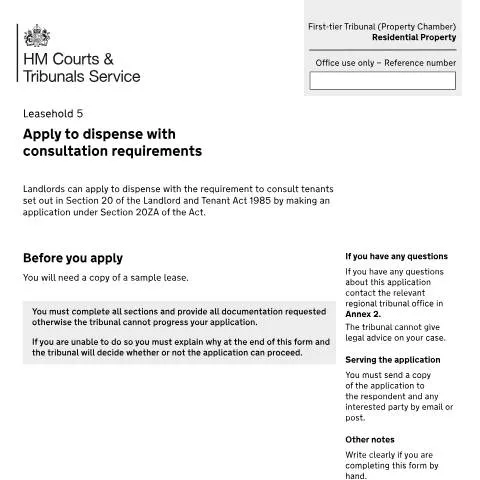
When Landlords Seek to Bypass Tenant Consultation: Understanding the Leasehold 5 Dispensation Process
The Leasehold 5 form represents a landlord's formal request to circumvent one of the most significant tenant protections in UK property law. Under Section 20 of the Landlord and Tenant Act 1985, landlords must consult leaseholders before undertaking qualifying works or entering into qualifying long-term agreements that would result in service charge contributions above statutory thresholds. However, Section 20ZA provides an escape route: landlords can apply to the First-tier Tribunal (Property Chamber) for dispensation from these consultation requirements.
This dispensation mechanism isn't simply administrative convenience. It addresses situations where strict adherence to consultation procedures might be impractical, impossible, or potentially harmful to the property or its occupants. Emergency repairs following storm damage, urgent structural works to prevent building collapse, or time-sensitive opportunities to secure favourable contractor rates all represent scenarios where the usual consultation timeline could prove counterproductive.
Yet the tribunal's power to grant dispensation comes with important caveats. Dispensation from consultation requirements does not automatically validate the reasonableness of service charges themselves. Leaseholders retain their fundamental right to challenge the costs, standard of work, or necessity of the expenditure through separate tribunal proceedings.
Decoding the Application Framework: Who Can Apply and When
The Leasehold 5 form is exclusively available to landlords and their appointed managing agents. This includes freeholders of residential buildings, head lessees holding intermediate leases with management responsibilities, and right-to-manage companies exercising statutory management rights. The applicant's capacity must be clearly stated, as this determines their legal standing to seek dispensation.
Timing proves crucial in dispensation applications. Some landlords apply prospectively before commencing works, recognising that emergency circumstances prevent proper consultation. Others submit retrospective applications after works have been completed without consultation, often following leaseholder challenges to resulting service charges.
The tribunal generally views prospective applications more favourably, as they demonstrate the landlord's awareness of consultation obligations and genuine attempt to comply with statutory requirements. Retrospective applications face greater scrutiny, particularly where landlords appear to have deliberately ignored consultation requirements or proceeded with works despite having sufficient time for proper consultation.
Multiple property scenarios require careful consideration. Where a landlord owns several buildings requiring similar works, separate applications may be necessary for each property unless the buildings share identical lease terms and the same leaseholder population. Conversely, works affecting common parts serving multiple buildings within a single development might warrant a consolidated application covering all affected properties.
Navigating the Core Application Sections: Essential Information Requirements
Section 1 demands comprehensive applicant details, including full contact information and specified capacity. For managing agents, this capacity designation proves particularly important as it establishes their authority to make the application on the landlord's behalf. The form accommodates multiple applicants through supplementary documentation, requiring signed confirmation from each party seeking inclusion in the application.
Representative appointments through Section 1.5 create exclusive correspondence channels with the tribunal. Once a representative is appointed, all future communications flow through this designated contact, potentially excluding the applicant from direct tribunal correspondence. This arrangement suits busy landlords preferring professional representation but can create communication gaps if not properly managed.
Property information in Section 2 extends beyond basic addresses to include descriptive details helping tribunal members understand the building's characteristics. A 1960s concrete-frame block of forty flats presents different maintenance challenges and urgency factors compared to a converted Victorian house containing four apartments. These contextual details influence the tribunal's assessment of whether dispensation is appropriate.
| Property Type | Typical Considerations | Common Urgency Factors |
|---|---|---|
| Purpose-built blocks | Lift maintenance, communal heating systems | Structural defects, fire safety compliance |
| Converted buildings | Shared service infrastructure, building insurance | Roof repairs, damp penetration |
| Mixed-use developments | Commercial/residential cost apportionment | Health and safety requirements |
Respondent Identification and Service Requirements: Ensuring Proper Notice
Section 3's respondent requirements extend to anyone paying service charges, creating potentially extensive notification obligations. This includes all leaseholders liable for service charges related to the proposed works, regardless of whether they actively participate in building management or maintain regular contact with the landlord.
Complex ownership structures require careful analysis. Share-of-freehold arrangements, where leaseholders collectively own the freehold through a management company, create situations where the same individuals might be both applicants (as directors of the management company) and respondents (as leaseholders liable for service charges). These dual roles must be clearly identified to avoid procedural complications.
Absentee leaseholders present particular challenges. Buy-to-let investors residing overseas, leaseholders who have relocated without updating their registered addresses, or properties held in trust arrangements can make comprehensive respondent identification difficult. The tribunal expects reasonable efforts to trace all affected parties, but accepts that complete identification may not always be possible.
Service requirements mandate that copies of the completed application reach all respondents and interested parties. Email service is acceptable where email addresses are known, but postal service provides greater certainty of delivery. Landlords maintaining comprehensive contact databases gain significant advantages in meeting these service obligations efficiently.
The Landlord Information Matrix: Clarifying Ownership Structures
Section 4's landlord information requirements acknowledge the complexity of modern property ownership structures. Where the applicant is the landlord, this section can be quickly completed with cross-references to earlier sections. However, managing agent applications require full landlord details, establishing the chain of authority for the dispensation request.
Corporate landlords must provide company details including registered addresses, which may differ from operational addresses used for day-to-day management. These distinctions matter for service of tribunal directions and decisions, particularly where companies use registered office services or have restructured since acquiring the property.
Trust arrangements, offshore ownership, and complex group structures can create identification challenges. The tribunal requires sufficient detail to understand who ultimately bears responsibility for compliance with any conditions attached to dispensation orders. Incomplete or unclear ownership information can delay proceedings or result in application rejection.
Representative appointments for landlords follow similar principles to applicant representatives, but with additional complexity where multiple parties hold interests in the property. Head lessees with management responsibilities, freeholder companies with appointed directors, and institutional landlords with professional management teams all require clear identification of authorised representatives.
Supporting Documentation Strategy: Building a Compelling Case
The tribunal's effectiveness depends heavily on complete documentation accompanying the Leasehold 5 application. A sample lease represents the minimum requirement, but comprehensive applications include multiple supporting documents demonstrating the need for dispensation and the reasonableness of the proposed approach.
Emergency situations require immediate evidence of urgency. Structural engineer reports highlighting imminent safety risks, insurance company notifications threatening coverage withdrawal, or statutory notices from local authorities demanding immediate action all strengthen dispensation applications. Photographic evidence, particularly time-stamped images showing deteriorating conditions, provides powerful visual support for urgency arguments.
Cost documentation serves dual purposes: demonstrating the financial impact of consultation delays and providing transparency about proposed expenditure. Contractor quotations with expiry dates, seasonal pricing variations, or limited-time availability of specialist equipment all support arguments that consultation delays would increase costs or reduce work quality.
Consultation attempt records prove particularly valuable in retrospective applications. Evidence of partial consultation, unsuccessful attempts to contact leaseholders, or consultation processes interrupted by emergency circumstances can mitigate the tribunal's concerns about deliberate non-compliance with statutory requirements.
- Sample lease provisions relating to service charges and consultation obligations
- Professional reports (structural surveys, fire risk assessments, building condition reports)
- Contractor quotations and availability confirmations
- Correspondence with leaseholders regarding proposed works
- Insurance correspondence or statutory notices creating urgency
- Photographic evidence of property conditions
- Service charge accounts and reserve fund statements
- Previous tribunal decisions affecting the same property
Tribunal Processing and Decision-Making: What Happens Next
Once submitted, Leasehold 5 applications enter the First-tier Tribunal's administrative system, receiving unique reference numbers for tracking purposes. Regional tribunal offices handle applications based on property location, with processing times varying according to regional workloads and case complexity.
The tribunal's initial review focuses on procedural compliance: complete sections, proper respondent identification, adequate supporting documentation, and evidence of service on affected parties. Applications failing these basic requirements face rejection or requests for additional information, potentially delaying resolution beyond any urgency that prompted the original application.
Substantive assessment considers multiple factors: the degree of urgency, potential prejudice to leaseholders from dispensation, alternative approaches that might have preserved consultation rights, and the overall reasonableness of seeking dispensation in the circumstances. The tribunal must balance landlord operational needs against leaseholder consultation rights.
Unopposed applications, where no respondents object to dispensation, typically proceed more quickly than contested cases. However, lack of opposition doesn't guarantee automatic approval – the tribunal retains discretion to refuse dispensation where statutory requirements haven't been met or where granting dispensation would be inappropriate.
Contested applications may require case management directions, exchange of evidence, and potentially oral hearings. These procedures extend resolution timeframes but ensure proper consideration of all parties' interests. The tribunal can impose conditions on dispensation orders, such as requirements for retrospective consultation on future similar works or specific cost transparency measures.
Important: Dispensation from consultation requirements does not determine whether service charges are reasonable or payable. Leaseholders retain full rights to challenge service charge amounts through separate tribunal proceedings, even where consultation dispensation has been granted.
Strategic Considerations and Long-term Implications
Successful dispensation applications create precedents affecting future landlord-tenant relationships. Properties with histories of dispensation applications may face increased leaseholder scrutiny of subsequent service charge demands, even where proper consultation has occurred. Building trust through transparent communication often proves more valuable than winning individual tribunal cases.
The tribunal's power to attach conditions to dispensation orders can create ongoing obligations extending well beyond the immediate works. Requirements for enhanced consultation on future projects, detailed cost breakdowns, or regular progress reports can significantly impact property management procedures.
Cost implications extend beyond tribunal fees and legal representation. Delays in obtaining dispensation can escalate emergency repair costs, void contractor quotations, or result in seasonal work restrictions. Conversely, premature applications before exploring consultation alternatives may damage landlord-tenant relationships unnecessarily.
Professional property managers increasingly view dispensation applications as part of comprehensive service charge management strategies. Early identification of potential consultation challenges, proactive engagement with leaseholders about building priorities, and transparent cost reporting can reduce dispensation application frequency while maintaining operational flexibility for genuine emergencies.
The interaction between dispensation procedures and other tribunal jurisdictions requires careful coordination. Service charge challenges, lease variation applications, and right-to-manage claims can all intersect with dispensation proceedings, creating complex case management requirements that benefit from professional legal guidance.
Understanding the Legal Framework and Grounds for Dispensation
The dispensation process under Form Leasehold 5 operates within a specific legal framework established by the Landlord and Tenant Act 1985 and subsequent regulations. The First-tier Tribunal (Property Chamber) has the statutory power to dispense with consultation requirements where it considers it reasonable to do so, but this discretion is exercised within well-defined parameters.
The primary legal test centres on whether leaseholders would suffer prejudice if the consultation requirements were dispensed with. This is not simply about financial impact—the tribunal considers whether leaseholders have been deprived of the opportunity to make representations that might have influenced the landlord's decision-making process or the terms of any contract entered into.
Several categories of circumstances commonly support dispensation applications. Emergency situations represent the most straightforward cases, where immediate action is necessary to prevent serious damage to the property or ensure occupier safety. These might include burst water mains, structural collapses, or urgent fire safety works. However, the tribunal scrutinises whether the situation genuinely constituted an emergency or whether earlier action could have avoided the crisis.
Retrospective applications form another significant category, typically arising where landlords have already commenced or completed works without following proper consultation procedures. While the tribunal can grant retrospective dispensation, applicants face greater scrutiny and must demonstrate that leaseholders have not been prejudiced despite the procedural breach. The tribunal may impose conditions, such as requiring the landlord to obtain additional quotes or provide detailed cost breakdowns.
Technical breaches of consultation requirements also warrant consideration. These occur where landlords have substantially complied with consultation obligations but failed to meet specific procedural requirements—perhaps serving notices on incorrect addresses or using slightly wrong timeframes. The tribunal typically adopts a pragmatic approach to such cases, focusing on whether leaseholders received adequate opportunity to participate in the process.
Fill in your form directly online
No printing: type your details into the boxes of the official form, tick, then download the PDF ready to send.
- 1Type into the form boxes
- 2Tick in one click
- 3Save and download the PDF
The tribunal's approach to determining prejudice has evolved through case law. In Daejan Investments Ltd v Benson, the Supreme Court established that the tribunal should focus on whether leaseholders lost the opportunity to make representations that might have made a difference. This test requires careful analysis of what leaseholders might reasonably have said and whether such representations could have influenced outcomes.
Procedural Requirements and Documentation Standards
Form Leasehold 5 applications demand meticulous attention to procedural requirements and supporting documentation. The First-tier Tribunal (Property Chamber) operates strict case management procedures, and inadequate preparation can result in applications being struck out or delayed significantly.
The application form itself requires comprehensive completion of all relevant sections. Applicants must provide accurate details of the property, including full addresses and lease references for all affected units. The tribunal cross-references this information with Land Registry records, so any discrepancies can cause processing delays. Where properties have been subdivided or addresses changed, applicants should provide clear explanations and supporting evidence.
Supporting documentation requirements extend well beyond basic property details. The tribunal expects to see copies of relevant lease provisions, particularly service charge clauses and any specific consultation requirements they contain. Some leases impose consultation obligations beyond statutory minimums, and failure to address these can undermine applications.
Financial documentation plays a crucial role in most applications. The tribunal requires detailed cost breakdowns for proposed works, including VAT where applicable. For emergency works already completed, applicants must provide invoices, receipts, and evidence of procurement processes followed. Where multiple contractors were involved, separate documentation for each element of work is necessary.
Evidence of any consultation already undertaken must be comprehensive. This includes copies of all notices served, proof of service (such as recorded delivery receipts or process server certificates), and records of any leaseholder responses received. Where notices were served electronically, applicants should provide evidence of successful delivery and any read receipts obtained.
Photographic evidence often proves invaluable, particularly for emergency works applications. Time-stamped images showing the condition necessitating urgent intervention can demonstrate the reasonableness of the landlord's actions. For ongoing works, progress photographs help illustrate the current position and any practical constraints affecting the consultation process.
Expert reports may be required for complex technical works. The tribunal expects reports from appropriately qualified professionals—chartered surveyors for building works, qualified electricians for electrical installations, or structural engineers for stability issues. These reports should address not only the technical necessity for works but also the reasonableness of the proposed approach and associated costs.
Case management directions issued by the tribunal must be followed precisely. These typically specify deadlines for serving documents on other parties, requirements for witness statements, and arrangements for any hearings. The tribunal has limited tolerance for non-compliance, particularly where this prejudices other parties' ability to participate effectively.
Strategic Considerations and Alternative Approaches
Successful dispensation applications require careful strategic planning, considering both immediate objectives and longer-term implications for landlord-tenant relationships. The decision to pursue dispensation should not be taken lightly, as the process can be time-consuming, costly, and may damage relationships with leaseholders.
Timing considerations prove critical in many cases. Emergency applications benefit from immediate submission, as delays can undermine claims of urgency. However, retrospective applications may benefit from allowing time for initial tensions to subside and for a more measured assessment of the situation. The tribunal's case load means processing times can extend several months, particularly for complex cases requiring hearings.
Alternative dispute resolution should be considered before formal applications. Many disputes arise from communication failures rather than fundamental disagreements about proposed works. Engaging professional managing agents or lease management specialists can help improve consultation processes and reduce the likelihood of future disputes. Some landlords find that enhanced communication strategies, including regular property updates and transparent financial reporting, significantly improve leaseholder relationships.
The cost-benefit analysis of dispensation applications requires careful consideration. Tribunal fees, legal costs, and management time can quickly accumulate, potentially exceeding the cost of conducting proper consultation procedures. For smaller works programmes, it may prove more economical to accept delays and follow standard consultation requirements rather than seeking dispensation.
Partial dispensation applications offer strategic flexibility in appropriate cases. Rather than seeking blanket dispensation for entire works programmes, applicants can request dispensation for specific elements while maintaining standard consultation for others. This approach may prove more acceptable to leaseholders and increase the likelihood of tribunal approval.
Conditional dispensation represents another strategic option. Applicants can propose conditions to address potential leaseholder concerns—such as obtaining additional quotations, appointing independent surveyors, or providing enhanced cost monitoring. The tribunal has power to impose conditions when granting dispensation, and proactive proposals can demonstrate reasonableness and good faith.
Settlement negotiations with leaseholders can provide alternative solutions. Some disputes resolve through direct negotiations, particularly where leaseholders' primary concerns relate to specific aspects of proposed works rather than fundamental objections. Mediation services, while not commonly used in leasehold disputes, can provide structured frameworks for reaching agreement.
Long-term relationship management should inform strategic decisions. Landlords with ongoing management responsibilities may prioritise maintaining positive relationships over short-term procedural advantages. Transparent communication, regular consultation on property management issues, and proactive maintenance programmes can reduce the likelihood of future disputes and create more cooperative relationships with leaseholders.
Professional advice proves invaluable for complex cases. Solicitors specialising in leasehold law can provide strategic guidance on application prospects and help structure cases to maximise success chances. Property management professionals can advise on alternative approaches and help improve consultation processes to prevent future issues.