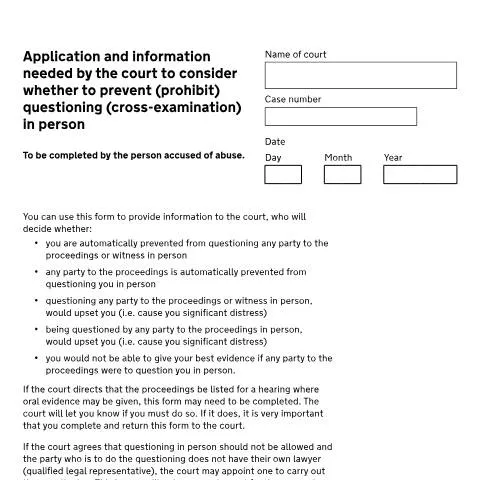
Protection from Cross-Examination: When the Accused Seeks Court Intervention
In criminal and family court proceedings, the prospect of face-to-face cross-examination can present profound challenges for those accused of abuse. Form EX741 represents a critical safeguard within the UK justice system, enabling defendants to request court protection from direct questioning that could compromise their ability to participate effectively in proceedings. This application mechanism acknowledges that whilst the right to cross-examine witnesses remains fundamental to British justice, circumstances exist where such direct confrontation may undermine the fairness of proceedings themselves.
The form addresses a complex legal paradox: balancing the traditional adversarial nature of UK courts with recognition that trauma, distress, or intimidation can prevent parties from giving their best evidence. Unlike standard procedural documents, EX741 requires the accused person to demonstrate why conventional cross-examination arrangements would be inappropriate in their specific case, potentially leading to the appointment of a court-appointed qualified legal representative to conduct questioning on behalf of unrepresented parties.
Automatic Prohibitions and Discretionary Protection Measures
The court's consideration of cross-examination restrictions operates on two distinct levels: automatic prohibitions and discretionary protective measures. Automatic restrictions apply when specific statutory conditions are met, typically involving previous convictions for particular offences or existing protective orders. The form systematically captures this information through questions about cautions, charges, and convictions for specified offences as defined under the relevant statutory instruments.
Discretionary protection requires the court to assess whether questioning in person would cause significant distress or prevent the giving of best evidence. This assessment extends beyond mere discomfort, requiring applicants to demonstrate substantial impact on their participation in proceedings. The form distinguishes between distress caused by being questioned and distress caused by having to question others, recognising that both scenarios can compromise fair proceedings.
| Type of Protection | Trigger Circumstances | Evidence Required |
|---|---|---|
| Automatic Prohibition | Conviction for specified offence against party/witness | Details of conviction, caution, or charge |
| Automatic Prohibition | Existing protective orders in favour of party/witness | Copy of order and case details |
| Discretionary Protection | Significant distress from being questioned | Written explanation of impact |
| Discretionary Protection | Inability to give best evidence if questioned | Detailed reasons for evidential impact |
Understanding Specified Offences and Evidence Categories
The form references specified offences and specified evidence as defined in statutory instruments, requiring applicants to check current definitions via the referenced legislation. These categories typically encompass sexual offences, violent crimes, and abuse-related convictions that directly relate to the parties or witnesses in the current proceedings. The temporal scope extends beyond convictions to include cautions and pending charges, reflecting the precautionary approach adopted by UK courts.
Specified evidence might include police reports, medical records, social services assessments, or other documentary proof of abuse allegations. Applicants must provide copies of such evidence alongside their application, enabling the court to assess both the credibility and relevance of the material to the cross-examination decision.
Strategic Timing and Procedural Integration
Form EX741 operates within strict temporal constraints, typically requiring completion and return within 14 days unless the court specifies alternative timeframes. This deadline reflects the court's need to resolve cross-examination arrangements before substantive hearings commence, particularly where oral evidence will be presented. Late applications may face rejection or require exceptional circumstances justification.
The form's deployment occurs when the court lists proceedings for hearings involving oral evidence, rather than as a routine filing requirement. This targeted approach ensures applications address genuine cross-examination scenarios rather than theoretical concerns. Courts notify relevant parties when completion becomes necessary, making the form reactive rather than proactive in most circumstances.
Coordination with Legal Representation Arrangements
The application process intersects significantly with legal representation arrangements. When the court grants cross-examination restrictions but the questioning party lacks legal representation, a qualified legal representative may be appointed specifically for questioning purposes. This representative operates under unique constraints: they conduct cross-examination without representing the party's broader interests and incur no cost to the unrepresented individual.
For applicants with existing legal representation, the form requires comprehensive solicitor details including firm information, reference numbers, and contact particulars. This information enables the court to coordinate procedural arrangements and ensure proper service of decisions and directions.
Evidential Requirements and Supporting Documentation
The form demands substantial evidential support beyond mere assertions of distress or inability to participate effectively. Applicants must provide copies of relevant protective orders, conviction records, and specified evidence of abuse. This documentation requirement serves dual purposes: substantiating the application's factual basis and enabling the court to assess the proportionality of requested restrictions.
When citing previous protective orders, applicants should include Non-molestation Orders, Restraining Orders, Protection from Harassment Orders, and various categories of Domestic Violence and Domestic Abuse Protection notices and orders. The form acknowledges the evolving landscape of protective legislation by including catch-all provisions for other relevant orders not specifically enumerated.
Articulating Impact on Evidence Quality
Perhaps the most challenging aspect of Form EX741 involves articulating how direct cross-examination would prevent the giving of best evidence. This concept extends beyond emotional distress to encompass cognitive, psychological, and practical barriers to effective testimony. Applicants might cite memory impairment under stress, inability to process complex legal questioning, or communication difficulties that emerge in confrontational settings.
The court requires brief reasons rather than extensive narratives, focusing applications on concrete impacts rather than generalised concerns. Effective responses identify specific aspects of the questioning process that would compromise evidence quality, such as intimidation effects, trauma responses, or communication breakdowns that would obscure relevant testimony.
Court Assessment Criteria and Decision-Making Framework
Judicial consideration of EX741 applications involves balancing competing interests: the accused person's right to effective participation against other parties' rights to proper cross-examination. Courts apply statutory tests for automatic prohibitions whilst exercising discretion for protection measures based on distress or evidential quality concerns.
The assessment process considers the specific dynamics of each case, including the nature of allegations, the relationship between parties, and the availability of alternative questioning arrangements. Courts may impose partial restrictions, such as limiting questioning topics or requiring specific procedural modifications, rather than blanket prohibitions on direct cross-examination.
Alternative Arrangements and Procedural Modifications
When granting cross-examination restrictions, courts possess wide discretion in fashioning alternative arrangements. These might include video-link facilities, screen arrangements, or intermediary services to facilitate questioning whilst maintaining protective measures. The appointed qualified legal representative option represents just one possible solution within a broader range of procedural adaptations.
The court retains ongoing jurisdiction to modify or revoke cross-examination restrictions if circumstances change during proceedings. This flexibility ensures that protective measures remain proportionate and necessary throughout the case's progression.
Completing the Application: Practical Considerations
Form EX741 requires careful completion to ensure effective court consideration. The opening sections capture basic case information including court name, case number, and next hearing date, establishing the procedural context for the application. Applicants must clearly identify their role as either applicant or respondent in the underlying proceedings.
The supporting evidence sections demand precise factual responses about previous offences, existing orders, and relevant abuse evidence. Checkbox formats streamline completion whilst requiring detailed explanations where applicable. The form's structure guides applicants through complex legal concepts by breaking down assessments into manageable components.
Statement of Truth and Legal Consequences
The form concludes with a formal statement of truth carrying significant legal weight. This declaration subjects applicants to contempt of court proceedings for knowingly false statements, emphasising the serious nature of the application process. The statement options accommodate various signing scenarios, including personal completion by applicants and authorised signature by legal representatives.
Different checkbox options reflect the diverse circumstances in which applications arise, from self-represented individuals to those with full legal representation. The signing requirements ensure proper authentication whilst maintaining accessibility for vulnerable applicants who may require assistance in completing the form.
Post-Application Procedures and Implementation
Following submission, the court processes EX741 applications through established case management procedures, often involving judicial consideration without formal hearings unless disputed issues arise. The court communicates decisions through standard notification processes, specifying any restrictions granted and arrangements for alternative questioning methods.
Implementation of cross-examination restrictions requires coordination between court staff, legal representatives, and any appointed questioning advocates. The court retains case management powers to ensure smooth operation of modified procedures whilst maintaining the integrity of the adversarial process within the constraints of granted protections.
Successful applications trigger administrative arrangements for appointing qualified legal representatives where necessary, establishing communication protocols, and modifying hearing procedures to accommodate protective measures. These arrangements aim to preserve the substance of cross-examination rights whilst eliminating the particular harms that justified the original application.
Vulnerable Witnesses and Special Measures: Beyond Personal Cross-Examination
When Form EX741 is granted and personal cross-examination is prohibited, the court must consider how questioning will be conducted whilst maintaining fair proceedings. The Youth Justice and Criminal Evidence Act 1999 provides the framework for special measures that extend beyond simply preventing direct questioning by an accused person.
Courts typically appoint a court-appointed representative to conduct cross-examination on behalf of the prohibited party. This representative, often a qualified barrister or solicitor, receives instructions from the accused but acts independently to ensure appropriate questioning. The appointment process involves careful vetting—the representative must have no conflict of interest and demonstrate competence in handling vulnerable witness cases.
Alternative arrangements may include video link testimony where the witness gives evidence from a separate room or location, with the cross-examination conducted via live video connection. This measure proves particularly effective when combined with prohibition orders, as it creates additional psychological distance whilst preserving the adversarial process.
Some cases warrant intermediaries—communication specialists who help witnesses understand questions and express their answers clearly. Intermediaries are especially valuable when witnesses have learning difficulties, communication disorders, or are very young children. The intermediary doesn't advocate for the witness but ensures questions are put in age-appropriate or comprehensible language.
Pre-recorded evidence represents another special measure where the witness's evidence-in-chief and cross-examination are video recorded before trial. This approach works well in cases involving serious allegations where multiple applications under Form EX741 might be necessary, allowing vulnerable witnesses to give evidence once in controlled conditions rather than facing repeated court appearances.
Courts must balance these protective measures against the fundamental right to fair trial. The European Convention on Human Rights Article 6 guarantees the right to examine witnesses, so any restrictions must be proportionate and necessary. Judges carefully consider whether alternative arrangements adequately preserve the accused's ability to challenge evidence whilst protecting vulnerable parties from inappropriate direct confrontation.
Enforcement and Breach Consequences
Once a prohibition order is granted following a successful Form EX741 application, strict enforcement mechanisms ensure compliance throughout proceedings. Understanding these consequences proves crucial for all parties, as violations can result in serious legal repercussions and case disruption.
Contempt of court represents the primary enforcement tool when an accused person attempts to directly question a protected witness despite a prohibition order. Such breaches constitute a serious offence that can result in immediate custody, substantial fines, or both. The court's contempt powers are exercised swiftly—judges may order the accused's removal from the courtroom and continuation of proceedings in their absence if necessary.
Legal representatives face professional conduct implications if they facilitate or encourage breaches of prohibition orders. The Solicitors Regulation Authority (SRA) and Bar Standards Board (BSB) treat such conduct as serious professional misconduct, potentially resulting in disciplinary action, suspension, or striking off. Representatives must actively advise clients about prohibition orders and refuse instructions that would breach court directions.
The court maintains several case management powers to address non-compliance. These include varying bail conditions, imposing reporting requirements, or in serious cases, remanding the accused in custody until trial. Where repeated attempts to breach prohibition orders occur, courts may consider whether the accused is deliberately attempting to intimidate witnesses or undermine proceedings.
Procedural consequences can significantly impact case progression. Breach attempts may result in adjournments, additional court hearings, or the need for enhanced security measures—all potentially delaying final resolution. Courts increasingly use these delays as factors when considering sentence, particularly where witness intimidation is suspected.
For family proceedings, breach consequences extend to contact arrangements and parental responsibility decisions. A parent who repeatedly attempts to cross-examine a protected former partner may find their contact with children restricted or supervised. Family courts view such behaviour as evidence of ongoing controlling or abusive tendencies that impact child welfare assessments.
The Criminal Justice Act 2003 allows courts to draw adverse inferences from a defendant's conduct, including attempts to breach prohibition orders. While not direct evidence of guilt, such behaviour may be considered when assessing the defendant's credibility or the likelihood of witness intimidation.
Enforcement extends beyond the courtroom through ancillary orders such as restraining orders or non-molestation orders that may be strengthened following breach attempts. These orders often include specific provisions about court attendance and behaviour during legal proceedings, creating multiple potential breach points.
Strategic Considerations for Different Case Types
Form EX741 applications require tailored approaches depending on the specific legal context, as different court jurisdictions and case types present unique challenges and opportunities. Understanding these strategic variations helps applicants present more compelling cases whilst anticipating potential judicial concerns.
In criminal proceedings, the prosecution's approach to Form EX741 applications must carefully balance victim protection against fair trial rights. Crown prosecutors often coordinate with witness care units to gather comprehensive evidence about the impact of direct cross-examination. The timing proves critical—applications made too close to trial may face judicial resistance due to case management pressures, whilst early applications allow proper preparation of alternative arrangements.
The Domestic Violence, Crime and Victims Act 2004 creates particular considerations for domestic abuse cases. Prosecutors must demonstrate not just past violence but the specific psychological impact of courtroom confrontation. Expert evidence from domestic abuse specialists often proves more persuasive than general medical evidence, as it addresses the unique dynamics of coercive control and post-separation abuse.
Family court applications under Form EX741 face different judicial attitudes, as family proceedings prioritise child welfare and ongoing relationships. Courts may be more receptive to prohibition applications where children are involved, but equally concerned about creating precedents that could be exploited in acrimonious separations. The Children Act 1989's paramountcy principle means child welfare considerations often tip the balance in favour of protective measures.
Private family proceedings present unique challenges where both parties are litigants in person. Courts must consider whether prohibition would create unfair advantages, particularly in financial remedy cases where cross-examination might reveal important evidence about assets or conduct. The recent emphasis on Practice Direction 3AA regarding domestic abuse allegations requires courts to make early determinations about protection needs, often before Form EX741 applications are considered.
Civil proceedings involving personal injury or clinical negligence present different strategic considerations. Claimants seeking prohibition orders must demonstrate that direct cross-examination would cause genuine psychological harm beyond normal litigation stress. Courts scrutinise such applications carefully, as civil proceedings assume parties can withstand adversarial questioning about their claims.
The strategic use of interim applications can strengthen Form EX741 cases. Applications for interim non-molestation orders or restraining orders create judicial findings about risk that support subsequent prohibition applications. Similarly, successful applications for anonymity orders or reporting restrictions demonstrate court recognition of vulnerability factors relevant to cross-examination protection.
Multi-defendant cases require careful consideration of whether prohibition should apply to all accused persons or only specific individuals. Courts examine the relationship between co-defendants and complainants, as prohibition against one defendant but not others may create tactical advantages or disadvantages that affect trial fairness.
The strategic timing of plea negotiations intersects with Form EX741 applications in complex ways. Defence teams may use the prospect of traumatic cross-examination as leverage in plea discussions, whilst prosecution teams must consider whether prohibition orders affect the strength of their evidence and willingness to accept pleas to lesser charges.
Appeal considerations influence strategic decisions about Form EX741 applications. Successful prohibition applications create potential grounds for defence appeals based on fair trial arguments, whilst unsuccessful applications may prompt prosecution appeals or renewed applications based on changed circumstances. Understanding these appellate risks helps parties make informed decisions about application timing and supporting evidence.