Understanding Your Position as a Respondent in Family Court Proceedings
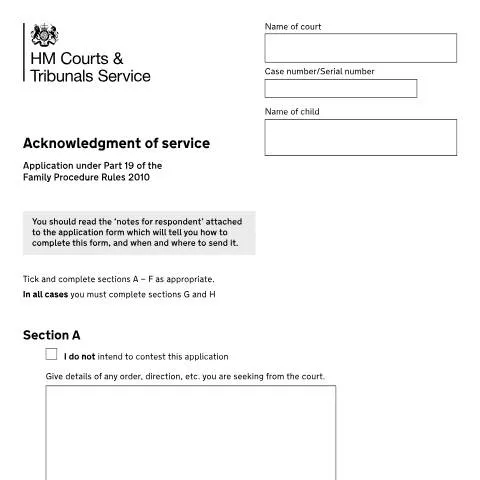
When family court proceedings are initiated under Part 19 of the Family Procedure Rules 2010, you may find yourself named as a respondent with specific obligations to respond to the court. The Form FP5 Acknowledgment of Service serves as your formal mechanism to communicate your position to HM Courts & Tribunals Service, whether you intend to cooperate with, contest, or challenge the application entirely.
Unlike standard acknowledgment forms used in civil proceedings, the FP5 operates within the specialised framework of family law, where the welfare of children often takes precedence over traditional adversarial approaches. This form provides structured pathways for different response strategies, from complete acceptance to jurisdictional challenges, each carrying distinct procedural consequences and timelines.
The form's significance extends beyond mere acknowledgment—it establishes your legal standing in the proceedings and determines how the court will manage your case going forward. Whether you're a parent, guardian, local authority representative, or other interested party, your response shapes the entire trajectory of the legal process.
Strategic Positioning Through Section Selection
The FP5's modular structure allows respondents to articulate nuanced positions through six distinct sections (A through F), each representing a different strategic approach to the proceedings. Section A enables you to indicate non-contestation while still seeking specific orders or directions from the court—a position particularly relevant when you agree with the application's underlying premise but require additional safeguards or conditions.
For instance, if an application seeks contact arrangements for a child, you might not contest the principle of contact but request specific supervision requirements or venue restrictions. This approach demonstrates cooperation whilst protecting legitimate interests, often viewed favourably by family courts prioritising collaborative resolution.
Section B provides the framework for active contestation, requiring you to outline alternative remedies sought. This goes beyond simple disagreement—the court expects constructive proposals that address the underlying issues whilst protecting all parties' interests. The brief details required here serve as a foundation for more comprehensive evidence and arguments presented later in the proceedings.
The jurisdictional challenge mechanism in Section C carries particular weight, as it must be accompanied by a formal application filed within fourteen days of submitting the FP5. This tight deadline reflects the court's preference for resolving jurisdictional questions early, preventing prolonged uncertainty that could prejudice other parties, particularly children whose welfare may be at stake.
Procedural Objections and Alternative Dispute Resolution
Section D addresses a sophisticated aspect of family proceedings: objecting to the chosen procedure rather than the substantive application. Under Part 19 of the Family Procedure Rules 2010, certain applications may be made through streamlined procedures, but circumstances might warrant more comprehensive processes offering greater protection or procedural safeguards.
Common grounds for procedural objections include situations where the simplified process fails to accommodate complex family dynamics, where multiple jurisdictions are involved, or where vulnerable parties require additional procedural protections. For example, if domestic abuse allegations underpin the application, you might argue that standard Part 19 procedures inadequately address safety concerns that warrant enhanced case management approaches.
The court's assessment of procedural objections considers whether the chosen route provides adequate opportunity for all parties to present their cases effectively. This evaluation balances efficiency against fairness, recognising that family proceedings often involve emotionally charged situations requiring careful judicial management.
| Objection Type | Typical Circumstances | Court's Primary Consideration |
|---|---|---|
| Complexity of Issues | Multiple children, cross-border elements, safeguarding concerns | Whether streamlined process can adequately address all factors |
| Vulnerable Parties | Mental capacity issues, domestic abuse, young parents | Availability of appropriate support and protection mechanisms |
| Evidential Requirements | Expert reports needed, extensive factual disputes | Whether procedure allows sufficient time and scope for evidence |
| Urgency Factors | Immediate risk to children, imminent relocation | Balance between speed and thoroughness of consideration |
Legal Representation and Evidence Coordination
The interplay between Sections E and F demonstrates the form's recognition that family proceedings often require coordinated legal and evidential strategies. Section E allows you to signal the filing of written evidence alongside the acknowledgment, establishing an early evidential foundation that can influence case management directions.
This early evidence filing serves multiple strategic purposes: it demonstrates the seriousness of your position, provides the court with preliminary information for case management decisions, and establishes timeline expectations for the proceedings. However, the evidence filed at this stage typically represents initial positions rather than comprehensive cases, with opportunities for supplementary evidence arising through subsequent court directions.
Section F's solicitor details serve practical administrative functions whilst also signaling to other parties and the court that you have professional representation. In family proceedings, where emotions often run high and legal complexities abound, professional representation frequently facilitates more effective case management and resolution prospects.
The court's case management approach often differs when dealing with represented versus unrepresented parties, with additional safeguards and explanations provided to litigants in person. Your representation status, declared through Section F, influences how the court structures subsequent hearings and communications.
Jurisdictional Challenges and Cross-Border Considerations
The fourteen-day deadline for jurisdictional challenges reflects the complex landscape of family law jurisdiction, particularly relevant in cases involving international elements or where parties have connections to multiple UK jurisdictions. Jurisdictional challenges under Section C require careful consideration of factors including children's habitual residence, parties' connections to different jurisdictions, and the availability of alternative forums.
For families with Scottish, Northern Irish, or international connections, jurisdictional questions become particularly acute. The court must determine not only whether it has jurisdiction but also whether it represents the most appropriate forum considering factors such as the availability of evidence, the location of witnesses, and the enforceability of any resulting orders.
Recent developments in post-Brexit family law have added complexity to jurisdictional assessments, particularly for cases involving EU member states. The court's jurisdiction analysis now incorporates different legal frameworks depending on the countries involved and the timing of proceedings initiation.
When preparing jurisdictional challenges, respondents must present clear evidence supporting alternative jurisdiction claims whilst demonstrating how the alternative forum better serves the interests of justice and child welfare. The court's assessment balances legal technicalities against practical considerations affecting all parties involved.
The Statement of Truth and Its Implications
Section H's statement of truth carries significant legal weight, subjecting signatories to potential contempt of court proceedings for false statements made without honest belief in their truth. This requirement reflects the family court's emphasis on accurate information as the foundation for decisions affecting children's welfare and family relationships.
The dual signing options—personal signature by the respondent or signature by their legal representative—accommodate different representation arrangements whilst maintaining accountability standards. When legal representatives sign on behalf of clients, they assume professional responsibility for the accuracy of information provided, subject to both court sanctions and professional regulatory consequences for misconduct.
The statement of truth encompasses not only the form itself but also any continuation sheets, recognising that complex family situations often require extensive documentation. This comprehensive coverage ensures that all submitted information meets the same accuracy standards, preventing attempts to circumvent truth requirements through supplementary documents.
Contempt of court proceedings for false statements represent serious consequences that can include fines, imprisonment, or other sanctions. The family court's approach to such proceedings considers factors including the materiality of false statements, their impact on proceedings, and whether false information was provided deliberately or through genuine mistake.
Case Management Implications and Timeline Considerations
Your FP5 submission triggers specific case management protocols within HM Courts & Tribunals Service, with different response types generating distinct procedural pathways. Non-contested applications typically proceed to administrative processing or brief hearings focused on implementing requested orders, whilst contested matters enter more comprehensive case management frameworks.
The court's initial case management decisions consider factors including the nature of your response, the complexity of issues raised, the number of parties involved, and any urgent welfare concerns. Cases involving jurisdictional challenges or procedural objections often require preliminary hearings to resolve threshold issues before addressing substantive matters.
Timeline expectations vary significantly based on your response strategy. Non-contested applications may be resolved within weeks, whilst complex contested matters can extend over many months, particularly when expert evidence or extensive fact-finding exercises are required. The court balances expedition against thoroughness, recognising that hasty decisions in family matters can have long-lasting consequences.
- Administrative track: Non-contested applications with straightforward requests
- Standard track: Contested applications without complex procedural or jurisdictional issues
- Complex track: Cases involving multiple challenges, international elements, or significant safeguarding concerns
- Urgent track: Applications requiring immediate judicial attention due to risk factors
Practical Submission and Follow-Up Requirements
The FP5's submission requirements align with broader family court protocols emphasising efficiency and accessibility. Unlike some civil court procedures requiring multiple copies or specific formatting, family court submissions typically accept single copies with electronic alternatives increasingly available through designated court systems.
Post-submission, you should expect acknowledgment from the court registry confirming receipt and providing case management information including hearing dates, directions for further evidence, and deadlines for compliance with court orders. The court's communication approach varies between jurisdictions, with some courts providing detailed case management schedules whilst others issue directions on a hearing-by-hearing basis.
Your ongoing obligations following FP5 submission include compliance with any directions contained in the original application, attendance at scheduled hearings, and prompt notification of any material changes in circumstances affecting the proceedings. Failure to meet these obligations can result in the case proceeding in your absence or adverse cost orders.
The family court's approach to case management emphasises active judicial oversight, with regular review hearings to monitor progress and address emerging issues. Your initial FP5 response establishes your position within this framework, but flexibility remains important as proceedings develop and new information emerges affecting children's welfare and family arrangements.
Specific Considerations for Different Application Types Under Part 19
The acknowledgment of service requirements vary significantly depending on the specific type of application filed under Part 19 of the Family Procedure Rules 2010. Understanding these distinctions is crucial for proper completion of Form FP5 and avoiding procedural delays.
Financial Remedy Applications
When acknowledging service for financial remedy applications, respondents must be particularly careful about the implications of their response. If you're responding to an application for a financial order following divorce or dissolution, your acknowledgment triggers specific timescales for filing a Form E financial statement. The 35-day deadline for submitting your financial disclosure begins from the date you file your acknowledgment, not from when you received the application.
For applications seeking variation of existing financial orders, the acknowledgment process requires careful consideration of whether you intend to cross-apply for your own variation. Failing to indicate this intention in your initial acknowledgment may limit your ability to make counter-applications later in the proceedings without seeking the court's permission.
Child Arrangement Applications
Responding to child arrangement applications under Part 19 involves additional safeguarding considerations that don't apply to other family proceedings. When completing Form FP5 for these cases, you must be aware that the court may order a Cafcass report or other welfare investigations based partly on the information you provide in your acknowledgment.
If the application involves allegations of domestic abuse or concerns about child welfare, your acknowledgment response can influence whether the court orders separate representation for children or appoints a guardian ad litem. Be particularly careful when describing your relationship with the applicant and any relevant background circumstances, as this information feeds into the court's initial risk assessment.
Applications Involving International Elements
Part 19 applications with international dimensions—such as those involving the Hague Convention on international child abduction or Brussels II bis Regulation—require enhanced attention to jurisdictional issues in your acknowledgment. You must specifically address whether you accept the English or Welsh court's jurisdiction to hear the matter.
If you dispute jurisdiction, this must be clearly stated in your acknowledgment, as failing to raise jurisdictional objections at this stage may result in you being deemed to have accepted the court's jurisdiction. For Hague Convention cases, the acknowledgment deadline is often shortened, and you may need to file additional documentation alongside Form FP5 to properly preserve your position.
Procedural Consequences of Filing or Failing to File Form FP5
The decision whether to file an acknowledgment of service carries significant procedural implications that extend well beyond the immediate case management directions. Understanding these consequences helps respondents make informed decisions about their litigation strategy from the outset.
Impact on Default Proceedings
Filing Form FP5 provides crucial protection against default judgment or orders being made in your absence. In family proceedings under Part 19, courts have discretionary powers to make interim orders even when a respondent hasn't acknowledged service, particularly in cases involving children or urgent financial matters.
However, the nature of family proceedings means that even if you fail to acknowledge service, the court cannot simply grant everything the applicant requests without proper consideration. The court retains its overriding duty to consider the welfare of any children involved and to ensure that financial orders are fair and reasonable. Nevertheless, your absence from the proceedings significantly weakens your ability to influence these determinations.
When a respondent fails to file an acknowledgment, the court may proceed to make directions for the case to progress, including setting hearing dates and ordering disclosure. You may find yourself bound by case management directions made in your absence, and seeking to vary these later typically requires showing good reason for your non-participation.
Effect on Costs Liability
The timing and manner of filing your acknowledgment can have significant implications for costs liability in family proceedings. While costs orders in family cases are less common than in other civil litigation, they can still be made where a party's conduct has been unreasonable.
Fill in your form directly online
No printing: type your details into the boxes of the official form, tick, then download the PDF ready to send.
- 1Type into the form boxes
- 2Tick in one click
- 3Save and download the PDF
Filing a late acknowledgment of service, particularly one that necessitates the adjournment of hearings or causes other procedural delays, may expose you to adverse costs consequences. Courts take a dim view of respondents who engage with proceedings only at the last minute, especially where this disrupts the efficient management of the case.
Conversely, filing a prompt and comprehensive acknowledgment that demonstrates your engagement with the issues can work in your favour if costs arguments arise later. It shows the court that you have approached the proceedings responsibly and haven't caused unnecessary expense or delay.
Strategic Considerations for Timing
While you have 14 days from service to file your acknowledgment, the precise timing within this period can have tactical implications. Filing very early may signal to the other party and the court that you're taking the proceedings seriously and are prepared to engage constructively with the process.
However, in some cases, using the full 14-day period allows you time to take proper legal advice and consider whether you want to make your own application or cross-application. This is particularly relevant in financial remedy cases where you might want to seek orders that go beyond merely responding to the applicant's claims.
For applications involving children, early acknowledgment can be beneficial as it demonstrates to the court your commitment to the child's welfare and your willingness to engage with any welfare investigations or mediation processes the court might order.
Common Errors and How to Avoid Them When Completing Form FP5
Mistakes in completing Form FP5 can cause significant delays and complications in family proceedings. Understanding the most frequent errors helps ensure your acknowledgment is processed smoothly and doesn't inadvertently harm your position in the case.
Incorrect Case Details and References
One of the most fundamental errors occurs when respondents incorrectly transcribe case details from the application they've received. The case number must match exactly with that shown on the application form and any accompanying court documents. Even minor discrepancies, such as missing zeros or transposed digits, can result in your acknowledgment being filed against the wrong case or rejected entirely.
Pay particular attention to distinguishing between similar case numbers if you're involved in multiple proceedings. Family courts often deal with related applications—such as divorce proceedings and associated financial remedy applications—that may have similar but distinct case numbers. Filing your acknowledgment against the wrong case number can result in your response not being properly recorded for the relevant proceedings.
The court name and address must also be precisely correct. With the ongoing restructuring of family courts and the centralisation of certain types of applications, ensure you're using the current court details rather than outdated information. Some applications are now processed centrally even though they may be heard at local family courts, and your acknowledgment must be filed with the correct administrative centre.
Inadequate or Contradictory Information About Representation
Errors in completing the legal representation section of Form FP5 can cause significant practical problems throughout the proceedings. If you indicate that you have legal representation but fail to provide complete solicitor details, the court may continue to correspond with you directly rather than through your legal representatives.
Conversely, if you indicate that you're acting as a litigant in person but subsequently instruct solicitors, you must promptly notify the court of this change. Failing to do so can result in important court communications being sent to the wrong address, potentially causing you to miss crucial deadlines or hearing dates.
When completing solicitor details, ensure you provide the correct DX number or email address for electronic service. Many courts now operate electronic filing systems, and incorrect electronic contact details can disrupt the entire communication chain for your case.
Misunderstanding the Scope of Acknowledgment
A common misconception is that filing an acknowledgment of service means you accept the applicant's version of events or agree with their proposed orders. This is not the case—acknowledgment simply confirms that you've received the application and intend to participate in the proceedings.
Some respondents make the error of using Form FP5 to set out detailed counter-arguments or to dispute factual allegations made in the application. This is not the purpose of the acknowledgment form, and including such material can cause confusion and may not be properly considered by the court at the acknowledgment stage.
Equally problematic is failing to indicate your intention to defend the application when you do intend to contest it. While you can generally file a response even if you initially indicated you wouldn't defend, this can cause procedural complications and may affect the court's case management approach.
Timing and Service Issues
Calculation errors in determining the acknowledgment deadline are surprisingly common and can have serious consequences. The 14-day period runs from the date of service of the application, not from the date the application was made or the date you first became aware of it. Understanding the rules for calculating service dates is crucial, particularly where service occurred by post or through alternative methods.
Where service occurred by first-class post, the application is deemed served on the second working day after posting, unless the contrary is proved. This means if an application was posted on a Wednesday, it's deemed served on Friday (assuming no bank holidays intervene), and your acknowledgment deadline would be the Friday two weeks later.
Some respondents make the error of assuming that because they received documents late in the day or on a weekend, this extends their deadline. Unless service actually occurred on a Saturday, Sunday, or bank holiday (in which case it's deemed served on the next working day), the time limit runs from the deemed service date regardless of when you actually read the documents.
Electronic service, where it has been agreed or ordered, follows different rules, and the acknowledgment period runs from the date of electronic transmission rather than deemed postal service dates. Ensure you understand which service method was used and calculate your deadline accordingly.