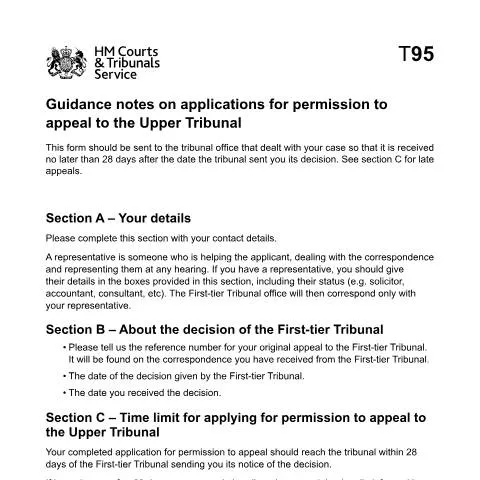
Navigating the Path to Upper Tribunal: When First-tier Decisions Fall Short
When a First-tier Tribunal decision doesn't align with your understanding of the law or appears fundamentally flawed, the T96 form serves as your gateway to challenge that ruling before the Upper Tribunal. This appeals mechanism operates within the General Regulatory Chamber framework, offering a crucial second tier of judicial scrutiny for decisions spanning diverse regulatory matters from professional licensing to environmental enforcement.
The Upper Tribunal represents a superior court of record with enhanced powers to examine questions of law that may have been mishandled at first instance. Unlike a simple review, this process requires demonstrating that the original tribunal made errors in law rather than merely disagreeing with factual findings or the exercise of discretion within legal parameters.
The Twenty-Eight Day Window: Understanding Time Constraints and Extensions
The T96 application operates under strict temporal boundaries, with a 28-day deadline calculated from when the First-tier Tribunal posted its decision notice. This timeframe reflects the tribunal system's emphasis on finality whilst balancing appellants' rights to challenge legally defective decisions.
However, the system acknowledges that rigid adherence to deadlines can sometimes produce unjust outcomes. Late applications remain possible through extension requests, requiring comprehensive explanations for the delay. The tribunal considers factors such as:
- Whether the delay was caused by circumstances beyond the applicant's control
- The length of the delay and actions taken during that period
- The strength of the proposed grounds of appeal
- Whether granting an extension would prejudice other parties
Automatic extensions apply in specific circumstances, particularly following unsuccessful set aside applications or review requests. These provisions recognise that appellants may reasonably pursue alternative remedies before escalating to the Upper Tribunal, and shouldn't be penalised for exhausting available options at the First-tier level.
Identifying Errors in Law: The Foundation of Upper Tribunal Appeals
The Upper Tribunal's jurisdiction is deliberately narrow, focusing exclusively on questions of law rather than re-examining factual disputes or challenging discretionary decisions within legal bounds. Understanding this distinction proves crucial for crafting successful applications.
Legal errors typically fall into several recognisable categories. Misapplication of statutory provisions occurs when tribunals apply incorrect legal tests or fail to consider relevant statutory criteria. For instance, in professional regulation cases, this might involve applying outdated fitness-to-practice standards or overlooking recent case law developments.
Procedural irregularities constitute another significant category, encompassing failures to follow prescribed procedures or breaches of natural justice principles. These might include inadequate opportunity to present evidence, bias concerns, or failure to adjourn when circumstances warranted.
| Error Category | Typical Examples | Evidence Required |
|---|---|---|
| Legal Misinterpretation | Wrong statutory test applied, case law ignored | Relevant authorities, statutory references |
| Insufficient Evidence | Decision unsupported by facts, speculation | Transcript excerpts, evidence gaps |
| Inadequate Reasoning | Unexplained conclusions, contradictory findings | Decision analysis, logical inconsistencies |
| Procedural Breach | Natural justice violations, wrong procedure | Procedural rules, hearing records |
Inadequate reasoning represents a particularly nuanced ground, requiring tribunals to provide sufficient explanation for their conclusions. Mere disagreement with outcomes doesn't suffice; appellants must demonstrate that reasonable minds couldn't reach the tribunal's conclusion based on available evidence, or that crucial reasoning steps remain unexplained.
Strategic Considerations: Suspension Requests and Interim Relief
Section E of the T96 form addresses whether the First-tier Tribunal's decision should be stayed pending appeal. This provision recognises that some tribunal decisions, if implemented immediately, could cause irreparable harm or render any subsequent Upper Tribunal victory meaningless.
Suspension applications require careful strategic consideration. Professional licensing cases exemplify this complexity: if a professional's licence is suspended immediately, they may lose clients, employment, or reputation in ways that cannot be remedied even if the Upper Tribunal ultimately finds in their favour.
The tribunal applies established principles when considering stay applications, weighing factors including:
- The likelihood of appeal success based on preliminary grounds assessment
- Whether damages could adequately compensate for harm caused by immediate implementation
- The balance of convenience between parties
- Public interest considerations, particularly in regulatory contexts
Regulatory cases often present particular challenges, as public protection concerns may outweigh individual hardship. However, strong legal grounds combined with appropriate safeguards can sometimes justify suspension, especially where immediate implementation appears disproportionate.
Representative Arrangements and Professional Support
The T96 form accommodates various representation arrangements, reflecting the complexity of Upper Tribunal proceedings and appellants' varying needs for professional support. Unlike some tribunal processes that encourage self-representation, Upper Tribunal appeals often benefit from specialist legal expertise given their focus on legal technicalities.
Legal representatives must be properly authorised, with new representatives requiring either legal qualification or written appointment letters. This requirement protects against unauthorised practice whilst ensuring tribunals can communicate effectively with appropriate parties.
Different professional backgrounds bring varying expertise to tribunal appeals. Solicitors and barristers offer comprehensive legal analysis and advocacy experience, whilst specialist consultants in regulated industries may provide crucial technical context for legal arguments. Accountants frequently represent in tax-related appeals, combining regulatory knowledge with legal understanding.
The choice of representative can significantly impact appeal prospects. Regulatory specialists understand industry-specific legal frameworks and precedents, whilst tribunal advocates excel at crafting arguments within the Upper Tribunal's particular procedural context.
Submission Pathways: Electronic versus Postal Applications
Modern tribunal administration embraces digital submission methods whilst maintaining traditional postal options, recognising diverse user preferences and technological capabilities. Electronic submission through tribunal email systems offers speed and confirmation receipts, crucial for meeting tight deadlines.
However, postal submissions remain important for complex applications involving extensive documentation or where electronic systems might compress or alter crucial formatting. The choice often depends on application complexity and supporting evidence volume.
Regardless of submission method, applications must include complete documentation packages. Missing elements frequently delay processing or result in rejection, particularly where core documents like the original First-tier Tribunal decision are absent.
The Upper Tribunal Landscape: Regulatory Chamber Specialisation
The General Regulatory Chamber represents one of several Upper Tribunal divisions, specifically handling appeals from First-tier regulatory decisions across diverse sectors. This specialisation enables judges to develop expertise in regulatory law principles whilst maintaining consistency across different industries.
Understanding the Chamber's jurisdictional scope helps appellants appreciate their position within broader regulatory frameworks. Cases span professional regulation, environmental compliance, immigration services, and estate agency oversight, among others. Each area brings distinct legal considerations whilst sharing common regulatory law principles.
The Chamber's approach emphasises proportionate case management, with procedures scaled to match case complexity and significance. Simple legal points may receive expedited treatment, whilst complex regulatory issues involving multiple parties warrant more extensive case management directions.
Precedential value represents another crucial consideration. Upper Tribunal decisions create binding precedents for future First-tier cases within the same regulatory area, meaning successful appeals can influence regulatory interpretation beyond individual cases.
Beyond Form Submission: The Appeals Process Trajectory
Filing the T96 form initiates a structured appeals process with distinct phases and decision points. Initial permission filtering represents the first hurdle, with Upper Tribunal judges assessing whether proposed grounds raise arguable points of law warranting full hearing.
Permission decisions themselves can be challenged through renewal applications to different Upper Tribunal judges, providing additional scrutiny for borderline cases. This two-stage permission system balances access to justice against the need to filter out unmeritorious appeals that would otherwise consume judicial resources.
Successful permission applications proceed to substantive hearings where legal arguments receive full examination. These proceedings typically involve detailed legal submissions, oral advocacy, and comprehensive judicial analysis of the legal issues identified during permission stages.
The Upper Tribunal's remedial powers extend beyond simple allow/dismiss outcomes. Judges can remit cases to the First-tier Tribunal with specific directions, substitute their own decisions where appropriate, or make declaratory orders clarifying legal principles for future application.
Understanding this broader process helps appellants appreciate that T96 submission represents just the beginning of potentially lengthy proceedings requiring sustained commitment and appropriate resources to achieve successful outcomes.
Understanding the Upper Tribunal's Jurisdiction and Powers
The Upper Tribunal (Administrative Appeals Chamber) operates with distinct jurisdictional boundaries when hearing appeals from the General Regulatory Chamber. Unlike other chambers within the First-tier Tribunal system, the General Regulatory Chamber covers an exceptionally diverse range of regulatory matters, from information rights and charity appeals to transport licensing decisions and gambling penalties.
When the Upper Tribunal grants permission to appeal via Form T96, it exercises what's known as "judicial review jurisdiction" in many cases. This means the Upper Tribunal doesn't simply substitute its own decision for that of the First-tier Tribunal, but rather examines whether the original decision was reached through proper legal process and reasoning. The Upper Tribunal has the power to:
- Set aside the First-tier Tribunal's decision entirely
- Remit the case back to the First-tier Tribunal for fresh consideration
- Make findings of fact that were not available to the First-tier Tribunal
- Substitute its own decision where the facts are not in dispute
- Award costs in exceptional circumstances where a party has acted unreasonably
The Upper Tribunal's approach varies significantly depending on the underlying regulatory framework. For Information Commissioner appeals, the Upper Tribunal tends to take a more interventionist approach, particularly on questions of proportionality under data protection legislation. However, for professional regulatory matters—such as appeals from decisions of bodies like the General Optical Council or General Pharmaceutical Council—the Upper Tribunal typically shows greater deference to specialist expertise, focusing primarily on procedural fairness and legal error.
Fill in your form directly online
No printing: type your details into the boxes of the official form, tick, then download the PDF ready to send.
- 1Type into the form boxes
- 2Tick in one click
- 3Save and download the PDF
Practitioners should note that the Upper Tribunal has increasingly recognised its role in developing consistent legal principles across the regulatory landscape. Recent cases have seen the Upper Tribunal establishing important precedents on the application of human rights principles to regulatory decision-making, particularly regarding Article 6 (fair trial) and Article 8 (private and family life) of the European Convention on Human Rights as incorporated through the Human Rights Act 1998.
The Upper Tribunal also maintains supervisory jurisdiction over certain decisions made by the First-tier Tribunal that don't require permission to appeal. These include decisions on case management directions, striking out applications, and certain preliminary rulings. Understanding which decisions require Form T96 and which can be challenged through alternative routes is crucial for effective case management.
Costs and Financial Considerations in Upper Tribunal Appeals
Unlike many other jurisdictions within the tribunal system, appeals to the Upper Tribunal from the General Regulatory Chamber can expose parties to significant cost risks. The Upper Tribunal operates under different costs rules compared to the First-tier Tribunal, where the general principle is that each party bears their own costs regardless of outcome.
The Upper Tribunal Rules 2008 provide that the Upper Tribunal may make a costs order where a party or their representative has acted unreasonably in bringing, defending, or conducting proceedings. This "unreasonable conduct" test is applied more liberally than in the First-tier Tribunal, and the Upper Tribunal has shown willingness to award costs where:
- An appeal is pursued without any reasonable prospect of success
- A party fails to engage properly with case management directions
- Excessive or irrelevant evidence is adduced without proper justification
- A party withdraws an appeal at a very late stage without good reason
- There is a pattern of non-compliance with tribunal orders or directions
The potential costs exposure includes not only the other party's legal costs but also the tribunal's own administrative costs in appropriate cases. Recent decisions suggest that costs awards in the Upper Tribunal can range from several hundred pounds for minor procedural defaults to tens of thousands of pounds in complex regulatory appeals where one party has conducted the proceedings unreasonably.
For unrepresented litigants completing Form T96, it's particularly important to understand that the Upper Tribunal's costs jurisdiction extends to ordering costs against individuals who cannot demonstrate they lack the means to pay. The tribunal will consider an individual's financial circumstances, but poverty alone is not a bar to a costs order where conduct has been genuinely unreasonable.
Conversely, successful appellants may find themselves unable to recover their costs even where the appeal succeeds, as the Upper Tribunal generally maintains the principle that regulatory appeals should not expose public bodies to routine adverse costs orders. This asymmetry in costs risk requires careful consideration when weighing whether to pursue an appeal through Form T96.
Legal aid is not generally available for Upper Tribunal proceedings from the General Regulatory Chamber, though exceptional funding may be available in cases involving human rights issues or where there is wider public interest. The Legal Aid Agency maintains strict criteria for exceptional funding applications, and practitioners should be aware that such applications can take several months to determine.
Strategic Considerations for Multi-Party and Complex Regulatory Appeals
Form T96 applications in complex regulatory matters often involve multiple interested parties, creating strategic considerations that don't arise in simpler two-party appeals. The General Regulatory Chamber frequently deals with cases where the original decision affects not only the immediate appellant but also competitors, professional colleagues, or members of the public who may have conflicting interests in the outcome.
When completing Form T96 in such circumstances, applicants must carefully consider whether to identify all potentially interested parties and whether those parties should be joined to the Upper Tribunal proceedings. The Upper Tribunal has broad powers to add parties to proceedings, either on application or of its own motion, and failure to identify relevant parties at the permission stage can lead to delays and additional costs later in the process.
In regulatory appeals involving professional disciplinary matters, there's often tension between the professional's desire for confidentiality and the regulator's duty to maintain public confidence in the profession. The Upper Tribunal has developed sophisticated case management procedures for dealing with sensitive personal and commercial information, including:
- Anonymisation orders protecting professional identity in appropriate cases
- Restricted reporting orders preventing publication of certain details
- Closed material procedures where national security considerations apply
- Confidentiality rings limiting access to commercially sensitive information
The Form T96 application should anticipate these issues and include appropriate requests for case management directions. The Upper Tribunal is generally more receptive to confidentiality applications made at the permission stage rather than as an afterthought during substantive proceedings.
For appeals involving regulatory decisions with cross-border implications—increasingly common in areas like data protection and financial services—the Upper Tribunal must navigate complex questions of territorial jurisdiction and the interaction between UK regulatory frameworks and retained EU law. Post-Brexit regulatory appeals often require careful analysis of transitional provisions and the extent to which EU jurisprudence remains relevant to UK regulatory decision-making.
Group litigation scenarios also present particular challenges when using Form T96. Where multiple parties wish to challenge the same regulatory decision, consideration must be given to whether separate applications should be made or whether a single lead application is more appropriate. The Upper Tribunal's approach to case management in group scenarios has evolved significantly, with increased emphasis on early identification of common issues and the appointment of lead representatives where appropriate.
The Upper Tribunal has also recognised the particular challenges faced by small businesses and individual professionals when challenging regulatory decisions. In appropriate cases, the tribunal may make directions for simplified procedures, including shorter time limits, reduced documentary requirements, and more flexible hearing arrangements. However, such accommodations must be balanced against the need for thorough examination of what are often complex legal and factual issues with significant implications for regulatory practice.