Understanding the RTB1 Form: Appealing a Local Authority’s Decision on Right-to-Buy for Elderly-Friendly Properties
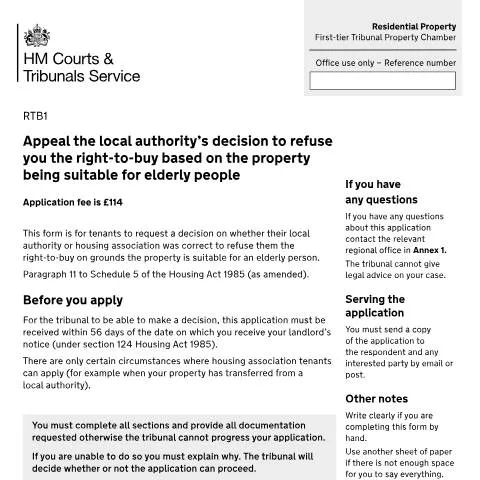
The RTB1 form is an official document issued by the First-tier Tribunal Property Chamber, part of HM Courts & Tribunals Service, designed for tenants who wish to challenge a local authority or housing association’s refusal of their right-to-buy application on the grounds that the property is deemed suitable for elderly residents. This guide aims to clarify the purpose of the form, who should consider using it, and the key steps involved in the appeal process.
Context and Purpose of the RTB1 Form
The right-to-buy scheme allows eligible tenants of local authorities and certain housing associations to purchase their homes at a discounted rate. However, decisions can be contested if tenants believe that the refusal was incorrect or unjustified. Specifically, the RTB1 form addresses cases where a local authority or housing association has refused the right-to-buy based on the assertion that the property is suitable for elderly occupants. Such refusals are often grounded in considerations related to the property’s features, location, or suitability for elderly living.
The legal basis for this appeal is found in Paragraph 11 of Schedule 5 of the Housing Act 1985 (as amended). The form provides a formal mechanism for tenants to request a tribunal review of the decision, ensuring that their rights are protected under the legal framework governing housing and tenancy rights in England.
Who Should Consider Using the RTB1 Form?
- Tenants who have received a notice of refusal: If you have been notified by your landlord that your right-to-buy application has been refused on the grounds that the property is suitable for elderly people, and you disagree with this assessment, the RTB1 form allows you to challenge that decision.
- Applicants within the specified timeframe: It is crucial to submit your appeal within 56 days of receiving the landlord’s notice, as late submissions are unlikely to be accepted by the tribunal.
- Housing association tenants: In certain circumstances, such as when a property has transferred from a local authority to a housing association, tenants may also be eligible to appeal using this form.
Key Steps in the Appeal Process
1. Gathering Necessary Documentation
Before submitting your appeal, ensure you have a copy of the landlord’s notice of refusal. You will also need to provide detailed information about yourself, your property, and any relevant correspondence. The form requires details such as your name, contact information, property address, and the date the tenancy was granted.
2. Completing the RTB1 Form
The form is divided into sections covering applicant and respondent details, property information, and reasons for the appeal. Clear and accurate information is essential, and additional pages can be attached if necessary. If you are completing the form by hand, ensure it is legible.
3. Submitting the Application
You must send a copy of the completed form to both the respondent (the local authority or housing association) and any interested parties. The application can be sent via email or post. Remember to include the application fee, which is specified as part of the process.
Important Considerations and Additional Information
It is important to note that the tribunal cannot provide legal advice regarding your case. If you have questions about the process or need clarification, you should contact the regional office listed in Annex 1 of the official guidance document. Ensuring all sections are completed and all requested documentation is provided will help facilitate a smooth review process.
In summary, the RTB1 form serves as a formal avenue for tenants to challenge decisions that deny their right-to-buy based on property suitability for elderly residents. By understanding the process and requirements, tenants can effectively exercise their rights and seek a fair review of their case through the tribunal system.