The Critical Three-Month Window: When Agricultural Succession Hangs in the Balance
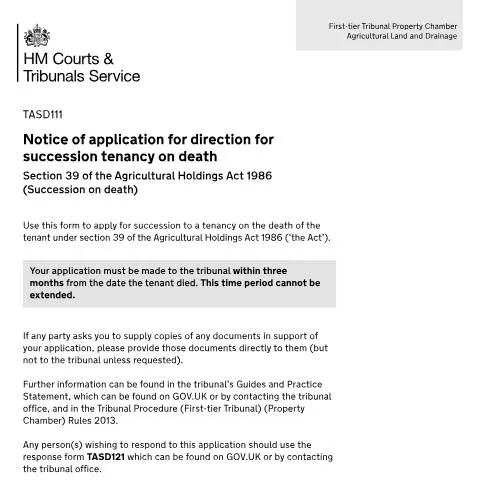
When an agricultural tenant dies, their farm's future often depends on swift action from eligible family members seeking to continue the tenancy. The TASD111 Notice of Application for Direction for Succession Tenancy on Death represents the only legal pathway to secure agricultural succession rights under section 39 of the Agricultural Holdings Act 1986, but it comes with an unforgiving deadline: three months from the date of death, with no possibility of extension.
This tribunal application to the First-tier Tribunal Property Chamber (Agricultural Land and Drainage) determines whether a deceased tenant's relative can step into their shoes and continue farming the same land. Unlike other succession processes where delays might be forgiven, agricultural tenancy succession operates under strict statutory timescales that reflect the urgent nature of farming operations and the need for landlords to know their position quickly.
The form's significance extends beyond mere paperwork—it triggers a formal legal process that can preserve family farming traditions spanning generations or, if handled incorrectly, result in the permanent loss of agricultural holdings that may have been in families for decades.
Decoding the Agricultural Holdings Act Framework Behind Form TASD111
The TASD111 application operates within a complex legislative framework that has evolved significantly since the Agricultural Holdings Act 1986. Understanding which type of tenancy the deceased held is crucial, as this determines whether succession rights exist at all.
Section 4.1 of the form requires applicants to identify their tenancy category from six distinct options, each with different legal implications:
| Tenancy Category | Date Criteria | Succession Rights |
|---|---|---|
| Pre-1984 tenancies | Granted before 12 July 1984 | Full succession rights under Part IV |
| Direction-based succession | Obtained after 1984 via section 39/53 | Limited to one further succession |
| Written contract tenancies | Post-1984 with succession clause | Contractual succession rights |
| Continuous occupation | Post-1984 to existing tenant | Preserved succession rights |
| 2006 Act tenancies | Post-19 October 2006 | Written succession provision required |
The distinction between these categories is critical because most agricultural tenancies granted after 12 July 1984 do not carry automatic succession rights. The Agricultural Holdings Act 1986 deliberately restricted succession to encourage more flexible letting arrangements, meaning that many modern farm tenancies will not qualify for succession applications regardless of family connections or farming experience.
Applicants must provide the exact date of the tenancy agreement in section 4.3, as this determines which legal regime applies. A tenancy dated 11 July 1984 carries full succession rights, while one dated 13 July 1984 may carry none at all unless it falls within one of the specific exceptions.
Mapping the Succession Battlefield: Who Can Apply and Who Must Respond
The TASD111 form requires careful identification of all parties who might have competing succession claims. Section 5 distinguishes between respondents (who become formal parties to proceedings) and section 6's other interested persons (who receive notice but aren't automatically parties unless the tribunal directs otherwise).
Landlords must always be named as respondents, including all trustees if the land is held in trust. The form specifically requires trustees' individual names rather than simply naming the trust, reflecting the legal principle that trustees hold legal title and must be properly served with proceedings.
More complex is identifying other family members who might have succession rights. The Act grants succession rights to close relatives of the deceased tenant, defined as:
- Surviving spouse or civil partner
- Children and grandchildren
- Parents and grandparents
- Siblings, aunts, uncles, and their children
- Adopted children with the same status as natural children
However, eligibility extends beyond family relationships. Potential successors must also demonstrate they derive their livelihood primarily from agricultural work on the holding and have the necessary experience and qualifications to farm the land commercially. This creates situations where multiple family members might theoretically qualify, requiring careful consideration of who to name in sections 5.1 and 6.1.
The form's structure anticipates competing applications, with section 5.1 specifically asking for details of other individuals "applying under section 39 of the Act in respect of the Holding by reason of the same death." This recognition that multiple succession claims may arise simultaneously reflects the reality that farming families often have several members involved in the operation.
Technical Precision: Mapping Requirements and Land Description Standards
Section 3 of TASD111 demands detailed technical information about the agricultural holding that goes far beyond simple addresses. The requirement for Ordnance Survey field numbers and maps "at a scale of 1:10,000 or larger" reflects the precision needed for tribunal proceedings where boundary disputes and land use classifications can significantly impact succession decisions.
The form categorises land into four distinct types:
- Arable land (including temporary grass)—land under rotation for crops
- Permanent pasture—grassland not under rotation
- Rough grazing—unimproved land suitable only for extensive grazing
- Other land (including orchards)—specialist agricultural uses
This classification isn't merely administrative; different land types carry different agricultural values and rental assessments. Tribunal members need accurate land descriptions to assess whether proposed successors have appropriate experience for the specific type of farming operation involved.
The mapping requirement serves multiple purposes beyond identification. Maps must show the holding "edged in red" and distinguish it from "all other relevant land"—crucial where family farming operations span multiple holdings or where succession claims might affect only part of a larger agricultural unit.
Ordnance Survey field numbers provide definitive identification that prevents disputes over which specific parcels are included in succession applications. These numbers, found on detailed OS maps, offer precision that general descriptions cannot match, particularly important where holdings comprise scattered parcels across wide geographical areas.
Strategic Timing: From Death Certificate to Tribunal Decision
The TASD111 process operates within rigid timeframes that begin immediately upon the tenant's death. The three-month application deadline is absolute—the form explicitly states "this time period cannot be extended," making it one of the most unforgiving deadlines in agricultural law.
This inflexibility reflects policy decisions about agricultural land use. Farming operations cannot remain in limbo indefinitely, and landlords need certainty about their position for future planning. The three-month window balances the need for families to grieve and organise their affairs against the practical requirements of ongoing agricultural operations.
Once submitted, the TASD111 triggers a formal tribunal process with its own timetable:
- Service period—applicants must serve copies on all named respondents and interested persons
- Response deadline—respondents have limited time to file TASD121 response forms
- Case management—tribunal may issue directions for further evidence or clarification
- Hearing preparation—parties prepare evidence on succession eligibility and suitability
- Tribunal hearing—formal proceedings to determine succession applications
The tribunal must consider not just eligibility but also suitability—whether the proposed successor has the skills, experience, and financial resources to operate the holding successfully. This assessment can involve detailed examination of agricultural qualifications, previous farming experience, and business plans for the holding's future operation.
Decisions aren't automatic even for eligible applicants. Where multiple family members apply, the tribunal must choose between them based on their respective suitability to continue the tenancy successfully.
Beyond the Application: Understanding Tribunal Powers and Potential Outcomes
Submitting TASD111 initiates proceedings where the First-tier Tribunal Property Chamber exercises significant discretionary powers. The tribunal doesn't simply rubber-stamp succession applications but conducts a thorough assessment of whether granting succession serves the interests of sound agricultural management.
The tribunal can make several types of direction:
- Grant succession to the applicant—confirming their right to continue the tenancy
- Grant succession to a different family member—where multiple applications exist
- Refuse all succession applications—where no applicant meets the required criteria
- Grant succession subject to conditions—such as rent adjustments or operational requirements
Conditional grants reflect the tribunal's power to ensure succession arrangements work practically for all parties. These might include provisions for rent reviews where the holding's agricultural value has changed, or requirements for specific improvements or management practices.
The tribunal also considers whether succession would result in effective land use. Applications may fail where proposed successors lack realistic prospects of maintaining viable farming operations, even if they meet technical eligibility criteria. This assessment can involve detailed scrutiny of business plans, financial resources, and market conditions affecting the particular type of agricultural enterprise.
Unsuccessful applicants retain limited appeal rights, but these focus on legal procedure rather than tribunal findings of fact about agricultural suitability. This emphasises the importance of preparing comprehensive evidence for the initial application rather than relying on appeal processes to correct deficiencies.
Practical Considerations for Complex Family and Business Situations
Real-world succession applications often involve complications not immediately apparent from the TASD111 form's straightforward sections. Family farming operations frequently span multiple generations, with various relatives having different levels of involvement and different succession claims.
Partnership arrangements create particular complexity where the deceased tenant was part of a farming partnership. The form requires identification of the specific tenancy held by the deceased individual, which may be distinct from partnership interests in the farming operation. Succession rights attach to tenancy interests rather than business partnerships, creating potential divergence between who continues farming and who holds tenancy rights.
Limited company structures add another layer of complexity. Where agricultural holdings are held by companies rather than individuals, succession rights may not apply at all, as the Act primarily contemplates individual tenancies. However, situations arise where individual tenants subsequently incorporate their operations, raising questions about whether succession rights are preserved or extinguished.
Divorce and remarriage situations require careful consideration of family relationships for succession purposes. Step-children may qualify as close relatives in some circumstances, while divorced former spouses generally cannot claim succession rights even if they remain involved in farming operations.
Multiple holding situations—where the deceased held several separate tenancies—may require separate TASD111 applications for each holding. Succession rights are specific to individual tenancies rather than applying generally to a tenant's entire agricultural portfolio.
The form's requirement to identify "other interested persons" becomes particularly complex in extended farming families where several generations may have legitimate succession claims. Strategic decisions about who to name can significantly impact proceedings, as unnamed parties may later seek to join proceedings or challenge eventual succession directions.
Documentary Evidence and Supporting Information Requirements
While TASD111 itself captures essential information, successful succession applications typically require substantial supporting documentation. The form's instruction that applicants should "provide documents directly to parties but not to the tribunal unless requested" reflects the tribunal's case management approach of requiring evidence only when specific issues arise.
Essential supporting documents typically include:
- Death certificate—establishing the date of death for deadline calculations
- Tenancy agreement—proving the deceased's tenancy rights and terms
- Agricultural qualifications—demonstrating the applicant's farming competence
- Employment records—showing agricultural work history and income sources
- Financial statements—evidencing capacity to maintain the farming operation
Land registration documents may be necessary where tenancy boundaries are disputed or where the holding comprises multiple parcels with different registration details. Historical rental payments can help establish the nature and extent of tenancy arrangements, particularly where written agreements are incomplete or ambiguous.
Evidence of agricultural experience requires particular attention to the statutory requirement that successors derive their livelihood "principally from agricultural work on the holding." This means demonstrating not just agricultural skills generally, but specific experience with the particular holding and type of farming operation involved.
Character references from agricultural professionals, neighbouring farmers, or industry organisations can support applications by demonstrating the applicant's standing in the local farming community and their prospects for successful tenancy continuation.
The tribunal's discretionary approach to evidence means that applicants must be prepared to produce additional documentation if questions arise during proceedings. However, the initial TASD111 application should be sufficiently detailed to demonstrate a prima facie case for succession without requiring immediate supporting documentation.