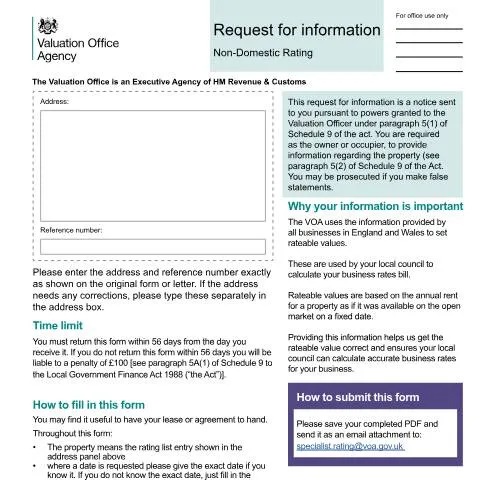
Understanding the VO 6035 Form: Your Essential Guide
Navigating the intricacies of property rating in the UK can be challenging, especially when dealing with non-domestic properties like stately homes. The VO 6035 form, officially titled "Request for Rental Information: Stately Homes," plays a pivotal role in this process, ensuring that the Valuation Office Agency (VOA) can accurately determine rateable values for properties. This article aims to provide a comprehensive overview of the VO 6035 form, from who needs to submit it to the specific requirements and details necessary for completion.
Who Needs to Fill Out the VO 6035 Form?
In essence, the VO 6035 form is directed towards owners or occupiers of non-domestic properties that fall under the category of stately homes. This includes a variety of historical estates that may have different uses ranging from event locations to tourist attractions. Here are the primary groups who may be required to submit the VO 6035 form:
- Property Owners: If you own a stately home that is open to the public, you are required to provide rental information.
- Occupiers: Those who are leasing or renting a stately home must also complete this form.
- Business Operators: If your business operates within a stately home, such as catering or retail, you have an obligation to report financial data as outlined in the form.
Understanding your role is crucial. If you are an occupier connected to the landlord (e.g., family relationships or through business agreements), specific details regarding this relationship must also be disclosed.
The Crucial Timeline for Submission
Timing is critical when it comes to the VO 6035 form. As per the guidelines set by the Valuation Office Agency, the form must be returned within 56 days from the date you receive it. Failure to adhere to this timeline may result in a penalty of up to £100. Here’s a breakdown of the key timeline elements:
- Receipt of the Form: Pay attention to the date stamped on the form; this is your starting point.
- Submission Deadline: Mark your calendar to ensure the form is submitted within the 56-day timeframe.
- Post-Submission Processing: Upon submission, the Valuation Officer will assess the information to determine the rateable value, which will subsequently be used by local councils to calculate business rates.
After submitting the form, the VOA aims to inform you of the outcome and any adjustments to the rateable value based on the information provided.
Diving Deep into the Forms: Breakdown of Sections
The VO 6035 form consists of multiple sections that require detailed information. Each part serves a specific purpose and requires careful attention to ensure comprehensive data is submitted. Below, we delve into the various sections of the form and highlight potential pitfalls while filling them out.
Part A: Basic Property Information
In Part A, you are required to provide essential details about the property. This includes:
- Current Occupier's Name: List the full name of the individual or entity currently occupying the property.
- Present Use of the Property: Clearly specify the function of the property, whether it's a stately home, a show garden, etc.
- Occupancy Start Date: Provide the date you first occupied the property; accuracy is key here.
- Correctness of Address: Confirm that the address stated on the form is accurate.
- Relationship to Landlord: If there’s a connection to the landlord, fully disclose this relationship.
Common pitfalls include not providing accurate address details or omitting the connection to the landlord, which can lead to discrepancies in the information reviewed by the VOA.
Part B: Financial Data from Previous Years
Part B focuses on the trading receipts for the last three financial years. This section is vital for the VOA to assess the economic viability of the property. The details needed include:
- Financial Receipts: Document the gross receipts for each year, specifying the source of income such as admissions, concessions, and grants.
- Type of Tenure: Indicate whether the property is freehold, leasehold, or another designation.
- Rental Information: If rent is being received from sub-letting any part of the property, this must be disclosed.
It is imperative to ensure that all financial figures are accurately reported; discrepancies may result in delays or penalties.
Part C: Additional Revenue Considerations
This section aims to capture additional payments received by the occupier, including any revenue from sub-letting or other agreements. Key points include:
- Payments for Letting: Clearly indicate if there are any rents received from letting parts of the property.
- Details of Lettings: Provide specifics about each letting arrangement, including the annual rent and whether it covers repairs or insurance.
Omitting any of this information can hinder the accuracy of the rateable value assessment.
Part D: Detailed Financial Breakdown
Part D requests a detailed breakdown of trade receipts and expenditures over the past three years. You're required to document:
- Gross Receipts: Differentiate between various sources of income like admissions, catering, and events.
- Cost of Sales: Outline the total cost associated with these activities.
- Net Profits: Calculate gross profits by subtracting costs from receipts for each income source.
This is often the most complex section of the form, and ensuring all figures are precise is paramount to avoid any issues with the VOA.
Submission Methods: Navigating Your Options
Once you have completed the VO 6035 form, the next step is to submit it. Understanding your submission options is vital:
Online Submission
The preferred method for many is online submission. You can save your completed PDF and send it as an email attachment to the VOA at [email protected]. This method offers a quicker turnaround and allows for easier tracking of your submission.
Postal Submission
Should you prefer traditional methods, you can also submit the form via post. However, it's advisable to send it via recorded delivery to ensure it reaches the VOA and to have proof of submission.
In-Person Submission
While less common, in-person submission is also an option. This might be preferable for those submitting complex forms or those who wish to discuss their submission directly with a Valuation Officer.
Always keep a copy of your submitted form and any covering letters or documentation for your own records.
After Submission: What Happens Next?
Once the VOA receives your VO 6035 form, they will process the information. Here’s a detailed look at what follows:
- Assessment of Information: The Valuation Officer reviews the submitted data for accuracy and completeness.
- Communication of Rateable Value: Following the assessment, you will receive notification of your property’s rateable value, which will be used by your local council.
- Opportunity for Appeal: If you disagree with the revised rateable value, you have the right to appeal. This typically involves submitting additional evidence to support your case.
It's crucial to monitor communications from the VOA, as there may be additional queries or requests for clarification following your form submission.
Final Thoughts on the VO 6035 Form
The VO 6035 form is more than just a bureaucratic necessity; it serves as the foundation for determining the rateable value of stately homes and similar properties, impacting business rates charged by local councils. Filling out this form accurately and thoroughly is essential for avoiding penalties and ensuring fair assessment.
By understanding the various sections, submission methods, and what to expect after submission, you can navigate this crucial process with confidence. It is advisable to seek professional guidance if you find aspects of the form particularly challenging or complex, especially regarding financial disclosures.
Understanding the Role of the Valuation Office Agency (VOA) in Property Valuation
The Valuation Office Agency (VOA) plays a crucial role in the UK's property taxation system. Established under the provisions of the Crown Estate Act 1961, the VOA is responsible for assessing the value of properties for various purposes, including council tax and business rates. When it comes to stately homes, the agency's role extends beyond mere financial assessment; it involves a deep understanding of historical significance, architectural merit, and land use. This multifaceted approach is essential when responding to requests for rental information, particularly in determining the fair rental value based on unique property characteristics.
For stately homes, the VOA must consider a variety of factors. These include the location, historical context, and even the market demand for such properties. Notably, these homes often come with vast estates, unique features, and significant heritage status, which can complicate rental valuations. The agency employs a team of qualified surveyors and valuers who specialize in heritage properties, ensuring that all assessments reflect the intrinsic value and unique circumstances surrounding each stately home.
In practice, when a VO 6035 request is submitted, the VOA will review the specifics of the property in question. They may look at recent rental agreements, property sales in the vicinity, and economic indicators that could affect rental income potential. The information provided in these assessments aids local councils in making informed decisions about tax rates and helps property owners understand their obligations and rights regarding property rental.
Common Challenges in Submitting a VO 6035 Request
Submitting a VO 6035 request for rental information can be a straightforward process; however, there are several challenges that applicants may encounter. Understanding these potential pitfalls can help ensure a smooth submission. One of the most common issues is related to completeness and accuracy of the information provided. The VOA requires detailed information about the property, including its size, amenities, and current usage. In cases where the property has undergone renovations or alterations, it's crucial to provide updated information that accurately reflects its current status.
Another challenge lies in the timing of the request. Applicants must be aware of the deadlines and the tax year calendar—specifically, the period from 6 April to 5 April. Submitting a request outside of this timeline may lead to complications or delays in processing. Additionally, applicants should be mindful of the specific terms outlined by the VOA regarding the submission process. Ensuring compliance with the Data Protection Act 2018 is also paramount, especially when dealing with sensitive information about tenants or previous rental agreements.
Moreover, there is often a lack of clarity around the interpretation of rental value, particularly for stately homes that may not conform to standard rental models. Factors such as heritage status, cultural significance, and the property’s market position might necessitate additional documentation or justification during the assessment phase. Engaging a qualified surveyor familiar with the nuances of these properties can significantly enhance the chances of a successful request.
The Future of Stately Home Rentals and VOA Assessments
As the real estate landscape evolves, so too does the approach to assessing stately homes for rental purposes. The growing popularity of heritage tourism and luxury rentals has led to an increased interest in these unique properties. Consequently, the VOA may need to adapt its assessment criteria to reflect changing market dynamics and trends in the rental market. This includes a more nuanced understanding of short-term versus long-term rental models and how they impact traditional assessments.
There is also a rising focus on sustainability and conservation within the property market, which is particularly relevant for stately homes. The VOA is likely to take into account the environmental impact of maintenance and renovations, especially in the context of energy efficiency and sustainability certifications. As property owners invest in reducing their carbon footprints, these factors may be integrated into the rental assessment process.
Moreover, the implementation of new technologies, such as data analytics and AI, presents opportunities for the VOA to enhance its valuation processes. By leveraging comprehensive data sets and predictive analytics, the agency can provide more accurate and timely assessments that reflect real-time market conditions. This shift can ultimately benefit property owners seeking to rent out their stately homes, as it may lead to more competitive and fair valuation outcomes.