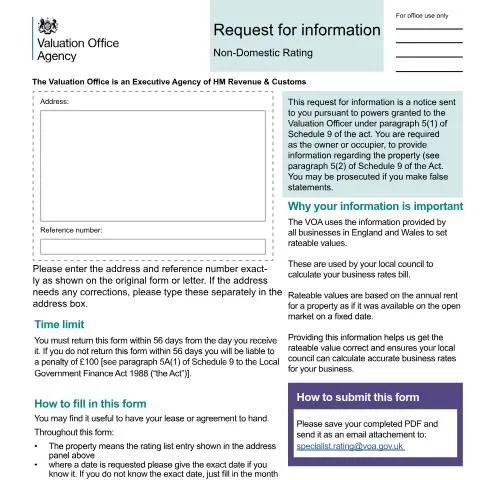
Navigating the VO 6076: Your Guide to Rental Information Requests in Renewable Energy
The VO 6076 form, titled "Request for Rental Information," acts as a critical instrument through which the Valuation Office Agency (VOA), an Executive Agency of HM Revenue & Customs (HMRC), gathers essential data needed for assessing business rates for properties involved in renewable energy production. Understanding this process can significantly impact how accurately your business rates are calculated, making it imperative for property owners and occupiers to engage seriously with the information requested.
Understanding the Role of the VO 6076 Form
This form is not merely a bureaucratic requirement; it serves a profound purpose in the realm of non-domestic rating. At its core, the VO 6076 enables the VOA to establish rateable values, which are ultimately used by local councils to calculate business rates. These rateable values derive from the annual rent of the property based on a hypothetical open market scenario, thus the accuracy of the data provided on this form can influence your financial obligations significantly.
The Legislative Framework Behind the Form
The request for information is grounded in the powers set forth in the Local Government Finance Act 1988, particularly under paragraph 5(1) of Schedule 9. By responding to this request, you are not only fulfilling a legal obligation but also contributing to the maintenance and compilation of the rating list, a key element in ensuring equitable business rate assessments across the country.
Who Must Complete the VO 6076?
Any owner or occupier of a non-domestic property engaged in renewable energy production should complete this form. This could include businesses operating power stations, solar farms, or other renewable energy facilities. If you occupy a property used for such purposes, it is your responsibility to provide accurate and timely information to the VOA.
Key Timelines: Submission Deadlines and Penalties
Upon receiving the VO 6076 form, you have a strict deadline of 56 days to return it. Failing to adhere to this timeline can result in a penalty of £100 as stipulated under paragraph 5A(1) of Schedule 9 of the Local Government Finance Act 1988. This punitive measure highlights the importance of prompt action and attention to deadlines in the administrative processes linked to business rates.
Preparing Your Documentation: Essential Records
Before filling out the VO 6076, gather all relevant documents, particularly your lease or occupancy agreement. This preparation can streamline the process and minimize the likelihood of errors. Key documentation includes:
- Your current lease agreement for the property.
- Financial records from the previous three accounting years, including receipts and expenditure related to renewable energy production.
- Any correspondence with your landlord or property management that may dictate your occupancy status.
Breaking Down the Sections of the VO 6076 Form
The form consists of several parts, each designed to gather specific types of information. Let's explore its sections more closely:
Part A: Property and Occupancy Details
- Current Occupier's Name: This must be filled out accurately as it identifies who is responsible for the property.
- Property Address: Verify that the address is correct; if not, provide the correct postal address.
- Occupancy Start Date: Indicate when you began occupying the property.
- Present Use and Technology: Clarify what the property is used for (e.g., type of renewable energy technology), including details on installed capacities.
Part B: Financial Information
This section gathers trading receipts and expenditures for the last three financial years. Accuracy is paramount here, as the VOA uses these details to determine the rateable value based on the business's financial health.
- Electricity Generated: Provide figures in MWh (megawatt-hours) for each accounting year.
- Gross Receipts: Detail all income from various sources of energy production.
- Cost of Sales and Operating Expenses: Be comprehensive, covering every cost from wages to operational maintenance.
Addressing Errors and Omissions
In the event you notice an error after submission, or if documentation was inadvertently omitted, swift action is essential. The VOA typically allows for corrections but requires that you communicate directly with them to rectify any issues.
- Contact the VOA: Use the email provided, [email protected], to address any concerns or corrections.
- Document Any Changes: Keep records of all communications and changes made to your submission.
Dealing with Refusals or Challenges
If your submitted information is contested, either by the VOA or by your local council, be prepared to provide further clarifications or evidence. This may involve additional documentation or, in some cases, formal appeals processes.
The Implications of Accurate Reporting
Providing precise information on the VO 6076 not only impacts your immediate financial obligations but also shapes the broader fiscal landscape for your local council. Accurate data contributes to fairer assessments, which can influence rates for all businesses within your rateable area.
Understanding Your Rights and Responsibilities
As a property occupier, you have the right to appeal any rateable value you believe is incorrect, but with that right comes the responsibility to provide truthful and complete information in your initial submission. Misrepresentation can lead to severe penalties, including prosecution, which underscores the importance of accuracy.
Specific Scenarios: Unique Situations to Consider
Different circumstances may complicate the process, such as changes in ownership, shared occupancy, or properties with mixed uses. Here’s how to approach these unique situations:
- For Shared Properties: Each occupier may need to submit a VO 6076 form detailing their proportionate share of the property and operations.
- In Cases of Ownership Transfer: If ownership has changed during the period in question, ensure to clarify who was occupying the property at what times.
- Special Cases of Joint Ventures: When multiple parties are involved in the renewable energy production, clear delineation of responsibilities and financial returns must be submitted.
Final Steps: Sending and Following Up on Your Submission
Once you have completed the VO 6076 form, follow these steps for submission:
- Check Your Work: Review the form for any possible errors or missing information.
- Email the Form: Save your completed PDF and send it as an attachment to [email protected].
- Keep a Copy: Always maintain a personal copy of the submitted form for your records.
Post-Submission Check-Ins
After submission, it’s advisable to follow up with the VOA to ensure your form was received and is being processed. Being proactive can help mitigate any potential issues that may arise during the assessment process.
Your Role in Shaping Accurate Business Rates
Completing the VO 6076 is more than just fulfilling an obligation—it is an opportunity for property owners and occupiers in the renewable energy sector to ensure fair treatment regarding business rates. The data you provide plays a vital role in shaping local economic policies, determining funding for public services, and contributing to the sustainable development goals that benefit the community as a whole.
Understanding the VO 6076 Request for Rental Information
The VO 6076 form is a critical tool for landlords and tenants in the UK, particularly in the context of renewable energy. This request for rental information is primarily utilized by the Valuation Office Agency (VOA) to gather details on rental properties that utilize or have the potential for renewable energy sources. Understanding how to fill out this form correctly can significantly impact energy assessments and subsequent taxation.
When filling out the VO 6076, it’s essential to provide accurate information regarding any energy-efficient improvements made to the property, such as solar panels or wind turbines. These enhancements can lead to reduced energy costs and can influence the property’s market rental value. Be mindful to include any certifications or evidence of energy efficiency improvements, as these may be requested by the VOA for validation purposes.
Moreover, the information provided in the VO 6076 can help the government in its efforts to achieve its carbon reduction targets. Landlords who invest in renewable energy may also benefit from various incentives, such as the Renewable Heat Incentive (RHI) or the Feed-in Tariff (FiT), and proper submission of this form ensures that all relevant information is considered when assessing these incentives.
Common Mistakes and How to Avoid Them
Many individuals encounter common pitfalls when completing the VO 6076 form, which can lead to delays or inaccuracies in their rental assessments. Here are some frequent errors and tips on how to mitigate them:
- Incomplete Information: A common issue is failing to provide all necessary details about the property. Ensure you have all relevant documentation, including any previous assessments, tenancy agreements, and details of energy improvements.
- Outdated Energy Performance Certificates (EPCs): When reporting energy efficiency measures, it’s crucial to reference current EPCs. Make sure your EPC is up to date, as outdated certificates may not reflect the true energy performance of your property.
- Ignoring Submission Deadlines: The VOA may have specific timelines for processing VO 6076 requests, so be aware of any deadlines to avoid delays. Keeping a record of submissions and setting reminders can be beneficial.
- Misunderstanding the Criteria for Renewable Energy: Some landlords may not realize which types of energy sources qualify under renewable energy regulations. Familiarize yourself with what constitutes renewable energy as per the latest government guidelines to provide accurate information.
By paying careful attention to these common issues, you can ensure a smoother process when submitting your VO 6076 request, ultimately enhancing your property’s value and compliance with energy regulations.
The Role of Renewable Energy in the Property Market
As the UK continues to pivot towards sustainable living and reduced carbon emissions, the role of renewable energy in the property market has become increasingly significant. The integration of renewable energy sources can not only improve the sustainability of a property but also enhance its marketability and rental value.
Properties equipped with renewable energy technologies, such as solar panels or heat pumps, are often seen as more attractive by potential tenants. This is primarily because they promise lower utility bills and a smaller environmental footprint. Moreover, properties that meet high energy efficiency standards may qualify for Green Mortgages, which offer better rates and terms for borrowers.
Landlords should note that there are financial benefits tied to renewable energy through government schemes designed to encourage the adoption of cleaner energy sources. These can include tax incentives, grants for renewable installations, and increased interest from tenants who prioritize sustainability.
Coupled with the growing demand for eco-friendly properties, understanding the dynamics of renewable energy in the property market can empower landlords and real estate investors to make informed decisions that align with both current trends and regulatory expectations.