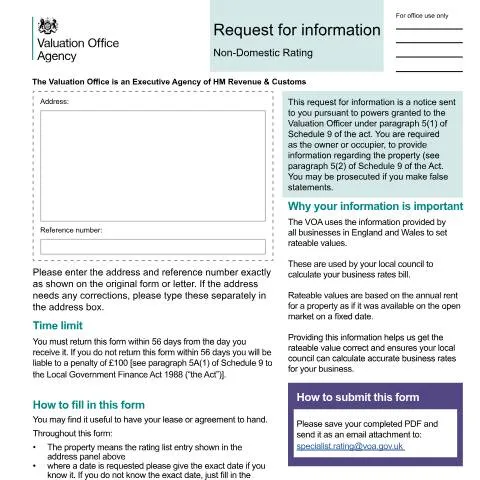
The Importance of VO 6028 in Business Rate Assessments
The VO 6028 form serves as a crucial tool in the assessment of business rates in England and Wales. When the Valuation Office Agency (VOA) requires information about markets and market places, this form is sent to the business owners or occupiers to gather essential data. The information collected through VO 6028 directly influences the rateable value assigned to a property, which in turn helps local councils determine the business rates bill for proprietors. Understanding this form is vital for those engaged in operating markets, as it plays a key role in ensuring that business rates are accurately calculated.Who is Required to Submit the VO 6028?
The responsibility to complete and submit the VO 6028 falls primarily on owners or occupiers of non-domestic properties involved in market operations. This includes a variety of market types, from farmers' markets to antique fairs. If you are affiliated with a market—whether as a stallholder or an organiser—it’s imperative to understand your obligations under the Local Government Finance Act 1988. Non-compliance or failure to submit accurate information could lead to penalties, including a fine of up to £100 if the form is not submitted within the stipulated timeframe.Understanding the Legal Background
The VO 6028 form operates under the framework established by the Local Government Finance Act 1988. Specifically, section 5(1) of Schedule 9 empowers the Valuation Officer to request information necessary for compiling or updating the rating list for non-domestic properties. By ensuring compliance with these legal requirements, businesses can avoid potential legal repercussions and penalties. Furthermore, the Data Protection Act 2018 assures that any data collected is processed lawfully, transparently, and fairly.Timelines: When to Expect and Submit the VO 6028
Once a business owner or occupier receives the VO 6028 form, they are mandated to return it within 56 days. Failure to do so not only jeopardises the accuracy of business rates but also incurs a monetary penalty. This timeframe is essential; understanding the implications of timely submission can significantly affect the finances of the business.What Happens After Submission?
After the completed VO 6028 is submitted, the information provided is meticulously reviewed by the Valuation Officer. This process can potentially lead to adjustments in the rateable value of the property based on the details of the market operations. It is therefore crucial for businesses to ensure that the data provided is accurate and comprehensive, reflecting the actual circumstances of their market activities.Navigating the Channels for Submission
There are multiple ways to submit the VO 6028 form, each with its own set of advantages and potential drawbacks.- Online Submission: By saving the completed PDF and emailing it to [email protected], users can enjoy a swift, paperless process. This channel is generally preferred for its ease and speed.
- Paper Submission: For those who prefer traditional methods, the form can be printed and mailed to the provided address. However, this may introduce delays in processing.
- In-Person Submission: While less common, some may choose to deliver the form directly to a local VOA office. This ensures immediate receipt but may require additional travel and time.
Decoding the VO 6028: A Comprehensive Breakdown of Sections
Completing the VO 6028 accurately is paramount. Each section of the form is designed to elicit specific information, and errors or omissions can lead to complications.Part A: Basic Information
This section requires the current occupier’s details and the description of the market. Additionally, it asks about the market's operational days and the type of tenure (e.g., freehold, leasehold). It’s essential to provide precise information here, as inaccuracies can lead to miscalculations in rateable value.Part B: Market Operation Details
In Part B, detailed descriptions of the market's operations are requested. Questions include how the market was established and information about its physical layout.- Market Establishment: Different methods of establishment may affect the rateable value. Ensure that this is clearly noted.
- Land Use: Knowing how the land is utilized, especially on non-market days, can be crucial. Be thorough in describing these aspects.
Part C: Financial Receipts and Expenditures
This section is critical for understanding the financial implications of the market. Providing accurate gross receipts is necessary, as it can impact the assessment of the market's economic viability.| Accounting Year Ending | Total Gross Receipts | Expenditure |
|---|---|---|
| Day:Month:Year | Input Amount | Input Amount |
| Day:Month:Year | Input Amount | Input Amount |
Preparing for Submission: Document Checklist
A structured approach to completing the VO 6028 can facilitate timely submission. Here’s a checklist to aid in preparation:- Lease or Agreement: Have this at hand for reference, as it contains critical information.
- Current Market Details: Ensure you have up-to-date information about the market’s operations and physical characteristics.
- Financial Records: Gather receipts and records for the last three financial years as requested in Part C.
- Contact Information: Be prepared to provide accurate contact details for communication with the VOA.
The Consequences of Non-Compliance
Neglecting to submit the VO 6028, or providing false information, can have serious consequences. Aside from the immediate £100 penalty, businesses risk facing increased scrutiny from the VOA, which may lead to further investigations and potentially higher rateable valuations.Legal Ramifications
Under the Local Government Finance Act 1988, failure to provide requested information can lead to criminal prosecution. This underscores the importance of understanding the legal implications tied to the VO 6028 form. Any business engaged in non-domestic market operations must prioritize compliance to avoid such pitfalls.Conclusion: The Long-Term Impacts of Accurate Rateable Values
The completion and submission of the VO 6028 form are pivotal in influencing local business rates and ensuring that they reflect the true operational dynamics of the market. Businesses should approach this process with diligence, ensuring that all information is accurate and submitted in a timely manner. A proactive attitude towards compliance not only safeguards against penalties but also contributes to a fairer rateable valuation system, benefiting both the business and the local community.Understanding the Role of the Valuation Office Agency in Rental Information Requests
The Valuation Office Agency (VOA) is an integral part of the UK's property and taxation framework. When dealing with rental information requests, such as the VO 6028, it is essential to understand the various roles and responsibilities of the VOA. Their primary task is to assess property values for tax purposes, which includes establishing the rental market's pulse.
When a VO 6028 request is submitted, the VOA not only processes the information but also provides context about local market conditions. This includes examining rental trends in specific areas, which can influence valuation for council tax, business rates, and housing benefits. The agency compiles data on rental prices across different markets, helping local authorities, landlords, and tenants to understand the dynamics of their respective markets.
In addition to providing rental information, the VOA also monitors changes in the property landscape, such as new developments, changes in demographics, and shifts in economic conditions. This ongoing analysis allows them to provide accurate and timely rental information, essential for those relying on data to make informed decisions about property investments or rental agreements.
For individuals or organizations requesting rental information through the VO 6028 form, it may be beneficial to specify the geographic areas of interest clearly. The VOA can then tailor its response to reflect current market conditions, including average rental prices, vacancy rates, and other pertinent metrics.
Common Challenges When Submitting a VO 6028 Request
When navigating the process of submitting a VO 6028 request for rental information, applicants may encounter several challenges. One common issue is ensuring that all required information is accurately completed. The VOA requires specific details about the properties in question, including their locations, property types, and any relevant rental agreements.
Another challenge is the timeframe for receiving a response. While the VOA aims to process requests efficiently, delays can occur due to high volumes of inquiries or the complexity of the information being requested. Applicants should be prepared for potential delays and consider submitting their requests well in advance of any deadlines they are working against.
Additionally, applicants may find difficulties in understanding the data provided. The VO's rental information can be technical, with various terms and metrics that may not be familiar to all users. Therefore, it is advisable to familiarize oneself with common valuation terminology before submitting a request. Understanding concepts such as 'comparative rents' and 'market adjustments' can help in interpreting the information received.
Finally, it's essential to know that the data received is representative of a snapshot in time and may not reflect future market changes. Therefore, ongoing research and monitoring of rental trends are recommended for anyone relying on this information for strategic decisions.
Best Practices for Using Rental Information from a VO 6028 Request
Once you receive the rental information from your VO 6028 request, applying best practices to utilize this data effectively is crucial. First, it is helpful to correlate the rental data with other market indicators, such as employment rates and demographic trends, to gain a more comprehensive understanding of the rental market's health.
Employ the information strategically by creating a comparative analysis with similar properties in the area. This can include evaluating rental prices across comparable neighborhoods and understanding any factors that might justify price differences, such as amenities, school districts, or transportation links.
Another best practice is to maintain an updated record of rental trends over time. Tracking this data can provide insights into seasonal fluctuations, helping landlords set competitive rental prices and aiding tenants in negotiating leases based on historical data.
Moreover, consider leveraging rental information for future planning. Landlords can base decisions on whether to raise rent, invest in property upgrades, or offer incentives based on market conditions. Tenants can use the information to negotiate fair rents or consider relocating if they identify better rental opportunities elsewhere.
Finally, stay engaged with local councils and community groups. They often have additional data and insights that can complement the information obtained from the VOA. Collaborating with these entities can present further opportunities for leveraging rental data and understanding local housing policies that may impact rental markets.