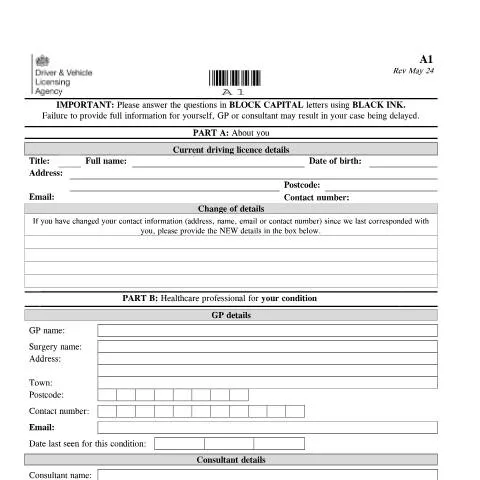
When Neurodevelopmental Conditions Meet the Road: Understanding DVLA's Medical Disclosure Process
The moment a healthcare professional mentions that your ADHD, autism spectrum condition, or learning disability might impact your driving ability, you enter a carefully regulated territory governed by the Driver and Vehicle Licensing Agency. The A1 form for neurodevelopmental conditions represents more than mere bureaucracy—it's the gateway to a medical assessment process that determines whether you can continue driving legally on UK roads.
Unlike other DVLA medical forms that focus on physical ailments or sudden-onset conditions, the A1 neurodevelopmental questionnaire addresses conditions that often manifest differently across individuals and may have been present since childhood. This creates unique complexities in assessment, as the form must capture how conditions like Tourette's syndrome or severe learning disabilities specifically affect your capacity to operate a motor vehicle safely.
The stakes are particularly high because neurodevelopmental conditions can affect multiple cognitive domains simultaneously—attention, memory, visual processing, and emotional regulation—all of which are crucial for safe driving. The A1 form serves as the initial screening tool that helps DVLA medical advisers determine whether further assessment, restrictions, or licence modifications are necessary.
Mandatory Disclosure Triggers: When Reporting Becomes Unavoidable
The legal obligation to report neurodevelopmental conditions to DVLA isn't always straightforward. Unlike conditions with clear-cut symptoms, neurodevelopmental disorders exist on a spectrum, making the reporting threshold more nuanced. You must complete the A1 form if your condition has worsened since passing your driving test, or if any healthcare professional believes it may affect safe driving.
For provisional licence holders, the situation is more complex. If you're learning to drive and have been diagnosed with ADHD, autism spectrum condition, or severe learning disability, you're required to declare this even before taking your test. The form helps DVLA determine whether you need additional support, restrictions, or assessment before being granted a full licence.
Current licence holders face different scenarios depending on when their condition was diagnosed:
- Pre-existing conditions: If diagnosed before obtaining your licence but never declared, you must now complete the A1 form
- Recent diagnoses: New diagnoses of neurodevelopmental conditions require immediate reporting within prescribed timeframes
- Deteriorating conditions: If your existing condition has worsened, affecting your driving ability more than previously
- Medication changes: Significant alterations to treatment regimens, particularly for ADHD, may trigger reporting requirements
The form specifically addresses situations where individuals hold different categories of licences. Group 1 licence holders (cars and motorcycles) have different thresholds compared to Group 2 (lorries and buses), with the latter facing more stringent medical standards due to the increased responsibility of operating larger vehicles.
Navigating the Medical Information Landscape
Completing the A1 form requires gathering comprehensive medical information from potentially multiple healthcare professionals. The form distinguishes between GP details and consultant specialists, recognising that neurodevelopmental conditions often involve multidisciplinary care teams.
Your GP section must include complete contact details, including email addresses and the date you were last seen for your specific condition. This isn't necessarily your most recent GP appointment—it's the last time your neurodevelopmental condition was discussed or reviewed. If you've never discussed driving implications with your GP, this might be a recent consultation or could date back to your original diagnosis.
The consultant details section proves more complex for neurodevelopmental conditions because care often involves multiple specialists:
| Condition Type | Likely Specialists | Department |
|---|---|---|
| ADHD (adult) | Psychiatrist, Clinical Psychologist | Adult Mental Health Services |
| Autism Spectrum | Clinical Psychologist, Psychiatrist | Neurodevelopmental Services |
| Learning Disabilities | Learning Disability Psychiatrist | Community Learning Disability Team |
| Tourette's Syndrome | Neurologist, Movement Disorder Specialist | Neurology Department |
If you're under the care of multiple consultants, choose the one most directly involved in managing symptoms that could affect driving. For instance, if you have autism and ADHD, prioritise the consultant managing your ADHD if attention and hyperactivity are your primary driving-related concerns.
Preparing for Medical Information Gaps
Neurodevelopmental conditions often involve historical diagnoses with incomplete current medical oversight. If you were diagnosed in childhood but haven't seen a specialist recently, you'll need to contact your GP to discuss current symptom management and driving implications. The form cannot be submitted with missing medical professional details—DVLA requires current healthcare oversight to process your application effectively.
Decoding the Symptom Assessment Framework
The heart of the A1 form lies in its systematic approach to identifying specific impairments that could compromise driving safety. Unlike generic medical questionnaires, this assessment framework specifically targets cognitive and behavioural domains relevant to vehicle operation.
Memory and learning difficulties are assessed in the context of driving-specific requirements: remembering traffic rules, learning new routes, retaining information about road signs, and adapting to changing traffic conditions. The form isn't concerned with general memory issues but specifically those affecting your ability to process and respond to driving-related information.
Visual processing problems extend beyond simple vision tests. This section addresses your ability to interpret complex visual information rapidly—reading road signs while monitoring traffic, judging distances and speeds of approaching vehicles, or processing multiple visual inputs simultaneously at busy junctions. Individuals with autism spectrum conditions may experience particular challenges with visual processing in high-stimulation driving environments.
The distressed behaviour category represents one of the most nuanced aspects of the assessment. This isn't about general emotional regulation but specifically about responses that could create dangerous driving situations. Examples include:
- Road rage incidents triggered by sensory overload (common in autism)
- Impulsive reactions to traffic frustrations (particularly relevant for ADHD)
- Aggressive responses to unexpected driving situations
- Difficulty managing anxiety in challenging driving conditions
Physical coordination issues affecting vehicle control represent the final assessment domain. This addresses whether your condition affects fine motor control, reaction times, or the ability to coordinate multiple physical actions simultaneously—essential skills for safe vehicle operation.
Condition-Specific Considerations
Each neurodevelopmental condition presents unique assessment challenges. ADHD primarily affects attention and impulse control, making sustained concentration during long drives or busy traffic conditions particularly relevant. The assessment focuses on whether medication effectively manages symptoms during driving or if breakthrough symptoms occur.
Autism spectrum conditions involve more complex assessments addressing sensory processing, routine disruption, and social communication in traffic situations. The form considers whether you can adapt to unexpected route changes, cope with sensory overload from traffic noise and lights, and interpret non-verbal communication from other road users.
Strategic Completion: Maximising Accuracy While Avoiding Delays
The A1 form's completion strategy significantly impacts processing times and outcomes. Block capital letters in black ink isn't merely a formatting preference—it ensures optical character recognition systems can process your responses accurately, preventing delays from illegible submissions.
When addressing questions about condition severity and driving impact, avoid minimising genuine concerns or exaggerating minor symptoms. DVLA medical advisers are experienced in assessing neurodevelopmental conditions and can identify inconsistencies between your self-reporting and medical professional input. If you're uncertain about specific symptoms or their driving implications, the form explicitly advises discussing responses with your healthcare professional before submission.
The critical decision point occurs at question 2: whether you or your healthcare professional think your condition may affect safe driving. For full licence holders whose healthcare professional believes their condition won't affect driving safety, you can stop completing the form at this point. This represents a significant time-saving provision but requires genuine professional assessment rather than assumption.
Managing Multiple Conditions
Many individuals with neurodevelopmental conditions have co-occurring diagnoses. The form allows multiple selections but requires strategic thinking about which condition most significantly impacts driving. If you have both ADHD and autism, consider which presents the greater driving challenge—attention difficulties or sensory processing issues—and ensure your medical professional contacts reflect expertise in managing your most driving-relevant symptoms.
The Medical Assessment Pipeline: From Submission to Decision
Once submitted, your A1 form enters a structured medical assessment process managed by DVLA's medical advisory services. Initial processing involves administrative checks ensuring all required information is present and legible. Incomplete forms are returned, causing significant delays, so thorough completion is essential.
DVLA medical advisers review your responses alongside information from your healthcare professionals. This isn't a simple tick-box exercise—advisers consider the specific combination of symptoms, their severity, current management strategies, and their potential impact on driving safety. The process may involve requesting additional information from your medical team or arranging independent medical examinations.
For neurodevelopmental conditions, the assessment often involves specialist driving evaluations at approved assessment centres. These practical assessments observe your driving ability in controlled conditions, focusing on areas highlighted in your A1 form responses. Occupational therapists or specialist driving instructors conduct these evaluations, providing detailed reports to DVLA medical advisers.
Communication Preferences and Processing Updates
The form's communication preferences section allows you to choose email or SMS updates rather than traditional postal correspondence. This significantly reduces processing times and ensures you receive timely updates about assessment progress. However, formal decisions are still typically communicated by post for legal documentation purposes.
You can also authorise healthcare professionals acting on DVLA's behalf to contact you electronically. This facilitates faster communication if additional medical information is required during the assessment process.
Potential Outcomes and Licence Modifications
DVLA's assessment of neurodevelopmental conditions can result in various outcomes, each tailored to your specific circumstances and symptom profile. Unconditional licence retention occurs when medical evidence demonstrates your condition doesn't significantly impact driving safety or is effectively managed through treatment.
More commonly, licences are issued with specific conditions or restrictions designed to accommodate your particular needs while maintaining road safety. These might include:
- Periodic medical reviews: Regular reassessments to monitor condition progression or treatment effectiveness
- Daylight-only driving: Restrictions for individuals with visual processing difficulties in low-light conditions
- Local area restrictions: Limitations on unfamiliar routes for those with severe learning disabilities
- Vehicle adaptations: Requirements for specific modifications to assist with physical coordination issues
In some cases, DVLA may require completion of an approved driving course specifically designed for drivers with neurodevelopmental conditions. These courses focus on developing strategies to manage condition-specific challenges while driving safely.
Licence revocation represents the most serious outcome, typically reserved for situations where medical evidence demonstrates significant safety risks that cannot be adequately managed through restrictions or treatment modifications. Even in these cases, the decision isn't necessarily permanent—licence restoration may be possible following successful treatment or condition stabilisation.
Appeals and Review Processes
If you disagree with DVLA's decision, formal appeal processes are available through the Magistrates' Court system. However, appeals require substantial medical evidence demonstrating that the original decision was incorrect based on available information. The A1 form's thoroughness and accuracy become crucial if appeal proceedings are necessary, as incomplete or inaccurate initial submissions can undermine later challenges.
Ongoing Obligations and Future Reporting Requirements
Completing the A1 form establishes an ongoing relationship with DVLA's medical services that extends beyond the initial assessment. You're legally obligated to report significant changes in your condition, treatment, or symptoms that might affect driving safety. This includes medication changes, symptom deterioration, or new diagnoses of additional conditions.
The form's authorisation section grants DVLA permission to request updated medical information periodically. This might involve routine reviews every one to three years, depending on your condition's nature and stability. These reviews typically involve updated questionnaires rather than complete A1 form resubmission, but the initial form establishes the baseline for all future assessments.
For individuals whose conditions are well-managed and stable, review periods may be extended or eventually discontinued. Conversely, conditions showing progression or treatment resistance may require more frequent monitoring to ensure continued driving safety.
Understanding that neurodevelopmental conditions often involve lifelong management rather than cure, DVLA's approach focuses on supporting continued driving privileges where safely possible while maintaining appropriate oversight to protect all road users. The A1 form represents the foundation of this balanced approach, translating complex medical realities into practical licensing decisions that respect both individual mobility needs and public safety requirements.