Understanding UKHSA's Leptospirosis Request Form: A Critical Tool for Infectious Disease Surveillance
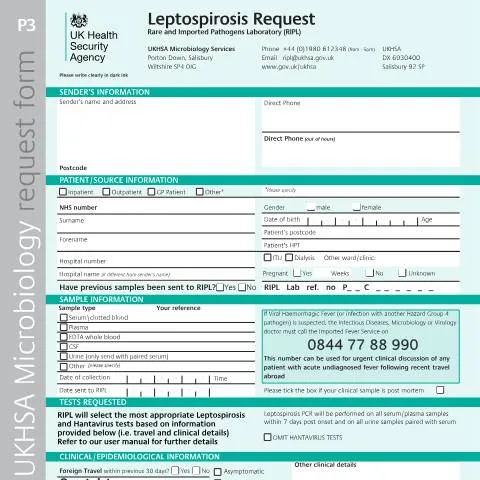
When healthcare professionals in the UK encounter patients presenting with fever, jaundice, or acute kidney dysfunction following potential exposure to contaminated water or animals, they face a diagnostic challenge that extends far beyond routine clinical assessment. The Leptospirosis Request Form from the UK Health Security Agency represents a sophisticated gateway to specialist laboratory services that can definitively identify one of the world's most widespread zoonotic infections.
This comprehensive request form serves as the primary communication channel between frontline clinicians and the Rare and Imported Pathogens Laboratory (RIPL) at Porton Down, facilitating targeted testing for leptospirosis and related conditions. The document's structured approach reflects the complex epidemiological factors that influence both diagnostic strategy and public health response, making it an essential tool in the UK's infectious disease surveillance infrastructure.
The Epidemiological Context Driving Laboratory Referrals
Leptospirosis transmission in the UK follows distinct patterns that directly inform the design of this request form. The infection primarily occurs through contact with water contaminated by infected animal urine, particularly from rats, cattle, and domestic animals. Understanding these transmission routes explains why the form places such emphasis on water contact and animal exposure details.
The disease's clinical presentation can range from mild flu-like symptoms to severe multi-organ failure, creating diagnostic uncertainty that necessitates laboratory confirmation. The form's clinical symptom checklist reflects this spectrum, encompassing early manifestations such as fever and myalgia through to severe complications including hepatic failure and renal replacement therapy requirements.
Occupational and Recreational Risk Factors
Certain occupations carry elevated leptospirosis risk, which the form addresses through its relevant occupational history section. Agricultural workers, veterinarians, sewage workers, and military personnel conducting field exercises face heightened exposure. Similarly, recreational activities including freshwater swimming, canoeing, and fell running in areas with livestock presence contribute significantly to UK case numbers.
The form's travel history requirements reflect the global distribution of different leptospiral serovars. Tropical regions, particularly Southeast Asia, Central America, and the Pacific Islands, harbour serovars rarely encountered in temperate climates. This geographical variation influences both diagnostic testing strategies and public health risk assessment.
Navigating the Specimen Collection and Submission Process
The laboratory's testing strategy depends critically on specimen timing and type, factors that the request form addresses through specific collection guidance. Serum or plasma samples collected within seven days of symptom onset undergo PCR testing, offering rapid pathogen detection during the acute phase when bacterial loads remain detectable.
| Sample Type | Optimal Timing | Testing Method | Clinical Utility |
|---|---|---|---|
| Serum/Plasma | Within 7 days post-onset | PCR + Serology | Acute diagnosis |
| Paired Serum | Acute + Convalescent | Serology | Retrospective confirmation |
| Urine | Days 7-14 post-onset | PCR | Extended detection window |
| CSF | Meningitic presentation | PCR + Culture | CNS involvement |
Urine specimens require paired serum samples for optimal interpretation, reflecting the complex kinetics of leptospiral excretion and antibody development. The form's emphasis on this pairing prevents incomplete diagnostic workups that could miss infection or provide misleading results.
Post-Mortem Sampling Considerations
The form includes specific provisions for post-mortem samples, acknowledging leptospirosis as a cause of sudden death, particularly in cases involving severe pulmonary haemorrhage syndrome. Post-mortem diagnosis requires modified sampling strategies and specialised handling protocols, which RIPL coordinates through direct consultation with pathologists.
Clinical Information Requirements and Diagnostic Strategy
RIPL's testing approach adapts to the clinical and epidemiological information provided, making accurate form completion essential for optimal diagnostic outcomes. The laboratory selects appropriate leptospirosis and hantavirus tests based on the submitted details, reflecting the overlapping clinical presentations of these conditions and the need for differential diagnosis.
The comprehensive symptom checklist enables laboratory scientists to correlate clinical severity with testing urgency and methodology. Patients presenting with hepatic failure, renal replacement therapy requirements, or meningitis receive prioritised processing, while asymptomatic individuals with exposure history may undergo screening protocols.
Antimicrobial Treatment Documentation
Recording antimicrobial therapy proves crucial for test interpretation, as antibiotic treatment can rapidly clear bacteraemia while potentially affecting PCR sensitivity. Early treatment with doxycycline or penicillin may eliminate detectable bacterial DNA within 24-48 hours, necessitating reliance on serological methods for diagnosis.
The form's antimicrobial documentation helps laboratory staff adjust testing strategies and interpret negative PCR results in the context of therapeutic intervention. This information also supports antimicrobial resistance surveillance, though leptospires generally remain susceptible to standard treatments.
Emergency Protocols and Urgent Clinical Consultation
The form prominently features emergency contact protocols for suspected viral haemorrhagic fever or other Hazard Group 4 pathogens, reflecting the overlap between tropical fever presentations. The Imported Fever Service on 0844 77 88 990 provides 24-hour clinical consultation for acute undiagnosed fever following recent travel abroad.
This emergency pathway acknowledges that initial clinical assessment may not definitively distinguish leptospirosis from more dangerous conditions such as Ebola, Marburg virus, or Crimean-Congo haemorrhagic fever. The consultation service enables immediate risk assessment and appropriate containment measures while laboratory testing proceeds.
Hospital Infection Control Implications
While leptospirosis rarely requires special isolation precautions, the differential diagnosis considerations embedded in the form's design ensure appropriate infection control measures. Healthcare workers completing the form must consider the full spectrum of possible diagnoses, particularly when patients present with haemorrhagic manifestations or severe systemic illness.
Laboratory Processing and Result Interpretation Pathways
RIPL's sophisticated testing algorithms reflect decades of experience in tropical medicine and emerging infectious diseases. The laboratory maintains extensive serovar libraries and molecular detection capabilities, enabling identification of both common and rare leptospiral strains encountered in UK practice.
Results interpretation considers the complex immunological response to leptospiral infection, where antibody development may lag behind clinical presentation by several days to weeks. The laboratory provides detailed interpretive comments that correlate serological findings with clinical presentation and exposure history.
Follow-up Sample Requirements
Many cases require sequential sampling to demonstrate seroconversion or rising antibody titres, particularly when initial samples are collected very early in the illness course. The form's reference system enables tracking of related samples and ensures continuity of diagnostic assessment across multiple submissions.
Convalescent samples collected 2-4 weeks after onset provide definitive serological confirmation in cases where acute samples yield inconclusive results. This staged approach reflects the natural history of leptospiral infection and the limitations of single-point testing.
Integration with National Surveillance Systems
Each completed form contributes to the UK's comprehensive infectious disease surveillance infrastructure, supporting both individual patient management and population health monitoring. Data collected through these submissions inform national risk assessments, travel health advice, and occupational health guidelines.
The standardised format enables systematic data extraction for epidemiological analysis, tracking seasonal patterns, geographical clusters, and emerging risk factors. This surveillance function proves particularly valuable for monitoring climate change impacts on vector-borne and water-related diseases.
International Reporting Obligations
Confirmed leptospirosis cases contribute to international surveillance networks, including World Health Organization reporting systems and European Centre for Disease Prevention and Control databases. The form's structured data collection supports these reporting requirements while maintaining patient confidentiality through appropriate anonymisation procedures.
Quality Assurance and Continuous Improvement Mechanisms
RIPL maintains rigorous quality assurance programs that extend to the request form system, ensuring diagnostic accuracy and appropriate clinical correlation. Regular audits of form completion quality identify common deficiencies and inform targeted education initiatives for healthcare providers.
The laboratory's user manual, referenced in the form instructions, provides detailed guidance on optimal sample collection, storage, and transport conditions. This resource undergoes regular updates based on evolving diagnostic technologies and changing epidemiological patterns.
Version control mechanisms, evidenced by the form's SPATHW0196.06 Version effective from Jan - 2024 designation, ensure healthcare providers utilise current documentation that reflects the latest diagnostic capabilities and reporting requirements. This systematic approach to document management supports consistent high-quality diagnostic services across the UK's diverse healthcare landscape.
Laboratory Testing Requirements and Sample Collection Protocols
Proper laboratory confirmation of leptospirosis requires adherence to specific sample collection and handling protocols established by the UK Health Security Agency. Healthcare professionals must understand these requirements to ensure accurate diagnosis and appropriate public health response.
The primary diagnostic approach involves serological testing through the microscopic agglutination test (MAT), considered the gold standard for leptospirosis diagnosis. Blood samples for serology should be collected during the acute phase (within the first week of illness) and again during convalescence (2-4 weeks later) to demonstrate rising antibody titres. A four-fold increase in titre between paired sera indicates recent infection.
For culture attempts, blood samples must be collected within the first 7-10 days of illness, preferably before antibiotic treatment begins. The organisms are notoriously difficult to culture, requiring specialised media such as Ellinghausen-McCullough-Johnson-Harris (EMJH) medium. Samples should be collected in sterile tubes containing sodium heparin as anticoagulant, avoiding EDTA which can inhibit bacterial growth.
Urine samples become increasingly important after the first week of illness when organisms may no longer be detectable in blood but can be shed in urine for several weeks. Fresh urine samples should be collected in sterile containers and processed within 2 hours, or alkalinised to pH 7.2-7.4 if delay is unavoidable. The intermittent nature of urinary shedding means multiple samples may be required.
Cerebrospinal fluid should be collected when meningeal involvement is suspected, particularly in cases presenting with severe headache, neck stiffness, or altered mental state. The fluid typically shows elevated white cell count (predominantly lymphocytes), raised protein levels, and normal or slightly reduced glucose levels.
Molecular diagnostic methods, including polymerase chain reaction (PCR), offer rapid results and high specificity. Real-time PCR can detect leptospiral DNA in blood, urine, or CSF samples. These tests are particularly valuable during the acute phase when organisms are present but antibodies may not yet be detectable. However, PCR availability may be limited to reference laboratories, potentially causing delays in results.
Sample transport requires careful attention to biosafety protocols. All specimens should be packaged according to UN3373 biological substance category B requirements, with appropriate labelling indicating suspected leptospirosis. Transport to the laboratory should occur at 4°C for samples intended for culture, whilst frozen samples (-20°C or below) are acceptable for PCR testing.
The UK Health Security Agency's Rare and Imported Pathogens Laboratory (RIPL) at Porton Down serves as the national reference laboratory for leptospirosis testing. Local laboratories may perform initial screening tests, but confirmation often requires referral to RIPL, particularly for serovar identification and antimicrobial susceptibility testing.
Occupational Health Considerations and Workplace Risk Assessment
Leptospirosis represents a significant occupational health concern across multiple industry sectors in the UK, necessitating comprehensive workplace risk assessments and targeted prevention strategies. Employers have legal obligations under the Health and Safety at Work etc. Act 1974 and the Control of Substances Hazardous to Health Regulations 2002 (COSHH) to protect workers from biological hazards including leptospirosis.
High-risk occupations include agricultural workers, veterinarians, abattoir workers, sewerage workers, water sports instructors, military personnel, and laboratory staff handling potentially infected materials. The Health and Safety Executive (HSE) provides specific guidance for each of these sectors, outlining risk assessment procedures and control measures.
Pre-employment health screening should identify individuals at potentially increased risk, such as those with immunocompromising conditions or chronic kidney disease. However, such conditions do not automatically preclude employment but may require additional protective measures and enhanced health surveillance.
Personal protective equipment (PPE) requirements vary according to exposure risk levels. Waterproof clothing, gloves, and protective footwear form the basic protection for most at-risk workers. In high-risk environments such as sewerage work or veterinary procedures, additional protection including eye protection, respiratory protection, and full-body suits may be necessary.
Workplace hygiene facilities must include adequate handwashing stations, shower facilities where appropriate, and facilities for cleaning and storing PPE. Contaminated clothing should not be taken home for washing, and employers must provide appropriate laundering services or disposable alternatives.
Health surveillance programmes should be established for workers in high-risk roles, including baseline health assessments and periodic review. Workers should receive training on recognising early symptoms of leptospirosis and the importance of seeking prompt medical attention. This training should emphasise that flu-like symptoms following potential exposure require immediate medical evaluation.
Incident reporting procedures must capture potential exposure events, enabling rapid risk assessment and appropriate post-exposure management. The HSE's RIDDOR (Reporting of Injuries, Diseases and Dangerous Occurrences Regulations 2013) requirements apply to confirmed occupational leptospirosis cases, mandating notification within specified timeframes.
Prophylactic antibiotic treatment may be considered for workers following high-risk exposures, particularly those involving direct contact with infected animal tissues or heavily contaminated water. However, such decisions require individual risk assessment considering factors such as the extent and nature of exposure, the worker's immune status, and local epidemiological factors.
Employers should maintain detailed exposure records, enabling retrospective analysis of incidents and continuous improvement of control measures. These records prove valuable for investigating suspected occupational cases and may be required for compensation claims or regulatory investigations.
Environmental Surveillance and One Health Approaches
Leptospirosis surveillance extends beyond human cases to encompass animal populations and environmental reservoirs, reflecting the complex ecology of this zoonotic disease. The UK's surveillance framework integrates human, animal, and environmental health sectors through collaborative One Health approaches coordinated by multiple agencies.
The Animal and Plant Health Agency (APHA) conducts surveillance in livestock populations, particularly cattle, pigs, and sheep. Routine serological surveys help identify circulating serovars and assess herd-level prevalence. Abortion storms in cattle herds often trigger intensive investigation for leptospirosis, given the significant economic impact on livestock productivity.
Wildlife surveillance programmes monitor leptospirosis in key reservoir species, particularly rodents. The UK Health Security Agency collaborates with wildlife organisations and research institutions to sample rodent populations in areas of human activity. Brown rats (Rattus norvegicus) serve as the primary reservoir for L. interrogans serovar Icterohaemorrhagiae, whilst field voles and other small mammals may harbour different serovars.
Environmental surveillance focuses on water bodies and soil in areas associated with human cases or high-risk activities. Molecular detection methods can identify leptospiral DNA in environmental samples, though viability assessment remains challenging. Factors such as water temperature, pH, salinity, and organic content influence organism survival in aquatic environments.
Climate change considerations increasingly influence surveillance strategies, as changing precipitation patterns, flooding events, and temperature variations affect both pathogen survival and human exposure risks. The UK's climate projections suggest increased winter rainfall and more frequent extreme weather events, potentially altering leptospirosis epidemiology.
Veterinary diagnostic laboratories contribute valuable surveillance data through routine diagnostic testing. The Veterinary Medicines Directorate's adverse event reporting system may capture leptospirosis cases in domestic animals, providing additional insights into circulating strains and geographical distribution patterns.
International surveillance coordination occurs through European Centre for Disease Prevention and Control (ECDC) networks and World Health Organization collaborating centres. These partnerships facilitate information sharing about emerging serovars, antimicrobial resistance patterns, and cross-border transmission events.
Genomic surveillance increasingly complements traditional epidemiological approaches, enabling detailed strain characterisation and transmission pathway analysis. Whole genome sequencing can identify outbreak sources, track transmission chains, and detect the emergence of new variants with altered virulence or antimicrobial susceptibility profiles.
Public health interventions informed by surveillance data include targeted risk communication campaigns, enhanced surveillance in high-risk areas, and recommendations for environmental control measures. Local authorities may implement rodent control programmes in areas with identified environmental contamination or recurrent human cases.
Research priorities identified through surveillance activities include understanding the role of domestic animals as potential transmission sources, assessing the impact of urbanisation on wildlife reservoir populations, and evaluating the effectiveness of environmental control interventions. Long-term surveillance datasets enable trend analysis and support evidence-based policy development for zoonotic disease prevention strategies.