When Clinical Suspicion Meets Laboratory Precision: The RIPL Lyme Disease Testing Gateway
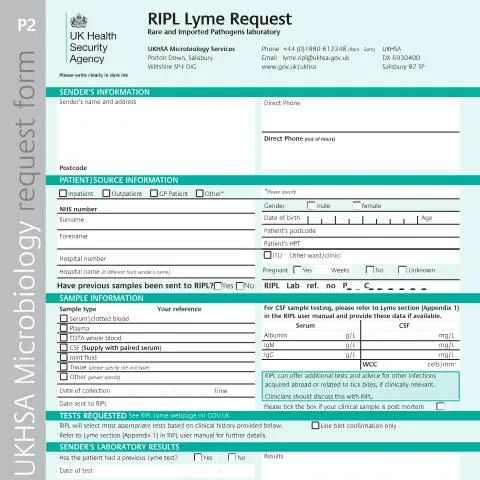
In the complex landscape of tick-borne disease diagnosis, the RIPL Lyme Request form serves as the critical bridge between clinical suspicion and laboratory confirmation. Managed by the UK Health Security Agency's Rare and Imported Pathogens Laboratory (RIPL) in Salisbury, this specialised testing pathway addresses one of the most diagnostically challenging infections in contemporary British medicine. Unlike routine blood tests ordered through standard NHS pathology services, Lyme disease testing requires this dedicated referral system due to the sophisticated testing methodologies and specialist interpretation needed for accurate diagnosis.
The form represents more than administrative procedure—it embodies a clinical decision point where healthcare professionals must weigh complex symptomatology against epidemiological risk factors. RIPL's position as the national reference laboratory means this single document potentially determines diagnostic outcomes for patients across England, Wales, Scotland and Northern Ireland, making its proper completion essential for both individual patient care and national surveillance of tick-borne diseases.
The Clinical Ecosystem: Who Initiates RIPL Testing Requests
The referral pathway to RIPL reflects the multi-tiered nature of Lyme disease presentation in UK healthcare. General practitioners form the primary referring cohort, particularly those practising in endemic areas such as the Scottish Highlands, New Forest, South Downs, and parts of Wales where Ixodes ricinus tick populations are established. However, the clinical presentation of Lyme disease—ranging from the pathognomonic erythema migrans rash to complex neurological manifestations—means referrals originate from diverse specialties.
Emergency department physicians frequently encounter acute presentations, particularly during peak tick season (May through October), when patients present with flu-like symptoms following outdoor activities. The form's detailed epidemiological sections prove crucial here, as emergency clinicians must rapidly assess exposure history against symptom onset patterns.
Specialist referrals represent another significant pathway. Rheumatologists investigating arthritis of unclear aetiology, neurologists evaluating facial palsy or radiculopathy, and dermatologists assessing unusual skin manifestations all utilise this testing route. The form's comprehensive clinical information sections accommodate these varied specialist perspectives, allowing each discipline to contribute relevant diagnostic elements.
Occupational health services present a distinct referral category. Forestry workers, gamekeepers, outdoor education instructors, and military personnel undergo both diagnostic and surveillance testing through this pathway. For these populations, the form captures not just current symptoms but ongoing exposure patterns essential for both individual diagnosis and occupational health monitoring.
Decoding the Sample Matrix: Laboratory Specifications and Clinical Correlations
The sample information section reveals RIPL's sophisticated diagnostic approach, extending far beyond standard serological testing. Serum samples remain the cornerstone for antibody detection, but the form's provision for multiple sample types reflects Lyme disease's protean clinical manifestations and the need for targeted diagnostic approaches.
Cerebrospinal fluid (CSF) testing becomes critical when neuroborreliosis is suspected. The form's specific CSF parameters—including albumin, IgM, and IgG levels alongside white cell counts—enable RIPL to assess both local antibody production and blood-brain barrier integrity. This dual approach proves essential for distinguishing genuine CNS infection from systemic disease with neurological symptoms.
| Sample Type | Primary Indication | Specific Testing Capability |
|---|---|---|
| Serum/Clotted Blood | Standard serological screening | Two-tier testing protocol (ELISA + immunoblot) |
| CSF (with paired serum) | Suspected neuroborreliosis | Intrathecal antibody synthesis calculation |
| Joint Fluid | Lyme arthritis investigation | Direct pathogen detection and serology |
| Tissue Biopsy | Acrodermatitis chronica atrophicans | Histopathological correlation with PCR |
The form's emphasis on paired samples for CSF testing reflects established diagnostic protocols. RIPL calculates the CSF/serum antibody index, a sophisticated measurement that distinguishes local CNS antibody production from passive transfer across a damaged blood-brain barrier. This calculation requires simultaneous processing of both samples, making the paired submission requirement non-negotiable for accurate neuroborreliosis diagnosis.
Joint fluid analysis represents another specialised testing domain. Lyme arthritis—particularly affecting large joints like the knee—may require synovial fluid examination when serology proves inconclusive. The form accommodates this through its flexible sample type selection, recognising that late-stage Lyme disease may present diagnostic challenges requiring multiple specimen types.
Epidemiological Intelligence: Capturing Exposure and Risk Factors
The clinical and epidemiological information section transforms this form from simple test requisition into a comprehensive exposure assessment tool. Tick bite history receives prominent positioning, but RIPL's approach recognises that many patients never recall specific tick attachment. The form therefore captures broader exposure patterns through occupational and recreational history sections.
Geographic exposure data proves particularly valuable for RIPL's surveillance functions. The laboratory maintains detailed records of case distribution, contributing to national understanding of Lyme disease epidemiology. When patients report exposure in novel geographic areas, this information may trigger enhanced surveillance or investigation of emerging endemic foci.
Travel history sections acknowledge the international dimension of tick-borne diseases. Patients may have acquired infections during European travel, where different Borrelia species predominate, potentially affecting both clinical presentation and diagnostic test performance. RIPL's expertise in imported pathogens makes this travel history particularly relevant for diagnostic interpretation.
The form's treatment history section serves dual purposes. Previous antibiotic therapy—whether specifically for suspected Lyme disease or for unrelated conditions—may significantly impact serological test results. Patients who received early treatment may never develop detectable antibody responses, creating diagnostic challenges that RIPL must navigate through careful clinical correlation.
Symptom Constellation Mapping: Clinical Features and Their Diagnostic Significance
RIPL's clinical features checklist reflects the protean nature of Lyme disease manifestations, accommodating presentations ranging from classic early disease through complex late-stage syndromes. Erythema migrans receives specific attention as the pathognomonic early sign, though the form acknowledges that many patients never develop or notice this characteristic rash.
Neurological symptoms occupy substantial form space, reflecting both the severity of neuroborreliosis and its diagnostic complexity. Facial palsy—particularly bilateral presentation—raises strong suspicion for Lyme disease, especially during tick season. The form captures this alongside broader neurological presentations including radiculopathy, meningitis symptoms, and cognitive dysfunction.
Cardiac manifestations, while less common in UK practice than in North American Lyme disease, receive appropriate recognition. Lyme carditis may present as conduction abnormalities or myocarditis, potentially requiring urgent intervention. The form's systematic symptom capture ensures these less common presentations receive appropriate diagnostic consideration.
The musculoskeletal symptom section addresses one of Lyme disease's most challenging diagnostic areas. Arthralgia and myalgia occur commonly in many conditions, but the form's systematic approach helps identify patterns suggestive of Lyme disease. Large joint arthritis, particularly affecting the knee, combined with appropriate exposure history, creates a clinical picture warranting specialized testing.
Laboratory Communication Protocols: From Submission to Results
RIPL's testing methodology extends beyond routine laboratory practice, incorporating both standard serological approaches and specialized techniques unavailable through conventional NHS pathology services. The two-tier testing protocol—combining sensitive ELISA screening with specific immunoblot confirmation—represents the diagnostic gold standard, but RIPL's expertise enables additional testing when clinical circumstances warrant.
The laboratory's capacity for molecular diagnostics proves particularly valuable for early disease detection when antibody responses may not yet have developed. PCR testing of skin biopsies, CSF, or joint fluid can provide definitive pathogen identification, though sample quality and timing significantly impact test sensitivity.
Results interpretation requires clinical correlation, making the form's comprehensive clinical information essential for accurate reporting. RIPL provides not just positive or negative results but detailed interpretative comments considering the clinical context, exposure history, and symptom timeline. This approach recognises that Lyme disease serology requires expert interpretation rather than simple algorithmic reporting.
The laboratory's surveillance function means anonymized data from submitted forms contributes to national epidemiological monitoring. Geographic distribution patterns, seasonal variation, and demographic trends all emerge from this systematic data collection, informing public health policy and clinical guidelines.
Quality Assurance and Submission Logistics
Proper sample handling proves critical for accurate Lyme disease testing, making the form's technical specifications essential reading for submitting clinicians. Serum samples require standard clotted blood collection, but timing considerations may impact result interpretation. Acute phase samples collected within the first few weeks of symptom onset may show negative serology despite active infection.
The form's emphasis on clinical sample timing reflects this diagnostic reality. Post-mortem tick boxes acknowledge that some patients may have received empirical antibiotic treatment, potentially affecting subsequent test results. RIPL's expertise in interpreting results within these clinical contexts makes detailed treatment history essential.
Transportation requirements follow standard pathology protocols, but the specialist nature of RIPL testing means samples may experience longer transit times than routine NHS laboratory specimens. The form's reference number system enables tracking and ensures appropriate linking of clinical information with laboratory samples.
Version control notation on the form reflects RIPL's commitment to maintaining current diagnostic standards. Regular updates incorporate evolving understanding of Lyme disease epidemiology and diagnostic methodology, ensuring the form captures information relevant to contemporary testing approaches.
Beyond Individual Diagnosis: Public Health and Surveillance Implications
Each RIPL Lyme request contributes to broader public health understanding of tick-borne diseases in the UK. The laboratory's unique position as the national reference facility means aggregated data from these forms provides epidemiological intelligence unavailable through other surveillance mechanisms. Geographic clustering of cases may identify emerging endemic areas, while temporal patterns inform seasonal risk assessments.
The form's detailed exposure history sections enable identification of high-risk activities and locations. This information proves valuable for developing targeted prevention strategies, whether for occupational groups, recreational users of high-risk environments, or residents of endemic areas. RIPL's surveillance data contributes to national guidance on tick bite prevention and awareness campaigns.
Veterinary implications emerge indirectly through the surveillance function. Areas showing increased human Lyme disease incidence often correlate with wildlife and domestic animal infection patterns, creating opportunities for integrated One Health approaches to tick-borne disease management.
The laboratory's expertise in imported pathogens means travel-associated cases receive particular attention. Novel geographic exposures may indicate emerging risk areas or changing tick distribution patterns, potentially requiring enhanced surveillance or travel health guidance updates. This international perspective proves increasingly important as climate change potentially expands tick habitats and travel patterns continue evolving.
Research applications represent another dimension of the form's utility. Anonymized clinical and epidemiological data supports ongoing research into Lyme disease pathogenesis, diagnostic methodology, and treatment outcomes. RIPL's comprehensive database enables studies impossible through conventional clinical practice, contributing to evidence-based improvements in patient care and public health policy.
Understanding Different Types of Lyme Disease Testing Available
The NHS employs a two-tier testing approach for Lyme disease diagnosis, which influences how you complete your test request form. The initial screening uses an enzyme-linked immunosorbent assay (ELISA) to detect antibodies against Borrelia burgdorferi, the bacterium causing Lyme disease. If this proves positive or equivocal, a confirmatory Western blot test follows.
When completing your form, specify if you're requesting testing for early localised disease (within 30 days of tick bite) versus disseminated infection. Early disease often produces negative serology results, as antibodies haven't yet developed sufficiently. Your GP may indicate "clinical Lyme disease suspected despite negative serology" in cases where erythema migrans (the characteristic bull's-eye rash) presents clearly.
Private laboratories offer additional testing methods not routinely available through the NHS, including polymerase chain reaction (PCR) tests and lymphocyte transformation tests (LTT). However, these aren't standardised across UK healthcare and may require specific justification on your request form. The UK Health Security Agency doesn't currently recommend these alternative methods for routine diagnosis.
Cerebrospinal fluid testing becomes relevant for suspected neuroborreliosis. This requires a separate lumbar puncture procedure and distinct laboratory request forms, typically initiated by neurologists or infectious disease specialists. The form must specify intrathecal antibody production testing alongside standard serum samples.
Joint fluid analysis may be requested for suspected Lyme arthritis, particularly affecting large joints like knees. This synovial fluid testing requires coordination between rheumatologists and laboratory services, with specific handling requirements noted on the request documentation.
Regional Variations and Specialist Referral Pathways
Lyme disease prevalence varies significantly across UK regions, affecting both testing protocols and referral patterns. Scotland reports higher incidence rates, particularly in Highland areas, leading to more streamlined testing pathways. Scottish health boards often maintain dedicated Lyme disease protocols, with some allowing direct GP referral to infectious disease units without preliminary hospital assessment.
The New Forest area in Hampshire, Exmoor, and parts of the South Downs represent England's highest-risk zones. Local Clinical Commissioning Groups in these areas may have established fast-track referral systems. When completing forms for patients from these regions, indicate the specific location of potential tick exposure, as this influences laboratory interpretation and clinical decision-making.
Wales has developed particular expertise through Public Health Wales, with centralised testing at the University Hospital of Wales in Cardiff. Welsh patients may find their samples automatically routed to this facility regardless of initial testing location, requiring specific patient identifiers on request forms.
Northern Ireland operates somewhat independently, with testing coordinated through the Public Health Agency. Cross-border patients (those living near the Republic of Ireland boundary) may need additional documentation confirming UK residency status for NHS-funded testing.
Specialist centres like the Hospital for Tropical Diseases in London or regional infectious disease units maintain particular expertise in complex Lyme cases. Referral to these centres typically requires detailed clinical justification on the initial request form, including previous treatment history and current symptom presentation. Some centres operate specific Lyme disease clinics with dedicated request procedures and extended consultation times.
Military personnel and their families may access testing through Defence Medical Services, which maintains separate protocols aligned with but distinct from civilian NHS pathways. Service medical centres use modified request forms incorporating occupational exposure risk assessment, particularly relevant for personnel training in high-risk woodland areas.
Legal and Insurance Implications of Test Results
Lyme disease testing results carry significant implications beyond immediate medical care, particularly regarding insurance claims and legal proceedings. Travel insurance policies increasingly scrutinise pre-existing conditions, and documented Lyme disease may affect coverage for future trips to endemic areas. When requesting tests, consider whether results will be shared with insurance providers, as this requires explicit patient consent under UK GDPR provisions.
Occupational health assessments may mandate Lyme disease screening for employees working in forestry, outdoor education, or conservation roles. These employer-requested tests require specific occupational health forms rather than standard NHS request documentation. The Health and Safety Executive provides guidance on workplace tick exposure, but testing protocols remain employer-specific.
Legal cases involving tick-borne disease transmission increasingly rely on documented medical evidence. Property owners, local councils, or activity providers facing liability claims require comprehensive medical records including initial test requests, results, and treatment responses. Ensure test request forms capture precise exposure locations and timeframes, as these details become crucial in legal proceedings.
Chronic Lyme disease remains controversial within UK medical practice, with some patients pursuing private treatment abroad. These international treatment episodes may require UK test results for continuity of care. Private healthcare providers often request specific test formats or additional serology panels not routinely performed by NHS laboratories.
Disability benefit assessments through the Department for Work and Pensions may consider Lyme disease as a qualifying condition, particularly when neurological complications persist. Test documentation forms part of the medical evidence supporting Personal Independence Payment or Employment and Support Allowance claims. Ensure comprehensive symptom documentation accompanies test requests to support potential future benefit applications.
Medical negligence claims occasionally arise from delayed Lyme disease diagnosis. Early test requests demonstrating appropriate clinical suspicion can protect healthcare providers from criticism, while delayed or inadequate testing may support patient compensation claims. Detailed clinical reasoning on request forms provides valuable medicolegal protection.