Understanding UKHSA's Enteric Virus and Polio Investigation Framework
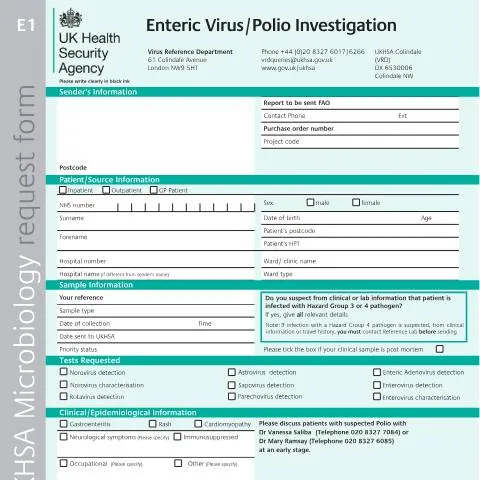
When healthcare professionals encounter patients presenting with symptoms suggestive of enteric viruses or poliomyelitis, the UK Health Security Agency's Enteric Virus and Polio Investigation referral form (E1) serves as the critical gateway for specialist laboratory analysis and public health surveillance. This comprehensive diagnostic tool, managed by UKHSA's Virus Reference Department at Colindale, enables clinicians to access advanced virological testing that extends far beyond routine hospital laboratory capabilities.
The form's significance becomes particularly apparent in cases involving acute flaccid paralysis, where rapid differential diagnosis between poliovirus and other enteroviruses can determine both individual patient management and broader public health responses. With the UK maintaining polio-free status since 1984, any suspected case triggers enhanced surveillance protocols that this referral system facilitates.
Clinical Scenarios Requiring UKHSA Virological Investigation
The E1 form addresses multiple clinical presentations that demand specialist virological expertise. Healthcare providers typically complete this referral when encountering patients with gastroenteritis of unknown aetiology, particularly in outbreak situations or when routine testing fails to identify causative agents. The form's comprehensive testing menu includes norovirus detection and characterisation, rotavirus identification, and screening for less common pathogens like astrovirus and sapovirus.
Neurological presentations warrant particular attention. The form specifically accommodates cases of acute flaccid paralysis, though these require immediate telephone discussion with Dr Vanessa Saliba (020 8327 7084) or Dr Mary Ramsay (020 8327 6085) before sample submission. This direct communication pathway ensures that potential polio cases receive immediate expert oversight and appropriate public health response coordination.
Immunocompromised patients represent another critical category. These individuals may develop prolonged viral shedding or atypical presentations that require enhanced diagnostic approaches. The form's dedicated tick box for immunosuppressed status alerts laboratory staff to potential complications and the need for extended culture periods or specialised testing protocols.
Travel-Related Investigations
The form's travel history section reflects the global nature of viral transmission patterns. Patients returning from regions with ongoing poliovirus circulation or areas experiencing norovirus outbreaks may require expedited testing. The three-month lookback period captures the relevant incubation and exposure windows for most enteric viruses, while specific questions about oral polio vaccine (OPV) exposure acknowledge vaccine-derived poliovirus risks.
Laboratory Testing Capabilities and Selection Criteria
UKHSA's Virus Reference Department offers a comprehensive array of diagnostic tests that healthcare providers can select based on clinical presentation and epidemiological factors. The testing menu encompasses both detection and characterisation services, with the latter providing crucial information for outbreak investigation and public health management.
| Virus Category | Detection Available | Characterisation Available | Clinical Relevance |
|---|---|---|---|
| Norovirus | Yes | Yes | Outbreak investigation, seasonal surveillance |
| Enterovirus | Yes | Yes | AFP cases, neurological symptoms |
| Rotavirus | Yes | No | Paediatric gastroenteritis, vaccine effectiveness |
| Parechovirus | Yes | No | Neonatal sepsis-like syndrome |
| Astrovirus | Yes | No | Persistent diarrhoea in immunocompromised |
| Sapovirus | Yes | No | Gastroenteritis outbreaks |
Enterovirus characterisation proves particularly valuable in differentiating between vaccine-derived and wild-type polioviruses, while norovirus characterisation enables genotyping essential for understanding transmission chains during outbreaks. Healthcare providers should consider requesting characterisation services when dealing with unusual presentations, suspected outbreaks, or cases with significant public health implications.
Parechovirus Testing Considerations
The inclusion of parechovirus detection reflects growing recognition of this pathogen's role in severe neonatal infections. Unlike other enteric viruses, parechovirus can cause sepsis-like presentations in infants under three months, making early detection crucial for appropriate clinical management and infection control measures.
Sample Collection and Handling Protocols
Successful virological investigation depends critically on appropriate sample collection and timely transport to UKHSA laboratories. The form accommodates various sample types, with faecal specimens representing the gold standard for enteric virus detection. Optimal collection occurs within 48 hours of symptom onset when viral shedding peaks, though detection remains possible for several days in most cases.
For suspected polio cases, multiple sample types may be required. The form's sample information section allows documentation of cerebrospinal fluid, throat swabs, and serial faecal specimens, each providing different diagnostic windows and sensitivity profiles. Post-mortem samples require specific handling protocols, with the dedicated tick box ensuring appropriate laboratory safety measures.
Transport arrangements to UKHSA Colindale follow standard pathological specimen protocols, with samples typically reaching the laboratory within 24-48 hours of collection. The form's priority status section enables healthcare providers to flag urgent cases requiring expedited processing, though this should be reserved for genuine public health emergencies or critically ill patients.
Cold Chain Maintenance
Viral specimens require consistent refrigeration during transport, with temperatures maintained between 2-8°C. Extended delays or temperature excursions can significantly reduce viral recovery rates, particularly for more labile viruses like norovirus. Healthcare providers should coordinate with local pathology services to ensure appropriate transport conditions and minimal delays.
Completing Patient Demographics and Clinical Information
The form's patient information section requires careful attention to detail, as accurate demographics enable effective public health follow-up and contact tracing when necessary. The NHS number serves as the primary identifier, though patients without NHS registration can still access testing through alternative identification methods.
Ward type designation proves particularly important for infection control purposes. Patients in high-risk areas such as neonatal intensive care units or transplant wards may require enhanced surveillance and contact tracing if viral infections are confirmed. The form's hospital number field facilitates communication between UKHSA and referring institutions regarding results and recommendations.
Clinical presentation details significantly influence laboratory testing approaches and result interpretation. Healthcare providers should provide comprehensive symptom descriptions, including onset dates, severity, and associated complications. The three-month exposure history section requires particular attention, as international travel or vaccine exposure can dramatically alter diagnostic considerations and public health risk assessments.
Immunisation History Documentation
The form's detailed vaccination history section reflects the critical importance of polio immunisation status in result interpretation. Inactivated polio vaccine (IPV) recipients cannot develop vaccine-associated paralytic polio, while oral polio vaccine (OPV) exposure creates potential for vaccine-derived virus circulation. Accurate documentation of vaccination dates and types enables appropriate risk stratification and public health response planning.
Hazard Group Classification and Safety Protocols
UKHSA's laboratory safety framework requires careful assessment of potential Hazard Group 3 or 4 pathogens before sample processing. While most enteric viruses fall into lower hazard categories, certain circumstances may elevate risk assessments. Patients with recent travel to areas experiencing viral haemorrhagic fever outbreaks or those presenting with unusual symptom complexes may require enhanced safety protocols.
The form's mandatory hazard assessment section ensures that laboratory staff receive adequate warning about potential high-risk specimens. Healthcare providers must contact the Reference Laboratory directly before sending samples if Hazard Group 4 pathogen infection is suspected based on clinical presentation or travel history. This precautionary approach protects laboratory personnel while ensuring appropriate diagnostic capabilities remain available.
Post-mortem specimens require particular consideration due to potential increased pathogen concentrations and unknown infection status. The dedicated tick box alerts laboratory staff to implement enhanced safety measures and consider extended culture periods that may be necessary for optimal pathogen recovery from deceased patients.
Administrative Processing and Result Dissemination
Once samples arrive at UKHSA Colindale, administrative processing begins with verification of form completion and sample integrity. Incomplete forms or inadequate clinical information may result in processing delays or requests for additional information from submitting healthcare providers. The form's contact details section ensures efficient communication channels remain open throughout the testing process.
Purchase order numbers and project codes enable healthcare institutions to track testing costs and allocate expenses appropriately. While UKHSA provides many diagnostic services without direct charges to NHS providers, certain specialised tests or research-related investigations may incur costs that require proper financial documentation.
Results typically reach healthcare providers within 3-5 working days for routine testing, though urgent cases may receive preliminary results within 24 hours. The form's "Report to be sent FAO" field ensures results reach the appropriate clinical team member, facilitating timely patient management and infection control decisions.
Follow-up Communication Protocols
Positive results for notifiable diseases trigger automatic communication with local Health Protection Teams, while unusual findings may prompt direct telephone contact with submitting clinicians. Healthcare providers should ensure contact details remain current and accessible, as UKHSA may require additional clinical information or recommend specific public health actions based on laboratory findings.
Integration with National Surveillance Systems
The E1 form serves as a crucial data collection point for national viral surveillance programmes that monitor disease trends, outbreak patterns, and vaccine effectiveness. Anonymous patient data contributes to epidemiological analyses that inform public health policy and emergency preparedness planning.
Enterovirus surveillance particularly benefits from this systematic data collection, as the information helps maintain the UK's polio-free certification and enables early detection of unusual viral circulation patterns. The form's travel history and vaccination status fields provide essential context for interpreting positive results and assessing transmission risks.
Norovirus surveillance utilises characterisation data to track emerging strains and predict seasonal outbreak patterns. This information supports infection control guidance for healthcare facilities and helps coordinate public health responses during periods of increased viral activity. Healthcare providers completing E1 forms contribute directly to these national surveillance efforts while accessing specialist diagnostic services for their patients.
Laboratory Testing Protocols and Sample Requirements
The investigation of enteric viruses and polio requires specific laboratory protocols that must be followed precisely to ensure accurate diagnosis and effective public health response. Healthcare providers submitting samples alongside the referral form must understand the stringent requirements for specimen collection, storage, and transport.
For suspected polio cases, the gold standard remains virus isolation from stool specimens, which should be collected as early as possible in the illness, preferably within 14 days of paralysis onset. Two stool specimens should be collected at least 24 hours apart and within 14 days of each other. Each specimen should be at least 8-10 grams in weight (approximately 2 teaspoons) and collected in sterile, leak-proof containers without preservatives or transport medium.
Enteric virus investigations typically require faecal samples for norovirus, rotavirus, adenovirus, and other gastroenteritis-causing pathogens. The UK Health Security Agency specifies that samples should be collected during the acute phase of illness, ideally within 48-72 hours of symptom onset for optimal viral detection rates. Fresh samples yield the highest diagnostic accuracy, though refrigerated specimens (2-8°C) remain viable for up to 48 hours.
Temperature control throughout the sample journey proves critical. Specimens should be transported to the laboratory within 24 hours of collection, maintained at refrigeration temperature using cold packs or refrigerated transport. Freezing should be avoided unless specifically requested by the receiving laboratory, as freeze-thaw cycles can damage viral particles and reduce detection sensitivity.
Regional Public Health England laboratories maintain different processing schedules and capabilities. The referral form must specify the urgency level – routine processing typically takes 3-5 working days, whilst urgent cases (suspected outbreaks, severe illness, or public health concerns) can be fast-tracked for same-day or next-day results. Priority testing requires prior telephone contact with the receiving laboratory to ensure appropriate resource allocation.
Quality assurance measures include proper patient identification on both the referral form and specimen containers. Discrepancies between patient details on the form and sample labels can result in processing delays or sample rejection. The requesting clinician's details must include GMC number, contact telephone number, and clear indication of the clinical urgency to facilitate result communication and follow-up queries.
Multi-Agency Coordination and Outbreak Response Protocols
Enteric virus and polio investigations often trigger complex multi-agency responses involving local authority environmental health teams, NHS foundation trusts, care home providers, educational institutions, and food business operators. The referral form serves as the initial trigger for this coordinated response, making accurate completion essential for effective public health action.
Local Health Protection Teams coordinate the immediate response to suspected viral gastroenteritis outbreaks in institutional settings. When the referral form indicates potential person-to-person transmission (multiple linked cases in care homes, schools, or healthcare facilities), rapid response protocols activate within hours. Environmental health officers may implement immediate control measures including visitor restrictions, enhanced cleaning protocols, and staff health monitoring whilst laboratory confirmation is pending.
Food-borne outbreak investigations require particularly detailed information on the referral form regarding recent food consumption, dining locations, and meal preparation details. The Food Standards Agency may become involved if commercial food premises are implicated, potentially leading to formal investigations under food safety legislation. Accurate timeline information on the referral form enables epidemiologists to calculate incubation periods and identify the most likely exposure sources.
Cross-border coordination becomes necessary when cases involve multiple local authority areas or international travel. The referral form's travel history section enables appropriate notification to European Centre for Disease Prevention and Control (ECDC) systems for cases with international implications. Recent travel to polio-endemic countries triggers enhanced surveillance protocols and may require coordination with the World Health Organization's Global Polio Eradication Initiative.
Care home outbreaks require specific management protocols outlined in the Health and Social Care Act 2008 regulations. The referral form information enables Care Quality Commission notification where required, particularly for serious incidents involving multiple residents or deaths potentially linked to infectious disease. Provider organisations must maintain detailed records of outbreak management, with the initial referral form serving as crucial baseline documentation.
Educational settings follow Department for Education guidance on infectious disease management, with the referral form triggering school health team involvement. Exclusion periods, enhanced hygiene measures, and parent communication strategies all depend on accurate initial assessment captured in the referral documentation. Higher education institutions may require coordination with student health services and accommodation providers for outbreak control in residential settings.
Legal Framework and Regulatory Compliance Requirements
The legal foundations governing enteric virus and polio investigation referrals stem from multiple pieces of UK legislation, creating complex compliance requirements for healthcare providers, laboratories, and public health authorities. Understanding these legal obligations ensures proper form completion and appropriate follow-up actions.
The Health Protection (Notification) Regulations 2010 establish statutory notification requirements for suspected polio cases, making the referral form part of a legal reporting chain. Clinical suspicion of acute flaccid paralysis in children under 15 years, or any paralytic illness where polio cannot be excluded, triggers mandatory notification to the UK Health Security Agency within 24 hours. Failure to comply with notification requirements can result in prosecution under public health legislation.
Data protection compliance under UK GDPR and the Data Protection Act 2018 governs personal information sharing in public health investigations. The referral form collects sensitive health data, requiring lawful basis for processing under public health provisions. Healthcare providers must ensure patients understand how their information will be used in outbreak investigations, though explicit consent is not required when processing serves public health purposes under legal obligation or vital interests grounds.
Information sharing between agencies follows established protocols under the Health and Social Care Act 2012, enabling appropriate data flow between NHS organisations, local authorities, and regulatory bodies. The referral form may be shared with environmental health teams, food safety authorities, educational institutions, and care regulators as necessary for public health protection, provided sharing is proportionate and necessary for the specified purpose.
Laboratory accreditation requirements under ISO 15189 standards govern diagnostic testing quality, with the referral form providing essential clinical context for appropriate test selection and result interpretation. Laboratories must maintain audit trails linking referral forms to test results and follow-up actions, supporting clinical governance and quality assurance processes.
Workplace health and safety obligations under the Health and Safety at Work Act 1974 may be triggered by outbreak investigations, particularly in food preparation environments or healthcare settings. Referral form information can support Health and Safety Executive investigations where occupational exposure contributes to illness transmission, potentially leading to enforcement action against employers failing to maintain adequate infection control measures.
International health regulations compliance becomes relevant for travel-related cases or imported infections. The referral form supports UK obligations under World Health Organization International Health Regulations (2005), enabling appropriate reporting to international surveillance systems and coordination with overseas health authorities for cross-border outbreak management.